The shame of America’s family detention camps

By Wil S. Hylton, New York Times

Christina Brown pulled into the refugee camp after an eight-hour drive across the desert. It was late July of last year, and Brown was a 30-year-old immigration lawyer. She had spent a few years after college working on political campaigns, but her law degree was barely a year old, and she had only two clients in her private practice in Denver. When other lawyers told her that the federal government was opening a massive detention center for immigrants in southeastern New Mexico, where hundreds of women and children would be housed in metal trailers surrounded by barbed wire, Brown decided to volunteer legal services to the detainees. She wasn’t sure exactly what rights they might have, but she wanted to make sure they got them. She packed enough clothes to last a week, stopped by Target to pick up coloring books and toys and started driving south.

As she pulled into the dusty town of Artesia, she realized that she still had no idea what to expect. The new detention center was just north of town, behind a guard station in a sprawling complex with restricted access. Two other volunteers had been in town for about a week and had permission from federal officials to access the compound the following day.

Brown spent the night at a motel, then drove to the detention camp in the morning. She stood in the wind-swept parking lot with the other lawyers, overlooking the barren plains of the eastern plateau. After a few minutes, a transport van emerged from the facility to pick them up. It swung to a stop in the parking lot, and the attorneys filed on. They sat on the cold metal benches and stared through the caged windows as the bus rolled back into the compound and across the bleak brown landscape. It came to a stop by a small trailer, and the lawyers shuffled out.

As they opened the door to the trailer, Brown felt a blast of cold air. The front room was empty except for two small desks arranged near the center. A door in the back opened to reveal dozens of young women and children huddled together. Many were gaunt and malnourished, with dark circles under their eyes. “The kids were really sick,” Brown told me later. “A lot of the moms were holding them in their arms, even the older kids — holding them like babies, and they’re screaming and crying, and some of them are lying there listlessly.”

Brown took a seat at a desk, and a guard brought a woman to meet her. Brown asked the woman in Spanish how she ended up in detention. The woman explained that she had to escape from her home in El Salvador when gangs targeted her family. “Her husband had just been murdered, and she and her kids found his body,” Brown recalls. “After he was murdered, the gang started coming after her and threatening to kill her.” Brown agreed to help the woman apply for political asylum in the United States, explaining that it might be possible to pay a small bond and then live with friends or relatives while she waited for an asylum hearing. When the woman returned to the back room, Brown met with another, who was fleeing gangs in Guatemala. Then she met another young woman, who fled violence in Honduras. “They were all just breaking down,” Brown said. “They were telling us that they were afraid to go home. They were crying, saying they were scared for themselves and their children. It was a constant refrain: ‘I’ll die if I go back.’ ”

As Brown emerged from the trailer that evening, she already knew it would be difficult to leave at the end of the week. The women she met were just a fraction of those inside the camp, and the government was making plans to open a second facility of nearly the same size in Karnes County, Tex., near San Antonio. “I remember thinking to myself that this was an impossible situation,” she said. “I was overwhelmed and sad and angry. I think the anger is what kept me going.”

Over the past six years, President Obama has tried to make children the centerpiece of his efforts to put a gentler face on U.S. immigration policy. Even as his administration has deported a record number of unauthorized immigrants, surpassing two million deportations last year, it has pushed for greater leniency toward undocumented children. After trying and failing to pass the Dream Act legislation, which would offer a path to permanent residency for immigrants who arrived before the age of 16, the president announced an executive action in 2012 to block their deportation. Last November, Obama added an executive order to extend those protections to their parents. “We’re going to keep focusing enforcement resources on actual threats to our security,” he said in a speech on Nov. 20. “Felons, not families. Criminals, not children. Gang members, not a mom who’s working hard to provide for her kids.” But the president’s new policies apply only to immigrants who have been in the United States for more than five years; they do nothing to address the emerging crisis on the border today.

Since the economic collapse of 2008, the number of undocumented immigrants coming from Mexico has plunged, while a surge of violence in Central America has brought a wave of migrants from Honduras, El Salvador and Guatemala. According to recent statistics from the Department of Homeland Security, the number of refugees fleeing Central America has doubled in the past year alone — with more than 61,000 “family units” crossing the U.S. border, as well as 51,000 unaccompanied children. For the first time, more people are coming to the United States from those countries than from Mexico, and they are coming not just for opportunity but for survival.

Read the whole story


Expect delays at Cave Rock on Wednesday

One bore of the Cave Rock tunnel will be closed Feb. 11 between 6:30am and 2pm so officials can stabilize the rocks.

A rock slide on Saturday temporarily closed the road. Boulders, some 6-feet-wide, had to be removed.

On Wednesday, the westbound lanes of Highway 50 will be closed. Traffic will alternate between using the eastbound lanes. Thirty-minute delays are likely.

The approximately $7,000 in emergency repairs will remove potentially loose rocks from the roadside slope near the westbound Cave Rock tunnel entrance, officials said.


5 TVs stolen from S. Lake Tahoe hotel

Five 46-inch flat screen televisions were stolen from the Best Western Station House hotel in South Lake on early Saturday morning.

Hotel workers believe the theft occurred Feb. 7 between 1 and 5:45am. They were taken from rooms that had not been rented.

Police Lt. David Stevenson told Lake Tahoe News an employee noticed one of the doors was ajar. It’s possible a keycard was used to access the rooms.

Stevenson said detectives are waiting for surveillance video from the Park Avenue hotel to see if the suspects are caught on tape.

Each TV was valued at $475.

— Lake Tahoe News staff report


9-year-old chamber claims it is 60

Lake Tahoe South Shore Chamber of Commerce came into being in 2006. On Feb. 25 it is celebrating its 60 anniversary. (That was not a typo.)

It was a 13-0 vote by the Tahoe Douglas Chamber of Commerce to merge with the South Lake Tahoe Chamber of Commerce. Three board members were absent and one abstained. The South Lake Tahoe chamber board voted 18-6 to combine resources. Those two chambers were then legally dissolved.

The new board created a new name, didn’t hire either of the existing executive directors and in one of the more controversial decisions entered into a long-term lease agreement for a building in Stateline.

Lake Tahoe South Shore Chamber of Commerce Executive Director B Gorman deferred questions about why the chamber is celebrating the Feb. 17, 1955, birth date of the South Lake Tahoe chamber instead of its own to Mike Johnson, a board member and attorney by trade.

“As for the ‘birth date’, a component of the current chamber was ‘born’ in 1955 and (the) merger with another component did not serve to alter that date,” Johnson told Lake Tahoe News.

He chose not to answer these questions posed by LTN:

• But how was it decided which birth date to recognize?

• And why not recognize your true birth date of a few years ago?

— Lake Tahoe News staff report


Snippets about Lake Tahoe

jonny moseley• Olympian Jonny Moseley, who skied for Squaw Valley and lives in Marin County, is being inducted into the Bay Area Sports Hall of Fame.

• The Victory Highway Eagle Monument will be unveiled Feb. 13 at 3:30pm on the corner of Donner Pass Road and Spring Street in Truckee.

• The Peelers, a cover band from San Francisco, is performing a free show at Vinyl inside Lake Tahoe Hard Rock on Feb. 14 at 9pm. Doors open at 8pm.

• Tahoe Fund expanded its board of directors to include Kevin Marshall, Pete Sonntag and Julie Motamedi Teel.

• There will be a public workshop to gather input and present options for components of the Highway 89/Fanny Bridge Community Revitalization Project on Feb. 26 from 5-7pm at Granlibakken in Tahoe City.


Mountains’ well being affects water downstream

By Gene Beley, Central Valley Business Times

California’s already over-subscribed water supply could be in even worse shape in the years ahead because of devastating Sierra Nevada wildfires, some of which have been started by arson, say experts in mountain watersheds and their forests.

The California Delta, heart of the state’s massive, multi-billion dollar water system, cannot survive without the mountain watersheds, warns John Kingsbury, executive director of the Mountain Counties Water Resources Association of Placerville. And the mountain forests are being burned by larger and larger wildfires.

Water in the Cascades and Sierra Nevada mountains flows into the Central Valley and provides water for more than two-thirds of the state plus two million acres of farmland.

Read the whole story


Eastern Sierra residents return to charred neighborhoods

By Kristin J. Bender and Michelle Rindels, AP

More than 200 residents of two communities ravaged by a wildfire along the eastern slope of the Sierra Nevada were allowed to return home Monday to an area that could see more wildfires as the state enters its fourth year of drought.

People whose homes were not destroyed have been allowed back. The owners of the 40 homes that were destroyed by the fire in Swall Meadows and nearby Paradise will be allowed to come and go to salvage what they can, said CalFire Capt. Liz Brown.

Brown said the towns are open only to residents.

Four firefighters were injured battling the wind-driven fire, but the injuries were minor, Brown said.

A three-year drought across California has created extremely dry timber brush that fueled the flames and pushed them all the way up the Sierra slopes to the snow line around 8,000 feet.

The fire started Friday afternoon near a highway on the border of Inyo and Mono counties. It blew up when 50 to 75 mph winds whipped through wooded areas near the two communities for about three hours, Brown said.

Quick evacuations made getting the firefighting started easier. “We are so grateful (people) left when we asked them to,” Brown said. “People listened, they left and we are able to focus on the firefighting.”

The cause of the fire remains under investigation, and authorities don’t yet have a tally of the damage, Brown said.

Firefighters made progress, and they have since contained 95 percent of the blaze that has charred about 7,000 acres. Smoking debris on hillsides does not pose a threat to homes or other structures, authorities said.

This current fire could be contained by Tuesday afternoon, but others may soon follow.

“The threat (of a wildfire) is there all year round,” Brown said. “There are just peak periods when it’s a little more dry and dangerous.”

Although Monday was dry with high winds expected and no rain in the forecast, firefighters are being extra cautious. “When the wind comes up, we are going to be on high alert to make sure we don’t have more issues,” Brown said.

More than 500 fire crews battled the blaze over the past few days.

Utility workers tended to the charred power poles along the roads in the two towns, and forestry crews sawed at fallen trees that blocked a main thoroughfare. Nearby, two gutted, gray trucks rested on a driveway that led to a pile of rubble.

Meanwhile, officials running the evacuation center in Crowley Lake said they received an outpouring of support. Pizzas, fresh fruit and a birthday cake collected on a folding table, while a white board filled up with the names and phone numbers of people who had volunteered their homes for displaced people and pets.


Truckee rock slide to take days to clear

The storm brought rocks tumbling down onto Highway 40 in Truckee. Photo/Serene Lakes Property Owners Association

The storm brought rocks tumbling down onto Highway 40 in Truckee. Photo/Serene Lakes Property Owners Association

By Associated Press

The California Highway Patrol says about a 3-mile stretch of old Highway 40 near the top of the Sierra Nevada between Truckee and the Sugar Bowl ski resort will remain closed for several days because of a big rock slide.

CHP public information officer Pete Mann told the Associated Press on Monday that the landslide occurred Friday on the old Donner Road that runs parallel to Interstate 80 in some parts near Donner Pass.

Mann says no one was injured but some very large granite boulders remain on the road. He says they will have to bring in large construction equipment to help clear the highway.

Sugar Bowl officials say travelers can still access the ski resort by taking the Soda Springs exit off I-80.


Storms good for the lake, ski resorts

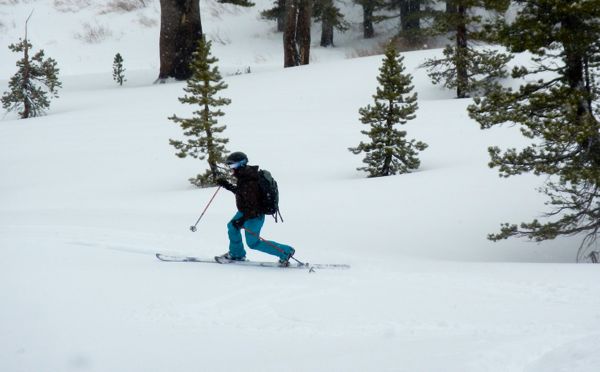
Backcountry skiers play in the fresh snow near Carson  Pass on Feb. 8. Photo/LTN

A backcountry skier plays in the fresh snow near Carson Pass on Feb. 8. Photo/LTN

According to the National Weather Service in Reno, the precipitation runoff since Friday has caused Lake Tahoe to rise 4.8 inches. Another way of looking at it is the last two storms added 16 billion gallons of water to the lake.

While the storms that blew through the basin were at times warm and never brought enough snow to stick at lake level, some ski resorts are reporting a foot or more of white stuff. Enough fell that today Mount Rose is opening its chutes. Other resorts are expanding their offerings. Homewood Mountain Resort is reopening Friday in time for the long Presidents weekend.

But the Lake Tahoe Basin is in for a dry spell for at least the next week. Temperatures are expected to be balmy by Thursday when highs will be in the low 60s.

— Lake Tahoe News staff report


Tahoe trees are more than scenery on a hike

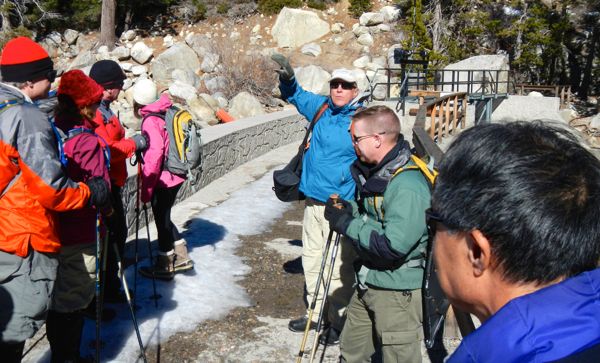
TRTA leader Jim Mrazek, in blue, pauses on the dam at Echo Lake to talk about the area. Photos/Kathryn Reed

TRTA leader Jim Mrazek, in blue, pauses on the dam at Echo Lake to talk about the area. Photos/Kathryn Reed

By Kathryn Reed

ECHO SUMMIT – It was a bit like a scavenger hunt, with everyone looking for pine cones, insects and animal tracks.

Pine cones were in abundance, especially because the snow was lacking. Insects were hiding, which is a good thing because that’s what they should be doing in winter. The tracks were limited to squirrels, but this, too, could have had something to do with the scarcity of snow.

Four leaders (one in training) with the Tahoe Rim Trail Association led a group of 13 on a trek to Echo Lake on Jan. 31.

It was supposed to be a snowshoe, but Mother Nature did not cooperate. Instead, many put Yaktrax on their hiking boots to combat the icy portions of the trail.

It was part hike, part educational experience, part environmental stewardship.

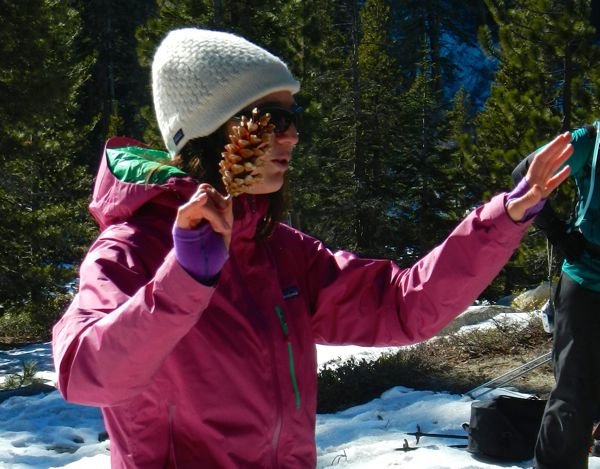
Maria Mircheva with the Sugar Pine Foundation explains the different pine cones.

Maria Mircheva with the Sugar Pine Foundation explains the different pine cones.

“When you walk in the forest it just looks like trees, but there is so much than trees,” Maria Mircheva, executive director of the Sugar Pine Foundation, says. “Sometimes when you look at a tree you can see its life story.”

Big gaps between branches can signal a big water year because of the growth spurt. Sometimes when there are no branches on one side it could mean another tree had been standing next to it and prevented the limbs from growing.

On this excursion there are Western white pine, red fir, Jeffery pine (the most popular tree in Lake Tahoe), lodgepole and white bark.

Blister rust is decimating the white pines and could one day wipe out this species of trees.

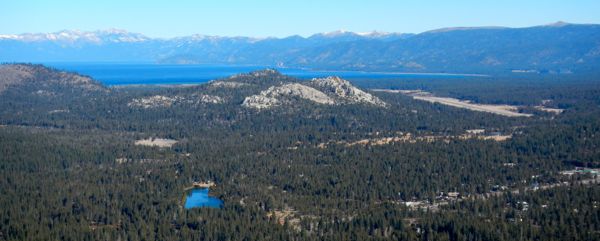
Views along the ridgeline look out to Lake Tahoe.

Views along the ridgeline look out to Lake Tahoe.

The group comes across a huge fir that has been uprooted. Mircheva shares how different diseases are taking hold of pines and firs. This tree was probably weakened by disease and came down in the Dec. 11 storm.

The foundation focuses its efforts on saving the sugar pine. This is done through education as well as plantings. Each year volunteers climb the tall trees, harvest the cones so the seeds may be extracted and then seedlings are planted in the forest. To date, about 10,000 have been planted since 2008. But the survival rate is only 20 to 25 percent.

Mircheva explains how the pitch coming out of trees is their healing mechanism. The difference between pitch and sap is sap is harvested and turned into syrup – and it comes from a different type of tree.

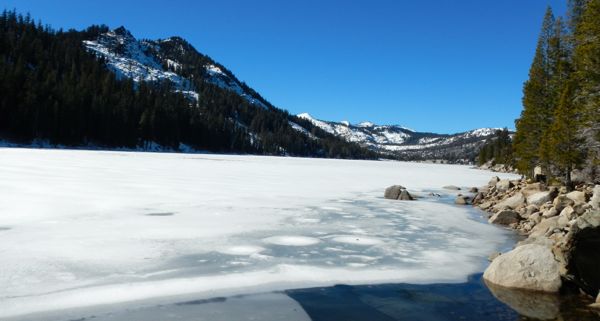
Lower Echo Lake is partially frozen.

Lower Echo Lake is partially frozen.

Pointing to the moss on the trees, Mircheva says it doesn’t go to the ground because snow should be covering the lower part of the trees. With that not happening this winter, it’s possible the moss will start growing on the lower portion.

The TRTA leaders – Jim Mrazek, Sue Henson, Renee Gorevin and Alan Catron – impart information about poles – safety and stability issues; about the need to make loud noise when a bear is on the trail; how this area of the Tahoe Rim Trail intersects with the Pacific Crest Trail and the role of trail angels.

This particular three-mile hike was free and open to the general public. Other excursions the TRTA does are open only to members. For information about future treks, go online.