Daily dose of nature good for kids

By Cynthia Orlando, Statesman Journal

Today more than 80 percent of the U.S. population lives in urban areas. It’s therefore fortunate we now understand many of the physical and psychological benefits healthy trees provide urbanites: Our parks and trees are more than aesthetically pleasing areas that help address pollution problems.

Unfortunately, life for everyone these days can be demanding — even for children. School, societal pressures and even relationship challenges with family members or friends can be stressful for kids and young adults. Also, children are spending more time than ever indoors and on electronic devices, including laptops, cell phones and electronic games.

In the last 10 years or more, the medical field has found these sorts of habits and stresses are unhealthy and can affect the immune system.

A renewed focus on the many health benefits children receive from exposure to nature and play in the natural environment is called for.

Read the whole story


Kerry to talk about incorporation at Squaw Valley

South Lake Tahoe City Manager Nancy Kerry will be the guest speaker at this month’s Incorporate Olympic Valley’s community meeting.

Kerry will discuss the keys to operating a successful and vibrant town. South Lake Tahoe was incorporated from six unincorporated areas in 1965 and is the most populated town in El Dorado County.

Incorporate Olympic Valley is working to become California’s next town and is awaiting the draft Comprehensive Fiscal Analysis, expected to be released in March. After that is completed, revenue neutrality negotiations with Placer County will begin.

The meeting is March 4 at 7pm at the Squaw Valley Public Service District offices, 305 Squaw Valley Road, beginning at 7 pm.


Safe savings critical as one nears retirement

By Michael Abbott and Christopher Bennett

As people creep into the retirement “red zone” – those years just before or right after they retire – it becomes more important than ever that they find ways to keep their savings safe.

Because at that point their retirement picture will change significantly only if they lose a lot of money.

They are not going to change who they are. But if they lose a bucket of money, they are not going to go out to eat, they won’t travel, they won’t be able to leave money to their children and grandchildren. They will end up having to make sacrifices.

In other words, they won’t be living the retirement they envisioned all those years they were saving a nest egg.

Having a “safe money” strategy is key to a secure retirement. It’s important to be able to create an income stream that the retiree won’t outlive.

There are several areas you and your financial professional can focus on as part of an overall “safe money” strategy.

Here are two examples:

• Rate of return vs. sequence of return. The average rate of return on an investment can be misleading, they say. That’s because in reality how well you hang onto your money depends more on “sequence of return.” That is, exactly when do those profits and losses come about?

To see how that might work, imagine a 50 percent loss followed by a 50 percent gain. That would appear to average out to a zero rate of return. But that’s not how it would look in your portfolio, Bennett says. If you have $100,000, a 50 percent loss drops it to $50,000. The market rebounds with a 50 percent gain. But a 50 percent gain on $50,000 just increases that investment to $75,000, so you’ve still taken a loss.

Now consider that kind of activity over the course of your retirement as you are also withdrawing money from your savings to live on. Depending on when market fluctuations happened, you could take major hits. That’s especially true if the dips come early in retirement when your savings are at their peak, and the rallies arrive late when there is less left in the account.

One big downturn and that money could run dry.

There are tools that a good financial professional uses that can help people reduce the risk created by sequence of return.

• Maneuvering toward tax-free income. Whatever the tax rates may be in the future, taxes can be a drag on your savings and may adversely impact your retirement security. So it’s important to consider the tax implications of how you hold your assets.

Even those Social Security benefits that retirees draw can be taxed, but they don’t necessarily have to be. Once again, a financial professional can review strategies that could help reduce or even eliminate the tax on that monthly Social Security benefit.

It’s possible to have tax-free income in retirement. Talk about being in control. Then you can just enjoy your retirement with your children and your grandchildren.

Michael Abbott has two decades of experience assisting retirees with their 401(k)s and pension plans. Christopher Bennett is a 16-year financial professional who has served as CEO of the Abbott Bennett Group since 2003. 


Feds may warn people against eating meat

By Maddie Oatman, Mother Jones

Every five years, the U.S. Departments of Agriculture and Health and Human Services get together to revise their recommendations about what Americans should eat. These guidelines influence doctors’ health advice, food labels, the ever evolving food pyramid-turned-plate, and what goes into school lunches.

In 2010, a time when more than half of adults were overweight or obese, the agencies recommended things like drinking water instead of sugary beverages, filling half your plate with fruits and veggies, cutting sodium, and just eating less in general.

It’s 2015, so time for some new advice. The guidelines draw on input from the Dietary Guidelines for Americans Committee, which will publish a report sometime this winter. So what are the hottest items under debate this year? Here’s a run-down of what to look for in the upcoming Dietary Guidelines for Americans report:

The meat vs. plants showdown: It probably comes as no surprise that Americans eat a diet lacking in fruits and vegetables and full of too many solid fats. In fact, vegetable consumption was on the decline between 2001 and 2010 even as each of us now eat 202.3 pounds of meat a year; a bit less red meat than a few years ago but more poultry than ever before. In the past, the government has warned against overdoing it with red meat and urged people to chow down on lean meats like chicken and fish instead.

But this year, for the first time, the committee might caution against overconsumption of all kinds of meat — and not just for health reasons, but also because of meat’s environmental footprint. Livestock operations now produce 15 percent of the world’s carbon emissions. Eating fewer animal-based foods “is more health promoting and is associated with a lesser environmental impact,” the committee suggested in its draft report.

Read the whole story


Snippets about Lake Tahoe

bevmo• BevMo in South Lake Tahoe is planning to open April 2.

• Amy Courneya of South Lake Tahoe will be on CBS’ “Let’s Make a Deal” on Feb. 19.

• Do you have electronics that need recycling? Check out this website to find a location to drop off the old stuff.

• Dawn Sitchon has launched a nutrition website and is working as a nutrition consultant at Elevate Wellness and Acupuncture Center in South Lake Tahoe.

• Reno dentist John Bocchi expanded his dental practice Sierra Smiles to Zephyr Cove.


Inspiring LTUSD educator saying goodbye

By Kathryn Reed

Planting seeds. It’s what Beth Delacour does every day. But what sprouts is no ordinary specimen. Her finished product is a responsible, self-confident educated young person.

This is Delacour’s seventh and final year as principal of South Tahoe Middle School. She is retiring when the school year is over.

She has spent her entire 35-year career in education at Lake Tahoe Unified School District. This is rare. Usually to move up in the education world one has to switch districts.

Delacour started with kids and is ending with kids – which she thinks is perfect. She started as a regular classroom teacher, then taught special education, became the program specialist for 10 years, agreed to take on the human resources job for three months – it turned into eight years, and now she is at STMS.

The most difficult time in the district for her was in 2007 when she was HR director and the Angora Fire wiped out 257 houses. Houses that belonged to teachers, staff and students. The support was immediate, with school facilities opening up that summer to help, with assistance continuing for months to allow people to gain some semblance of their lives prior to that June.
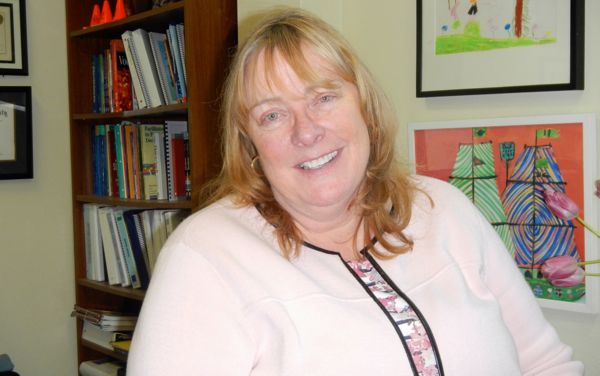
Beth Delacour is retiring after 35 years in LTUSD. Photo/Kathryn Reed

Beth Delacour is retiring after 35 years in Lake Tahoe Unified School District. Photo/Kathryn Reed

“My favorite part of the job was anything with kids,” Delacour tells Lake Tahoe News as she sat in her office.

She has a view to the front walkway – seeing who is coming and going from her school. Her door is usually open. People pop in needing answers. Student artwork is in her office. One wall is the entire school schedule. Books are a prominent feature.

Delacour isn’t an ordinary educator. Her dedication, compassion and passion are extraordinary. Her job doesn’t end when the last bell rings. It’s not over when Friday comes. Some might say she cares too much, if such a trait is possible.

But it’s always been this way for the 58-year-old. When she started at Tahoe Valley Elementary School it was usual for her to be at the school until 6:30 at night. She was making $11,000 a year and thought it was great.

Her passion for kids has never wavered.

“Personally, it’s always a thrill to work with a professional who has a heart for all students. Her emotion always comes through with seeing them succeed. That is fun to watch,” Superintendent Jim Tarwater told Lake Tahoe News.

Tarwater has worked with Delacour in her current position as well as when she was director of human resources.

Karin Holmes has also worked with Delacour in two capacities – as a teacher at STMS and since last year as assistant principal.

“Beth is the most supportive person you could ever work with. I don’t think I would be here if it weren’t for her,” Holmes told Lake Tahoe News. “She has so much heart. It is just amazing. She is honest, she speaks the truth.”

Holmes tells stories of being various places around town and hearing people talk about the impact Delacour has had on their lives.

“Beth is a role model for kids and they respond,” Holmes said.

While Judy Klingler has liked all six of the principals she has worked for as their assistant, she said there is something special about Delacour.

“She has heart and compassion. Kids always are first and foremost. They are her passion,” Klingler told Lake Tahoe News. “She always puts the kids first, whatever they need, whatever the goals are they had. (She was there) whether for financial help or just being there as an inspiring adult.”

Delacour has no intention of leaving all of this behind. But what exactly the future holds, well, she isn’t sure. More time with her dad, kids and grandkids is the first priority. After about a six-month break from life as she knows it, Delacour said she would start the next chapter of her life. It’s likely to involve children and/or older people.

She knows she will miss her students, but she also knows it is time to move on.

“I have great hope for the kids and their future. Some of them are phenomenal,” Delacour said. “If they are going to run the world, it’s in good shape.”


Editorial: Pensions may not be sacrosanct in bankruptcy

Publisher’s note: This editorial is from the Feb. 18, 2015, San Jose Mercury News.

Besides common sense, here’s another reason cities and other government agencies should fully fund their retirement plans — and public employees should not count 100 percent on plans that are not fully funded today.

A federal judge’s ruling in the Stockton bankruptcy case earlier this month was the wake-up call that public worker pensions in California could be altered in times of fiscal crisis. Retirement boards, government officials and public employee unions can head this off by fully funding retirement programs and, most important, setting salary and benefit levels that are sustainable. Otherwise, the outcome of a bankruptcy could be worse for public employees than it was for Stockton’s workforce.

When Judge Christopher Klein upheld Stockton’s plan to exit bankruptcy after nearly three years, he made clear that, although pensions were spared, they could have been on the chopping block.

He rejected arguments that California’s Constitution and laws protect pensions from cuts in U.S. bankruptcy proceedings.

Read the whole story


Calif. may revamp school construction funding

By Allen Young, Sacramento Business Journal

California’s legislative analyst on Tuesday proposed a new system for funding school facilities: grants to districts based on enrollment.

The grants would be adjusted depending on local resources. The state would require schools to adopt five-year accountability plans.

The report addresses an issue that is critical not only to public schools, but California’s construction industry. It arrives as California’s building community and educators have raised concerns that the current school construction-funding program — which relies on statewide voter-approved bonds — is out of money.

Read the whole story


Living history snowshoe on the South Shore

The Tahoe Rim Trail Association is hosting a historical snowshoe on Feb. 28 from 10am-1pm on the South Shore.

(If there is no snow, it will be a hike.)

During this event people will follow in Snowshoe Thompson’s winter tracks. Steve Hale of Comstock Characters will be acting as Thompson in a Chautauqua performance. It will be like trekking during the winter of 1865, but with modern equipment.

Thompson carried the mail  back and forth from Genoa and Placerville for two decades in the mid-1800s.

The hike is free, but reservations are necessary. Sign up online.


Calif. considering new drought restrictions

By Fenit Nirappil, AP

As the California drought drags on, water officials are considering expanding mandatory outdoor water restrictions on homeowners and adding new limits on restaurants, hotels and decorative fountains.

At an informational meeting Tuesday, the State Water Resources Control Board also appeared ready to extend existing rules imposed last summer to boost water supplies.

That would mean Californians still won’t be able to wash cars with hoses that don’t shut off and must limit watering their lawns.

The emergency regulations also authorized agencies to fine water wasters up to $500 a day, though such stringent enforcement has been rare.

Possible new rules under consideration include a ban on running outdoor water fountains and prohibiting lawn watering during cold and rainy periods.

“The key is to get away from very light mandatory restrictions,” said Felicia Marcus, chairwoman of the board.

Other ideas presented Tuesday targeted businesses such as requiring restaurants to only serve water on request and telling hotels not to automatically provide guests with fresh towels and sheets every day. Some cities have similar rules already in place.

The board has considered making some water restrictions permanent with the prospect of future droughts looming.

“We definitely need permanent regulations,” said Frances Spivy-Weber, the board vice-chairwoman. “I just don’t see how we can enter the next 30 years with climate change without them.”

The board has the power to define unreasonable water use. That power can also be used to ban golf course and cemetery owners from using drinking water to maintain landscapes when recycled water is available, but Marcus said the board isn’t targeting those areas now.

The board could consider the extension of restrictions next month and take up other possible regulations later in the year.