Hoteliers’ quarterly earnings soar

By Charisse Jones, USA Today

Boosted by the strengthening U.S. economy, Marriott International Inc. posted a $197 million profit in the last three months of 2014, 30 percent more than during that quarter in 2013.

The hotel company’s earnings of 68 cents per share was a 39 percent improvement over earnings during that period the previous year.

“Business is looking very good,” said Laura Paugh, Marriott’s senior vice president, investor relations, who noted that the company expects revenue per available room to grow between 5 and 7 percent in North America and also worldwide this year.

Confidence that strong travel trends will continue was also reflected in the 39,000 rooms that Marriott added to its inventory in 2014, and the 240,000 that were in the pipeline at the end of the year.

Read the whole story


Douglas inches toward revamping Stateline

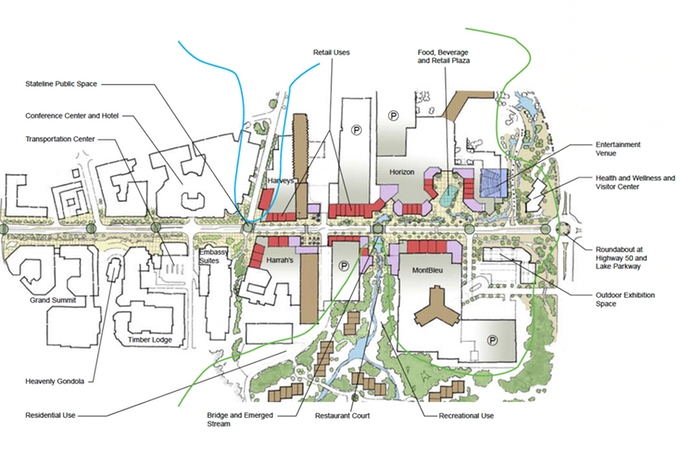
The event venue on this South sShore Vision Plan rendering, in blue on the right, is being studied. Rendering/Design Workshop

The event venue on this South Shore Vision Plan rendering, in blue on the right, is being studied. Rendering/Design Workshop

By Kathryn Reed

STATELINE – A 6,000- to 7,500-seat indoor-outdoor event center on the South Shore is gaining traction.

The South Tahoe Alliance of Resorts has put up $100,000 for feasibility and blight studies for the project. The blight study is because it would be considered a redevelopment project. Within the next few months a decision is likely as to whether this is something worth pursuing.

“It needs to be walkable to Stateline from California,” Mike Bradford, with STAR, told Lake Tahoe News. That is one of the preliminary findings.

This has a lot to do with if the venue were to be used as a convention center-meeting place, because California agencies must rent rooms in the state even if they convene elsewhere.

That is why the original Chateau project in South Lake Tahoe was going to have a convention center – to attract the business-tourist market.

In the South Shore Vision Plan that was created in 2011, and funded by STAR, it calls for such an event center to be built behind what is now Lake Tahoe Hard Rock. But a plot of land behind MontBleu is now also under consideration.

Originally, it was to be completely an indoor facility, but that thinking has changed. It could be more similar to what those on the North Shore envision to be built at Northstar.

Bradford said Harrah’s-Harveys is on board with the idea, knowing the outdoor concert series at Harveys’ parking lot would move to the new venue. A bit of irony is Harrah’s at one time was going to be the driving force behind the convention center project in South Lake Tahoe, but declined to do so.

The new facility could possibly generate more than $20 million in annual revenue. More exact numbers will come from the feasibility study. Who would own and operate it are other factors to be worked out.

If things pencil out, then STAR will take its findings to the Douglas County commissioners.
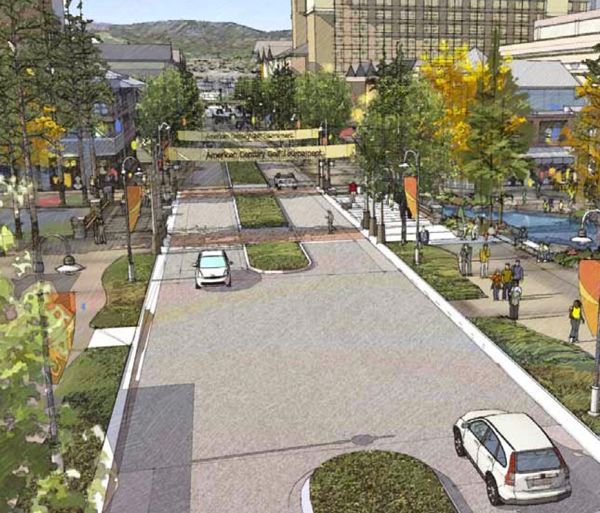
Support for the loop road and better connectivity was voiced Feb. 19 at the Douglas County Commission meeting. Rendering/Design Worshop

Support for the loop road and better connectivity was voiced Feb. 19 at the Douglas County Commission meeting. Rendering/Design Workshop

On Feb. 19 this events center was alluded to more than once as commissioners received updates on the Countywide Connectivity Transportation System, and Recreation and Tourism Plan.

All 13 speakers want the commissioners to go forward with the connectivity plan – namely the loop road that ties Douglas County and South Lake Tahoe in the casino area – and the greater South Shore Vision Plan. And while the electeds support the idea, they question whether the broader community will support the plan when it comes to funding.

Commissioner Greg Lyon expects a “hurricane” of backlash to come from the valley. That is because raising taxes is how it will likely be paid.

Douglas County has the Nevada Legislature’s permission to implement a 2.5 percent utility operator fee that would raise $2 million, a 5-cent fuel tax to generate $900,000 and a 25-cent sales tax to raise $1.5 million. The money would benefit the lake and valley.

County officials say that nearly $5 million could become $50 million after bonding and then it could be used as a 25 percent match. (Gone are the days where state and federal dollars come without the need for local dollars.) This was then broken down to be $4.84 per month per resident (not household), with one-third of the money coming from tourists.

Commissioners took no action Thursday.

Staff, though, envisions one of the top priorities being the loop road. Every Stateline casino is behind it based on testimony Feb. 19, as are Edgewood Companies, Lake Tahoe Resort Hotel and Heavenly Mountain Resort.

Other priorities are: Highway 395 Main Street revitalization, an alternate truck route, Ranchos connectivity path, and airport multi-modal regional transit. The county would need $22 million, with the remainder from other sources, according to staff.

The event center also ties into the recreation plan as a venue.
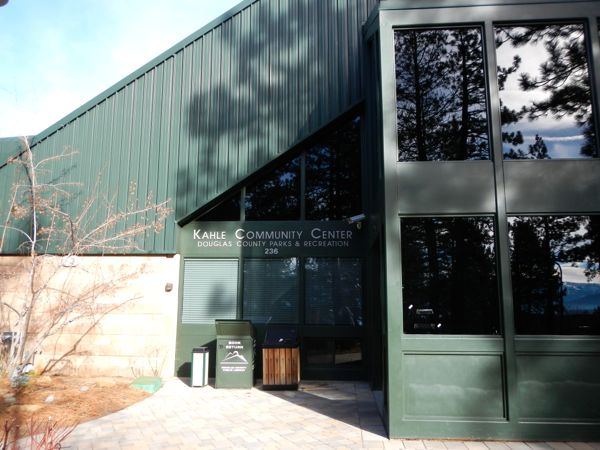
Kahle Community Park is money generating facility at Stateline.

Kahle Community Park is a money generating facility at Stateline.

Douglas County used the same consulting firm – MIG out of Oregon – as South Lake Tahoe and El Dorado County did for their recreation master plan. They were done at the same time in order to look at the greater needs of the entire South Shore.

Cindy Mendoza with MIG gave a presentation to the commissioners on Thursday, saying the No. 1 key project is the event center.

Signage is another important thing to let people know where recreation facilities are and then to explain to people where they could get to on a particular trail and what the mileage is.

While Kahle Community Center’s long-term plan was to have an aquatic center, Mendoza said with South Lake Tahoe looking at a leisure type swimming pool at its rec center then Douglas County might instead consider expanding its gym.

The goal is to have the recreation facilities on both sides of the state line be for everyone on the South Shore, and then be used in a coordinated manner to attract athletic events.

Scott Morgan, who heads the recreation department for Douglas, would not say if the vacant Kingsbury Middle School might still be an option for the county when it comes to expanding facilities. That Stateline site has sat vacant for years with not one person or entity putting in an offer to buy it.

Indoor tennis courts at Zephyr Cove Park are still on the books. Morgan told Lake Tahoe News the new library director does not oppose such a scenario, but added that it would not happen anytime soon. The library last year allowed the Zephyr Cove Tennis Club Foundation to transform part of the building, which sits next to the courts, into a pro shop.



Opinion: Transportation an environmental driver

By Joanne Marchetta

There’s a lot to be learned by studying the success of others. At the Tahoe Talks Brown Bag Lunch this month, a design engineer for the Federal Highway Administration discussed how modern roundabouts are being used to improve traffic and make roads safer for drivers, bicyclists, and pedestrians, as well as where they would make the most sense at Lake Tahoe.

Tahoe Regional Planning Agency and its partners started the monthly discussion series to better engage people and get all of us thinking about critical issues such as transportation and how we can work together for solutions to our biggest challenges.

Joanne Marchetta

Joanne Marchetta

Transportation plays a central and transformative role in restoring Lake Tahoe’s environment, revitalizing our local communities, and making our Region more sustainable. About 70 percent of the fine sediment that washes into the Lake and reduces its water clarity comes from roads and developed areas.

Fortunately, costly projects to upgrade our roads, bridges, transit systems, and bike trails can achieve multiple benefits. They can reduce traffic congestion and stormwater pollution while at the same time improving safety, air quality, pedestrian mobility, public access, scenery, parking, quality of life, and economic vitality.

TRPA is working with many partners in and out of the basin to envision, develop, and deliver the transportation system Lake Tahoe deserves.

We’re updating our TRPA Regional Transportation Plan and TRPA Bicycle and Pedestrian Plan. We’re teaming up with the Tahoe Transportation District to complete a set of comprehensive traffic corridor studies that will identify some of our biggest transportation needs.

We’re also working with Tahoe Transportation District on a long-range transit plan to improve connectivity for increased ridership. The plan will identify strategies for an integrated regional transit system with improved connections outside the Basin, and explore options for free-to-rider service.

While those major planning efforts continue, significant work is being done to upgrade roads in our communities.

Last year, California and Nevada transportation departments continued their multi-year water quality program and invested $130 million in projects to add bike lanes and reduce stormwater pollution on highway 50s, 89 and  207. That work is part of an ongoing effort to improve Lake Tahoe’s water quality by upgrading stormwater treatment on area highways.

Placer County started a $48 million project to revamp Highway 28 through the Kings Beach commercial core. The project will improve traffic flow, pedestrian access, and landscaping, and reduce fine sediment pollution into Lake Tahoe by an estimated 45,000 pounds per year.

South Lake Tahoe rebuilt Harrison Avenue with a new traffic pattern, streetlights, sidewalks, bike paths, and landscaping to revitalize that commercial corridor and reduce stormwater pollution.

TRPA’s new On Our Way grant program awarded $550,000 in federal funding for local jurisdictions, school districts, and nonprofit groups to identify neighborhood- and community-level projects that can increase walking, bicycling, and public transit use.

Progress will continue this year as El Dorado County finishes its Lake Tahoe Boulevard Enhancement Project to complete a missing link in the bike path network between South Lake Tahoe and Meyers and Tahoe Transportation District starts building a three-mile bike trail from Incline Village to Sand Harbor with $12 million in federal funding and help from the nonprofit Tahoe Fund, which raised more than $1 million in private donations for the project.

Other important projects are under environmental review and on the horizon for us to consider, including the Highway 89/Fanny Bridge Community Revitalization Project, the Highway 50/South Shore Community Revitalization Project (aka loop road), and a proposal to restore cross-lake passenger ferry service between the North Shore and South Shore.

Some of our transportation challenges are financial. We need to fix flawed transportation funding formulas that steer dollars into our Region as if it is only a little known, sparsely populated rural area and fail to recognize the millions of people who visit each year, many of them driving up from nearby metropolitan areas and putting significant demand on our infrastructure.

Roundabouts are one tool in helping to solve our transportation challenges. Much more remains to be done. And now is a crucial time for people to be informed, engaged, and vocal about what they want to see happen in the Lake Tahoe Basin because transportation is transformation.

Joanne Marchetta is executive director of the Tahoe Regional Planning Agency.


Food bank to distribute goods in SLT

The Food Bank of El Dorado County is bringing the mobile food pantry to South Lake Tahoe on Feb. 25.

Emergency food supplies will be handed out from 10-11am in the American Legion parking lot,  2748 Lake Tahoe Blvd.
One allocation per family is allowed. Please share this information if you know of someone who can be helped with an extra supply of food.

For information, email info@foodbankedc.org or call 530.621.9550.


Heavenly to play key role in women’s cycling event

The inaugural Amgen Tour of California women’s UCI stage race will kick off with a 74-mile ride that starts and ends at Heavenly Mountain Resort on May 8.

It will be a counter-clockwise race around the lake. The day will end with the climb up the 15 percent grades of Keller Street back to Heavenly.

The race starts at 10am.

Race and tourism officials are hoping there won’t be a repeat of 2011 when the Amgen men’s tour was snowed out. It was to start in Stateline and end in Northstar.

Leg two is May 9 with a start time of 10:30am. It will start and finish at Heavenly, but will be 50 miles.

This 25-mile circuit will be tackled twice. After a quick descent from Heavenly, they will ride out to Meyers. The second half of the course features the switchbacks of Apache Avenue, followed quickly by the climb back up to Heavenly on Ski Run Boulevard to the finish line.

Fourteen of the top women’s cycling teams from around the world will compete.

The four days of women’s competition will be staged in conjunction with the men’s eight-day race.


Child porn lands El Dorado County man in prison

An El Dorado County resident was sentenced Feb. 19 to 12.5 years in prison for possession of child pornography.

According to court documents, Nicholas Robert Bowen, 63, of Grizzly Flats and a female companion were arrested by Davis police officers after the female was caught exposing herself to 10- to 12-year-old boys while Bowen filmed the encounters using a spy camera built into his glasses. A subsequent search of Bowen’s phone and his computer, including in a folder called “boys,” discovered more than 600 images and videos of minors engaged in sexually explicit conduct.

U.S. District Judge Troy Nunley at sentencing said the conduct was “egregious,” and that Bowen was an “active individual” in the offense, further noting that Bowen’s actions have had a “huge impact” and potentially “ruined” the childhoods of the victims in this case.

Charges remain pending against Bowen in Yolo County Superior Court.

— Lake Tahoe News staff report


Critics try to ban coyote hunting in Nev.

By Jeff DeLong, Reno Gazette-Journal

Critics of coyote hunting contests hope to ban the controversial practice in Nevada, insisting it amounts to little more than wanton slaughter of wildlife.

Hunters counter that it is a legally protected sport that may help keep in check a soaring coyote population increasingly posing threats to livestock, pets and people.

Don Molde of Reno and Fred Voltz of Carson City have petitioned the Nevada Board of Wildlife Commissioners for regulatory changes that would outlaw contests awarding cash or other prizes for killing coyotes.

Read the whole story


Sierra ramping up events for March

Sierra-at-Tahoe’s second annual Equinox Spring Festival is March 21. This free festival features live bands on three consecutive weekends, events for all ages and competitions on and off the mountain.

Competitions including the Van’s Hi-Standard Series and 9th annual Buckle Up Big Air will be taking place on-mountain, while the 8th annual Salsa Showdown will happen in the base area.

Scott Pemberton and Sierra Jorts Party play March 21. Rainbow Girls and New Belgium’s Slow Ride Competition is March 28. Family Crest and Sierra Pillow Fight is April 4.

For more info, go online.


Researchers delve into munchies from pot

By Angus Chen, NPR

Shortly after toking up, a lot of marijuana users find that there’s one burning question on their minds: “Why am I so hungry?” Researchers have been probing different parts of the brain looking for the root cause of the marijuana munchies for years. Now, a team of neuroscientists report that they have stumbled onto a major clue buried in a cluster of neurons they thought was responsible for making you feel full.

This cluster, called the POMC neurons, is in the hypothalamus, a region of the brain that scientists typically associate with base instincts like sexual arousal, alertness and feeding. Tamas Horvath, a neuroscientist at the Yale School of Medicine and the team’s leader, says that the POMC neurons normally work by sending out a chemical signal telling the brain, you’re sated, stop eating.

In the past, when neuroscientists shut down POMC neurons in mice, all the mice became morbidly obese. Horvath figured that in order for the drug in marijuana — compounds called cannabinoids — to spawn that undeniable impulse to feed, it would have to bind the activity of these neurons and make them fire less. Paradoxically, Horvath says, “We found the exact opposite.”

Read the whole story


New frontier in apples — never brown

By Ben Tinker, CNN

The U.S. Department of Agriculture on Friday approved America’s first genetically modified apples. Their appeal: They don’t turn brown when bruised or sliced.

“This is really huge. It’s what we’ve waited almost five years for with regulatory approval,” says Neal Carter, founder and president of Okanagan Specialty Fruits, the Canadian company that engineered the apples. “Now we can get down to business planting trees and selling Arctic apples. We’re stoked.”

The USDA’s Animal and Plant Health Inspection Service granted its approval “… based on a final plant pest risk assessment that finds the GE (genetically engineered) apples are unlikely to pose a plant pest risk to agriculture and other plants in the United States … [and] deregulation is not likely to have a significant impact on the human environment.”

Read the whole story