Warm weather has bugs starting to come out

By Paul Nelson, KTVN

The warm and sunny weather has more than just the birds enjoying the outdoors.

People are also taking advantage of the spring-like weather along with those of the six-leg variety. “Insects, being cold-blooded, as soon as it starts warming up, things start happening with them,” says Jeff Knight, entomologist, Nevada Department of Agriculture.

Knight says what’s happening now is more common around the first of April. “I’m seeing a lot of activity in my own yard of things that are not normal for another month or so.”

Knight says box elders and clover mites tend to come out first. And if the warm weather continues, we’ll see even more species. “Definitely, the honey bees will come out and go out and explore. They’re not going to find much, at this time.”


Medical pot spawns other Nev. businesses

By Andrea Domanick, Las Vegas Sun

It has been a busy weekend for lawyer Alicia Ashcraft.

For the past few days, the managing partner at Ashcraft & Barr, a local firm specializing in business regulation, has been unpacking boxes and putting the finishing touches on its newly expanded office. In December, Ashcraft & Barr partnered with Colorado-based marijuana law experts Vicente Sederberg to form a practice dedicated to serving the needs of Nevada’s budding medical marijuana industry.

The firm is one of several ancillary businesses cropping up throughout the state that are capitalizing on the growing demand for cannabis-related products and services. With the arrival of commercial producers and dispensaries comes a new set of market needs, from accessory vendors to greenhouse manufacturers and security officers to lawyers.

Legal cannabis sales in the United States ballooned 74 percent in 2014, to $2.7 billion from $1.5 billion in 2013. The market in Nevada is expected to grow 341 percent in 2015, according to ArcView Group, a market research firm and investment network specializing in legal cannabis.

Read the whole story


Tahoe Tails — Adoptable Pets in South Lake Tahoe

Freddie

Freddie

Freddie is a 7-year-old gray tabby Abyssinian mix who came here with his friend Zombie, who is a pretty 10-year-old silver tiger mix, when their owner went into the hospital. They are a really nice bonded pair who would prefer to be the only pets in their new home. They qualify for our senior for seniors discount.

Freddie and Zombie are spayed/neutered, microchipped, tested for FIV, and vaccinated. They are at the El Dorado County Animal Services shelter in Meyers, along with many other dogs and cats who are waiting for their new homes. Go to the Tahoe animal shelter’s Facebook page to see photos and descriptions of all pets at the shelter.

Call 530.573.7925 for directions, hours, and other information on adopting a pet. For spay-neuter assistance for South Tahoe residents, go online.

— Karen Kuentz


S. Tahoe officials strategize about the future

By Kathryn Reed

Recreation is going to be the economic driver for South Lake Tahoe. One way to do this is to stop letting county and state lines be a roadblock. Another is to invest in facilities so they become moneymakers that could provide dollars for other city needs.

But more opportunities besides or in addition to being a recreation mecca are possible based on the ideas that were elicited Feb. 21.

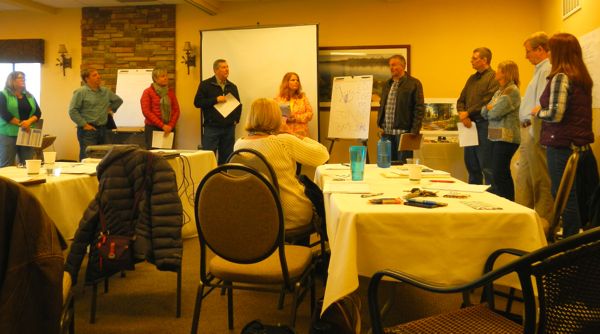
Councilmembers, department heads and other key staff spent 3½ hours Saturday talking about what the city could be. Barely touched on was how to turn the ideas into reality, but that will be flushed out at another meeting as well as when the midyear budget review is presented in April.

“Until we know who we are, we won’t know why we are doing it,” City Manager Nancy Kerry said. “There is no shared agreement of who we are.”

But she added, “One South Shore is starting to take hold.” This is the philosophy of realizing what happens throughout the South Shore impacts everyone and that working together instead of against each other is better for everyone.

And while the city is accountable to the residents within its boundaries, the decisions it makes have impacts beyond its borders.

Ted Gaebler, author of “Reinventing Government” and a retired city manager who spent 50 years in local government, facilitated the meeting at Lakeland Village. He asked them all to express their vision for the city – regardless of money, current policy, how long it would take to achieve or the realistic ability to achieve the goal.

The purpose was to stimulate these city leaders and to get them thinking beyond the norms, beyond what is expected and beyond the ordinary.

South Lake Tahoe city staff explain to the council the projects that are in the works. Photo/LTN

South Lake Tahoe city staff explain to the council the projects that are in the works. Photo/LTN

Here are some of the ideas:

• Erase the state line. Or go even further and create an entity whereby the Lake Tahoe Basin governs itself – almost like it is a state unto itself, or have the area be one bi-state county.

• Turn the casinos into condos.

• Have Caltrans turn Highway 50 over to  the city so it becomes a city street, which would give the city more opportunities.

• Redevelop Barton Ranch – possibly convert it into a farm for locally sourced food.

• Light rail on Highway 50.

• Tear down dilapidated hotels in town and build quality affordable housing.

• Build a quality recreation center.

• Create an events center for concerts.

• Public art.

• More special events.

• Focus on quality of life.

• Ensure the community is engaged in order to make changes.

• A safe community – in terms of lighted walkways, low crime, and fire safe.

• Build a children’s or discovery museum.

• Better transportation.

• Better connectivity with the trail system.

• Tear down one-third of the hotels. (“We need families here instead of tourists.”)

• Purchase private beaches and turn them into public beaches.

• Remove private residences from the shoreline and create more public access via commercial enterprises like lakeside dining.

• Get rid of Campground by the Lake and make it city offices.

• Revise commercial floor area so it is only needed for one level; this would create more development opportunities.

• Turn the airport into a heliport and then have special events there.

• Take over South Tahoe Public Utility District; this would reduce redundancies and allow for improvements to be made faster.

• Collaborate with private entities and public agencies.

Gaebler reminded the City Council that their responsibility is to the steer the boat, not to actually be doing the rowing.

“We can’t do any of the stuff we would like to do without new revenue,” Councilman Austin Sass said.

He wanted his colleagues to embrace getting a tax hike of some kind on the ballot in November 2016. But they collectively said “slow down” so there would be time to evaluate what exactly any new income would be spent on. Then there will be the discussion about how the money would be raised.

The electeds do seem to agree money should be spent on recreation – but that is a broad topic. The idea, though, is to improve recreation – which will bring money to city coffers – and use revenue from those recreation endeavors to fund road improvements and other needs within the city.


Opinion: Climate change is killing us

By Larry Weitzman

Climate change, a term used in place of anthropogenic, global warming (AGW, meaning human produced carbon dioxide is causing the world to warm which will cause disastrous effects to the Earth) has come to the forefront of California politics again, like it wasn’t already every other word out of a liberal politician’s mouth already. It seems that the new president pro tem, Kevin de Leon, of the California Senate has announced new proposals to “fight” global warming. As if humans think they can change the climate any better than Don Quixote can battle windmills.

You’ve heard the story, if we don’t “fight” global warming, humankind will be inundated in unnatural disasters, more storms, more intense storms, heat waves, cold snaps, droughts, famine, pestilence, disease, islands will be enveloped by the oceans, and coastal cities will be inundated by a dramatic rise in sea level and so on. Of course the only solution to “fighting” global warming is more government, more unelected bureaucracy, more restrictive laws, less choices, more taxes and a lot less freedom. And of course these same politicians have all the answers to all problems. Just ask them. But we are all willing to give up some freedom for some alleged security, right?

Larry Weitzman

Larry Weitzman

While our populace has been literally flooded with potential horror stories from the mainstream media or blathering politicians of ever more intense weather events being caused by global warming, none of it is true, either in there being more frequent or more intense storms or as to a dramatic sea level rise. But like Don Quixote, politicians just see it as a way to destroy America as more restrictive laws, less choice, less freedom and more taxes are nothing more than creeping socialism. Remember environmentalists are like watermelons, green on the outside and red on the inside.

As more data and reports come out that scientists are producing selective data to fit the theory of climate change by cheery picking, more scientists are also learning that the actual data both anecdotal and scientific doesn’t support the theory. As the evidence that AGW is just not factual becomes more apparent, the proponents will become so high pitched that everything that happens will be caused by AGW, including the latest hangnail you got two days ago.

A recent story about the work of Paul Homewood published in the Telegraph of the UK showed how those scientists including the biggest fanatical proponent of AGW, James Hansen have been “adjusting” data to fit the theory. Hansen recently produced data showing historical Arctic temperatures being lower than they actually were to claim that Arctic temps are rising. This wholesale temperature fibbing was exposed by statistician Steve McIntire from a paper Hansen published in 1987. Homewood called this temp manipulation by the U.S. sponsored Goddard Institute of Space Studies (GISS) and the government’s Global Historical Climate Network (GHCN) the “real elephant in the room of the greatest and most costly scare the world has known. This really does begin to look like one of the greatest scientific scandals of all time.”

Munich Re, the world’s largest re-insurer, published its review of natural catastrophes in 2014. Its findings were lower losses from weather extremes and earthquakes. It noted the unusually quiet hurricane season. In fact it has been a quiet hurricane season for the last nine years. To jog your memories, shortly after Hurricane Katrina, a middle of the road class III storm, in 2005, we were told repeatedly by the climate alarmist fearmongers that hurricanes would increase in numbers and intensity and Katrinas would become commonplace. Of course they were wrong and the reason was those same alarmists had absolutely not one shred of evidence and/or data to back up such a statement. Most Katrina damage was from the failure of flood control devices.

Swiss Re, the world’s second largest re-insurer said that 2014 global disasters events cost insurers $34 billion below recent annual averages.

Studies also showed that the most expensive losses were from winter damage, not heat or storm related. Winter damages in the U.S. and Canada ranked fourth in losses. As to flood damage Professor Roger Pielke of University of Colorado says that “while the U.S. is prone to very large flood events, resulting in tens of billions of dollars in losses … the trend since 1940 is striking. As the nation has seen its economic activity expand by a factor of 13, flood losses as a proportion of that activity have dropped by 75 percent.“ Research has also shown very little evidence of increasing flood frequency or magnitude either in the U.S. or globally.

With respect to each year being the hottest ever is also misleading. According to the NASA satellite data and Remote Sensing System, last year was not the hottest, but even the claim that if it was the hottest, it was the hottest by 0.01 degrees, which puts it within the margin of error for several other “hottest” years. The attempt here by the alarmists fearmongers is to scare the public. If the temperature goes from 72 degrees to 72.01 degrees while you could say it is hotter, the truth is that it is such an insignificant increase it is hardly worth mentioning. The warmest recent year was 1998, an El Nino year which brought record rainfalls to California. Since 1998 temperatures have declined slightly notwithstanding the fact that CO2 has increased steadily by about 8 percent. So much for the validity of climate models that claim temperature increases of several degrees.

And notice how the winter weather isn’t mentioned in the same sentence as an Ice Age with respect to the Eastern two-thirds of the United States. Or the fact another boat, an Australian 207 foot fishing vessel, the Antarctic Chieftain, got stuck in the expansiveness of the Antarctic ice and had to be rescued last week by the heavy icebreaker, the U.S. Coast Guard’s Polar Star. The same thing ironically happened to a New Zealand research vessel last year studying AGW.

With respect to California’s current drought, history shows that as recently as the last several hundred years or so California had even more severe long term droughts as Fallen Leaf Lake was dry and its current 415-foot deep bottom was filled with a forest. This drought was discovered by scientists from UNR were studying a fault line under the lake. They found a stand of trees upright on the bottom. It was more evidence that California went through a megadrought for hundreds of years during what is now known as the Medieval Warm Period. Graham Kent, a scientist in the study, said it was a megadrought that lasted 200 years where precipitation was 60 percent of what we now consider normal. And we also know this megadrought was not caused by humans, SUVs, oil consumption or any other of the ridiculous claims today.

But that hasn’t stopped politicians for using an unproven theory to pass laws to fundamentally change the essence of the United States, never mind destroy the economy of California, which is their real purpose.

And for those liberal/socialists now in control of the state Legislature, it will not create jobs. If wind, solar power and electric cars were so terrific, they wouldn’t need to pass laws to make us buy them or outlaw other forms of power and cars leaving such unreliable power systems and impractical vehicles as our only choice. They would sell on their own. The fact that politicians don’t say is that they are very expensive and impractical. As put by politician and Chicago Mayor Rahm Emanuel, “Never let a crisis (real or imagined) go to waste.”

Larry Weitzman is a resident of Rescue.


Monopoly keeps growing after 80 years

By Allison Prang, Bloomberg

How do you keep a Depression-era board game like Monopoly growing after 80 years? Keep giving people a reason to buy a new one.

That’s been the strategy of Hasbro Inc., which has created hundreds of versions of the game in a bid for repeat shoppers. Special editions of Monopoly cover everything from the New England Patriots to “The Walking Dead” TV show. The best-selling variation currently on Amazon.com is based on Walt Disney Co.’s “Frozen.”

Monopoly’s ceaseless reinvention has helped bolster demand in a era when kids are engrossed in smartphones and tablets. Sales of the product have climbed more than 15 percent in the past three years, and lately it’s been outperforming the rest of Hasbro’s board-game business. A key driver: a 2013 token contest that let people vote out one of Monopoly’s game pieces and choose a new one to take its place. After intense lobbying online, the cat replaced the iron.

Monopoly, which celebrates its 80th birthday next month, is a bright spot in Hasbro’s sluggish games category.

Read the whole story


Liquor licenses exceed limits in Calif.

By Brad Branan, Sacramento Bee

Communities across California have exceeded state limits for the number of businesses selling alcohol, raising questions about the approval process for liquor licenses.

A Sacramento Bee analysis of data from the California Department of Alcoholic Beverage Control found that 49 of 58 counties have exceeded limits for on-sale licenses, off-sale licenses or both. On-sale licenses cover bars and restaurants where alcohol is consumed on site; off-sale covers stores where alcohol is bought for consumption elsewhere.

In the capital region, El Dorado, Yolo and Placer counties have exceeded at least one of the limits, which allow one on-sale license for every 2,000 residents and one off-sale license for every 2,500 residents.

Read the whole story


Ganong top U.S. finisher in super G

By USSA

SAALBACH-HINTERGLEMM, Austria — In a turny, technical super G set by American coach Forest Carey that did not excuse any mistakes, the Austrian Matthias Mayer once again emerged victorious. That makes for two gold medals in two days for the Austrian who figured out this challenging track full of blind gates, fallaways and big jumps on an aggressive, bumpy surface. Travis Ganong (Squaw Valley) was the top American finisher, toughing out a ninth place finish after falling ill and missing the downhill.

France’s Adrien Theaux, who launched off the final jump with flair into a spread eagle in Friday’s downhill training run, finished second and Norway’s Kjetil Jansrud in third.

While many racers battled visibility, with thick fog in the middle of the course, Ganong had a different battle to fight. A gnarly stomach bug kept him in bed all day Saturday, forcing him to miss the downhill on the challenging Schneekristall-Zwolfer track. Ganong, who hasn’t been able to break into the top 20 this season in super G, battled the sickness to score his best result of the season — ninth place. With the exception of hitting a hole at the bottom of the course at a right foot double with a tricky fallaway that gave many competitors problems, Ganong maintained a good pace throughout his run.

“I really was not expecting anything,” Ganong said. “Yesterday I was really sick — like the most sick I’ve felt in my life. I was throwing up and I spent the whole day in bed sleeping. I had to skip the downhill race. So this morning I didn’t even spin on the bike or do any warm-up or anything. I just showed up and skied and I had no plan, really, I just went gate to gate. Maybe that’s a good thing. Maybe that’s better for me, mentally, for super G.”

This is a brand-new track for these guys, and with no training run and so much terrain, there is a lot to learn. What’s more, athletes fought damp mist and thickening fog. Visibility worsened at the mid-section of course where the bumps and ruts were also at their worst. When Canada’s Manuel Osborne-Paradis skied out in that section of the course, he exclaimed, “Can’t see two gates!”

It was a deep American field, eight skiers competed in today’s super G. Andrew Weibrecht (Lake Placid, N.Y.) finished 19, Jared Goldberg (Holladay, Utah) 30, Ted Ligety (Park City) 35, Wiley Maple (Aspen) 38, and Tim Jitloff (Reno) 42nd. Steven Nyman (Sundance, Utah) and Marco Sullivan (Squaw Valley) did not finish.


States seek alternatives for highway, bridge funding

By David A. Lieb, Associated Press

JEFFERSON CITY, Mo. — Touted as one of the first interstate highways, a 200-mile span of Interstate 70 between suburban St. Louis and Kansas City stands as a prime example of the challenges facing the nation’s roads.

Built in the 1950s and ’60s with a 20-year-life expectancy, the four-lane highway is crumbling beneath its surface and clogged with traffic as it carries more than 30,000 vehicles a day on many of its rural stretches, requiring more frequent repaving. The cost to rebuild and widen it is estimated at $2 billion to $4 billion — as much as five times the projected yearly construction and maintenance budget of Missouri’s transportation department.

And there is no easy way to pay for it. The state fuel tax hasn’t risen in about 20 years, and voters defeated a 1-cent sales tax for transportation. Gov. Jay Nixon has since floated the idea of hiking the gasoline tax and reviving a previously failed plan to turn I-70’s reconstruction over to a private entity that could charge tolls estimated at up to $30 per car.

As legislatures convene across the country, lawmakers and governors are confronting similar realities in their own states: how to address an aging network of roads, highways and bridges during an era in which federal money for such projects has remained stagnant or declined.

Figures compiled by the Associated Press show the total amount of money available to states from the Federal Highway Trust Fund has declined 3.5 percent during the five-year period ending in 2013, the latest year for which numbers were available. During that span, the amount of inflation-adjusted federal highway money dropped in all states but Alaska and New York.

In response, states have tried to devise ways to fill the gap. Governors and lawmakers in several states are proposing new taxes, tolls and fees to repair a road system whose historical reliance on fuel taxes no longer is providing enough money to cover its costs.

“You’re seeing states all across the country that are looking to do something, because they realize you can’t count on the federal government,” said Missouri state Rep. Dave Hinson, a Republican who supports the idea of raising the state sales tax for road improvements.

Roads, highways and their bridges form the basic framework of everyday life in America. They provide the crucial underpinning of daily commutes, the trucking industry’s transfer of food, computers and other goods from seaports to suburban strip malls, and summertime trips to beach towns and mountain getaways. They also are generally an afterthought until they no longer are up to the task.

Governors, lawmakers, local elected officials and engineers across the country say that is where the country has arrived, with a decades-old highway infrastructure that is not receiving enough money to match its needs.

About 20 percent of the nation’s 900,000 miles of interstates and major roads are in need of resurfacing or reconstruction, according to federal data analyzed by the American Road & Transportation Builders Association. A quarter of its 600,000 bridges are in such poor condition that they are rated as structurally deficient or are considered to be functionally obsolete because they have narrow lanes or other features not designed for today’s traffic.

The funding shortfall has led to rougher roads requiring more frequent, short-term repairs and jammed commuter routes that simply have more vehicles than the roads were designed to carry.

On Missouri’s I-70, the surface remains relatively smooth, but its weakening foundation means the state must pay to repave it more frequently. Whenever a lane closes, traffic backs up for miles.

On one fairly typical recent afternoon, the congestion forced Tom Crawford to drive his Dodge Durango about 10 miles under the speed limit. Behind him, two trucks with oversized loads were backing up traffic. In front of him was another long line of blinking red tail lights.

“We’ve got trucks and cars that are just bumper to bumper — people hitting their brakes,” Crawford, president and chief executive of the Missouri Trucking Association, said in a cellphone interview from the highway.

The increased congestion on I-70 often makes trips longer for truckers, he said, potentially raising their costs.

Calls for greater funding have been getting louder in state and local governments. This year, transportation funding increases could be on the agenda in as many as one-third of state legislatures. That comes after roughly one-fourth of the states increased transportation taxes or fees during the past two years.

The state proposals stand in stark contrast to the inaction in Congress, where a temporary funding patch is scheduled to expire in May and lawmakers have been at odds over a long-term highway plan. A federal fuel tax increase appears unlikely.

Earlier this month, President Obama proposed a six-year, $478 billion program to pay for highway, transit and infrastructure upgrades, with funding roughly split between the current fuel taxes and a tax on the foreign profits of U.S. corporations. How much of that plan survives Congress, where majority Republicans seek to limit government spending and reduce taxes, will not be determined for months.

Obama’s 2009 stimulus act provided a brief spike in transportation funding. But the annual amount available to states from the Federal Highway Trust Fund has hovered around $40 billion since 2007 while the needs have continued to mount.

Even though total state and federal road funding exceeded the general rate of inflation over the past decade, the pace has tapered off in recent years as the amount coming from the federal government declined. The American Association of State Highway and Transportation Officials estimates that annual road and bridge spending by all levels of government is falling $32 billion short of what is needed.

The flat federal funding is having an impact because states rely on federal dollars for an average of about half their capital expenses for roads and bridges, according to the American Road & Transportation Builders Association. The rest is covered with state money, which comes predominantly from fuel taxes.

Gasoline tax revenue has grown little since 2007 — and actually declined on an inflation-adjusted basis, according to some analysts — as vehicles have become more fuel-efficient and people cut back on driving.

“The method that we use to fund transportation — the primary method, the motor fuels tax — is a model that doesn’t work anymore,” said David Ellis, the top infrastructure investment analyst at the Texas A&M Transportation Institute.

To compensate, lawmakers in Maryland, Massachusetts, New Hampshire, Pennsylvania and Wyoming passed gasoline tax increases during the past two years. But about half the states have not raised their gasoline taxes in at least a decade, and the federal gas tax has remained at 18.4 cents a gallon since 1993.

Although some members of Congress have expressed a willingness to consider an increase, House and Senate Republican leaders have said there aren’t enough votes to pass a gas tax hike. Many states are now considering alternative ways of paying for roads.

Virginia recently scrapped its per-gallon gasoline tax in favor of a new tax on the wholesale price of gas and a higher tax on other retail sales. The state also has turned to public-private partnerships to build projects.

Among them are new express lanes that opened in December on Interstate 95 in northern Virginia, a $925 million project financed partly by private investors who have a long-term contract to collect tolls.

Lawmakers in Minnesota, Utah and Missouri also are expected to consider proposals this year that could levy a sales tax on fuel, allowing the states to reap more money when the price of gasoline rises. And Michigan voters will decide in May on a 1 percent general sales tax for transportation.

In his inaugural address last month, California Gov. Jerry Brown cited $59 billion of needed maintenance on roads and bridges in the nation’s most populous state. He said the state was falling “further and further behind” but did not offer specifics on how to address the deficit.

Most state are simply looking to maintain their current highway system rather than add to it, said Jim Tyman, director of policy and management at the American Association of State Highway and Transportation Officials.

“A lot of those facilities are in need of really massive rehab, almost reconstruction from the ground up,” he said.


Being mindful — one way to jump-start exercise routine

By Gretchen Reynolds, New York Times

By now, many of us, beset by bad weather and declining motivation, are struggling to maintain our New Year’s exercise resolutions. But a timely new study offers encouragement, suggesting that by paying more attention to the experience of exercise itself, even the most reluctant of exercisers might begin to find pleasure in movement.

Scientists, like the rest of us, have long wondered why some people stick with exercise and others do not. The possible explanations involve everything from genetics and personality to practicalities like work schedules and access to showers. But in multiple studies of exercise behavior, one of the most reliable indicators of whether people will continue to exercise is that they find exercise satisfying. They gain enjoyment from being active.

The problem with that finding is that it does not explain what makes exercise satisfying and so is not very helpful on a practical level. Simply advising unenthusiastic exercisers to start enjoying their workouts more seems unlikely to have the desired effect.

So for the new study, which was published last month in The Journal of Health Psychology, researchers at Utrecht University in the Netherlands and other institutions recently decided to more closely parse the psychological underpinnings of exercise satisfaction, hoping to tease out what makes exercise feel pleasurable to some and like drudgery to others.

They wondered in particular about the role of mindfulness.

Read the whole story