Spinouts, slick roads keep law enforcement busy

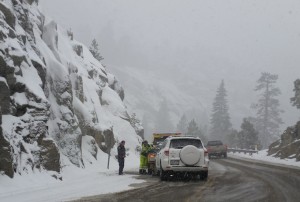
Slick conditions on Echo Summit contributed to this accident Feb. 28. Photo/Carolyn E. Wright/Copyright

Slick conditions on Echo Summit contributed to this accident the afternoon of Feb. 28. Photo Copyright 2015 Carolyn E. Wright

Law enforcement has been dealing with spinouts all day in and around the Lake Tahoe Basin.

The California Highway Patrol dispatch center in Truckee said there have been no injury accidents in their jurisdiction, which includes the entire basin. South Lake Tahoe Police Department as of 6:10pm Feb. 28 also has had zero injury accidents. Truckee police officers on Saturday responded to more than 15 reports of traffic collisions and vehicle spinouts because of the snow.

On the South Shore six people were hurt Saturday morning about one mile west of Cave Rock on Highway 50.

Snow totals have varied from about an inch in South Lake Tahoe to nearly a foot in Meyers and even more on the North Shore.

A winter weather advisory is in effect until 8pm Feb. 28 for the Tahoe-Truckee areas. Sunday is supposed to be mostly sunny, according to the National Weather Service, with a high of 39 degrees in Tahoe. Snow is back in the forecast for Monday.

— Lake Tahoe News staff report


Nevada lawmakers introduce competing equal pay bills

By Riley Snyder, AP

Nevada lawmakers are introducing competing bills aimed at closing the gender pay gap.

Assembly and Senate Democrats rallied with sign-toting supporters in front of the state legislative building earlier this week, calling on lawmakers to pass a bill requiring women and minority groups to be paid equally. State Sen. Pat Spearman introduced a bill that would incorporate parts of the Lily Ledbetter Fair Pay Act and the Paycheck Fairness Act.

“This is not something that I thought up last night,” the Las Vegas Democrat said. “This is really something that really has been in the works since before the session ended last time.”

Meanwhile, Republican Senate Majority Leader Michael Roberson is sponsoring SB167, which would empower the state Equal Rights Commission to administer fines and strengthen Nevada discrimination protection law. Roberson said his bill, which was introduced in the Senate last week, and he wasn’t aware of Spearman’s bill.

“I see a lot of press releases,” he said. “Where are the bills?”

Both proposals would allow employees who prove discrimination to collect up to two years of back pay and would allow the state’s administrative body to levy fines against employers. Spearman said her bill would create a penalty for repeat offenders and would also allow workers to collect attorney’s fees if legal action is taken.

Spearman said her bill goes further than Roberson’s and equal pay is an area that shouldn’t be compromised.

“In the words of Dr. King, there’s a fierce urgency of now,” she said.

The proposals are based on federal legislation that extend the statute of limitations on discrimination claims and seek to reduce the wage gap by making wages more transparent and fairly allocated.

Republicans and Democrats in the Senate have introduced similar legislation on a number of issues during the session, including bond rollovers for school construction and tightening laws that forbid stalking and domestic abuse convicts from owning firearms.

Truckee Meadows Community College political science professor Fred Lokken said the maneuvering is unusual, and it could hurt Democrats.

“It’s kind of like they’re hijacking legislation and modifying it,” he said of Republicans. “The intent could be for Republicans to derail the entirety of the Democrats’ agenda.”


Bill would honor fallen El Dorado County Marine

Rep. Tom McClintock, R-Granite Bay, has introduced a bill to honor Marine Staff Sgt. Sky Mote, who was killed in Afghanistan on Aug. 10, 2012.

The legislation will designate a mountain peak in the John Muir Wilderness, under which the Mote family gathered to camp every year, as “Sky Point.” Every member of the California congressional delegation is a co-sponsor of the bill.

Mote, who grew up in El Dorado, was awarded the Navy Cross, the Purple Heart, the Navy-Marine Corps Commendation Medal, a Navy-Marine Corps Achievement Medal, two Combat Action Ribbons and three Good Conduct Medals.

Sky Mote enlisted in the Marine Corps upon graduation from Union Mine High School in El Dorado. His nine-year service included a deployment to Iraq and two deployments to Afghanistan.


SLT changes dates for Citizens Academy

South Lake Tahoe has changed the dates of the spring Citizens Academy. The academy will be on consecutive Wednesdays from 5:30-8pm beginning May 6 and running through June 17.

The change is to avoid potential conflicts with the South Tahoe Action Team (STAT) class which will be April 2-23.

The Citizens Academy is a free, seven session interactive course designed to provide residents with an in-depth look into municipal government, as well as, information about the services and programs of the city of South Lake Tahoe.

Participants are required to complete an application by April 24 at 5pm. Applications and the course outline are online.


6 people hurt in 2-car accident in Zephyr Cove

Witnesses told Lake Tahoe News it's surprising anyone lived. Photo/LTN

Witnesses told Lake Tahoe News it’s surprising anyone lived. Photo/LTN

Updated 12:37pm:

Six people were injured in a two-vehicle accident Saturday morning in Zephyr Cove.

The two vehicles hit each head-on near Hidden Woods on Highway 50 about 8:50am Feb. 28.

Three people were transported to Renown Medical Center in Reno and three to Barton Memorial Hospital in South Lake Tahoe. All had serious injuries. The one person who was flown to Renown was in critical condition, according to NHP Trooper Dan Lopez.

Speed and snow contributed to the accident, Lopez said.

“They were going too fast in the snowy conditions on the roadway,” Lopez told Lake Tahoe News. “Chain controls were up.”

A Toyota Camry with three men and two women from Southern California was headed east when the vehicle crossed into oncoming traffic, Lopez said. The Camry struck a Volvo SUV driven by a Carson City resident.

Both vehicles flipped over. The road is open after being partially closed for about two hours.

— Lake Tahoe News staff report


Wilderness as therapist

By Ray Wiles, High Country News

One of the environmental movement’s most legendary characters was also a traumatized war vet. You might remember George Washington Hayduke for his inventive, destructive antics, but he was also a man who measured road miles by the number of six-packs it took him to drink while driving and whose mind often wandered back to Vietnam. “What’s more American,” Hayduke wonders in Edward Abbey’s novel The Monkey Wrench Gang, “than violence?”

The fictional Hayduke had a real-life model: a former Army medic named Doug Peacock. Peacock served in Vietnam during his 20s, and as he went through the violence of that war, the thing he carried was a map of the Northern Rockies. He brought it out during rare quiet moments and imagined himself in its contours, rolling over the sharp granite creases of the Wind River Mountains or the grassy meadows north of Yellowstone Lake. When he returned from the war, he returned to nature, studying grizzlies for several decades and fighting for their federal protection, as well as for that of other threatened species. These days, the 72-year-old activist and writer has become a new role model, not just for greens, but for a new generation of veterans.

“What they need to do is go out and immerse (themselves) in the wild,” he said recently. “Let it wrap around you. See what it does to you.”

The idea of wilderness as therapy for veterans is nothing new. In recent years, a growing number of such programs are springing up around it. But in order for it to work on the scale that’s needed, its supporters are going to have to get the military behind it. And that’s where the difficulty lies.

Read the whole story


Sullivan top U.S. finisher in downill

By USSA

GARMISCH, Germany — After more than two hours of delays, the race finally were finally able to squeak one last downhill into February. Fighting flat light and typical thick fog on the Garmisch Kandahar, Marco Sullivan (Squaw Valley) was the top American downhiller of the day, finishing in sixth place.

It was an Austrian-dominated day, with Hannes Reichelt winning the race, Romed Baumann in second and Matthias Mayer in third. This is the second Austrian downhill podium sweep in a row, with Mayer, Max Franz and Reichelt taking first, second and third in Saalbach.

Even after hours of delays, the snow was fairly consistent — with 140 volunteers working Friday night until 10 p.m. and starting again at 4 a.m. But because of the light conditions, the track was shortened — beginning at the super G start — which did not suit the classic downhillers usually favored on the Garmisch hill.

The shortened course didn’t seem to faze Sullivan (although he said going from the super G start “kind of neuters the race a little bit”), who was eighth in the second training run. Starting 23rd, he attacked the whole way down and took sixth place behind the dominating Austrians. This is his best result since his fifth place finish in Lake Louise in November.

“The race was so tight. I think a tenth — one way or the other — would have cost me five places,” said Sullivan. “It’s crazy. It was go-for-broke. Luckily, I skied it pretty cleanly, didn’t have any big mistakes and had a good result.

Steven Nyman (Sundance, Utah), who was fourth in the training run, looked for speed throughout his run, but was bucked around on the tricky, shortened course and took 17th. Travis Ganong (Squaw Valley) was 22, behind a three-way tie for 19. Andrew Weibrecht (Lake Placid, N.Y.) was 33rd and Wiley Maple (Aspen) 45th. Garmisch first timers Jared Goldberg (Holladay, Utah) and Bryce Bennett (Squaw Valley) were 36 and 48, respectively.


2 U.S. athletes on podium in moguls

By USSA

TAZAWAKO, Japan – On a snowy day in Japan, Hannah Kearney (Norwich, Vt.) claimed her fourth World Cup win of the 2015 season on Feb. 28, besting Japan’s Junko Hoshino and Canada’s Audrey Robichaud. Jeremy Cota (Carrabassett Valley, Maine) earned his first World Cup podium of the season, finishing second behind Canada’s Mikael Kingsbury.

The U.S. women qualified four athletes for the round of 16 before Kearney and Morgan Schild (Pittsford, N.Y.) made their way to the round of six. Kearney, who celebrated a birthday this week, skied strong to stay in the top spot through each of the rounds.

“The training yesterday was difficult due to the snow conditions, so today we didn’t really know what to expect,” said Kearney. “We had some fresh snow, and the weather changed every run. I adjusted as best I could. It definitely wasn’t my cleanest skiing, but I was rewarded for fighting through those mistakes.”

Schild, who qualified for the World Cup tour from U.S. Selections back in December, has been killing it on the NorAm tour, where she currently is ranked second behind fellow U.S. teammate Nessa Dziemian. It’s clear 18-year-old Schild can hold her own on the World Cup circuit.

Ali Kariotis (Tiburon, Colo.), Keaton McCargo (Telluride, Colo.), Mikaela Matthews (Frisco, Colo.) and K.C. Oakley (Piedmont) completed the roster for the U.S. women, finishing 15, 16, 20 and 21.

The men also had a strong showing, qualifying five athletes to the round of 16 before Cota, Dylan Walczyk (Rochester, NY) and Bryon Wilson (Butte, MT) advanced to final two. This was Cota’s first World Cup podium since a third place finish in Ruka in 2012.

“It’s been too long since I’ve been on the podium, so I knew I had to try something different,” said Cota. “I tried to ski my runs without overthinking anything and keep it really simple. I was really happy with my skiing.”

Walczyk finished fifth, followed by Wilson in sixth, Tom Rowley (Long Beach, N.Y.) in 11, Joe Discoe (Telluride, Colo.) in 16, Sho Kashima (Stateline) in 27 and Troy Murphy (Bethel, Maine) in 37.


Unexpected consequences of ongoing drought

By Lydia O’Connor, Huffington Post

What happens when America’s most populous state runs low on its most precious resource for the fourth year in a row?

A lack of rainfall doesn’t just result in problems for farmers, the food industry and people with sprawling lawns. It can have serious consequences that aren’t so obvious. While there have been concerns about California’s relentless drought creating weird-tasting beer and driving a sudden surge in succulent thievery, there are lesser-known side effects that are pretty alarming.

“The proportion of mosquitoes infected with West Nile virus is at the highest level ever detected in California,” Ron Chapman, director of the California Department of Public Health announced in September. By the end of 2014, the state had recorded 798 human cases, the most since 2005 and more than five times the number recorded in 2011, when the historic drought began. Of those infected, 29 died.

Rats and other rodents moving into human-populated areas mean even more unwanted animals follow. Sacramento’s Len Ramirez, who runs a rattlesnake removal business, told CBS Sacramento that halfway through 2014, it was already one of the busiest years he’d seen in nearly three decades. In just one week in July, he removed 72 rattlesnakes that got too close for people’s comfort.

In some cases, less water means a higher likelihood of coming in contact with contaminated water. Californians who rely on private wells for water, often in the state’s poor, rural areas, are at particular risk, Reuters reports, because there’s a higher concentration of contaminants when there’s less water.

Read the whole story


Ballot measures: South Lake Tahoe voters make critical financial decisions for the city

Linear Park in South Lake Tahoe receive a makeover with the help of Measure R funds. Photo/LTN file

Linear Park in South Lake Tahoe received a makeover with the help of Measure R funds. Photo/LTN file

Publisher’s note: This is one in a series of stories Lake Tahoe News will be running leading up to the 50th anniversary of South Lake Tahoe on Nov. 30.

City 50th Anniversary Logo v4By Kathryn Reed

One reason South Lake Tahoe incorporated 50 years ago was to have a greater say in how it was governed. Residents were a bit disgruntled with how the powers that be in Placerville were doing things at the lake.

It took a vote of the populace to make the city of South Lake Tahoe a reality. But that wasn’t the end of ballot initiatives in the city. Through the years voters have had an opportunity to decide on a number of issues.

All tax proposals, by law, must go to voters – whether it’s at the city, county or state level. But a city can bring other issues up for a vote – like parking. The June 3, 2014, Measure P was the last item a City Council put on the ballot.

Anti-paid parking advocates to their cause to voters in June 2014. Photo/LTN file

Anti-paid parking advocates took their cause to voters in June 2014. Photo/LTN file

This came about because of the controversial metered parking program the city had initiated in various parts of town. While the issue had been talked about for years, approved by various councils and included in budgets, after it became a reality a group of citizens called Tahoe for Tahoe wanted the meters and the program to be abolished. Because of legal reasons they could not get a measure on the ballot themselves. The city, knowing it could essentially be stabbing itself in the foot, agreed to take the issue to the people.

And the people said get rid of the program. It required a 50 percent plus 1 percent vote to pass. It did so with 66.96 percent.

The meters associated with the program were removed Aug. 31, 2014.

The first vote put to the people after incorporation came on Nov. 6, 1984. It was called Measure C. This would have created the county of Tahoe. It failed, with the naysayers casting 22,027 votes and proponents having 18,434 votes.

This idea, though, has not gone away. There are people today who believe the basin portion of El Dorado County would be better off being its own county.
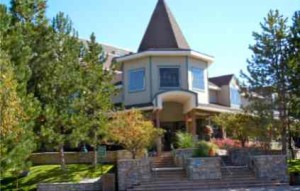
Lake Tahoe Resort Hotel, which was Embassy Suites when it opened, is a still a player in redevelopment.

Lake Tahoe Resort Hotel, which was Embassy Suites when it opened, is a still a player in redevelopment.

Next came another Measure C, but for a completely different reason. This was to increase the transient occupancy tax to 10 percent in most parts of the city and to 12 percent at specific hotels in the redevelopment area.

Voters on Nov. 8, 1988, said yes with 77.5 percent. It required a 66 percent yes vote to pass.

This was the start of redevelopment in the city. The purpose of the higher tax rate was and still is to help pay off the $110 million bond debt in case property taxes were ever insufficient. Every year at least some of those TOT dollars have gone to the debt. That debt won’t be paid off for more than 20 years. There was a time before the recession that only $100,000 from the TOT was needed to help with the debt. As property values rise, the property taxes increase, which in turn means less TOT required to pay the bills and more of it going to the general fund.

The city didn’t ask the voters for anything else until 12 years down the road. This time it was a joint measure with El Dorado County and the Tahoe Paradise Resort Improvement District. The three formed the Community Facilities District Recreation Joint Powers Authority.

Hockey is not popular at the city owned ice rink. Photo/ Jessie Marchesseau

Hockey keeps becoming more popular at the city owned ice rink. Photo/ Jessie Marchesseau

A special election was called on Sept. 19, 2000, where voters were asked to pay a 30-year $18/year tax to fund recreation. This was known as Measure S. The $6.5 million in bonds are to paid off in 2030. The money paid for the city ice rink that is now operated by a private company, the ball field next to Lake Tahoe Community College and $50,000 a year of TPRID, as well as bike trail improvements.

Sixty-nine percent of the voters said yes.

Hotel taxes were back before voters two years later.

Measure Z passed on Nov. 5, 2002, with 56.1 percent of the voters saying yes. It needed 50 percent plus 1 percent vote.

This measure added $1 to every hotel room night to add to the city’s transient occupancy tax revenue. TOT along with property and sales taxes are the three main revenue sources for South Lake Tahoe.

It was in place from Feb. 1, 2004, to Oct. 31, 2006. Measure Z brought in about $1.1 million a year when it existed, which at the time helped the city make ends meet.

This was the last time the city raised the TOT.

South Lake Tahoe lodging establishments are accessing a fee that goes toward marketing. Photo/Provided

South Lake Tahoe lodging establishments are assessing a fee that goes toward marketing. Photo/Provided

However, in 2006 the South Lake Tahoe Tourism Improvement District was formed. The group of lodging establishments agreed to assess guests $3 per night at hotels-motels and $4.50 night at time shares and agent-managed vacation home rentals. That money is then used for marketing purposes by the district. It is considered a fee and that is why it did not have to go to the voters.

They did this the day after Measure Z expired.

The sales tax in South Lake Tahoe went from 7.25 percent to 7.75 percent after voters gave the go-ahead on Nov. 2, 2004.

Measure Q passed with 58 percent of the vote. It needed 50 percent plus 1 percent for approval.

That extra half percent goes directly to South Lake Tahoe. This is unlike most sales tax that is set by the state, collected by the state, and spent by the state. Some is filtered back to the county and then the city, but not a ton compared to what is collected.

Voters on Nov. 8, 2005, said no to raising the snow removal fee. This was called Measure R – not to be confused with the later recreation measure by the same name.

This Measure R would have increased the snow removal tax from $20 to $40 per parcel. It required a two-thirds approval, but only 54.2 percent of the voters said yes so it failed.

Voters on Nov. 3, 2010, were asked to revise Measures S with Measure B, which stood for ball fields. It would have given more money to ball fields, but the bike community came together to help defeat the measure.

It needed 66 percent to pass; it received 60.54 percent.

Next up was the idea to increase the maximum amount on business license fees. It would have increased the not to exceed amount from $3,387 to $10,000 per calendar year.

But voters on Nov. 2, 2010, said no to Measure E – but barely. It required a 50 percent plus 1 percent vote. It received 50.81 percent.

Bike trails are improving with Measure S/R funds. Photo/LTN file

Bicycle trails are improving with Measure S/R funds. Photo/LTN file

Ball field and bicycle advocates came together in 2011 to successfully rewrite Measure S. What is now known as Measure R was approved by voters that Nov. 8. It rejiggered how money could be allocated, making it less restrictive. More existing ball fields and bike trails have received upgrades instead of the money mostly going to new facilities.

On the June 5, 2012, ballot the business license cap was revisited by the city.

The analysis from the city attorney at time regarding Measure B said, “Passage of Measure B will reduce the business license tax on 95 percent of businesses in the city of South Lake Tahoe by 5 percent. The measure increases the maximum any business pays from $3,448 to $20,000 based on the tax rate for each type of business. The current business license tax rates and maximum tax are increased annually for inflation, but if Measure B passes, the tax rate per $1,000 of gross receipts and the maximum tax of $20,000 shall not be increased for inflation.”

It passed with 55.61 percent of the votes.

The next ballot measure likely to be put forth by the city will come in 2016. It may be to raise the transient occupancy tax or create an amusement tax or both, all with the purpose of creating a funding source for recreation improvements.