S. Tahoe to regulate long-term motel rentals

By Kathryn Reed

South Lake Tahoe wants to put motels that are being used as long-term housing under a microscope to ensure they comply with health and safety codes.

There are 120 hotel-motels in the city with about 5,000 rooms. Of those, 58 establishments have 1,300 rooms that are not being used for traditional tourist accommodations. That equates to 26 percent of the rooms in the city.

“They are not high-quality transitional housing,” Shawna Brekke-Read, Development Services director, told the City Council on March 3.

The draft Single Room Occupancy ordinance was before the council for discussion and input on Tuesday. The goal is to get these establishments to pay transient occupancy tax or be part of the new ordinance that is expected to be adopted this spring.

Using motels as housing is not regulated nor do the units face any inspections because there are no laws on the books that would allow this to happen. That is all about to change.

Problems at these dwellings are varied.

The staff report says, “Commonly, long-term hotels-motels lack a kitchen or safe cooking facilities, the electrical service is inadequate for the electrical demand, hot water heaters are broken or missing, sanitation is poor, smoke detectors are missing or faulty plumbing is problematic, and units are infested with pests.”

But not everyone believes all of these motels should be cast as squalor. Ted Long, a local attorney who used to be on the City Council, represents 60 units managed by Tahoe Rents.

“All the landlords I know want to do the right thing,” Long told Lake Tahoe News. “We don’t need a special ordinance for hotels. The people who are going to be hurt, despite the good intentions, are the people who live there.”

Long said the city is lumping all long-term rentals into the same category and adds that is not fair. He would prefer the motels fall under the multi-family dwelling ordinance that covers six units or more.

While the proposed ordinance would require the hotel rooms to be more like an apartment, Mayor Hal Cole stressed, “We are not turning hotels into apartments.” He said the ordinance creates hybrid-housing units that will be regulated.

Plus, if these hotels were to be apartment conversions, it would require the Tahoe Regional Planning Agency to be involved. It would also negate the city’s ability to collect the hotel tax.

It was agreed that requiring laundry facilities on each floor is not a good idea based on overflows being common when people cram two loads into one washer.

Another issue for Long and some of the landlords who attended the meeting is having to provide one off-site parking spot for every unit. Outside council chambers they talked about how many of their tenants don’t even own a vehicle.

The council (Tom Davis was out ill) agreed to soon conduct a workshop about the proposed ordinance with the goal of attracting more owners and tenants. It was proposed to do so somewhere other than the airport since buses don’t go there and transportation may be an issue for people living in these establishments.

Also needing clarification is whether sewer permits will be needed to accommodate possible required changes.

Richard Solbrig, general manager of South Tahoe Public Utility District, told Lake Tahoe News sewer permits are needed “when the plumbing facilities in a structure are expanded/added, not just rearranged or replaced with new fixtures. Typically in a private residence, it is the addition of a new bathroom. A new sewer unit costs $4,950. Any expansion of plumbing facilities in a structure does trigger a building department permit, and part of that permit process is a sign-off by the district.”

—–

In other action:

• Council meetings have not been available to Charter customers because the city and cable provider are squabbling over use of the building where the city’s equipment is stored. Meetings may be watched online via the city’s website.

• The city is revisiting its arts and crafts fair regulations for 2016. The council directed planning commissioners to refine what juried shows would look like as well to provide more specifics regarding uniform booths for vendors.

• The March 17 meeting will include an in-depth discussion about what to do with the city’s dilapidated streets.

• At the April 7 meeting as part of the midyear budget discussion the council will talk about how best to spend the nearly $1 million surplus from the 2013-14 budget.



Letter: Paradise lost in El Dorado County

 To the community,

My wife moved up to El Dorado County in the 1980s to raise her children in a safe bucolic environment, sending them first to Buckeye School and eventually Ponderosa High School. She bought a lovely little house on 2 acres in Shingle Springs along French Creek Road, which was close to the schools and yet very rural across the street from a cattle ranch. She bought a horse, a lifelong dream. In 2002 I retired and moved up to the foothills from the Bay Area seeking peace and quiet. We met and were married in 2003 and moved in together in her little house in Shingle Springs where I took over the upkeep and maintenance of our little “ranch.” I soon fell in love with El Dorado County.

All was happiness and light until San Stino threatened to destroy all that we had worked for for so many years. We became involved in the Shingle Springs Community Alliance, gathering signatures on the green (Measure O), yellow and purple initiatives, speaking to thousands of people during that time period that felt the same as we did. They all wanted to keep our rural quality of life. We’ve attended countless Board of Supervisors meetings and written countless letters asking them to please represent our interests not those of the developers (Parker Development, Sierra Pacific Industries, Gallo, and Joel Korotkin the San Stino and Dixon Ranch developer). All along we have held out some hope that they are listening to us.

In the run up to last November’s election developer interests and their enablers in county government and the Chamber of Commerce spent over $1,000,000 spreading lies about our Measure O initiative. You remember the No on MNO Campaign? They lied to the voters and spread enough confusion in their minds that of course folks were compelled to vote no on all three of them. Despite all of that, we soldiered on still hoping for a miracle. Most recently a new group calling itself the Alliance for Responsible Planning has come forward spreading more lies for the pro-development community. It is never ending.

For us, the bubble finally burst at the Board of Supervisors meeting on Feb. 24. That is when we finally realized that the county is in bed with the developers too deep and no matter what we do we are probably going to lose. My wife and I are now seriously considering moving out of El Dorado County for good before the value of our property plummets and we cannot afford to leave.

One of the things that broke our hearts was how quickly folks giving testimony were willing to throw us under the bus as long as the high-density development wasn’t slated for their backyards. Well, let me tell you, they’re coming for yours next. Don’t believe me? Watch the first couple of minutes of the following YouTube video where Kirk Bone of Parker Development gleefully compares upgrades to Highway 50 in El Dorado Hills to the Golden State freeway between Los Angeles and Orange County.

If you don’t think it’s coming, you’re more deluded than I was.

We are angry, very, very angry. If you are feeling the same, I suggest you follow the money. To begin with you might want to take a look at the following YouTube videos:

First this one and then this one.

If you want to stay and fight, you might want to join us. Think David and Goliath. We still have two more initiatives (the yellow and the purple) on the 2016 ballot and we need your help. Get involved. Join us online.

Edward Mattson, Shingle Springs


Outdoor concert scene growing on South Shore

Outdoor music – it’s becoming the norm on the South Shore.

On the same day the South Lake Tahoe City Council entered a five-year deal with OnCourse Events to continue the Live at Lakeview concert series, Lake Tahoe Hard Rock announced it would be converting its back parking lot into a temporary outdoor concert amphitheater that will seat up to 7,500 people. The Stateline casino will host six to eight shows starting in June and conclude on Labor Day weekend. No acts have been disclosed.

The same goes for Live at Lakeview.

The free Thursday concerts at Lakeview Commons started in 2012, and have grown in popularity each year.

New this year is that instead of being considered a sponsor of the event, the city will be a partner. This is reflected in the nearly $40,000 worth of contributions – some cash, mostly in-kind – the city is providing to make this a signature event.

Rob Giustina, owner of OnCourse Events, had a difficult time answering pointed questions about finances. Still, the city opted to grant a one-year boost in cash from $2,500 to $5,000 to compensate for the late start in being able to book acts.

A point of dispute in previous years was who owned the rights to the name Live at Lakeview. It was agreed March 3 that this is the intellectual property of OnCourse Events.

OnCourse, which has operated the concert series from the get-go, was the only business to respond to the request for proposals. The 10 concerts will start June 25 and conclude Aug. 27. They run from 4:30-9pm.

— Lake Tahoe News staff report


Snippets about Lake Tahoe

barton• Barton’s infection preventionist, Vicki J. McKenna, is one of 5,000 professionals in the nation who has earned a CIC, a certification in infection control, credential through the Certification Board of Infection Control and Epidemiology.

• The recent storms have allowed Royal Gorge cross country ski area to reopen.

• Former South Lake Tahoe resident Bud Heng has published “Think & Grow Wealthy: Your Amazing Passage to Prosperity & Abundance”.

• Lake Tahoe South Shore Chamber of Commerce was recognized at the Western Association of Chamber Executives Conference for its accomplishments in political advocacy and communications.


S. Tahoe retailers abide by tobacco sales law

Out of 142 retail stores surveyed during the past two months in El Dorado County, 32 sold tobacco to underage youth.

The majority of stores that sold tobacco to kids were located in the unincorporated areas of the county, but nearly every community had at least one store that sold. The only exception was South Lake Tahoe where no store engaged in the illegal activity.

The Youth Tobacco Purchase Survey was conducted Feb. 13 in South Lake Tahoe and on Jan. 10 on the West Slope by El Dorado County sheriff’s deputies, Placerville and South Lake Tahoe police officers, and Tobacco Use Prevention Program staff.

Trained youth volunteers between 14-17 entered retail stores and attempted to buy cigarettes and other tobacco products. The legal age to buy tobacco is 18. Merchants who sold tobacco to youth received citations from law enforcement; those who did not sell tobacco were thanked by law enforcement.

Tobacco retailers are required by law to check identification, verify age and post state mandated age-of-sale warning signs. Tobacco and tobacco products must be behind the sales counter or in a locked display.

A similar youth purchase survey conducted in 2012 in El Dorado County found that 11 percent of retailers sold tobacco to kids.

“We aren’t sure why the sales rates have gone up so much in this most recent survey compared to only a few years ago,” Christy White, project director for the El Dorado County Tobacco Use Prevention Program, said in a press release. “We have conducted education to merchants numerous times over the past ten years, but stores often have frequent clerk and owner turnover. It is a continual challenge to ensure they are aware of, and following, the law.”

— Lake Tahoe News staff report


Truckee PD looking for OHV money

The Truckee Police Department is submitting a preliminary off-highway vehicle grant applications to the California State Parks Off-Highway Motor Vehicle Recreation Division for the funding to create and maintain an OHV program.

The money would be used for enforcement and education related funding.

The application is available online for public review and comment until April 6. Public comments need to be submitted to both the Truckee Police Department and the OHMVR, instructions on how to comment are on the OHMVR’s website under “Public Review Instructions.”

People wishing to direct their comments directly to the police department may email rmoreau@townoftruckee.com.


Chronic DUI offender found guilty

A six-time DUI offender is likely going back to prison.

Michael Ramirez, 43, of Concord was convicted Feb. 26 in El Dorado County Superior Court of two counts of felony driving under the influence and three counts of driving on a suspended license. He had been arrested in the county last summer on the driving under the influence charge.

According to the district attorney’s office, Ramirez had four prior driving under the influence convictions, including a prior felony driving under the influence conviction. In the last 10 years he has been in prison twice.

Sentencing is scheduled for April 6.

— Lake Tahoe News staff report


Limited snowfall takes toll on water supply

By Kathryn Reed

While there is still lingering snow on some lawns in the Lake Tahoe Basin, the fact that it is barely measurable in most places is indicative of the winter that has barely existed in the Sierra.

The lack of snowfall continues to be illustrated with each snow survey. On Tuesday morning representatives of the state Department of Water Resources were at Echo Summit taking samples of snow to determine the water content. The 6.7 inches of snow contain 0.9 inches of water, representing 5 percent of average for this time of year.

The situation keeps getting worse. Statewide the water content was 50 percent of average in December and 25 percent in January.

On Tuesday, 103 electronic sensors found Tuesday’s snow water equivalent to be 5 inches or 19 percent of the March 3 multi-decade average. This is nearly a record. In 1991, the statewide water content was 18 percent of average. But that same year there was the Miracle March, which brought more precipitation than normal.

But there is no moisture in the forecast for Tahoe in the next week. And highs are expected to return to 60 degrees by Sunday.

Skiers and snowboarders on March 1 welcome fresh snow at Sierra-at-Tahoe. Photo/Kathryn Reed

Skiers and snowboarders on March 1 welcome fresh snow at Sierra-at-Tahoe. Photo/Kathryn Reed

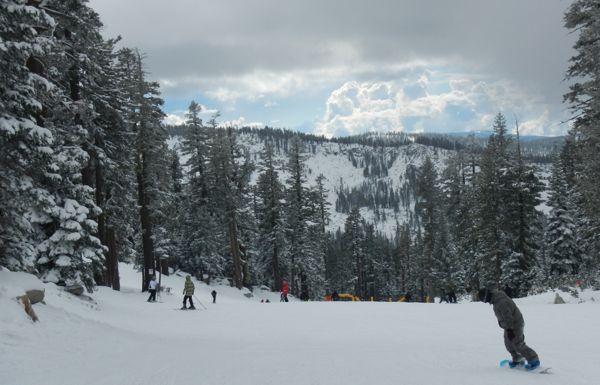
If there had not been a storm in the last week, today’s numbers have would be even worse. And while the storm brought a foot of snow or more to many Tahoe area resorts much to the delight of skiers who were in search of that rare powder day this winter, it will have little impact to the state’s fourth dry season.

While parts of Northern California are faring well when it comes to rain totals, this will not help them much in the summer. This is because it is the snowpack in the Sierra that sustains municipalities and farms downstream, supplying about 30 percent of California’s water needs. Without a snowpack to melt, it will be a trickle that flows into reservoirs. That in turn means less water to be doled out to users.

Already farmers and some Bay Area water districts have been told to count on little or no water allocations from the federal system. Those users will then be tapping into the groundwater, which is already severely depleted in some areas.

Adding to the concern is that users are not conserving as well as they had been earlier this winter. The state Water Resources Control Board on March 3 announced a steep decline in water conservation from 22 percent in December to approximately 8.8 percent in January in year-over-year water use comparisons.

The state Water Board on March 17 will consider renewing an emergency regulation supporting water conservation that was adopted last July. It restricts outdoor water use and authorizes penalties for water waste.


Restaurants replacing tips with service charge

By Chris Macias, Sacramento Bee

The rant from Mr. Pink in the 1992 flick “Reservoir Dogs” was delivered like a salvo against the service industry:

“… This tipping automatically, it’s for the birds,” said Mr. Pink (played by Steve Buscemi) before paying a breakfast tab with his gangster crew. “As far as I’m concerned, they’re just doing their job.”

Back then, Pink’s words seemed like a penny-pincher’s rationale. But fast-forward two decades, and a tipless restaurant world that Mr. Pink craved looks closer to becoming a reality.

A movement around Northern California, and the San Francisco Bay Area in particular, is shifting away from the time-honored practice of tipping servers to simply adding a service charge to the bill. Gratuity has long been included in the bill at Chez Panisse in Berkeley and Yountville’s The French Laundry, and recently become the norm at such Bay Area restaurants as Comal and Trou Normand. In Sacramento, The Kitchen has traditionally tacked on a service charge in lieu of tipping.

Read the whole story


World famous rock climber to give talk

Lynn Hill, widely regarded as one of the best climbers of all time, will talk March 12 at 7pm at Squaw Valley’s Olympic Village Lodge.

Her show, “Climbing Free: My Life in the Vertical World” documents her four-decade rock career, from her humble beginnings with Yosemite’s “Stone Masters” to defining the modern era of free climbing with her free ascent of The Nose on El Capitan.

Now in its ninth year, the Alpenglow Sports Winter Film Series has become a staple seasonal event for North Tahoe’s skiing and climbing community. This is the final installment for this season.

All shows are free and raffle prizes are used to raise funds for local nonprofit organizations. Tahoe Food Hub is the beneficiary for Hill’s show on March 12.