Prediction: Food prices to be stable through 2015

By Russ Parsons, Los Angeles Times

There’s good news for shoppers in the latest Consumer Price Index update from the Department of Agriculture, released last week. Food prices in general should show little to no increase over last year. But there are a couple of exceptions and a couple more troubling caveats.

First the good news: The latest report by the USDA’s Economic Research Service predicts that supermarket food prices will increase only 2 percent to 3 percent in 2015. Fresh fruits and vegetables are predicted to increase less than 1 percent.

What will probably be more expensive is beef. Prices are predicted to increase by 5 percent to 6 percent as the effects of the Midwestern drought linger. Though the weather improved some there this summer, it takes cattle 16 to 18 months to reach maturity, so the effects remain.

Read the whole story


Nev. transportation director against raising speed limit

By Richard N. Velotta, Las Vegas Review-Journal

You won’t see members of the state Transportation Department’s board of directors backing a bill to increase the speed limit on rural Nevada interstate highways to 85 mph.

Fearing that encouraging a study of where higher speed limits would be feasible sends the wrong message about safe driving, the department’s director will lobby against Senate Bill 2, a measure introduced by stae Sen. Don Gustavson, R-Sparks. The proposal would allow speed limits to be increased on portions of interstate highways from 75 mph.

Department director Rudy Malfabon told members of the state board on Monday that he was planning to address the Board of Examiners this week for funding to study which sections of highways would be best suited for higher speed limits.

But board members said they prefer Malfabon not conduct a study because that would leave the impression the board is considering or supports increasing the speed limit.

While the matter was not on Monday’s Transportation Board agenda, individual members weighed in, most of them opposed to an increase.

Read the whole story


Road beat: ‘Four-wheel drive doesn’t negate laws of physics’

By Larry Weitzman

“Seventy-five percent of the accidents in snowy conditions are four-wheel drive vehicles” said Lee Aderlee, retired California Highway Patrol officer. That’s a telling statistic that all drivers of four-wheel drive vehicles should be aware of.

Aderlee went on to say, “Four-wheel drives don’t negate the laws of physics.”

“Many people who drive four-wheel drive vehicles develop a false sense of security and get themselves into trouble … four-wheel drives will not stop any faster than a two-wheel drive car,” Aderlee said. “Four-wheel drive cars accelerate better, but very few accidents occur when accelerating, they occur when they are going too fast for the conditions and are unable to slow down, steer and/or stop.”

Aderlee is absolutely correct.

A four-wheel drive is just what it says. With limited slip differentials, it can put torque or power to any or all of your vehicle’s wheels. Most cars today are front-wheel drives which means the drive wheels are only on the front axles. There is no power to the rear wheels. Rear-wheel drive is the opposite.

In four-wheel drives, if the rear wheels cannot obtain sufficient traction to accelerate the vehicle, then power is transferred to the front wheels or spreads the power to all wheels to obtain the necessary traction. With front wheel biased four-wheel drives, most power goes to the front wheels unless slippage is detected.

But four-wheel drive only helps in making you go in a straight line, it does nothing to help you stop and once front traction is lost, you have no effective steering. The only devise that helps you stop and maintain directional control are antilock brakes. In addition to ABS are electronic black boxes called stability control, which through throttle retardation, individual wheel braking, accelerometers, yaw sensors and steering input sensors attempt to keep the vehicle going in the intended direction. All of these new things should never lull you into as put by Aderlee “a false sense of security.”

Aderlee says there are two things to keep in mind when driving in snowy conditions, speed and anticipation. Any speed beyond the ability to react safely to a problem, such as another vehicle out of control, an animal or a road obstruction is too fast. Four-wheel drive will not help you in such a situation.

Aderlee says chains offer the most effective stopping action as well as significantly improved traction.

Four-wheel drive will help keep you going in mud or in slippery conditions, but it doesn’t remove the common sense necessary when driving in snowy or icy conditions.

When you see all those advertisements of four-wheel drive vehicles doing amazing things, there is a captioned which usually reads: “Professional driver on a closed course.” But even more important is that those professional drivers are in perfect conditions with the knowledge of anticipation. And as the advertisement says, they are professional drivers, drivers highly skilled and experienced in negotiating difficult conditions and who understand and can feel what the vehicle is doing. How successful would an off the street driver be in a NASCAR race? Most of the time all you do is turn left. How hard can that be? At the speeds they travel, extremely hard.

It’s fairly easy to go straight during snowy conditions. It’s when you need to slow down or alter your direction when you get into trouble. When that happens, and that can happen at any time, a four-wheel drive has no advantage over a comparably equipped two-wheel drive. Drive within your limits, the weather’s limits, the road condition’s limits and your vehicle’s limits. The braking ability of a four-wheel drive vehicle is no better than a two-wheel drive vehicle. A two-wheel drive vehicle with ABS and/or chains will outperform a 4 x 4 in braking during snowy conditions without ABS and/or chains.

When the CHP posts speed limits of 25 mph with chains, it’s a maximum safe speed. They are not kidding. The laws of physics are not repealed by four-wheel drive. When traction between the rubber and the road is reduced, so must the speed, as stopping distances are increase by the approximate square of the speed under the best of conditions.

Larry Weitzman has been into cars since he was 5 years old. At 8 he could recite from memory the hp of every car made in the U.S. He has put in thousands of laps on racetracks all over the Western United States.



Transit for South Shore seniors in slow motion

By Kathryn Reed

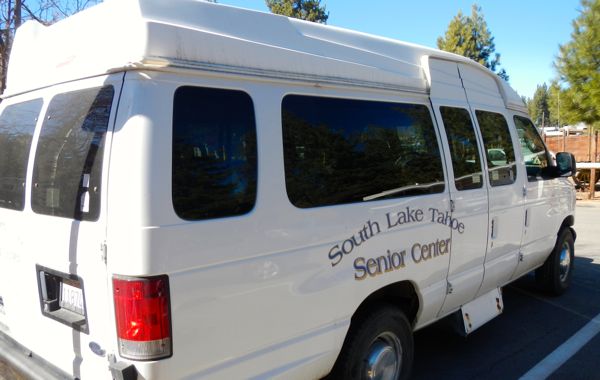
A van in front of the South Lake Tahoe Senior Center rarely leaves the premise. However, that doesn’t mean seniors don’t have any place to go.

“I don’t care who owns it and I don’t care who provides it, they just need the service,” City Manager Nancy Kerry told Lake Tahoe News.

The city and El Dorado County officials are trying to resolve who owns the van and therefore who is responsible for it. A certified driver and liability insurance are other issues to be addressed.

The van seats eight, has room for one wheelchair and meets Americans with Disability Act requirements.

Tahoe Transportation District officials are also in on the discussions because they would like to use it for specialized transportation services for seniors and disabled on the South Shore much like what the pilot program on the North Shore is doing.

South Shore seniors have a van, but limited use. Photo/LTN

South Shore seniors have a van, but limited use. Photo/LTN

“Tahoe Transportation District is in the process of making a formal request for the vehicle,” Tara Styer, TTD mobility manager, said at the March 9 Lake Tahoe Collaborative meeting. She said the vehicle is being used two hours a week now, but that is not nearly enough.

Mobility management is the latest buzz phrase in the transportation world. It’s about concentrating on the individual needs of riders. In this case, the population is primarily seniors and disabled. Others would be able to use the vehicle if there is space.

“The unmet needs are out-of-area transportation,” Styer said.

In particular, getting people to specialized medical appointments. And with the expansion of Medi-Cal, there are few local dentists who will see those patients.

Veterans in the area in 2014 lost their transportation to the hospital in Reno.

Styer envisions each week the van being used for local trips. Then out-of-town trips to Reno, Placerville, Roseville, Sacramento, Carson City, and North Shore-Truckee would be scheduled.

Grants have been applied for to help pay for the vehicle. Passengers would pay a limited amount.

Tahoe Senior Plaza has a vehicle it shares with Kelly Ridge residents. However, off the hill trips are not frequent, according to Styer. The other option for people is the on demand service provided by TTD, but at $3 one-way it can be cost-prohibitive. These are reasons why other alternatives are being investigated.


Editorial: McDonald’s makes a healthy choice

Publisher’s note: This editorial is from the March 6, 2015, Washington Post.

When it comes to familiar icons, McDonald’s ranks high in symbolism around the nation and the world. McDonald’s is also the world’s largest restaurant chain. The company deserves praise for a decision just announced that cannot have been easy to take but is important: to curtail the use of antibiotics in chicken products sold in the United States.

Antibiotics, drugs that fight bacterial infections, came into widespread use after World War II and are now a mainstay of human health. They save lives and enable all kinds of medical advances. But at the same time that antibiotics became known as wonder drugs, bacteria gradually adapted and started to overcome the drugs, a phenomenon known as antibiotic resistance.

 For several decades, it didn’t seem to be a big problem because new antibiotics were being discovered. But now resistance is reaching crisis proportions and the pipeline of new discoveries has dwindled.

Read the whole story


Tahoe City boat ramp repairs delayed

The Lake Forest boat ramp replacement project keeps getting more expensive and longer to complete.

When Tahoe City Public Utility District went out to bid on the project in February 2014 it was supposed to cost a little more a half million dollars and be finished in December that year.

Now the price tag is more than $1 million and sometime in May is when what is usually a year-round ramp will reopen.

The latest problem is that precast concrete panels don’t meet TCPUD or state specifications. Those are now being replaced.

— Lake Tahoe News staff report


Mancuso may end season early

By Jessica Kelley, Ski Racing

The U.S. might be missing one familiar face at next week’s World Cup Finals in Meribel, France. Julia Mancuso of Squaw Valley has announced that she will be taking a brief break from racing and is heading back to the U.S.

Mancuso, who has been troubled with hip pain her entire career, decided to sit out last Sunday’s super G in Garmisch-Partenkirchen in attempts to alleviate the persistent pain. She then announced via social media that she would be returning to the U.S. to seek treatment and a solution for her long-running hip injury.

Mancuso had surgery in 2006 following her Olympic gold medal in Torino on the same hip she is struggling with currently and was able to come back strong the following season. This year looked to be a promising one for Mancuso with a string of three straight top-10 results in Lake Louise, including a podium in the second downhill, which was part of the first-ever American sweep in a World Cup. She took a brief break following World Championships and missed the next World Cup weekend. Since returning, she has struggled to find her early season form and according to reports, she has not felt “right” all season long.

Read the whole story


New partnership seeks to restore Sierra forests

By Matt Weiser, Sacramento Bee

The Sierra Nevada is many things to California: a mountain playground in winter and summer, a swath of public land stretching nearly the length of the state, and vital habitat for a broad variety of wildlife. It also provides the majority of California’s freshwater supply.

With a fourth year of drought looming, state and federal agencies have launched an ambitious partnership to improve the Sierra’s ability to store and filter water, as well as reduce fire risks, by restoring its forests.

Called the Sierra Nevada Watershed Improvement Program, it aims to coordinate the diverse activities of government agencies, property owners and nonprofit groups to focus on the Sierra’s most serious problems. Goals include restoring streams and meadows, improving habitat and thinning overgrown forests, while also protecting economic uses of the land, such as logging and grazing.

The effort is being led by the Sierra Nevada Conservancy, a state agency, in partnership with the U.S. Forest Service, the primary landowner in the Sierra.

Read the whole story


Importance of storm drain monitoring to be discussed

Jesse Patterson of the League to Save Lake Tahoe will highlight successes and lessons learned from Pipe Keepers, a program that engages citizens to monitor stormwater runoff dumping out of pipes directly into Lake Tahoe and Eyes on the Lake where citizens monitor the Lake for aquatic invasive species and report their findings.

The presentation on March 18 form non-1:30pm at Lake Tahoe Community College will also highlight ways that these programs can serve as a model for other citizen monitoring efforts.

People will be taught how volunteer monitoring programs are integral to protecting Lake Tahoe and influencing policy and public opinion.


Snippets about Lake Tahoe

snc• Sierra Nevada College needs volunteers for the March 16-20 Health and Life Sciences Expo. For more info, contact Diana Hitchen at dkhitchen@ucdavis.edu or 775.881.7560, ext. 7483 or sign up online.

• Two more shows have been added to the Harveys Outdoor Concert Series. On July 18, Imagine Dragons will be on stage for their Lake Tahoe debut.  Slightly Stoopid returns Aug. 13 with Dirty Heads and Stick Figure.

• El Dorado County is having a grand opening celebration for its animal shelter in Diamond Springs on March 29 from 2-4pm.

• The California Tahoe Conservancy and California Department of Parks and Recreation will host a workshop April 1 from 6:30-8pm at the North Tahoe Event Center to gather input on the feasibility and design for a reconstructed public pier in Kings Beach.