Sierra Nevada snowpack hits historic low

By Peter Fimrite, San Francisco Chronicle

The abominable snowpack in the Sierra Nevada reached an unprecedented low this week, dipping below the historic lows in 1977 and 2014 for the driest winter in 65 years of record-keeping.

Electronic surveys show the water content of the snow throughout the Sierra is a shocking 8 percent of the historical average for this time of year, by far the driest it has been since 1950, the year record-keeping began, because of the lack of rain and snowfall and the exceedingly high temperatures. It is a troubling milestone that water resources officials say is bound to get even lower as the skies remain stubbornly blue.

“It’s certainly sobering when you consider that the snowpack in a normal year provides about 30 percent of what California needs in the summer and fall,” said Doug Carlson, the spokesman for the California Department of Water Resources. “What this suggests is that we will have very little water running off. It accentuates the severity of the drought and emphasizes the importance of people cutting back on their water use.”

Read the whole story


Important to leave young wildlife alone

Spring is a busy time of year for wildlife. Bears, deer, birds and bobcats as well as dozens of other species emerge from winter ready to fill their bellies and raise their young. Because of this increase in wildlife activity, the California Department of Fish and Wildlife reminds people to leave young wildlife alone if they come across them. The improper handling of young wildlife is a problem in California and across the nation, especially in spring.

Healthy fawns may lay or stand quietly by themselves in one location for hours while their mother is away feeding. Once a fawn is removed from its mother, it can lose the ability to survive in the wild. The same danger applies to most animals, including bears, coyotes, raccoons and most birds.

Dave Cook, a rehabilitator with Sierra Wildlife Rescue in El Dorado County, says his organization receives about 60 fawns a year, mainly between June and July, from people who believe the animals have been orphaned or injured.

It’s also important to remember that wild animals carry ticks, fleas and lice, and they can transmit diseases to humans, including rabies and tularemia, so it is best to leave the responsibility for intervention to CDFW personnel or permitted wildlife rehabilitators. In addition, it is illegal to keep orphaned or injured animals for more than 48 hours in California.


State releases money for EDC road projects

The California Transportation Commission has allocated $325.8 million to 142 transportation projects, including ones on the South Shore.

Fifty-one biking and pedestrian projects throughout the state will receive $27 million in allocations from the Active Transportation Program.

El Dorado County will receive $750,000 to construct a class I bike and multi-use path on Sawmill Road. This will complete that section, which will then link to Highway 50 and Lake Tahoe Boulevard.

Additional dollars are coming to the county through Proposition 1B funds. Statewide, $8.4 million is being allocated.

To reduce the number and severity of collisions on highways 49 and 50 in El Dorado County, $620,000 will be spent to place a thin, high-friction surface treatment on the roadway at various locations.

— Lake Tahoe News staff report


Study: U.S. workers squander unused paid time off

By Patrick Clarke, Travel Pulse

A recent study on vacation time conducted by economic analysis firm Oxford Economics and commissioned by the U.S. Travel Association reveals that many Americans are hurting themselves and their companies by refusing to capitalize on paid time off.

According to Rachel Emma Silverman of the Wall Street Journal, Oxford Economics’ research found that Americans are wasting $52.4 billion in earned benefits each year as a result of unused paid vacation days, while U.S. businesses are left with $224 billion in liabilities for accumulated vacation time.

The study found that, on average, workers vacate roughly five vacations days every year.

Read the whole story


Sandoval looms over fight for Reid seat

By Michael R. Blood and Kimberly Pierceall, AP

Senate Minority Leader Harry Reid’s decision to retire next year leaves no clear successor in his home state of Nevada, where a popular Republican governor appears reluctant to change jobs and the pending loss of Reid’s clout in Washington is causing anxiety over who might replace him.

As of Friday, the list of potential candidates came down to Gov. Brian Sandoval and everyone else. The political centrist who was easily re-elected last year is likely to face intense pressure from national Republicans and business interests to pick up where Reid leaves off on Capitol Hill.

Sandoval didn’t deliver an unequivocal “no” Friday but he made clear the 2016 contest wasn’t on his current agenda.

“My focus is in on Nevada, period. Politics can take care of itself, but right now I am absolutely laser-focused on getting my budget through and improving education in Nevada,” he said.

Beyond the governor, the race would be wide open.

Reid, the longtime Senate Democratic leader, quickly blessed former Nevada Attorney General Catherine Cortez Masto to run for his seat, while Rep. Dina Titus, another Democrat, said she would consider a bid. Among Republicans, other possibilities are Rep. Joe Heck, Nevada Attorney General Adam Laxalt and former Lt. Gov. Brian Krolicki.

“The major decision will be made by Brian Sandoval,” said political scientist Eric Herzik, who teaches at the University of Nevada, Reno. “If he jumps in, this race tips overwhelmingly to the Republicans.”

The Nevada campaign will inevitably figure in the fight for control of the Senate. In a video statement Friday, Reid said Democrats must retake the majority and “it is inappropriate for me to soak up all those resources” to defend his seat.

Awkward in public, clumsy with words, the 75-year-old Reid never was a beloved figure at home. He survived a brutal re-election campaign in 2010, when angry voters turned on him in the aftermath of the recession. He’s been in the Senate since the Reagan era.

But he helped deliver victories for President Barack Obama, including on national health care reform, and his name is affiliated with a long string of wins in Nevada, from development on the Las Vegas Strip to Yucca Mountain, which he helped stop after it was approved by Congress as a nuclear dump in 2002.

Reid lost his role as Senate majority leader when last fall’s elections swept Republicans into power. He suffered serious eye and facial injuries on New Year’s Day while exercising at his Nevada home.

Las Vegas native Daniel Bastardo, smoking a cigarette during a break from his casino security job, said it was going to be hard to replace the man who proved Sin City was worthy of political respect.

“You gotta hang up your hat at some point,” said the 28-year-old Democrat, understanding Reid’s desire to retire. “I’m worried who’s going to represent us now.”

The sense of looming loss was felt around the state. With Reid’s pending departure, Nevada will be without its most experienced hand on Capitol Hill. Sen. Dean Heller, R-Nev., has been in Washington for several years in a chamber where seniority equals influence, and the state’s House members are relative newcomers in a body where members sometimes serve decades.

Sig Rogich, an influential Nevada Republican who helped Reid defend his seat in 2010, said “you don’t lose him and not expect to feel the void.” The Nevada Mining Association said the state would “miss having this native son in its corner.”

The contest will play out in a state in which Democrats hold an edge in registration but voters have long displayed an independent streak. Obama was a two-time winner, but the state also helped send Republican George W. Bush to the White House twice.

Democrats are anchored in the Las Vegas region, while Republicans have an edge in rural parts of the state. A fast-growing Hispanic population is gradually reshaping the electorate, similar to other states in the West, including California.

A major factor in the coming election will be the casino industry, which has a long history ignoring party labels and picking winners in Nevada politics.

Jan Jones Blackhurst, an executive vice president at Caesars Entertainment, called Reid “irreplaceable.” Reid won broad support from the industry in his 2010 victory over tea party favorite Sharron Angle, a Republican.

Finding the right successor, she said, is “a big issue and big concern.”

With Reid’s influence, “all of the sudden Nevada mattered,” she added. With his exit, “that’s going to be a challenge for the state.”

The 2016 presidential race will also intertwine with the Senate contest, potentially driving up turnout among key voter groups, including Latinos. Part of Reid’s victory in 2010 was credited to a Democratic political apparatus that ferreted out supporters, but it’s unclear if another candidate can duplicate those efforts.

Betty Post, a Republican retiree in Las Vegas, said she was thrilled to see Reid stepping down. “We need new blood in there,” she said, adding that she considered the long-serving senator a “bully.”

To Las Vegas attorney Elizabeth Stephens, a Democrat, Reid’s exit could be summed up succinctly. “It’s scary,” she said.


Expect to see smoke from controlled fires

The U.S. Forest Service may continue prescribed fire operations in several locations around Lake Tahoe on March 30, weather permitting.

Operations may take place in Blackwood Canyon between Tahoe City and Tahoma, on the south side of Meeks Bay, on Gardner Mountain near South Tahoe High School and off Gardner Street, on Luther Pass near Grass Lake, at Ski Run Boulevard near Heavenly and on the East Shore near Logan Creek Drive. Operations may last through the next several weeks as conditions allow.

Each operation follows a prescribed fire burn plan, which considers temperature, humidity, wind, moisture of the vegetation, and conditions for the dispersal of smoke.

Smoke from prescribed fire operations is normal and may continue for several days after an ignition depending on the project size. Agencies coordinate with state and local county air pollution control districts and monitors weather conditions closely prior to prescribed fire ignition. They wait for favorable conditions that will carry smoke up and out of the basin.

Before conducting prescribed fire operations, agencies may post road signs around affected areas and make email or phone notifications. The Forest Service updates the local fire information line at 530.543.2600, ext. 6.


Cable companies make cutting the cord difficult

By Timothy Stenovec, Huffington Post

Your options for how to watch TV continue to grow, but cable companies could make you pay dearly if you want to “cut the cord.”

Sony and Dish have recently launched services that allow you to watch live TV streamed over the Internet without subscribing to a cable or satellite package, and Apple is rumored to be working on its own live TV product that will be available this fall. HBO and Showtime will offer standalone streaming services later this year that will allow people to subscribe to the premium networks without paying for TV packages.

The slew of new offerings could prompt some of the millions of households that don’t pay for traditional TV to start buying subscriptions to new services. The new options could also spur others to cut the cord — that is, to ditch their expensive set top boxes in favor of paying Sony, Dish or even Apple, instead of their cable provider, to watch TV.

Read the whole story


Calif. loosens sex offender residency rules

By Sam Stanton, Sacramento Bee

State prison officials said Thursday that they are loosening some restrictions on where thousands of California sex offenders may live in response to a state Supreme Court ruling earlier this month.

The new policy essentially means that state officials will review the cases of all 6,000 sex-offender parolees to determine whether their criminal histories involved children or other sex crimes. Those with offenses involving children will remain under current restrictions created by the Jessica’s Law measure passed by voters in 2006 that prevent them from living within about a half mile of schools, parks and other places where children may be present.

But others – such as offenders convicted of rape of an adult or statutory rape – who have shown no propensity for crimes against children may be allowed to live without such restrictions, a move officials hope will reduce the number of homeless sex offenders in California.

Read the whole story


Tahoe homeless facility not progressing

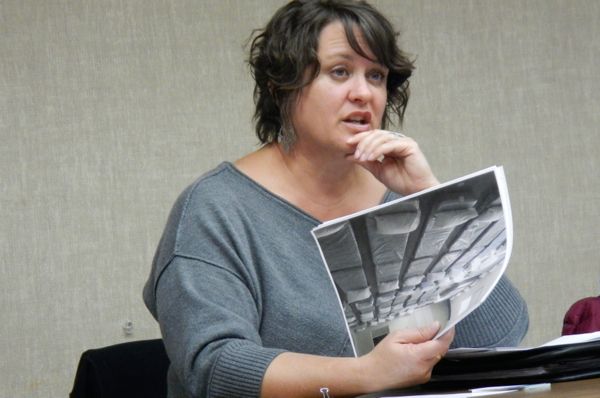
Anne Schiller with Catholic Charities in Reno  talks about what her agency offers homeless people. Photo/Kathryn Reed

Anne Schiller with Catholic Charities in Reno talks about what her agency offers homeless people. Photo/Kathryn Reed

By Kathryn Reed

Another winter has gone by and still there is no place for the homeless in South Lake Tahoe to seek shelter.

Frustration is beginning to show among those who keep meeting to talk about establishing a warming room in South Lake Tahoe. Without nonprofit status, it is impossible to apply for grants that would help fund such an endeavor. The group doesn’t want to form its own nonprofit and no entity has come forward to volunteer to be the umbrella under which the warming room proponents could function.

“We need to get buy-in from the people we want to serve. We need a vision of what we want to create,” Marissa Muscat with Barton Hospital and Live Violence Free said.

Representatives from Catholic Charities in Reno spoke to the group March 24 about what they offer and some of the realities of such an endeavor.

They were quick to say that the talking can go on forever and encouraged the Tahoe folks to jump in, start small and go from there.

Thirty-seven families with kids going to school in Lake Tahoe Unified School District are living in non-traditional housing. Thirty-eight homeless people were identified in the January count; a nationwide effort by the federal government to document this class of people. Throughout El Dorado County there were 247 homeless people counted that day. In the Truckee-Tahoe City area there were 51 people.

It was pointed out that not everyone wants out of this way of life. The Reno women shared how one veteran was given a studio apartment. When he was shown it he turned it down, instead preferring to be at the shelter.

Mental illness is one of the largest barriers to get people to change their habits.

“It’s surprising how many of these people have income who are staying in a combination of these shelters,” Anne Schiller, chief clinical officer for Catholic Charities, said.

Their overflow shelter, which operates during the cold weather months, costs $24,000 a month to operate. It is equally split between Catholic Charities, the city of Reno and Washoe County.

Men and women are allowed – no kids, no pets. A mattress is provided for a few, but mostly they sleep on mats that resemble insulate pads for backpacking. One is lined up after the other. There is no privacy. But they are out of the cold. Most nights the 100 mattresses are spoken for.

This is more than most warm rooms provide. Typically they are just a building out of the cold where homeless must sleep on the floor or stay up all night.

Linens are changed twice a week, a deep cleaning occurs once a week and spraying for things like lice and bed bugs happens once a week.

The hours are from 7pm to 7am. Bed checks and perimeter checks are done regularly.

Once a week case management is provided to help these people get services they need and to apply for aid they qualify for.

This facility is in addition to the regular shelter Catholic Charities runs.

“We’ve tried different things and they have not worked that well,” Schiller said. “Before this facility we tried local hotels.”

The problem was it was not in a great location, no staff was on-site to deal with issues and there was a lot of property damage.

For now, the Tahoe group is going to keep meeting, brainstorm and try to find a nonprofit to essentially be the fiscal agent.


Opinion: Poverty not an action item for Legislature

By Dan Walters, Sacramento Bee

Poverty is the issue du jour of this year’s legislative session – with good reason.

Dan Walters

Dan Walters

By an alternative Census Bureau method of calculating poverty, including the cost of living, 23.4 percent of California’s 39 million residents are impoverished, the nation’s highest rate.

A Public Policy Institute of California study found that poverty is fairly consistent throughout the state, although Los Angeles County, with high living costs and mediocre incomes, has the highest.

Read the whole story