To get a sense of just how complicated the bankruptcy of Caesars Entertainment’s main operating division is, picture a Chicago courtroom filled with 200 lawyers, all working on the case.
That’s a real situation Caesars faced recently, general counsel Tim Donovan told gaming regulators on Thursday. Donovan said Caesars was paying for many of those lawyers, who represent the company and creditors.
Since the operating division sought bankruptcy protection in mid-January, hoping to eliminate about $10 billion in debt, the case has mostly played out in Chicago, where it was filed.
But Caesars executives had to appear before the Nevada Gaming Commission for approval of some routine matters last week, and commissioners used it as an opportunity to get a detailed look into the bankruptcy.
So for around two hours, Donovan and his colleague, Caesars Chief Financial Officer Eric Hession, presented information and answered questions related to the financial restructuring of the operating division, Caesars Entertainment Operating Co.
Caesars is the parent company of Stateline’s Harrah’s Lake Tahoe and Harveys.
Skittles is a very nice 4-year-old Dachshund. She was found as a stray and her people never looked for her. She is housebroken and does well with other dogs, but no cats or small pets please.
Skittles is spayed, microchipped, tested for heart worm, and vaccinated. She is at the El Dorado County Animal Services shelter in Meyers, along with many other dogs and cats who are waiting for their new homes. Go to the Tahoe animal shelter’s Facebook page to see photos and descriptions of all pets at the shelter.
Call 530.573.7925 for directions, hours, and other information on adopting a pet.
For spay-neuter assistance for South Tahoe residents, go online.
— Karen Kuentz
Not all dreams of South Lake Tahoe founders realized 50 years after incorporation
One of the first things to change in the city was signs. This is Highway 50 near Park Avenue in 1964. Photo/Bill Kingman
Publisher’s note: This is one in a series of stories Lake Tahoe News will be running leading up to the 50th anniversary of South Lake Tahoe on Nov. 30.
By Laurel Ames
Despite the grumbling by South Tahoe residents about the county seat located in Placerville, 60 miles away, and the difficulty of getting to El Dorado Board of Supervisors meetings, emotions did not coalesce about various irritations until it was revealed that El Dorado County was largely financing the West Slope county government with funds they collected in the Tahoe basin.
Those funds were primarily the locals’ property taxes, and the taxes and fees paid by the developers of new subdivisions that were exploding around the communities. The new subdivision projects were clear-cutting trees, gouging out flat home sites, and installing sub-par roads, with only a thin layer of asphalt. Because the decisions about how large, how many and where the subdivisions would be built and what level of engineering they needed were made in Placerville, they received only a very cursory review.
In addition, developers were throwing up poorly-designed shoddily-built buildings on Highway 50, damaging or filling wetlands and shoving streams into ditches, plus building on the beaches and had already dredged the Upper Truckee Marsh for the Tahoe Keys – all of it approved by the county Board of Supervisors.
But the worst evidence of our powerlessness was the indefensible proliferation of ugly signs along the highway, each competing to be larger and more gaudy in color, with a fast increase in every kind of lighting, moving lights blinking, flashing and bursting across the signs.
“We’ve become incorporated five years too late.” — Brad Murphy, first mayor of South Lake Tahoe, the Tahoe Daily Tribune reported Dec. 1, 1965. But he proclaimed the city would now take leadership in protecting the lake’s beauty.
After incorporation, everyone agreed that the sight down the highway at the state line was a horrible vision of our new city. The San Francisco Chronicle described it as “The Market Street of the Sierra.”
With the feeling that we were being ripped off, being surrounded by poor standards of building, by the county’s failure to recognize the special Tahoe environment and the shoddy level of county-provided public services, including poor snowplowing service, slow sheriff response times, and little road repair, plus the failure to even acknowledge the need for a community vision for the South Shore area that recognized the importance of the lake for our community, people began to talk about creating their own local government.
A small core group came together to build a strong organization of dissatisfied residents to figure out how to get ourselves our own locally elected officials, keep our taxes in the basin and under our control, and assure that the former charm of our mountain town was restored, while our lake was protected. Creating a new city was the solution, and incorporation was the legal process. Volunteers soon joined in for the numerous tasks – from typing stencils for the mimeograph machine to organizing fundraisers and everything else in between.
That group was made up of Betty and Tom Mitchell, the Bijou Elementary School principal; Mary and Vaughn Burlingham, a developer; and myself and Wink Ames, an insurance broker and my husband at the time.
“The people of Lake Tahoe’s South Shore formally have taken steps to control and preserve the natural beauty of this area. The overwhelming vote for incorporation proves the people do care what happens to the lake. We now have local government control and do not have to rely on those from other areas to take care of our needs.” –– Wink Ames
With the help of many others, we researched local government law and faced the problems of attaining property owner signatures when 67 percent of the lot and cabin owners were not residents, all in an era when there were no computers, no faxes and no copy machines. It was plain hard work after buying the property owner rolls from the county assessor to sort the thousands of names and addresses by hand (first, we cut the county records into individual strips by name and address and then laid them out, one by one, in a very primitive sorting system) until we could write (again by hand) addresses on envelopes, paste on stamps and mail requests for a signature to residents and out-of-town property owners so we could form our own town.
Betty Mitchell remembered the numerous “addressing parties” that locals came to in order to help the effort. And then the county, which was watching us attack their golden egg, threw up a big hurdle – they interpreted the state law on signatures required for incorporation to be every signature on a property deed. We were dumbfounded, as the county required only one signature for many actions, including paying property taxes. We were looking at properties that individually were owned by up to 18 people. The decree by the county set us back, until a local lawyer volunteered to help. We sued the County (Ames vs. Board of Supervisors) and a judge agreed with us – only one signature per parcel.
Following two years of work by volunteers, our efforts paid off in a wildly successful election, and the city of South Lake Tahoe was born on Nov. 16, 1965 — the date of the vote.
El Dorado County approved development on the South Shore without regard to the environment. Photo/LTN file
How the city has shifted
This past few weeks Betty Mitchell, Wink Ames and I have looked back, reminisced, and thought about what the city was in the beginning, and what it is now. Fifty years is a long time, but our memories came together over highlights and details.
By far the most significant and we hope long-lasting change was from the challenge to the city from the myriad ugly, ugly signs and billboards. It wasn’t easy, and Mitchell remembers her husband, who had been appointed to the first Planning Commission, was irate about a large Harrah’s sign stuck in the ground on property in California next to the highway. That sign, among others of the most gross, was targeted for removal in the first phase of cleaning up the signs. But Harrah’s put pressure on a city councilman, the city manager put pressure on Tom Mitchell, who stood his ground, but the other planning commissioners caved and gave Harrah’s 14 years to remove the sign.
Today, all those signs are gone, much of the gaudiness has gone away, and, except on the Nevada side, signs are now classier, muted from the wild abandonment of the 1960s, but still subject to the whims and senses of the city Planning Commission, as those who read the city agendas can see. The city’s early vision of signs that were not obtrusive was on the road to attainment until this past summer when the city got two new very large very bright-colored lighted signs – Auto Zone orange and BevMo red. Oops. Is this the vision for the city’s future?
The other great success we remembered was the city action to kill the proposed freeway from Meyers to Harrah’s parking lot at Stateline. The route of the four-lane freeway was through every meadow in town, as it further rerouted the Upper Truckee River along the airport, and curved toward Stateline across the river and ran parallel to Barbara Street. Just past the north end of the airport, in the middle of that meadow, a large freeway flyover, with off ramps and on ramps to the flyover to connect to another freeway that would replace Highway 89 up the West Shore. That 89 freeway right-of-way can still be seen in the form of the large lagoon on the town side of Venice Drive in the Tahoe Keys. The roadways would cover up all of the meadow at the intersection of 50 and 89. Another place to see the old proposed freeway is the snow storage yard for Caltrans at the end of Sierra Boulevard.
The freeway then headed toward Stateline across Trout Creek meadow, Bijou Creek meadow, across the drainage above Pioneer Trail, across Ski Run, up the hill, through the houses and down to the Harrah’s parking lot. Caltrans had spent years buying up right-of-way, businesses and houses, as they advanced their plans.
The new City Council got wind of the enormity of the road and how it would affect the town, and called Caltrans (at that time the Department of Highways) to meet with the community at a meeting in the new high school auditorium – and the city turned out. The Caltrans engineers were there with their presentation, and the freeway opponents brought in experts and organized local speakers. South Tahoe was passionately opposed to the freeway.
The highlight of the event was when the head Caltrans engineer was asked if they had prepared mock-ups (models) of the freeway, and he said “no”. But Bill Ledbetter, CEO of Harveys, had managed to obtain a full-color picture of the mock-up of the exit into Harrah’s parking lot, had made 400 8 x 10 color glossies and had them handed out to the audience as the question was being asked. The Caltrans rep slunk back to his seat and the City Council took up the issue of signing an agreement with Caltrans to proceed with the project. The vote was 4-1 against.
When the city went off the rails
Several years later, a different group was formed by Ed McCarthy (later the founder of the Council for Logic and mentor of Terry Trupp, later the mayor of the city who was arrested for drug dealing) that announced that the freeway was desperately needed and campaigned for a vote of the people to approve the freeway. His ads said, in full caps, “THE STATE OF CALIF WILL BUILD AND PAY FOR ANY KIND OF ROAD WE WANT.” By that time the time-share developers were building time-shares and they signed up their new owners to support a new parkway. People voted for it, even though “parkway” was just a nice name for a freeway. But it was too late, and a combination of Caltrans harboring a grudge against the city, and the later advent of CEQA and new environmental rules that would have prevented the super-sized road in the wet meadows, ended the idea of splitting the city into two sides and destroying parts of large wetlands of the largest river in the Tahoe basin.
While later the city hungered for the two loop roads at the state line, one above and one to connect to the road near the Edgewood golf course, and even today wants a larger loop road above the existing loop road, it has not attempted to reignite any effort to build a freeway through the city’s meadows. The early city had its head on straight, and the town held a vision of protecting the meadows. Wink Ames noted that he ran for the second City Council on a platform to protect the environment and the communities, and that local control would be brought to us by thoughtful and responsible representatives. Ames got the most votes.
At the beginning, the new city quickly hired a land use planner, and citizens got to work in a yearlong process called 14,000 Planners. As Ames remembers, the planner told the groups that they could have any kind of community it wanted, provided they could articulate and agree on a picture of what that vision was. They met for a year and turned out the city’s first General Plan, which was aimed at creating a true mountain village style community, protecting the remaining open spaces, limiting sizes of building to be compatible with the small communities of Stateline in California, Bijou, Al Tahoe and Tahoe Valley. And protecting the large pine trees for their significant role along the highway for the scenic values of the communities was important to the residents.
“I really believed it would work,” Ames said of the 14,000 Planners plan. “But the vision is gone. It doesn’t look any better now.”
Mitchell noted that the community wanted local control and they thought that, in addition to snowplowing that was better than the hit-or-miss of the county, road repairs and a city police department, they would see their town start to look better. But it never happened.
BevMo’s sign lacks a mountain feel. Photo/LTN
My thought is the city lost its vision of being a series of mountain villages and has not replaced that with a cohesive new vision, as demonstrated by the new BevMo and Auto Zone. The Chateau at Stateline is seen as an improvement over the Hole in the Ground (brought to us by city approval) but lacking an architecturally pleasing exterior reminding us all that when the beautiful Outdoorsman building was remodeled into a drug store, the best building South Shore ever had was lost forever.
And worst of all, the water at the lake’s edge in the summer, which was astoundingly clear in 1965, is now lost to streaming algae, milfoil mats and a shoreline that is no longer the “pristine purity and crystal clarity” that the politicians used to brag about in 1965. Instead, the city, when faced with state and federal rules to protect the lake, took umbrage at the concept that the locals would be stewards, and led the fight against a regional agency, fought the legislation that required new development rules, and did not accept fiscal responsibility for protecting the lake – garnering the city its moniker in out-of basin government offices as “welfare queens” in that the city wanted the state and feds to pay for protecting the lake, but to reap the benefits from living at Tahoe.
Today, as you drive down Highway 50, try to imagine the highway lined with tall pine trees, with the Y a real Y with a hundred old Ponderosa pines in the center – an area that is now all pavement. Fifty years from now, will the remnants of tall pine trees still exist, or will the highway run past a solid wall of 42-foot tall buildings, side by side?
The city of South Lake Tahoe can try again for a new vision for the town and embrace protecting the meadows, the lake, and the big trees, emphasizing the natural values of the surroundings in their decisions.
Based on the last 50 years, it looks like a long shot.
Laurel Ames was one of the key players in getting South Lake Tahoe to incorporate. She still lives in the city.
Opinion: How dogs laugh with you
By Ian Frazier, Outside
I was sitting on a front porch in Helena, Mont., with my 14-year-old son on a hot summer afternoon when the smoke of nearby forest fires made the air even hotter. A black Labrador belonging to nobody we knew came walking along in a low, overheated mood. On a neighbor’s lawn, a sprinkler was going. The dog saw it, bounded into the spray, and stayed there for a long while. Then he came out, shook himself a lot, and walked up onto the porch. He sat on his haunches looking at us.
This was one happy dog. This dog owned happiness.
Regarding us benevolently, his eyes had the fogginess of total bliss. Just sitting there, wet and dripping, he embodied the sound ahhhhhhhhhhh. My son and I agreed that we had never seen a human being as happy as that dog, and suddenly we became happy ourselves.
A dog’s sense of smell is said to be ten thousand times better than a human’s, and that’s also how much better dogs are than humans at being happy. Human happiness is a shabby thing compared with a dog’s. For eons, humans benefitted from the canine gift for happiness and favored happy dogs, who thus passed along their happy genes, producing a species that is now besotted, almost deranged, with happiness.
Of course, many other animals take pleasure in being alive — eagles soaring, otters skidding down slides, cows content to the point of smugness. But there’s a selfishness to that happiness.
Dog happiness always looks outward. To reach fullest expression, a dog’s happiness has to be lived large and strewn around. The only thing that slows down a dog’s happiness is if he can’t infect you with it so you can be happy together.
By sponsoring an Adopt A Day of Nourishment on March 23, Kirkwood Mountain Resort partnered with Bread & Broth to feed over 90 community members at St. Theresa Church Grace Hall.
“I love our community and love to help in any way,” said Sean Groover, Kirkwood’s warehouse manager. “Kirkwood is happy to be a part of this event and this community.”
Also helping at the dinner were fellow Kirkwood Mountain Resort team members Scarlett Mellin, director mountain dining; Kristen Gregg, Kirkwood Inn manager; Jason Bucholz, executive chef; and Tara Gonyer, General Store manager.
Upon arrival at 3pm, the Kirkwood volunteer crew jumped right in to help the B&B volunteers pack the give-away bags with fruit, dairy products, canned goods and bread products. From there, they manned the serving line for spaghetti dinner firsts, seconds and to goes, and at the end of the event cleaned and put away tables and chairs.
By Adopting A Day, not only do our sponsors donate $250 to cover all the costs of the evening meal, B&B encourages our sponsors to become involved with their sponsorship by helping with most aspects of the dinner.
“This was a great time. It felt good to help,” said Bucholz.
Helping others who are dealing with difficult life situations and struggling with hunger is an experience that raises awareness and improves the lives of others. Thank you to Kirkwood Mountain Resort and their employees for their service to the community. To help B&B as a donor or sponsor, contact me at 530.542.2876 or carolsgerard@aol.com.
Carol Gerard, Bread & Broth
Trend — hotels giving guests free boozes
By Jessica Festa, USA Today
One of my favorite new hotel perks for 2015 is Kimpton Hotels & Restaurants’ new nitecap program, which includes complimentary booze and snack pairings and a nightly wine hour, when vino flows like water. I love that Kimpton is embracing the ultimate pairing of travel and booze, and luckily other hotels are doing the same.
In February, the Sonesta Fort Lauderdale launched a “Daily Delights” schedule providing a different perk each day, such as free Prosecco from 5-6pm on the not-at-all-cheesy-sounding Toasty Tuesdays in the lobby bar, and wine and cheese from 5-6pm in the Bistro Restaurant on Wine Down Wednesdays.
The new boutique Canopy by Hilton brand will also be launching 11 properties within the U.S. and London in 2015-16, with each offering a tasting of local beers and seasonal cocktails for a dose of culture.
Facebook’s plan to take over the media was first articulated in October, by the New York Times’ David Carr. The social network had become a dominant source of online news for its billion-plus users. But it found that those users were frustrated by the experience of reading news on Facebook, especially on their phones. It required clicking links to third-party media websites, whose pages were slow to load, riddled with ads, and often failed to match the promise of their clickbait headlines.
Facebook has tried to solve this problem from a number of angles, many of which I’ve written about in the past. But the ultimate solution was the one Carr laid out: Facebook would simply host news’ sites content on its own platform, then share a slice of the ad revenue that resulted.
I wrote in depth in January about Facebook’s plan to cut out the middle man, explaining how it might work and why publishers would feel compelled to participate. At the time, Facebook had just published a blog post encouraging publishers to post videos natively on its platform, so that they could play automatically in users’ feeds. (Facebook’s algorithms heavily prioritize native video posts over, say, YouTube videos.) But I predicted that we’d eventually see Facebook nudge media outlets to post full news stories directly to Facebook as well — perhaps by “late 2016.”
That prediction suddenly looks far too conservative. The Times reported earlier this month that Facebook “has been quietly holding talks with at least half a dozen media companies about hosting their content inside Facebook rather than making users tap a link to go to an external site.” And it will start testing the new scheme “in the next several months,” with the New York Times, National Geographic, and BuzzFeed among the likely partners at launch. No doubt others will be lined up to follow their lead.
In the final months of 2014, the nation’s plastic bag manufacturers spent $3.1 million to sidetrack a California law that sought to ban throwaway bags.
But that political spending spree may be a small down payment on what could be a hugely expensive environmental fight on the state ballot in 2016 – and one with profound national implications as well.
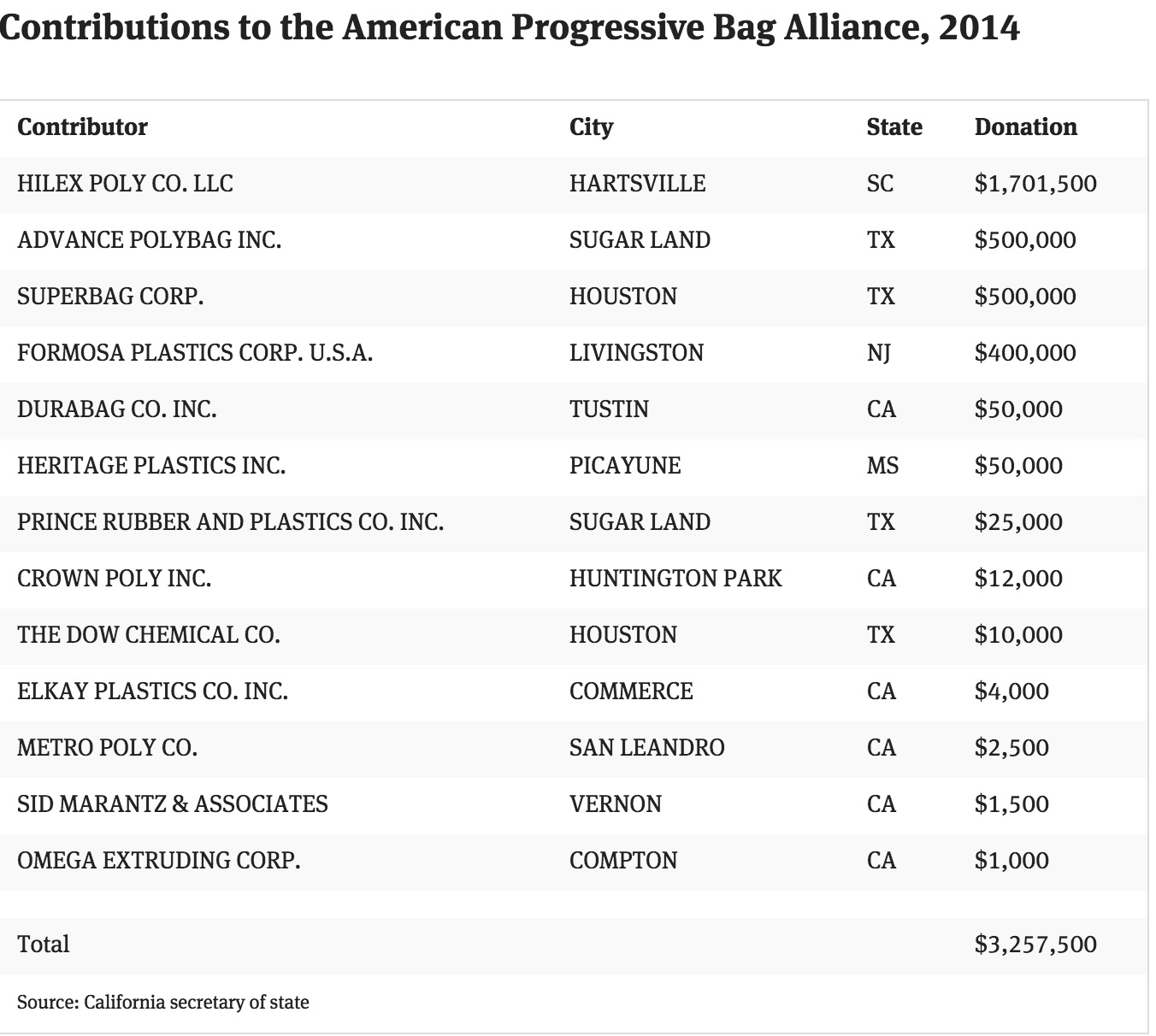
Last year, the California Legislature barred retailers from giving plastic shopping bags to consumers. A dozen bag manufacturers – most from outside the state – banded together to finance a quick-strike petition challenging the law before it had gone into effect.
The bag companies gathered some 800,000 signatures – enough to put the issue of whether California should ban the bags to a statewide vote. Until the November 2016 election, the new law remains in limbo.
The biggest bag manufacturers are based in South Carolina, Texas and New Jersey. But starting in 2010, the industry emerged as a free-spending political player in California’s Capitol, pumping about $6 million into donations and lobbying since then.
That’s a measure of how eager the industry is to stop California from enacting what would be the first statewide ban in the country.
With the referendum looming, the price could get quite a bit steeper.
The cost of running a statewide ballot measure spirals upward every election. Four winning campaigns spent an average of $34 million in 2014, according to a recent analysis by Forward Observer, a Sacramento political consulting firm.
Meanwhile, a Los Angeles Times poll showed that 60 percent of Californians support the bag ban.
Given those numbers, overturning the ban will be a “heavy lift” for the industry, said Renee Van Vechten, a professor of political science at the University of Redlands and an expert on state initiatives. Even extraordinarily heavy spending might not make a difference, she said.
“Is it winnable? The easy answer would be no,” she said. “But they obviously think they have a chance and a lot to lose if it goes forward.”
The campaign’s cost likely will be shouldered by the same companies that financed the petition drive. Here, from state records, are the petition donors:
Throwaway bags are a staple of America’s convenience lifestyle, but environmentalists complain that they are a huge source of litter and pollution.
Californians throw away 14 billion bags per year, the state Legislative Analyst’s Office said. Estimates of cleanup and disposal costs range from $25 million to $500 million, and a huge number of bags don’t make it to the landfill.
But the industry contends that the rationale for banning plastic bags is based on “emotional imagery, junk science, and exaggeration, rather than facts and good data,” as Phil Rozenski, policy chair for the American Progressive Bag Alliance, wrote in an email.
Bag bans threaten the livelihood of 30,000 American workers, he wrote. Instead of a job-killing ban, California should pursue “comprehensive recycling education and in-store take back programs,” he wrote. He also called California’s law “a scam” and said the industry believes voters will vote to repeal it.
For years, environmentalists concentrated on backing local ordinances to ban throwaway plastic bags. San Francisco was the first to enact a ban, in 2007. Today, advocates say more than 100 California communities and dozens more around the country have such laws on the books.
The push for a statewide ban began in 2010, recalled Los Angeles activist Hans Johnson, but it ran into a furious and well-financed lobbying campaign. From 2010 through 2014, South Carolina-based Hilex Poly Co. spent $1.8 million lobbying the California Legislature, records show, far more than it spent in any other state. The American Progressive Bag Alliance, the industry’s Washington, D.C.-based political arm, spent an additional $1 million.
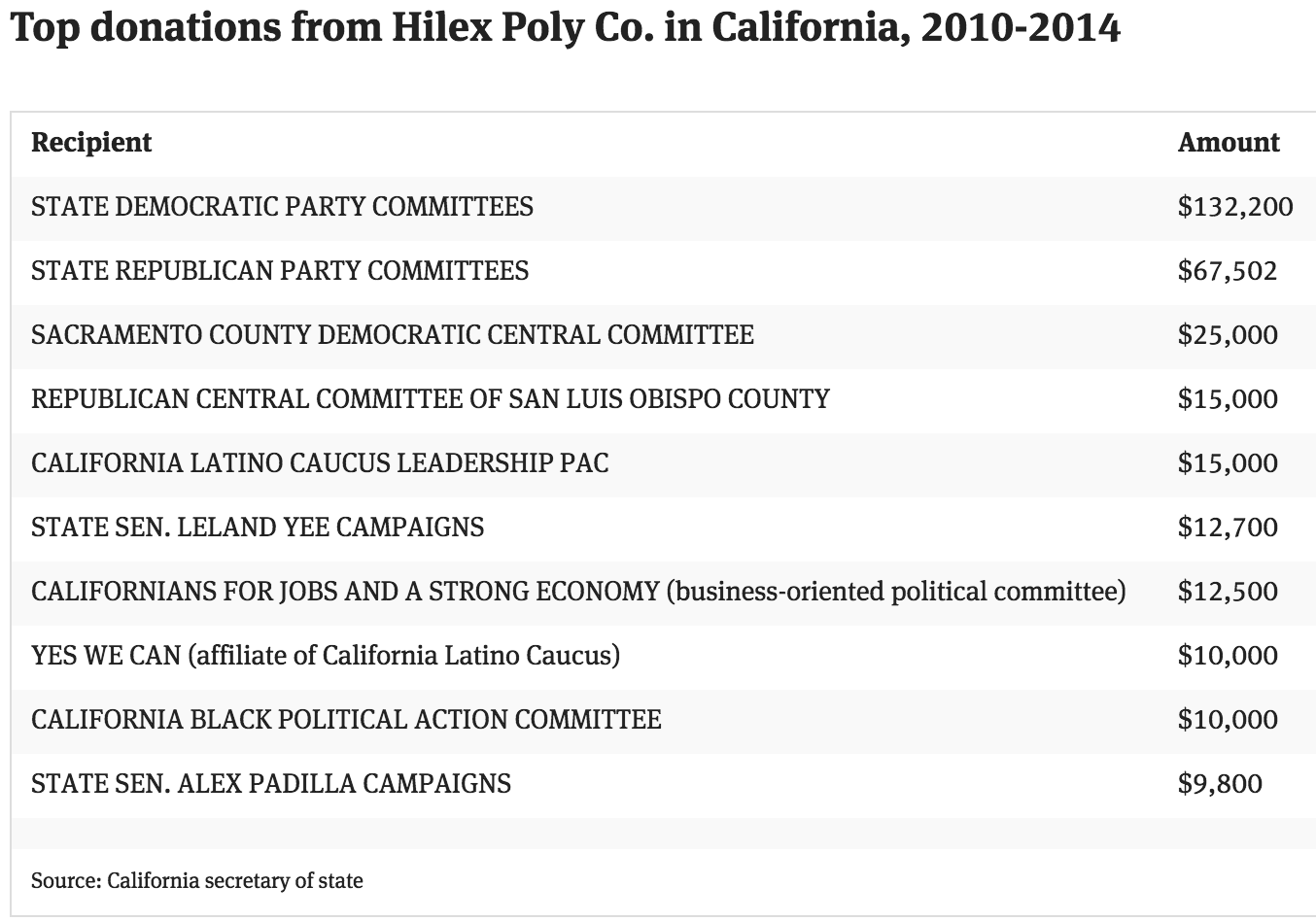
Hilex also donated more than $500,000 to about 70 state lawmakers and political committees in California, favoring Democrats, who controlled the Legislature, by about 2 to 1. The top recipient lawmaker was state Sen. Leland Yee, D-San Francisco, who was indicted last year in an FBI bribery sting. Hilex gave $9,800 to then-state Sen. Alex Padilla, D-Van Nuys, now the secretary of state and the author of the bag ban measure that was enacted in 2014.
While the bill was pending – and Padilla was in a tight race for secretary of state – the bag alliance paid for a flurry of television and radio ads criticizing what it called “Padilla’s misguided bag ban.” A lobbying report indicates that the alliance spent $266,000 on the ad campaign.
Top donations from Hilex Poly Co. in California, 2010-2014:
STPUD offering ways to save water outdoors
South Tahoe Public Utility District is putting on a series of informational meetings for people who are interested in reducing outdoor water use.
The district is hosting a meeting for landscapers interested in the Turf Buyback Program. All attendees will be placed on a list to be distributed to program participants. The meeting is April 29 at 6pm.
On May 6 at 6pm there will be a workshop about the Turf Buyback Program for homeowners. The district will provide information on the program, discuss the requirements in detail, and provide additional resources for how to reduce your water use.
Those two meetings are at 1275 Meadow Crest Drive, South Lake Tahoe.
Learn how to maintain your landscape and reduce water use by improving water management and system efficiency. This workshop on June 5 from 7:30am-noon features indoor presentations and outdoor demonstrations by irrigation industry professionals.
Register online for the June meeting. The cost is $20. It will be at Lake Tahoe Community College.