USFS quick to contain fire in Desolation Wilderness

Firefighters were able to quickly extinguish a blaze started by an illegal campfire at Granite Lake in Desolation Wilderness.

Despite the high winds on March 31, the fire did not spread.

Illegal and unattended campfires cause more 90 percent of wildfires in the Lake Tahoe Basin, according to the U.S. Forest Service.

“While we realize the warm weather, combined with lack of snow has given folks early access to recreation areas, people need to remember that campfires are only allowed in designated campgrounds and are not allowed on National Forest beaches or in the Desolation Wilderness,” Fire Management Officer Steve Burns said in a statement. “We need the public to be mindful of the current fire danger and help prevent human-caused wildfires by not building illegal campfires.”

For information on campfire safety, go online.

— Lake Tahoe News staff report


7 steps to a fear-free money plan

By Donna M. Phel

Money worries can lead to sleepless nights for just about everyone, but surveys routinely reveal that women more than men feel the anxiety from a rocky financial situation.

In a 2014 Money magazine survey, for example, two-thirds of women said they were worried about their financial outlook, compared with 54 percent of men.

Recent studies also found that women tend to be overwhelmed by debt more frequently than men.

They are more likely to carry over a credit card debt from one month to the next, as well as pay only the minimum required by their lender.

That can lead to the misconception that women are bad with money, but that’s not necessarily the case.. Emergencies arise. Children need school supplies. Elderly parents can need medication. The list can go on and on.

Women don’t need to remain in perpetual state of anxiety.

Here are seven tips for developing a fear-free plan of action:

• Learn financial basics. Go online or to the library and read financial articles, books and newspapers. Seek the help of a financial advisor who can assess your situation, suggest ways to improve and create a financial plan that could get you on track for retirement.

Many women avoid going to see a financial advisor because they don’t have any money or are deep in debt and believe they can’t afford it, but that’s precisely when you should see a financial advisor.

Get organized. Rid yourself of clutter and set up systems to keep track of paperwork. If the task seems overwhelming, take it a step at a time, such as cleaning out just one desk drawer a week.

Balance your checkbook regularly, too. Do it weekly or bi-weekly if possible, Phelan suggests, but never go more than a month. “This isn’t a chore most people enjoy, but it’s necessary for a healthy budget,” she says.

• Use cash instead of credit. Credit cards distance us from the effect purchases have on our bank accounts, at least until the bill arrives. Cash, on the other hand, is an immediate reminder of the financial consequences of that purchase. Sometimes a reminder is a good thing.

One away to wean yourself off credit is to carry and use your checkbook and leave the credit cards at home.

Track your spending. Write down everything you spend money on for one week. Then look in your checkbook and credit-card statements and write down everything you spend money on for one month. You will be amazed at how much you spend and where the money goes.

The next step is to create a spending plan. Write down how much income you have each month and decide how you want to spend it. Pay yourself first by saving a certain percentage each month. After that, list all your mandatory bills and find ways to cut non-essentials.

Look for ways to increase your income. When you can’t pay your bills each month, you have two options. Increase your income or reduce expenses. “It’s likely some combination of the two will be necessary,” Phelan says. “No matter how you view it, you need to start looking for ways to open up new income streams.”

• Develop new retirement strategies. Women should create what I refer to as Stackable Income Streams to Empower Retirement Security, or SISTERS. Essentially, they need to “stack” enough dependable income streams to meet their monthly spending needs in retirement. Women should consider non-traditional residence sharing, such as renting out empty rooms, getting a roommate or downsizing, she says. They could create profitable home-based businesses from their hobbies. Women should consider delaying their retirement start date and working part-time in retirement.

• Talk with other women. What are your friends doing to better manage money and prepare for retirement? Consider forming a SISTERS club that meets regularly to discuss retirement planning. They might discover that they have ideas, talents and resources to share with other women, which might enhance the retirement planning experience and success of a larger scope of women.

Donna M. Phelan is the author of “Women, Money and Prosperity: A Sister’s Perspective on How to Retire Well”. She has spent 19 years at some of Wall Street’s largest and most prestigious investment firms. 


Maple isn’t just for pancake syrup

By Noelle  Carter, Los Angeles Times

Growing up, I associated maple flavor with the pancake syrup found at the breakfast table. It was sweet but mostly flavorless. As if its only purpose was to baptize food in a sticky coating of liquid sugar. I wasn’t the biggest fan.

Today it seems maple is everywhere. It flavors ice cream, candy, coffee, tea, barbecue sauce and more. Thirsty? Hydrate yourself with maple water, now hip enough to be touted as “the next coconut water.”

And maple isn’t just limited to retail products. Go out to eat and you’ll find it added to any number of restaurant dishes. It’s a chef’s Eliza Doolittle.

Read the whole story


CVS wants to become people’s doctor’s office

By Eliza Gray, Time

In the fifth season of “Curb your Enthusiasm”, Larry David visits a pharmacist to fill his father’s blood-thinner prescription. “You know, there’s another drug on the market that I personally like a lot better,” the pharmacist tells Larry. “But the doctor prefers this one?” Larry says. He holds up his hands like a scale and weighs his options. “Doctor,” he says, holding up one hand, then “pharmacist,” holding up the other. He decides: “I’ll go with the pharmacist.”

You may too if Larry Merlo has his way. Merlo, 59, is the CEO of drugstore giant CVS Health. Trained as a pharmacist himself, Merlo has ambitions to play a much bigger role in your health care. He’s already pretty involved. Last year at 7,800 stores, CVS, the second largest drugstore chain in the U.S., filled more than 700 million prescriptions and administered 5 million flu shots – all while selling customers everything from groceries to gift wrap.

Now Merlo says the drugstore can do more. In his vision, CVS will leverage its sizable MinuteClinic business – which already has 970 locations – to diagnose patients, decide on treatments and then sell them the pills they need to get well. In its role as the pharmacy-benefits manager for some 65 million people, CVS also negotiates the price of those pills and helps decide which ones get reimbursed under various insurance plans. Merlo would also like America to stop smoking: he roiled the tobacco industry last year by dropping the sale of cigarettes in CVS stores. And if that causes some customers to have withdrawal pains, the CVS pharmacy can fill a prescription for a drug that helps them quit.

By taking on more of the role of your doctor as well as that of your druggist, CVS looks to grow beyond its already considerable size ($4.6 billion in earnings for 2014). But Merlo argues that the stakes are far higher. He thinks CVS can save lives–and hundreds of billions of dollars in unnecessary health care costs annually–by efficiently treating Americans’ routine sniffles and aches, nudging them to take better care of themselves and making sure they take their medications when they’re supposed to.

Read the whole story


Opinion: Bringing awareness to distracted driving

By Shannon Laney

To save lives and educate all Californians, especially young drivers, about the dangers of distracted driving, the California Office of Traffic Safety (OTS), California Highway Patrol (CHP), Impact Teen Drivers, and more than 200 law enforcement agencies statewide are working together on increased education and enforcement efforts for National Distracted Driving Awareness Month in April and California Teen Safe Driving Week, the first week of April.

Driving takes one’s full attention and any distraction can have deadly, dangerous consequences. Imagine driving for4 to 5 seconds while blindfolded. That can be the effect of looking down to send a text message. In the average time it takes to check a text message – less than 5 seconds – a car travelling 60 mph will travel more than the length of a football field.

Throughout the month of April, police, sheriff and the CHP will focus on educating the public about the dangers of driving distracted through local media interviews, visits to schools, and traffic safety presentations. In addition, April 15 has been earmarked for special statewide high visibility enforcement days for all law enforcement agencies that are participating in the national traffic safety campaign.

The urge to read and answer an incoming message when we hear the text sound can be almost overwhelming. The Office of Traffic Safety is using a message of Silence the Distraction in new public service announcements aimed at getting drivers to turn off their phones while driving so they won’t be tempted.

“No text, call, or social media update is worth a crash,” said OTS Director Rhonda Craft. “With an average of less than a second to react to an urgent situation, drivers need to have all their attention on the roadway.”

While distracted driving can take on many forms and affects all road users, young drivers are at a greater risk. During “California Teen Safe Driving Week,” April 1-7, Impact Teen Drivers will focus on educating teens that their number one killer – reckless and distracted driving – is 100% preventable.

“People are realizing that everyday behaviors, such as texting or reaching for a dropped item, can be lethal when done behind the wheel,” Kelly Browning, executive director of Impact Teen Drivers.

Each of us must drive responsibly, keeping full attention to the task at hand — driving. If you have teenagers in your family who are driving, make sure they understand the laws and what their responsibilities are as well. The collective goal with this month-long campaign is to change the behavior of all drivers. That change begins with education.

Shannon Laney is a sergeant in the South Lake Tahoe Police Department.


Exercise may aid cancer treatment

By Gretchen Reynolds, New York Times

In a study involving mice, aerobic exercise slowed the growth of breast cancer tumors and made the cancer more sensitive to chemotherapy. The results raise the possibility that exercise may change the biology of some malignant tumors, potentially making them easier to treat.

Scientists and clinicians have known for some time that solid tumors can create their own, peculiar ecosystem within the body. As a tumor grows, it sends out biochemical signals that prompt the creation of additional blood vessels to provide the expanding tumor with more oxygen. Oxygen is, of course, important for cell health, including in normal tissue.

But in some tumors, these new blood vessels begin to proliferate so wildly that they create a “jumble and tumble” of tubes that can curl around and choke one another, reducing blood supply and oxygen to the tumor, says Mark W. Dewhirst, the Gustavo S. Montana Professor of Radiation Oncology at Duke University School of Medicine and senior author of the study.

As a result, the tumor becomes hypoxic; it exists in an environment with little oxygen.

Read the whole story


Lecture to focus on osteoporosis

William Cottrell, a doctor with Barton Osteoporosis and Bone Health, will be talking about Osteoporosis: Prevention & Treatment on April 16.

Cottrell will discuss:

  • What is it? An introduction to bone biology.
  • How do you diagnose osteoporosis?
  • How is it treated? Nutrients and pharmaceuticals.

The free talk will be from 6-7pm at Sierra Nevada College, Tahoe Center for Environmental Sciences, Room 139, Incline Village.


Don’t let financial blunders leave wallet empty

By Jim Chilton

To err is human, but when mistakes affect your pocketbook it’s not exactly divine.

Don’t feel alone if you’ve committed a financial blunder, though. Two-thirds of Americans have made a significant money mistake somewhere along the way.

Since April is National Financial Literacy Month, this is a good time for anyone to pledge to do a better job handling money, says Chilton, whose organization’s mission is to “eliminate financial illiteracy, one community at a time.”

SOFA does that by conducting free workshops and seminars for corporations, small businesses, government agencies, community colleges, libraries, churches or organizations.

One thing I always tell people is that you can’t let your emotions get in the way when you are trying to meet your financial goals. When it comes to finances, there is always going to be at least a little uncertainty.

But he says people can go a long way toward financial stability if they avoid these common blunders:

• Living without a net. Bad things happen in life, even to the best people who are trying to do the right things. That’s why you need to set aside savings that will serve as an emergency fund in case you suddenly have major medical problems or lose your job. I recommends a six- to 12-month cushion that would cover your mortgage, groceries, utilities and the other necessities of day-to-day living.

• Failing to check credit reports. More than 70 percent of credit reports contain some sort of error. Meanwhile, identity theft is on the rise. You should check your credit reports annually to make sure you are not a victim.

• Giving little thought to retirement. Many people fail to properly prepare for retirement. If you think Social Security will take care of you, think again. Social Security is designed as supplemental income, not something that can replace your entire paycheck, Chilton says. You need to plan and save to make sure you can lead the lifestyle you want in your later years.

• Racking up credit card debt. Credit seems to rule, but cash should be your real king. Americans are carrying more than $800 billion in credit card debt, he says. Making a conscious effort to use cash will help wean you off your reliance on plastic. If you are struggling with credit card debt, you need to start making a plan to get rid of that debt.

• Seeking advice in the wrong places. Uncle Felix may mean well, but he’s not necessarily the ideal person to offer you advice on the stock market. A trained professional is your best bet. Sure, word of mouth can be helpful, but it can be equally hurtful. Before you pick someone to help you with investments, though, do your homework because you want someone with a good reputation. Check with the Better Business Bureau and do a Google search to see what else you can learn.

• Trying to do too much, too quickly. Financial problems that took years to create aren’t going to be fixed overnight. So ease into your new financial plan. Instead of a dramatic overhaul that could leave you frustrated, try to make small changes that will lead to larger commitments.

Even as we get older and presumably know more, we are still bound to make a misstep here or there. We simply can’t know it all, especially when it comes to our finances.

But if we realize our limitations, we can at least learn to make fewer mistakes and do a better job of setting and meeting the goals we have for our money.

Jim Chilton is the founder and chief executive officer for the Society for Financial Awareness, or SOFA, a nonprofit public benefit corporation with a mission to provide financial education across America. 


Defensible space, tree removal training available

The Tahoe Fire and Fuels Team is hosting two workshops for local defensible space and tree removal contractors.

Contractors attending either training will be included on the 2015 Tree Removal and Defensible Space Contractor List provided to residents participating in defensible space grant programs, requesting tree removal permits, or receiving defensible space inspections.

The first is April 23 from 8:30-11am, North Tahoe FPD Station 51, 222 Fairway Drive, Tahoe City. The other is April 30, 8:30-11am, Tahoe Regional Planning Agency, 128 Market St., Stateline. RSVP by April 17 by emailing bbarr@trpa.org

Attendees will receive training on:

  •  Tree removal and defensible space related regulations in the Tahoe Regional Planning Agency Code of Ordinances.
  • Fire agency defensible space requirements and available grant programs.
  • TRPA’s online Tree Removal Permit Application tool.


No denying drought — barren ground at 7,000 feet

By Susan Wood

PHILLIPS STATION –The state isn’t fooling around anymore.

In an apparent precursor to Mark Twain’s theory, Gov. Jerry Brown issued a mandate April 1 for South Lake Tahoe residents along with the 38 million other Californians to reduce water use by 25 percent. He did so while attending the water year’s last and only recorded bare snow survey. There was nothing to register at the foot of Sierra-at-Tahoe ski resort. This has never happened before at this time of year.

If people don’t comply with the state Department of Water Resources’ order, it could ultimately lead to fines. The executive order will be monitored closely through metering by water districts.

Beyond incentives and other restrictions, this means significant cuts to large users such as golf courses, campuses and the mass collective of state residents — signaling “a new era” commanding shared responsibility, Brown indicated.

When asked by Lake Tahoe News how Tahoe residents should handle the dilemma of watering their yards versus choosing responsible water conservation in what may turn out to be a historic fire season, Brown was sympathetic. He was standing less than 10 miles from the hallowed ground of this region’s worst wildland fire – Angora 2007. Many wildland fires start close to concentrated residential areas. Flames can ignite from hot power tools left in brittle brush or from a vehicle or careless smokers tossing a cigarette onto dry terrain.

“What I would tell the residents is now we are embarking on an experiment no one has tried. This will require adjustment. It will require learning. But this is our new normal. It will take heart. It will take instruction. We have the technology. All we need is the political will. It’s somewhat of a burden. And agriculture is already undergoing major cutbacks. But we can do a lot better,” Brown told Lake Tahoe News, while joined by the state’s Water Resources chief Mark Cowin, snow survey monitor Frank Gehrke and a flood of media.
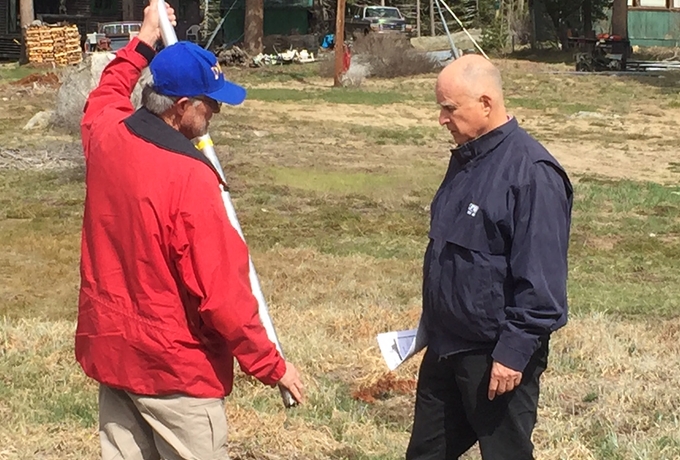
Frank Gehrke with the state Department of Water Resources, left, tells Gov. Jerry Brown, on April 1 how his tool would be used in a normal snow year. Photo/Susan Wood

Frank Gehrke with the state Department of Water Resources, left, tells Gov. Jerry Brown, on April 1 how his measuring tool would be used in a normal snow year. Photo/Susan Wood

Is it time for cisterns to be installed in yards? — Lake Tahoe News asked Cowin.

Cowin replied there’s financial assistance and incentives for programs that encourage more stormwater management and those that replace grass lawns with more natural habitat. The state also suggested funding of rebates for low water-use appliances.

Water districts’ role in monitoring resident and commercial water use is critical.

“If they don’t perform, there will be repercussions – maybe fines,” Cowin pointed out. “It’s as bad as it’s ever been.”

To South Lake Tahoe Public Utility District General Manager Richard Solbrig, a head start was definitely in order. Since 2007, the district has implemented odd-even restrictions on when residents can water, he reminded Lake Tahoe News on a phone call. The turf buy-back program has much demand. And the district stands at about halfway complete on installing its water meters for 14,000 customers. At least 2,000 more are scheduled to go in this summer.

If the state wants to truly do some good – more money for the incentives already put into place would represent a welcome mat to Solbrig.

“(The state executive order) really came with no surprises. If the state wants to make a real dent, they’ll put a few more thousand dollars into our turf buyback program,” he said. There’s a waiting list to get on it because the demand is so high.

And agencies such as STPUD, Tahoe Regional Planning Agency and the city of South Lake Tahoe have hired a Sacramento lobbyist to closely monitor the situation to maximize the benefit for our region.

The one additional requirement Solbrig noticed is the restriction on watering during a rainfall event and within 48 hours afterward.

“That could be a challenge to enforce, obviously,” he said.

The specifics will be discussed at the district’s board meeting on May 7.

Restaurants will also be asked to only deliver water to tables when requested. Hotels will need to implement new laundry frequency programs to guests.

Change. Change. Change. Indeed, the state is entering year four of the drought.

Gehrke illustrated the seriousness of the lack of snowfall by showing the marks on the survey measuring stick that records the water content of the Sierra snowpack. The maximum measurement recorded in 1983 – an El Nino year — sat at the top of the pole with 150 inches. The average is 63 inches. The lowest recorded before this year was 27 inches set in 1977. Last year’s measured 33 inches at the meadow located where Highway 50 and Sierra-at-Tahoe Road meet.

The ski resort up the hill closed March 17; its second earliest shutdown. Resort general manager, John Rice, stood in attendance in tennis shoes – not normal attire for the ski season.

Gehrke characterized the latest condition of the drought as “distressing” – especially since in all his years of measuring the state snowpack’s water content, Wednesday went down as a first to have bare ground on April 1. At least 5 feet of snow should be covering the ground.

“I think the governor here expresses the seriousness of it,” he said.

Are the state’s residents in denial? Have we done enough?

The impression from California’s leaders is yes and no.

“We’re always in denial. But we want to think about the good, and that’s good. But we’re making the climate worse at a rapid pace. Steps take more steps,” the governor added.

In other words, there’s “rationing” now through the various water districts. And now there’s a definitive strategy across a vast state. Brown outlined this order as a proposal in the overall strategy the state has to combat climate change symptoms facilitated by “billions of tons of chemicals released into the atmosphere” where greenhouse gases are trapped.

“That’s why we have cap and trade and electric cars. This is all not easy,” Brown said. And perhaps not smooth-sailing in the words of Tahoe’s most famous writer Twain: “Whiskey’s for drinking, water’s for fightin’ over.”