Aquatic mammals, hiking — topics of library talks

South Lake Tahoe Friends of the Library is putting on two diverse programs in May.

The first is May 5 at 6pm. Will Richardson with Tahoe Institute of Natural Sciences will present Tahoe’s Aquatic Mammals. It will be an evening of learning about beavers, river otters and more.

On May 12 at 6pm, South Lake Tahoe native and author Aaron Hussmann will discuss his book “500 Miles of South Lake Tahoe Hikes”. The book will be for sale and he will be signing them after the talk.

Both programs are free and at the library, 1000 Rufus Allen Blvd., South Lake Tahoe.


Feds blasted for Lake Tahoe logging

By Nick Cahill, Courthouse News Service

SACRAMENTO — A federal judge refused to dismiss a professor’s claim that the U.S. Forest Service is damaging the Lake Tahoe watershed by clearing timber and brush and depositing the slash in streams and wetlands.

U.S. District Judge Garland Burrell Jr. ruled Tuesday that the Forest Service’s argument was based upon faulty evidence and that plaintiff Dennis Murphy did not waive his legal challenge to the Upper Echo Lakes Hazardous Fuels Reduction Projection by failing to comment during a public comment period.

Burrell denied all three of the Forest Service’s claims for dismissal.

Murphy, a former consultant for the Forest Service, claims the agency violated the National Environmental Protection Act when it invoked a categorical exclusion for an environmental assessment, and falsely claimed that the project “does not individually or cumulatively have a significant effect on the human environment.”

The Forest Service also implemented the project contrary to the description in a memo sent to the public, Murphy said.

Read the whole story


Nev. bill would give state money to private schools

By Michelle Rindels, AP

Nevada lawmakers reviewed a bill Friday that would allow students to apply for the portion of state funds designated for their public education and use it to pay for tuition at private schools.

Republican Sen. Scott Hammond is sponsoring SB302, which would create education savings accounts. Parents could obtain a grant equal to 90 percent of their child’s per-pupil state and local funding allotment, which varies by county, and use it for tuition, textbooks, tutoring or college savings.

The program is “for parents who feel like they’re in a ZIP code where their kids have to go to a certain school and the school just isn’t providing their student what they need,” Hammond said. “This is something that will allow them to go where they need to go.”

Hammond deflected suggestions that the program would essentially provide private school vouchers, and said parents would have the final say on where the education funding would go.

“Under this program, no dollars are pre-determined for any particular institution,” he said during the hearing Friday.

The bill is similar to a measure endorsed by Gov. Brian Sandoval that would create Opportunity Scholarships, which would help lower-income students attend private schools. Businesses would receive a tax credit if they donated to a scholarship organization, and those funds would be awarded to students who fall below 300 percent of the poverty level.

That measure, AB165, has passed the Assembly and a Senate committee on split votes, and it is headed for a final vote on the Senate floor.

Sandoval mentioned the Opportunity Scholarships in his State of the State speech, but he hasn’t stated a position on SB302. Hammond said the two ideas are compatible.

“The Opportunity Scholarship will really take care of needs of those who have the most need,” Hammond said. “Mine is a little different and might take care of a different segment of the population.”

State analysts say the program would cost about $70 million over the next two years, based on the assumption that 25 percent of the state’s private school students would use it.

The conservative think tank Nevada Policy Research Institute strongly supports the measure, saying it will force underperforming schools to improve in order to keep funding.

“Schools would have a powerful incentive to provide a high-quality education, because their failure to do so would lead to parents taking their tuition dollars elsewhere,” institute President Andy Matthews said.

Representatives from the education advocacy group StudentsFirst Nevada said they oppose the measure in its current form. They want to see the policy targeted toward low-income students or those in bad schools, and they want to ensure there’s accountability for the private schools where the money is sent.

“SB302, as written, is essentially universal vouchers for students, which StudentsFirst cannot support,” said Andrew Diss, the organization’s director.

Washoe County School District lobbyist Scott Baez testified against the bill and said that while the district supports school choice, diverting money away from public school systems could present a problem.

“We feel that limited state resources should be kept with public schools,” he said.

Hammond acknowledged that the idea, which is law in Arizona and Florida, is likely to face opposition. School districts and teacher groups have spoken out in the past against measures that divert state dollars to private schools.

“I’m sure it will be challenged. Everywhere it goes it is challenged,” he said.

Associated Press writer Riley Snyder contributed to this report.


Snippets about Lake Tahoe

caltrans• Here is the El Dorado-Tahoe roadwork schedule from Caltrans for this week.

• There are now no Carrows restaurants in the Lake Tahoe Basin. The last South Lake Tahoe eatery closed last week. Reports are that it is becoming a chicken wings type food place.

• Tahoe Truckee Earth Day is April 18 from 11am-5pm at Squaw Valley.

• Wednesday’s from May 6-June 10, 7:30-9am Tahoe Institute for Natural Science will be leading bird walks at the Village Green, 960 Lakeshore Blvd., Incline Village.

• Incline Village’s Mountain Golf Course opens May 1 and the Championship Course opens May 8.


Then and now: Building during a drought

A drought in 1929 made shoreline construction in South Lake Tahoe easier. Photo/Lake Tahoe Historical Society

A drought in 1929 made shoreline construction in South Lake Tahoe easier. Photo/Lake Tahoe Historical Society

In 1929, during a record drought at Lake Tahoe, Frank Globin was able to build this dance pavilion and boat landing on the Lake Shore Park Pier which extended from the end of Sacramento Avenue in Al Tahoe.

The dance hall was popular for several decades. Photo/Lake Tahoe Historical Society

The dance hall was popular for several decades. Photo/Lake Tahoe Historical Society

These facilities existed until the 1960s.

Looking toward the pavilion from El Dorado Beach. Photo/Bill Kingman

Looking toward the pavilion from El Dorado Beach. Photo/Bill Kingman

The pavilion and the very long pier extension are seen in the distance just beneath the tree in this 1963 view from El Dorado Beach.

While it would be easy to build again because of the drought, the pavilion would never be permitted in 2015. Photo/Bill Kingman

While it would be easy to build again because of the drought, the pavilion would never be permitted in 2015. Photo/Bill Kingman

Here is the drought view today.

— Bill Kingman


Sierra Club wants coal out of Liberty’s portfolio

By Kathryn Reed

The Sierra Club is on a mission to get Liberty Utilities to stop using coal.

The national environmental group is behind a campaign to prevent the electric company from renewing its contract with North Valmy when it expires at the end of the year.

Liberty supplies power to the California side of the Lake Tahoe Basin, Truckee, Alpine County and other areas.

“We are the last Californians using coal to heat our hot tubs,” Grace Anderson with the Tahoe Area Sierra Club chapter said at last week’s meeting.

According to the California Energy Commission, “Electricity supplies from existing coal and petroleum coke plants represented about 8 percent of the total energy requirements to serve loads in California during 2012. A little over 93 percent of this coal-based energy came from power plants located outside California.”

Valmy is in Humboldt County in Nevada.

Liberty gets 5.2 percent of its power from coal.

The problem with coal, according to the Sierra Club, is how dirty it is.

“Coal is the absolute dirtiest of all energy sources and the greatest contributor to global warming: coal-fired power plants are responsible for over 83 percent of the CO2 pollution since 1990, and have the highest ratio of CO2 output per unit of electricity out of all the fossil fuels,” according to Green America.

On Nov. 17, 2008, then Gov. Arnold Schwarzenegger signed Executive Order S-14-08 requiring that “…[a]ll retail sellers of electricity shall serve 33 percent of their load with renewable energy by 2020.”

Based on the graphic below from Liberty’s website, the company is nowhere close to meeting that mandate.

Screen Shot 2015-04-04 at 10.23.26 PM

Liberty buys much of its power from NV Energy. NV in 2013 said it would begin eliminating coal immediately. However, the Valmy plant is expected to be online through 2025.

While the local Sierra Club chapter has not taken a stance on the issue, Anderson is working with the national Sierra Club to get the Canada-based power company to rethink how it does business.

There will be hearings about the Valmy plant before the state Public Utilities Commission later this year. The Sierra Club is on a letter writing campaign to the CPUC to stop Liberty from using coals.


Opinion: Bringing awareness to sexual violence

By Chuck Allen

In Nevada, every 8 hours, 6 minutes someone is raped.

Throughout the month of April, the Washoe County Sheriff’s Office will be supporting the Alliance for Victim’s Rights and Sexual Assault Awareness in Northern Nevada. Sexual violence is a serious problem that can have lasting and harmful effects on victims and their family. It’s important to raise awareness and have an open discussion about prevention strategies.

Sexual assaults can happen to anyone: children, students, wives, mothers, grandmothers, the rich and poor, boys and men. The assailants can be anyone: classmates, co-workers, or a total stranger although often a friend or a family member.

The most predominant form of sexual assault in Washoe County is alcohol or drug related.

“In many alcohol related sexual assaults, the perpetrator takes advantage of the victims intoxication,” said Detective Lt. Tom Green, “when the victim is drinking, it makes it very difficult for them to guard against an assault.”

The sheriff’s office offers the following recommendations on ways to reduce risk of a sexual assault:

1. Avoid Dangerous Situations

Don’t let alcohol or other drugs cloud your judgment. Most law enforcement calls on sexual assaults occur at parties involving drugs and alcohol.

Trust your instincts-if a situation or place makes you feel uncomfortable or uneasy, leave.

Be aware of your surroundings. Knowing where you are and who is around you may help you to find a way to get out of a bad situation.

Try to avoid isolated areas or being alone. It is more difficult to get help if no one is around.

Walk with purpose. Even if you don’t know where you are going, act like you do.

2. Safety Planning

Make sure your cell phone is with you and charged and that you have money.

Don’t leave your drink unattended. If you leave your drink alone, get a new one. Don’t accept drinks from people you don’t know or trust.

Have a code word with friends or family so that if you don’t feel comfortable, you can call them and communicate your discomfort without the person you are with knowing. Your friends or family can then come to get you or make up an excuse for you to leave. If you see a friend heading into a dangerous situation at a party, encourage them to leave or stay by their side.Be conscious of exits or other escape routes.

Think about options for transportation (cab, car, bus, train, etc.)

Avoid putting music headphones in both ears so that you can be more aware of your surroundings, especially if you are walking alone.

3. Your Home

Make sure all doors (don’t forget sliding glass doors) and windows have sturdy, well-installed locks, and use them. Install a wide-angle peephole in the door. Keep entrances well-lighted.

Never open your door to strangers. Offer to make an emergency call while someone waits outside. Check the identification of sales or service people before letting them in. Don’t be embarrassed to phone for verification.

Be wary of isolated spots-apartment laundry rooms, underground garages, parking lots, offices after business hours. Walk with a friend, co-worker, or security guard, particularly at night.

Know your neighbors, so you have someone to call or go to if you’re uncomfortable or frightened.

If you come home and see a door or window open, or broken, don’t go in. Call the police from a cell phone, public phone or a neighbor’s phone.

4. Outdoors

Avoid walking or jogging alone, especially at night. Stay in well-traveled, well-lit areas.

Wear clothes and shoes that give you freedom of movement.

Be careful if anyone in a car asks you for directions; if you answer, keep your distance from the car.

Have your key ready before you reach the door-home, car, or office.

If you think you’re being followed, change direction and head for open stores, restaurants, theaters, or a house with its lights on.
5. Your Car

Look around and under your car and in the back seat before you get in.
If your car breaks down, lift the hood, lock the doors, and turn on your flashers. Call police on a cell phone, or use a “Call Police” banner or flares.
If someone stops, roll the window down slightly and ask the person to call the police or a tow service.

Don’t hitchhike, ever. And don’t ever pick up a hitchhiker.

6. If the Unthinkable Happens – Your Goal is to Survive

Scream and make a scene. Be rude, make noise to discourage your attacker from following.

Alert those around you if you are threatened.

If you become a victim of a crime, you should call the police. The sooner you tell, the greater the chances the rapist will be caught. But if you are uncomfortable about calling the police, contact the Crisis Call Center’s Sexual Assault Support Services 800.273.8255.

Residents are encouraged to attend any of the following special events in support of Sexual Assault Awareness Month:

UNR Joe Crowley Student Union, April 21 – 6:45pm: Screening of “The Mask You Live In” with a community/panel discussion following the film. The Mask You Live In follows boys and young men as they struggle to stay true to them-selves while negotiating America’s narrow definition of masculinity.

Alliance for Victims’ Rights (AVR) Washoe County Candlelight Vigil & Award Ceremony on April 22 at 5:30pm at 1 South Sierra St. in Reno.

Safe & Healthy Homes Fair & 5k River Run/Walk hosted by Washoe County Domestic Violence Task Force on April 18 from 8-11:30am, Idlewild Park California Building.

Chuck Allen is sheriff of Washoe County.


Tree sap headed for beer taps

By Michael Hill, AP

CHATHAM, N.Y. — The maple sap bubbling away in Ron Davis’ upstate New York sugar house is destined for pancakes, waffles, sweets and — for years now — beer kegs.

The local syrup adds a touch of woodsy sweetness to the maple amber beer made by nearby Chatham Brewing, one of a cadre of craft brewers nationwide bridging the gap between tree tap and bar tap. The amount of syrup destined for pint glasses from this spring’s maple run is a relative trickle, but maple beers offer something for the growing numbers of local food lovers and craft beers aficionados.

“It’s not sugary or something like a cider,” said Will Richard, drinking a pint with friends at the brewery’s bar near the Massachusetts line. “You have that almost like a hickory taste that you get from maple syrup but just not the overwhelming sweetness of it.”

Maple beers fit into an artisanal age that sees craft brewers extracting flavor from bananas, oysters, Sriracha sauce and, inevitably, bacon.

Many maple brews are often offered seasonally to coincide with spring maple runs or autumnal leaf falls. In Green Bay, Wis., Hinterland sells its maple bock January through April. Chatham’s maple amber is a year-round offering. And while craft brewers will add syrup at different points in the brewing process, Chatham head brewer Matt Perry pours it into to the maple amber after fermentation so that the syrup flavor comes through. He favors the darker, heavier syrup from later in the run.

In Vermont — the woodsy heart of America’s syrup-making belt — brewer Sean Lawson of Lawson’s Finest Liquids has become a sort of maple maestro with brews like Sticky Ale and Maple Tripple Ale, which is brewed with maple sap.

“It’s amazing the way the maple flavor carries through to the finished beer,” Lawson said.

On a recent day at Chatham Brewing, Perry slowly poured some of Davis’ sticky syrup from a pitcher into a stainless steel carbonation tank, where it dissipated into the bubbling brew. Perry said the maple mixes better with a malty beer as opposed to the assertively hoppy beers popular now among craft drinkers.

“This is a really good gateway beer to craft for a lot of folks,” Perry said. “It’s a little bit more agreeable to the palates that aren’t used to craft beer.”

Chatham Brewery is in a rural area popular with weekenders from New York City and distributes its beers regionally. Davis is a retiree whose Blackberry Hill Farm is close by. He has been tapping trees since the early 1970s, even using metal buckets in the early days.

Maple tappers like Davis log long hours in the sugar house this time of year, when daytime temperatures creep higher amid cool nights. It took a little longer this year because of the frigid winter, but by the end of March, the plastic tubes spider-webbed from some 800 taps were flowing with clear, watery sap.

Davis boils an average of 150 gallons each spring in his sugar house in a wood-fired boiler that fills the small space with billowing steam. Most will still be bottled as syrup for local sales. About 25 to 35 gallons of syrup a year goes to the nearby brewery, an extra flow of business that Davis is happy to have.

“He takes it in five-gallon containers,” Davis said. “So it’s a lot less bottling.”


Kids’ book explores science of hurricane chasers

By Kathryn Reed

Flying into the middle of a hurricane – on purpose – seems a little nutty. But that is exactly what scientists with the National Oceanic and Atmospheric Administration are paid to do.

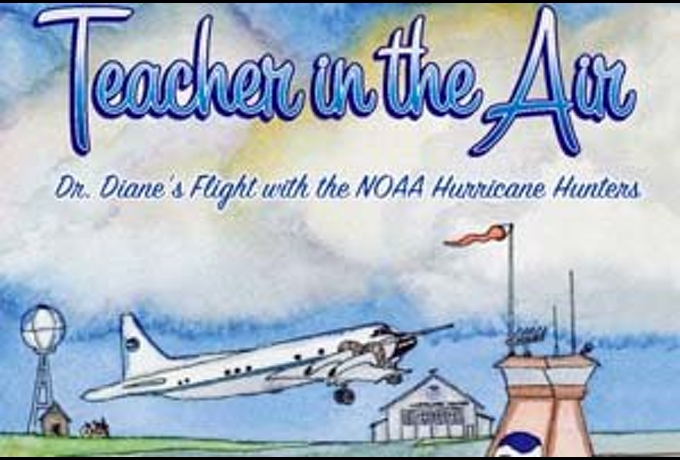
Diane Marie Stanitski and John J. Adler capture their work in a children’s book called “Teacher in the Air: Dr. Diane’s Flight with the NOAA Hurricane Hunters”.

teacher in the air bookStanitski, at least when the book was published in 2006, was a climatologist and associate professor at Shippensburg University in Pennsylvania. Adler at the time was a lieutenant commander in the NOAA Corps.

The book traces Stanitski’s flight aboard a tricked out plane whose purpose is to fly into hurricanes to gather data for scientists to study. The science involved in the book is geared toward middle school students. And that’s good because this can be an age where youngsters become enthralled with a subject matter that could become a career.

The books says, “Dr. Diane asked the scientists when they first became interested in weather. Many started observing weather patterns in middle school and sharpening their math and science skills in high school. They never realized that a degree studying science would lead to a career involving the excitement of flying into the eye of a hurricane!”

It is a well-illustrated book by Bruce David Cowden. This is what makes the book more child-like.

While the words are not overly technical, the subject matter is not that of an ordinary kids’ book. Words in bold are defined in a glossary in the back. It’s one of those books that is fun and educational at the same time.


Pesticide linked to cancer has boomed in Calif.

By Rachael Bale, Reveal

Monsanto Co.’s Roundup has been having a bad couple of weeks. Last week, the World Health Organization declared that its active ingredient, glyphosate, and two other pesticides probably cause cancer in humans.

Another study out this week suggests glyphosate use also may contribute to antibiotic resistance, a mounting problem that’s begun to be compared to climate change.

Glyphosate is one of the most widely used pesticides in the world. Using our California pesticide database, we wanted to see where it is used, on which crops and just how much gets applied.

In California, glyphosate use for commercial agriculture has increased by nearly two-thirds over the past decade. About 20 percent of it went to almonds alone. It is most heavily applied in the Central Valley counties of Fresno and Kern.

While it’s popular in the United States, glyphosate is banned, or about to be banned, in several countries because of health risks that may range from infertility and birth defects to kidney disease. The WHO report now says it could cause non-Hodgkin lymphoma.

Malathion, WHO found, could cause non-Hodgkin lymphoma and prostate cancer. In California, malathion use has decreased by more than 40 percent from 2003 to 2012. Much of the malathion applied in California goes to strawberry and alfalfa crops.

Use of diazinon, the third pesticide newly identified as probably carcinogenic, has dropped 85 percent in California during the past decade. It’s used most heavily on lettuces. More than one-third of all diazinon applied in California was used in Monterey County. The WHO says there is some evidence diazinon could cause non-Hodgkin lymphoma and lung cancer.

The U.S. Environmental Protection Agency, which regulates pesticides, does not consider glyphosate, malathion or diazinon to be carcinogenic. In 1985, the EPA classified glyphosate as possibly causing cancer, but six years later, changed its designation after new studies suggested it does not cause cancer.

Malathion and diazinon are part of a class of pesticides known as organophosphates, which previously have been the source of health concerns because of what they can do to the brain and nervous system. They work by blocking an enzyme called acetylcholinesterase, which breaks down a certain neurotransmitter. When there isn’t enough acetylcholinesterase, the neurotransmitter builds up, causing nerve overstimulation. That causes pest insects to die, but in high enough doses, it can make humans really sick, too.

When your nervous system doesn’t work right, your muscles – including your heart and those involved with breathing – don’t work right either. Effects of organophosphate exposure range from eye and skin irritation to muscle twitching, trouble breathing and a fast heartbeat, to seizures and death. Some organophosphates, including malathion and diazinon, also are considered by some agencies to be endocrine disruptors – meaning they mess with humans’ hormones.

These new cancer designations are controversial, especially in the case of glyphosate. Some scientists, along with Monsanto, say the evidence that WHO cites appears thin. The Science Media Centre in London has a valuable roundup of scientists’ reactions to WHO’s announcement.

Another thing to keep in mind is the difference between hazard (pesticides can cause cancer) and risk (how likely a person is to get cancer from those pesticides).

“The IARC (World Health Organization’s International Agency for Research on Cancer) process is not a risk assessment. It determines the potential for a compound to cause cancer, but not the likelihood,” Alan Boobis, a biochemical pharmacology professor at Imperial College London, told the Science Media Centre.

That means the next step is more studies looking at the health of farmworkers and nearby residents who are exposed to these pesticides to determine if they are likely to cause cancer in real-world situations.