King Fire burn area being reforested
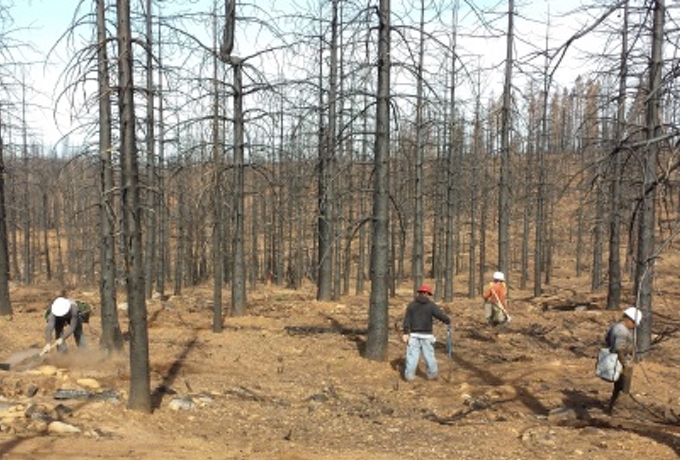
 Contractor crews from Sierra Nevada Forestry Service planting seedlings.  USFS photo by D. Walsh

Crews from Sierra Nevada Forestry Service planting seedlings. Photo/D. Walsh/USFS

Crews spent hours last week manually replanting 324 acres in Eldorado National Forest burned in the King Fire last fall.

The seedlings currently being planted will re-establish plantations in units that were previously planted after timber harvests in the early 1990s, as well as units planted after the 1986 Hale Fire, and other units that were planted as part of a soil study in 1992. These plantations all burned severely in the King Fire, leading to greater than 90 percent tree mortality. Replanting conifers during the first spring after a fire is advantageous because trees can get established before competing vegetation recaptures the site which increases the chances of seedling survival, according to U.S. Forest Service officials.

The young trees being planted are from a diverse stock of species native to the Sierra Nevada — ponderosa pine, sugar pine, and white fir.

The trees in the current plantation re-establishment project are being planted in low-density groups with wide spacing between the groups.

Up to 12,081 additional acres may be planted after the King Fire Restoration Environmental Impact Statement (EIS) is completed.  This hazard tree removal project will remove dead, dying, and other trees that present a hazardous condition to campgrounds damaged during the King Fire.


Marijuana operation busted up in Tahoe Keys

An indoor marijuana grow house in the Tahoe Keys was raided by officers last month, with processed and packaged pot with a street value of $76,500 confiscated.

Sgt. Joe Sherry with the California Highway Patrol on March 17 at 10:15pm saw a pickup on Emerald Drive in South Lake Tahoe illegally parked and partially blocking the road. He reportedly saw several people unloading what appeared to be a large quantity of marijuana from the vehicle into a residence.

Suspects ran into the residence, though Sherry was able to detain one person at the front door.

“The subject admitted to unloading marijuana from the vehicle into the residence and confirmed there was an indoor marijuana grow operation inside the residence,” officers said in a press release.

A search warrant uncovered what officers said was an elaborate filtration and hydroponic system along with a large number of live marijuana plants.

The CHP has not released the names of the suspects who were arrested.

— Lake Tahoe News staff report


Raley’s upping customer service for wine buyers

By Sonya Sorich, Sacramento Business Journal

As competition for local grocery shoppers’ attention increases, Raley’s Inc. is heightening its focus on wine.

So don’t be surprised if you soon see a wine steward in your local Raley’s store, ready to help you decide which adult beverage to serve at your big Saturday night dinner.

“It’s our job to make sure the customer comes in and doesn’t feel overwhelmed,” said Curtis Mann, a wine, beer and spirits buyer for the West Sacramento-based grocer.

The wine stewards are part of an effort that began about two years ago: a decision to transform 20 of the company’s approximately 120 locations into “wine shop stores,” according to Mann. Those 20 stores include Raley’s locations, as well as Bel Air Markets and Nob Hill Foods, which the grocer also operates.

Read the whole story


‘Slow Food Story’ to be shown in Tahoe City

To celebrate Earth Day, the Lake Tahoe chapter of Slow Food will host a screening of the documentary film “Slow Food Story” at Tahoe Art Haus & Cinema in Tahoe City.

The film traces the roots of the Slow Food movement from 1986 in Italy to the global revolution to think differently about food, its makers and sustainability.

The screening will feature refreshments including local kombucha from Folk Brewing on tap and heirloom variety popcorn grown in the Sacramento Valley.

The film will be shown April 22 at 7pm. Cost is $10. Tahoe Art Haus & Cinema is at 475 N. Lake Blvd., Tahoe City.


Drought may not hurt whitewater rafting season

By Tom Stienstra, San Francisco Chronicle

In the strange and continuing saga of California’s weather and water, the three best whitewater-rafting destinations — the South Fork American, Tuolumne and Middle Fork American — should have sensational conditions this summer in spite of the drought.

The rivers are not expected to be in crisis in spite of the record-low Sierra Nevada snowpack, 8 percent of the historical average and the lowest measured in 65 years of records.

The numbers show that Northern California’s winter was not so dry as it was warm. So warm that it rained more than snowed in the high country for most of the winter, although rainfall totals are still below average for most of the state.

Read the whole story


Snippets about Lake Tahoe

edc• El Dorado County Supervisor Brian Veerkamp will be representing the board at future Meyers meetings because Supervisor Sue Novasel has a conflict of interest based on property ownership. Veerkamp is also the alternate for Novasel on the Tahoe Regional Planning Agency Governing Board.

• The Douglas County Public Library in Minden will be honoring the contributions of its volunteers on April 16 from 2:30 to 4:30pm at the Minden Library.

• Caltrans is alerting motorists that Interstate 80 will be closed overnight in both directions in south Placer County as crews raise the Horseshoe Bar Road Overcrossing. Motorists can expect an eight-mile detour during the closure, scheduled to start at 11pm April 14 and ending at approximately 5am April 15. The interstate will close again from 11pm April 15 until about 5am April 16.

• The beach at Kings Beach made the list of top 10 Best U.S. Beaches for Families by Trip Advisor’s Family Vacation Critic.

• Truckee’s building counter is now a five-day a week operation from 7:30am-4pm.


Lake Tahoe clarity improves substantially

Drought is a good thing for Lake Tahoe’s clarity.

This was proved with today’s announcement that the largest gain in clarity in more than a decade occurred in 2014. A disc that looks like a white dinner plate could be seen to a depth of 77.8 feet, an increase of 7.5 feet.

The Secchi disk has been used for decades to measure lake clarity. It’s dropped over the side of a boat at various locations and then someone eyeballs how far they can clearly see it. The deepest point was 93.5 feet on July 7, and the lowest was 57.4 feet on Sept. 16.

Annual average clarity readings since 1997: • 2014: 77.8 feet  • 2013: 70.2 feet  • 2012: 75.3 feet  • 2011: 68.9 feet  • 2010: 64.4 feet  • 2009: 68.1 feet  • 2008: 69.6 feet  • 2007: 70.1 feet  • 2006: 67.7 feet  • 2005: 72.4 feet  • 2004: 73.6 feet  • 2003: 71 feet • 2002: 78 feet  • 2001: 73.6 feet  • 2000: 67.3 feet  • 1999: 69 feet  • 1998: 66.1 feet  • 1997: 64.1 feet  Source: TERC

Annual average clarity readings since 1997:
• 2014: 77.8 feet
• 2013: 70.2 feet
• 2012: 75.3 feet
• 2011: 68.9 feet
• 2010: 64.4 feet
• 2009: 68.1 feet
• 2008: 69.6 feet
• 2007: 70.1 feet
• 2006: 67.7 feet
• 2005: 72.4 feet
• 2004: 73.6 feet
• 2003: 71 feet
• 2002: 78 feet
• 2001: 73.6 feet
• 2000: 67.3 feet
• 1999: 69 feet
• 1998: 66.1 feet
• 1997: 64.1 feet
Source: TERC

“While these latest data are very reassuring, they should not be interpreted as victory in our joint restoration efforts,” Geoff Schladow, director of the UC Davis Tahoe Environmental Research Center, said in a statement. “Complete restoration is still decades away, and some of the greatest challenges still lie ahead of us. We are enduring drier and warmer conditions than we have ever encountered, and the restoration consequences of that are still far from understood.”

In light winters there is less runoff into the lake. This means less sediment to cloud the water. Warmer temps also means the lake water is mixing less; this also is good for clarity. (It also brings a whole different set of ecological issues.)

Researchers provided measurements for winter (December–March) and summer (June–September). Winter clarity last year improved by 1 foot. The winter average of 78.7 feet was well above the worst winter average, 66.6 feet seen in 1997. The largest improvement was seen in summer clarity, where there was a 13-foot improvement over the preceding year. At 78.7 feet this is the highest value since 2002.

Scientists are also giving credit for the improvement to the entities working to curtail sediments from reaching the lake. This is through the total maximum daily load and environmental improvement programs. More than $1 billion has been spent in the last decade on projects related to Lake Tahoe’s clarity.

In 1968, the disk could be seen to 102.4 feet. Efforts are under way to get back to that level, but it’s not expected to happen for more than a half century.

— Lake Tahoe News staff report


Low bidder says Calif. will overpay testing contractor

By Christopher Cadelago, Sacramento Bee

California education officials relied on three paper slips and a box to help determine who would win a nearly quarter-billion-dollar contract to overhaul the state’s system of testing students.

At a state Board of Education meeting last month, board President Michael Kirst drew each of the three firms’ names to decide the order in which they would present their case.

The apparent loser says it was anything but fair. Pearson School questions whether it was put through an elaborate charade designed to pick the state’s current testing vendor, Educational Testing Service. Pearson representatives want the job rebid and are threatening a lawsuit.

In the world of lucrative government contracts, the effort to design and build a system for more than 3 million students a year could have far-reaching implications. The new assessments are considered a cornerstone of the state’s education system, helping improve classroom instruction and marking progress in English and mathematics for kindergarten through 12th grade. Given the innovative approaches being considered, experts said the winning bidder would be in position to parlay the agreement to provide tests to other states.

Read the whole story


Bill would require warrant for digital files

By Katie Orr, Capital Public Radio

Law enforcement officers need a warrant if they want to search your house. A bill in the California Legislature would require they also get one to search your email.

The bill is sponsored by the ACLU of Northern California. It would require that law enforcement agencies obtain a warrant to search digital files, such as emails or documents saved on a “cloud” server.

ACLU attorney Chris Conley says the state’s privacy laws must be updated to reflect modern times.

Read the whole story


Healthy strategies key to dealing with stress

By Kathryn Reed

Getting rid of stress might not be possible, but how one deals with it can lead to a healthier outcome.

Money, work, health and relationships are the top stressors for people in the United States.

Identifying the stressors is the first step to being able to get rid of them.

Sonia Rupp with Barton Psychiatry last week shared ideas about how to cope with stress. Nearly 70 people gathered at Lake Tahoe Community College to hear the talk.

One of the problems is people often choose ways to cope with the stress that compound the problem. It could be chilling in front of the TV, overeating or choosing unhealthy food, or drinking alcohol.

Rupp said a drink at the end of the day to take the edge off is probably one of the worst things someone can do. This is because alcohol is a depressant. The booze also can lead to a poor night’s sleep.

“More and more women are using alcohol as an unhealthy strategy,” Rupp said.

Lack of sleep comes with its own set of issues, which can exacerbate the stress.

Bed is not the place to be reading, watching TV or working on a computer. Sleep and intimacy, Rupp said, are the only activities that should occur in bed.

Being active, getting quality sleep and not drinking are the better ways to handle the stress.

“When you can’t control the stress, it’s important to have healthy coping habits,” Rupp said.

She suggested taking a few minutes every day to breathe. It doesn’t have to be full-on meditation, but just enough time to let the brain turn off and not have the worrisome thoughts be all consuming.

Rupp also suggested mental exercises to divert attention to something other than what is causing the stress. Creative outlets are also encouraged, especially because they tend to provide a sense of accomplishment.