Nev. anti-bullying bill passes 1st hurdle

By Associated Press

CARSON CITY — A Senate committee has passed a bill backed by Gov. Brian Sandoval that would implement a broad anti-bullying program throughout Nevada’s school system.

Lawmakers voted 6-1 on Tuesday to pass SB504, which would create an Office for a Safe and Respectful Learning Environment within the Nevada Department of Education. Republican Sen. Don Gustavson opposed it.

Sandoval has proposed allocating $36 million over the next two years to hire one school social worker for every 250 students. SB504 deals with the policy portion of the plan, while the funding portion will be considered separately in a money committee.

SB504 would strengthen reporting requirements for bullying incidents, and create a 24-hour hotline and a website for submitting complaints.

Parents of bullying victims gave tearful testimony last week in support of the bill.


Heller talks veterans issues at Legislature

By Sean Whaley, Las Vegas Review-Journal

CARSON CITY — Sen. Dean Heller, R-Nev., said Monday that wait times for Nevada veterans who have filed benefit claims with the Veterans Administration have improved significantly but remain one of the longest in the nation.

Heller, in remarks to the Nevada Legislature, said the wait time has improved from 478 days to 257 days but is still far from the 125 days that the VA has promised.

“It’s unacceptable and until the backlog is eliminated, I won’t back down,” he said.

Read the whole story


Casino exec: Gaming will keep evolving

By J.D. Morris, Las Vegas Sun

When former Las Vegas Mayor Jan Jones Blackhurst began working at Caesars Entertainment about 15 years ago, it was a very different company.

Then known as Harrah’s Entertainment, the company had just moved its headquarters from Tennessee to Las Vegas, so it was, in many ways, the new kid on the block. Since then, Jones Blackhurst has seen Caesars expand dramatically. It’s now a corporate giant on the Strip and in the broader global casino industry.

As executive vice president of communications, government relations and corporate responsibility, Jones Blackhurst is responsible for growing the company’s corporate philanthropy work. Her achievements recently earned her a 2015 Corporate Social Responsibility Professional of the Year award from PR News.

Jones Blackhurst recently spoke about Caesars’ corporate social responsibility and other gaming industry issues, including the bankruptcy restructuring of Caesars’ largest operating division.

Read the whole story


Nev. driver’s licenses may be invalid for air travel

By Andrea Domanick, Las Vegas Sun

If you renew your Nevada driver’s license by mail, beware: Soon, you won’t be able to use it to board an airplane.

As of November, only licenses renewed in person at the Department of Motor Vehicles are recognized for federal use. That means expired licenses renewed by mail can’t be used to access federal facilities, as of October won’t work at military facilities, and beginning in 2016, won’t be accepted to board commercial aircraft.

Why the change? In 2005, Congress passed the Real ID Act, a federal law designed to combat terrorism and identity theft by standardizing how state IDs are issued. The law set basic criteria for receiving a driver’s licence or identification card, such as which documents states may accept as proof of identity and residency.

Read the whole story


Snippets about Lake Tahoe

zctcUpdate April 9, 7:18pm:

• Zephyr Cove Tennis Club has revamped its website.

• Nevada has the fewest number of structurally deficient bridges of any state at 2 percent, according to the American Road and Transportation Builders Association.

• Louis Franklin has been hired as South Tahoe High School’s football coach and special education teacher.

• Base Camp Pizza in Heavenly Village is hosting its first Yappy Hour, with a portion of proceeds benefitting Animal Coalition of Tahoe. The April 8 fundraiser is from 5-8pm. Dogs are welcome on the patio, people without pets are welcome inside. ACT raises funds for a spay-neuter program and the Meyers animal shelter.


Road beat: Kia K900 is understated luxury

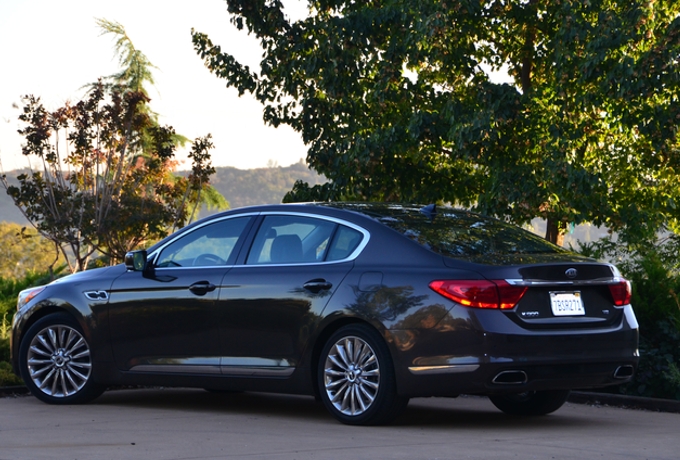
The Kia K900 is understated elegance. Photos/Larry Weitzman

The Kia K900 is elegance redefined. Photos/Larry Weitzman

By Larry Weitzman

Kia is now in the super luxury car business. First they blew us away with the Kia Cadenza, a near luxury/luxury car that the Road Beat was thoroughly impressed with. It had everything, ride, handling stellar performance, good fuel economy, superb quality and great looks. What was not to like? Now a year later Kia dropped another explosive car, the K900. Not much of a name, but oh, what a car.

As you know by now, Kia and Hyundai are effectively two brands owned by the same company so most everything is shared by respective models. It saves money for both. But unlike other manufactures, the exterior and interiors have no sharing. Sharing is in the chassis and powertrains. So while the K900 has mechanical similarities to the ultra luxury vehicle marketed under the name Hyundai Equus, they don’t look alike and have completely different identities.
Specifications Price $60,400 to $66,400 Engine 5.0L, DOHC, 32 Valve V-8 420 hp @6,400 rpm   376 lb.-ft. of torque @ 5,000 rpm Transmission 8 speed automatic Configuration Longitudinal front engine/rear wheel drive Dimensions Wheelbase 119.9 inches Length 200.6 inches Width 74.8 inches Height 58.7 inches Track (f/r) 63.8/64.1 inches Weight 4,555 pounds Fuel capacity 19.8 gallons Trunk capacity 15.9 gallons Steering lock to lock 2.96 turns Cabin volume 110.8 cubic feet Wheels 19X9 inch alloys Tires (f/r) 245/45/275/40 Performance  0-60 mph 5.32 seconds 50-70 mph 2.81 seconds 50-70 mph uphill 3.56 seconds Top speed Does anyone really care? Fuel economy EPA rated 15/23/18 mpg city/highway/combined. Expect 18-19 mpg in suburban, rural driving; 29 mpg on a level highway at 70 mph.

Specifications
Price $60,400 to $66,400
Engine 5.0L, DOHC, 32 Valve V-8 420 hp @6,400 rpm
376 lb.-ft. of torque @ 5,000 rpm
Transmission
8 speed automatic
Configuration
Longitudinal front engine/rear wheel drive
Dimensions
Wheelbase 119.9 inches
Length 200.6 inches
Width 74.8 inches
Height 58.7 inches
Track (f/r) 63.8/64.1 inches
Weight 4,555 pounds
Fuel capacity 19.8 gallons
Trunk capacity 15.9 gallons
Steering lock to lock 2.96 turns
Cabin volume 110.8 cubic feet
Wheels 19X9 inch alloys
Tires (f/r) 245/45/275/40
Performance
0-60 mph 5.32 seconds
50-70 mph 2.81 seconds
50-70 mph uphill 3.56 seconds
Top speed Does anyone really care?
Fuel economy EPA rated 15/23/18 mpg city/highway/combined. Expect 18-19 mpg in suburban, rural driving; 29 mpg on a level highway at 70 mph.

K900 has a cleaner look, with no swoops or extraneous lines. The front end is simple and clean with a wide mouth grille with an interior surround that has Kia’s trademark slight indentations. But what makes the K900 special are the super trick LED headlights. Well done, Kia. The understated and elegant body is pulled taught from the rear creating a muscular surface tension. In addition you can see the striking resemblance between the K900 and the Cadenza.

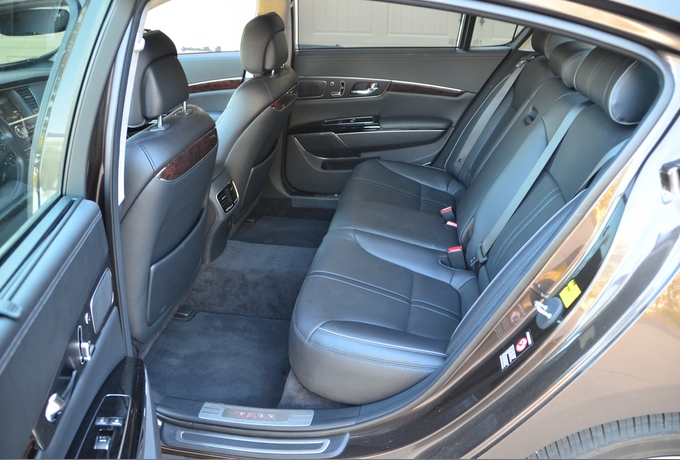
It is a large car with a 120-inch wheelbase and a length of 200.6 inches. While it looks low, K900 isn’t with a height of 59 inches. But width is a bit narrow at 75 inches making handling in tight places a bit easier. Interior dimensions are huge with nearly 111 cubic feet of cabin volume plus a 16 cubic foot trunk. Limousine proportions abound in the rear seating area.

K900 is so smooth and quiet the entire car feels like its two tons of creamy butter. And that goes for the entire vehicle, mechanicals and interior appointments. You need to experience this ride; it is special, very special.

Under the hood is a silky DOHC, 32 valve V-8 that cranks out 420 of the quietest and smoothest horses ever encountered by this cowboy (and I have had more than a few) at 6,400 rpm accompanied by 376 pounds of twist at 5,000 rpm, meaning this engine is making about 358 hp at that engine speed. The power is transferred to the rear wheels via a baby-butt smooth 8-speed automatic tranny, a tranny that sometimes seems slow to respond. Of course the systems have every piece of electronic wizardry available to mankind such as traction control, an Advanced Vehicle Safety Management system and probably the ability of direct communication with the International Space Station.

Performance is absolutely world-class with an average 0-60 mph elapsed time of 5.32 seconds. The acceleration seems to increase with speed. Catch the right gear at the right time; it almost gets scary quick. And it does it with an uncanny quiet and smoothness. Passing performance is equally exhilarating with 50-70 mph simulated passing times of 2.81 and up a 6 percent grade barely slowing that time to 3.56 seconds. The K900 rocks. Now here is the best part, the K900’s comparatively amazing fuel economy. EPA rates the K900 V-8 at a somewhat guilt ridden 15/23/18 mpg city/highway/combined. But during 400 miles of mostly suburban driving and only 40 miles of highway time, mostly driven for testing, the big K900 average between 18-19 mpg. The K900 averaged 24 mpg in a roundtrip from Placerville over the Sierra to South Lake Tahoe and back. On top of that in a two-way average the K900 averaged 29 mpg on a level highway at 70 mph. The engine spins a low 1,750 rpm at that speed. With its 20-gallon fuel tank, an easy 500 plus miles is doable nonstop.

Being a sophisticated, world-class automobile means a sophisticated world-class suspension that it has in the form of a refined MacPherson strut system upfront and a multilink system on the rear. It rides on 19 x 9 inch alloys with huge 245/45 series tires up front and superwide 275/40s in the rear. Track is also wide at 64 inches and steering is a reasonably quick 2.96 turns lock to lock. That should add up to fantastic handling, but it doesn’t and the reason is there is little feedback through the numb steering. That doesn’t mean the K900 doesn’t corner, it does. The cornering power with the wide track and big wheels and tires is tenacious, it just takes some attention and concentration to guide it when your speed is close to excessive and the road bends. Now we are talking here about racetrack like conditions, not normal driving where the K900 is an absolute pleasure to navigate.

Remember maneuvering in tight places? Well the K900 makes it easy with front and rear cameras, plus giving you a 360-degree vertical view of everything surrounding your car (Around view monitor) as you move. That system was a first for me and simply amazing. You should never bump into anything ever again.

By now you must think that the K900 rides beautifully and it does soaking up bumps like nobody’s business. And it does it in a very muted way. But it is not a floater; the ride is also very solid and controlled. The quiet of the K900 is deafening. There is no road, wind and engine noise, none. About the only time you get to hear it’s wonderful V-8 burble is at half throttle or more. Although it lets you know it’s there with a muted roar at full throttle.
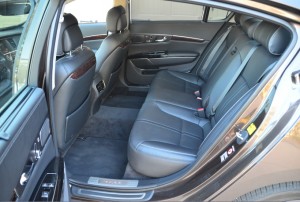
Plenty of room for passengers.

Plenty of room for passengers.

Braking is by four-wheel ventilated discs at all four corners and they are powerful stopping the big Kia in 42 feet from 40 mph. K900 has just about every conceivable system, TV screen display, and beeper warnings to attempt to keep you safe. It is a buffet of safety. Even the heads up display has a blind spot detection display and a lane departure warning system. The next thing will be a ballistic recovery system that will automatically deploy a parachute if you drive of a cliff or flotation devises beyond the multiple airbags if you took an inadvertent sea cruise. LED lighting is outstanding.

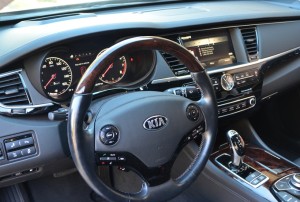
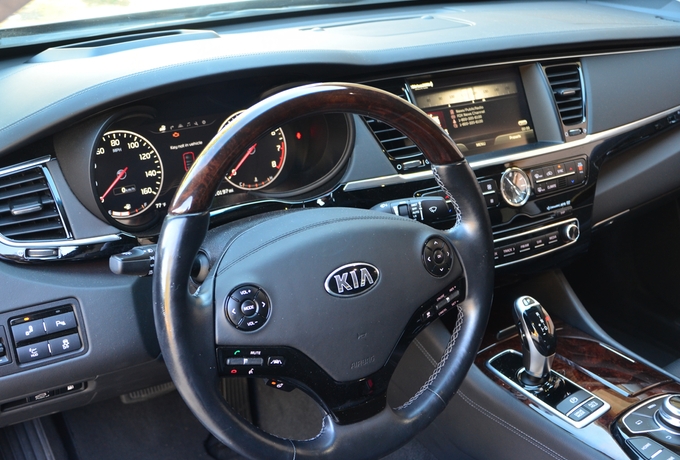
Soft Nappa leather covers the seats and most everything inside is soft touch materials. Rear seat leg room is about the most copious I have ever seen. Instrumentation is a complete TFT LCD cluster displaying an analog tach and speedo plus ancillary gauges and a trip computer. Good stuff. Kia claims 17 speakers for its Lexicon sound system. I often thought I was in a much nicer appointed Carnegie Hall.

Operating the basic sound system is fairly easy, but getting deeper into all its features does require some learning. It is a bit complex. Both seat controls are located conveniently on the doors. The trunk is a large 16 cubic feet and well shaped with the trunk hinges enclosed for protecting any cargo. The quality of the materials and fit and finish are second to none.

Pricing starts for the V-8 at $59,500 plus $900 for the boat from Korea. My tester had the $6,000 VIP package which contained the TFT instrument display, the Surround view monitor, head’s up display, Smart cruise control, Advanced Vehicle Safety Management System and some other items. Fancy carpeted embroidered floor mats are standard! Personally, I would go with the standard K900 without the VIP package. In value terms, K900 sets new standards. And a new 311 hp V-6 model is coming and will be thousands less.

Larry Weitzman has been into cars since he was 5 years old. At 8 he could recite from memory the hp of every car made in the U.S. He has put in thousands of laps on racetracks all over the Western United States.


Millennials changing the hotel market

By Hugo Martin, Los Angeles Times

At the latest breed of hotel, rooms are up to one-third smaller than traditional quarters, with furniture that looks fresh from an Ikea showroom.

The work desk is downsized and might double as a nightstand. The Internet speed is super fast. The Wi-Fi is free. Power outlets and USB ports dot the walls, especially near the bed to accommodate binge watching.

The target is the millennial traveler, ages 18 to 34, who likes to stay connected online, eat on the run and commune with other millennials.

Hotel giants, including Marriott International and Hilton Worldwide, are launching brands with names such as Moxy, AC, Edition, CitizenM and Canopy. Even billionaire Sir Richard Branson has a new millennial-oriented chain, dubbed Virgin Hotels.

Read the whole story


Opinion: Keeping tabs on local elected officials not easy

By Joe Mathews, Zocalo

Did we win in Bell?

Thinking LA-logo-smallerThere is no greater symbol of local California corruption than Bell, a city of 35,000 people, 2 1/2 square miles, and many gas stations in southeast L.A. County. For years, Bell City Manager Robert Rizzo and his minions exploited every dark corner of California’s convoluted systems of local governance and finance. They paid each other scandalously high salaries (Rizzo’s package of wages and benefits was worth $1.5 million annually), used the city’s redevelopment agency like a piggybank, borrowed improperly, squirreled away money in illegal retirement accounts, purchased property off the books, approved illegal fees and taxes, and used a sham charter election to exempt themselves from state laws.

Joe Mathews

Joe Mathews

Today, five years after this malfeasance was exposed, a new narrative of Bell has emerged. That narrative is one of triumph, best exemplified by a conference on the corruption scandal organized by Chapman University last month. The tale’s heroes were all assembled: journalists who broke the story, a police whistleblower, citizens who challenged corrupt officials, prosecutors who won convictions of those officials, and state officials who put through new laws in response. They were joined by the administrators and lawyers who painstakingly put the city of Bell back together. Among their many successes is a $22 million reserve in the city’s coffers.

All this should be cause for celebration. The Bell case—and the response to it—provided a new roadmap for how California communities can respond after they are victimized by city hall. Future municipal corruption cleanup crews will have new laws and two new state appeals courts rulings to aid them in removing and obtaining restitution from corrupt officials.

ut when it comes to the question of prevention—of how to make sure that California doesn’t see more Bells—there is less reason to party. That’s because Californians have failed to learn the central lesson of our long history of municipal corruption: The new rules that are a response to such scandals often enable future scandals.

To put it another way: The sense of triumph we feel after getting past a scandal is part of our problem.

Bell, while spectacular in its particulars, is really part of a larger wave of never-ending local corruption cases that goes back 50 years. Back in the 1950s and 1960s, county tax assessors from San Francisco to San Diego put their discretion up for sale—offering businesses lower property tax assessments in exchange for power, cash, and votes.

The predictable response was to limit the discretion of local officials over property—first with state laws, and later with Proposition 13, which effectively took away the power of local officials to set tax rates. This set the pattern for responding to local California scandals. When cities or school districts find some way to cheat, the state puts new limits on their discretion. This limits the power of local communities and their appointed leaders. But it hasn’t stopped scandals.

Why not? Because the weight of all these new limits on the locals has made community governance in California incredibly complex. So complex that it’s nearly impossible for citizens to understand what local representatives are up to—and thus provide a check on their actions. In fact, it’s so hard for local elected officials to understand their own actions that most cities must hire expensive administrators and consultants to navigate through the sea of rules.

Effectively, all these limits have left local governments with two options if they want to obtain revenues and improve their communities. The first is to beg the state for money; this has been such a popular option that local governments represent by far the biggest lobby in Sacramento.

The second option is to cheat. Or, to put it less judgmentally: to peer into the dark corners of the complicated system and invent new ways to get around the rules to govern and raise revenues. It’s worth remembering that while the Bell officials were corrupt and flouted laws, they didn’t steal and they didn’t embezzle, at least not in the traditional sense. They were just unusually brazen in exploiting the dark corners of California municipal finance.

So to truly reform local governance, Californians must first recognize a paradox: Preventing local officials from behaving like those in Bell requires giving more discretion and freedom to local officials.

Instead of using limits and restrictions to force city officials into dark corners, let’s lift limits and give officials more discretion to operate more easily in the daylight. The best, most direct reform would be to give California’s local governments more power to raise taxes and other revenues themselves.

The power of taxation is itself a tool of accountability. When cities can tax, the citizens and businesspeople who might see their taxes raised have a strong incentive to watch what’s happening in city hall. And when taxpayers are watching, it’s much more difficult to give your city manager an $800,000 salary.

If local control means anything, it means letting local elected leaders make their own choices about how much revenue they must raise to meet their local needs. But for 50 years, California leaders and voters have moved in the very opposite direction.
Doug Willmore, the city manager who is now leaving Bell after having dug it out of its hole, noted in his presentation at the Chapman conference that the city’s finances remain very complex. Revenues and expenditures are accounted for in 36 different funds. The city’s chief objective must be “normalizing” finances, his presentation said.

But California’s rule-heavy system doesn’t allow for normal. And so here’s the bad news about the good news in Bell: The city’s recovery may delay our reckoning with our own role in municipal scandals.

Until we understand the paradox of Bell, there will be more Bells.

Joe Mathews is California and innovation editor of Zócalo Public Square.


Calif. sets water use targets amid record low savings

By Fenit Nirappil, AP

SACRAMENTO — California cities face mandatory targets to slash water use as much as 35 percent while regulators warn voluntary conservation hasn’t been enough in the face of a devastating drought.

Underlining their point was data released Tuesday showing a new low in saving water. Residents did less to curtail water use in February than any other month since officials started tracking conservation.

Along the south coast, home to more than a third of Californians from San Diego to Los Angeles, residents actually showed an increase in water consumption despite longstanding calls for cutbacks.

“These are sobering statistics and disheartening statistics,” said Felicia Marcus, chairwoman of the state Water Resources Control Board.

Overall, the numbers indicate that statewide water use fell by less than 3 percent in February as compared to baseline data established in 2013, the last year before Gov. Jerry Brown declared a drought emergency.

The figures mirrored preliminary reports that helped spur Brown last week to demand that urban water users statewide cut back their consumption by 25 percent.

To meet that goal, the water board on Tuesday released draft water reduction targets for more than 400 water agencies ranging from 10 to 35 percent. The targets are set based on per-capita water use.

Some cities must drastically improve water savings. San Diego and Los Angeles must cut water use by 20 percent after cutting only 2 percent and 7 percent since June.

Others such as Santa Cruz, which cut its water use by a quarter, are likely to easily meet smaller targets.

State officials say they’re prepared to slap large fines on agencies that don’t take steps to conserve or meet reduction targets, although they haven’t used similar powers earlier in the drought.

The newly released water use data show the difficulties of changing longstanding habits, such as watering lawns, washing cars and taking long showers, board members said at the Tuesday meeting. Also, they noted, that water use in February 2013 was already low because the weather was cooler that year.

Still, the governor should be able to use the figures to his advantage. His call for a mandatory 25 percent cutback goes beyond his request asking residents to voluntarily reduce their use by 20 percent when he declared the drought emergency in January 2014. Statewide conservation has been about 9 percent since then.

The board credited some already water-conscious communities, including Stockton, Santa Cruz and Mountain View, for slashing use in February.

Places such as Newport Beach expected to make drastic improvements. Water use must plummet by 35 percent in the wealthy beach town during the same months consumption fell only 7 percent.

Newport Beach has reduced lawn watering to four times a week, which is twice as often as state recommendations allow, and it prohibits residents from refilling their pools more than 1 foot a week.

Since July, Newport Beach residents used about 120 gallons a day, compared to about 100 for others who live along the southern coastline.

Newport Beach officials have spent months informing residents about new regulations and ways to cut back, and they’re now seeking new authority to issue fines.

“We liked the friendly approach, and it seems to be working well, but we aren’t afraid to issue citations,” said George Murdoch, the city’s utilities general manager.

The water board has given local water departments discretion to come up with their own conservation rules, but it has established some statewide regulations, such as banning lawn watering 48 hours after rain and prohibiting restaurants from serving water unless customers ask.

The agency also plans to have municipalities penalize overconsumption through billing rates.

Water use along the coast is expected to increase this summer as tourists and seasonal residents flock to beach homes.

Meanwhile, some water agencies are working on more drastic actions of their own. Southern California’s giant Metropolitan Water District will vote next week on a plan to ration water deliveries to the 26 agencies and cities it supplies, according to spokesman Bob Muir.

The cuts, which would take effect July 1, were proposed before the governor imposed the mandatory restrictions and are expected to drive agencies to curb demand and help meet the conservation goals.


SLT council solidifies vacation rental rules

By Kathryn Reed

Vacation rentals are a $20 million business in South Lake Tahoe – and then some.

That’s just how much is collected each year by property managers. It’s a big business that was brought to light at Tuesday’s South Lake Tahoe City Council meeting. People and entities are profiting greatly from this somewhat controversial industry.

The city collects a 10 percent hotel tax on those properties. That amounts to $2 million a year.

Some property managers – the middlemen between owners and renters – take 40 percent off the top.

House cleaners, repair people, hot tub cleaners and others are ancillary businesses benefiting from the vacation home rental (VHR) market. Then there are the businesses and employees in and around the neighborhoods that provide services and goods to the tourists.

This economic pyramid was brought to light April 7 during the course of the several-hour discussion about how the VHR ordinance should or should not be changed.

On the flip side were those who are furious about having residential areas being turned into lodging rows, where it’s not about having neighbors, but instead being party central every weekend. It’s about having strangers populate the street on a regular basis.

Some wondered why permitted lodging establishments must meet Americans with Disabilities Act requirements and other laws, while VHR properties don’t.

An unknown is whether the proliferation of VHRs is contributing to the low occupancy rate at hotels in the city.

In all, 30 people spoke at the meeting. The city received 57 letters. The room was packed, with about another two dozen in the lobby watching the proceedings on television. (Councilman Tom Davis was outside the chambers because he is not allowed to participate because of his ownership in Tahoe Keys Resort.)

Enforcement of the rules already on the books was a constant refrain. Property managers were quick to point to the 162 complaints the city received from the 22,000 rentals — saying that is minuscule. What the industry doesn’t disclose is how many complaints are made to them that the city – aka public – never knows about.

At the end of the day, the council agreed:

• To have future VHR permit applicants follow a process similar to getting a special use permit, which will include notifying neighbors of the desire to use the structure as a vacation rental. Exact details will be brought back to the council this spring.

• Occupancy should be limited to two people in a studio, four in a one-room, then two per bedroom plus four others for two-bedroom and larger places.

• To have two ordinances – one dealing with rentals in neighborhoods, one for those in tourist areas that would include places like Marriott and Lakeland Village. This is because the commercial areas have different rules already for things like trash, and health and safety regs.

• No noise is permitted after 10pm.

• Trash mandates would be deferred to the Waste Management JPA, which expects to have rules in place for its three jurisdictions – South Lake Tahoe, El Dorado and Douglas counties – in the coming months.

• To not deal with individual room rentals in a residence.

• Renters and owners who violate the ordinance will face fines, with the fourth infraction in a 12-month period resulting in revocation of the VHR permit.

• To hire people to make the program work — including more and better enforcement.