Opinion: Should California become Florida?

By Joe Mathews

Florida Gov. Rick Scott travels to California this weekend to steal away some of our state’s businesses. So why don’t we return the favor by developing plans to steal away some of Florida’s greatest assets — old people?

Californians like to think of this state as a place of endless youth and growing diversity. But the biggest transformation in California is the breathtaking speed with which our population is aging. Instead of measuring ourselves against oil-rich Texas or Wall Street-dependent New York, we should focus on Florida as our competitor.
Joe Mathews

Joe Mathews

While Californians 65 years or older represent just 12 percent of the state’s population today (a figure slightly below the national average and well below Florida’s rate of 19 percent), the number of 65-plus seniors is projected to nearly double, representing 20 percent of the population by 2030. That rate of growth is roughly the equivalent of adding one new Rossmoor — the massive senior community in Walnut Creek — twice a month for the next 15 years.

And even that may not be enough geezers to meet our needs. Other sources of new Californians are drying up — immigration is flat, the birth rate has dropped, and high costs of living are pushing young families out of state. Our state’s budget system relentlessly forces cuts at our universities and older voters dominate our politics — both preclude big investments to attract more young people. So if California wants to grow, and find new buyers for our homes and new shoppers for our retail, our best option may be to convince more people to spend their golden years in the Golden State.

U.S. economic surveys show that the fastest-growing American regions are the most successful in attracting retirees. Yet California has built very little of the senior-oriented infrastructure that makes Florida a magnet for the old. Instead, we’ve treated seniors like cost centers (because of their high health costs) and spent the last generation cutting back services they need — from health and housing to culture and transportation. Too many California communities are chasing the same young, creative people with the same bike paths and downtown lofts — even though the young are declining as a share of the state’s population. It’s telling of our myopia about the old that the biggest California debate involving seniors right now is about how to make it easier for them to end their lives when they’re terminally ill.

State Sen. Carol Liu, one of the few state leaders focused on aging in California, contrasts the avalanche of attention she received for a bill requiring helmets for adult bicycle riders to the silence that greeted a recent comprehensive report from her select legislative committee on aging. But that report is worth reading. In more than 200 pages, it recounts California’s collective failure to plan properly for old age — long-term care programs scattered across six departments, an alarming lack of data and standards — and makes 30 recommendations, including the appointment of an aging czar.

California may never be able to compete with Florida on income taxes (ours are high, theirs are non-existent), but our climate is more comfortable, and, as anyone who has visited the Coachella Valley knows, we have lots of things to offer seniors. (Maybe some Californian could pitch Gov. Scott, who will be termed out of office in Florida shortly after his 66 birthday in 2018, on buying in La Quinta.)

Given the expense of living in coastal California, it would make sense to focus senior recruiting efforts on lower-cost communities inland. UCLA Anderson School economist Jerry Nickelsburg has argued that the Central Valley would have much to gain by focusing on seniors. That would require governments and private companies to build improved health care facilities and train more people to work in professions serving seniors. The good news is that those are low-risk investments that would raise education levels and produce badly needed jobs.

Liu’s report notes that California’s seniors will be highly diverse. And therein lies more opportunity. According to the United Nations, the worldwide population of older persons — age 60 or over — is expected to more than double to 2 billion by 2050. If California can develop senior infrastructure that can serve people of many cultures and languages, California could pitch itself as a global destination for retirees.

Go West, old man.

Joe Mathews is California and innovation editor for Zócalo Public Square, for which he writes the Connecting California column.


Nev. bill limits students to bathrooms based on biological sex

By Associated Press

CARSON CITY — Transgender activists and progressive groups say they’re appalled with a proposed Nevada law forcing students to use bathrooms corresponding to their biological sex.

Republican Assemblywoman Vicki Dooling is sponsoring AB375, which was discussed Friday in the Assembly Judiciary Committee.

The bill would require students in public schools to use locker rooms and restrooms based on their sex at birth. Dooling said schools would need to provide separate facilities for transgender students and the bill would extend student privacy protections.

Transgender students and activists testified against the bill and said it would lead to more discrimination and bullying against transgender students who tend to face higher rates of suicide and discrimination.

The committee took no immediate action on the measure. The bill would need a committee vote on Friday to survive.


Poets to read at LTCC

National Poetry Month is being celebrated at Lake Tahoe Community College with two Nevada poets on April 21 at 7pm in the Roberta L. Mason Library.

Reno’s Poet Laureate, Gailmarie Pahmeier, and poet and teacher Shaun T. Griffin will read selections from their works, answer audience questions, and sign copies of their books, which will be available for sale.

Pahmeier, Reno’s first poet laureate, has been a Nevadan for more 30 years. She teaches creative writing and contemporary literature courses at the UNR, where she was honored with the Alan Bible Teaching Excellence Award and the University Distinguished Teacher Award.

Griffin is the co-founder and director of Community Chest, a rural social justice agency serving children and families in northwestern Nevada since 1991. For more than 20 years he has taught a poetry workshop at Northern Nevada Correctional Center and publishes a journal of their work.

The event is free.


Calif. voters may decide pot legalization in ’16

By Philip Ross, International Business Times

Marijuana legalization is once again lighting up California politics. The country’s largest state, along with Arizona and Nevada, has a ballot measure in the works to get legal weed before voters next November.

Advocates of legalization in California say if they can get marijuana to the polls in 2016, a presidential election year that will bring more out more young voters, it’ll pass with flying colors.

When retail marijuana went before California residents in 2010, 54 percent voted against it. Political analysts say that public opinion on pot has since shifted.

“I see a parallel — not a perfect parallel, but a parallel — with marriage equality,” Ben Tulchin, a pollster in San Francisco, told the San Francisco Chronicle Wednesday. “The first battle you may lose, like in California, but you start a conversation and get the dialogue going. … And you eventually see a very big shift.”

Read the whole story


EDC Fair taking submissions

Bacon biscuits? Beach Ball Art? Selfies? These are just a tiny sampling of the ways you can quench your creativity and have some fun entering the El Dorado County Fair’s many competitions.

The theme of the June 18-21 fair is Hog Days of Summer.

This year’s entry guide is available online. Entry forms are due May 20.

For more information, entry forms and pre-sale tickets, go online.


Workshops to focus on transportation in Tahoe

There will be two meetings next week about the Active Transportation Plan being created for the Lake Tahoe Basin.

The first is April 14 from 5:30-7:30pm at the South Lake Tahoe Library, 1000 Rufus Allen Blvd. The second workshop is April 16 from 5:30-7:30pm at Kings Beach Elementary School.

Spanish interpreters will be on hand, child care provided and free food.

There will be four stations that include drawing routes on maps, identifying intersection improvement locations, taking a survey, and choosing top priorities for goals and infrastructure types for biking and walking in Lake Tahoe. Short presentation will be given at 5:30pm and again at 6:30pm if desired.

Also, a community survey may be accessed online. The survey is open until June 30.


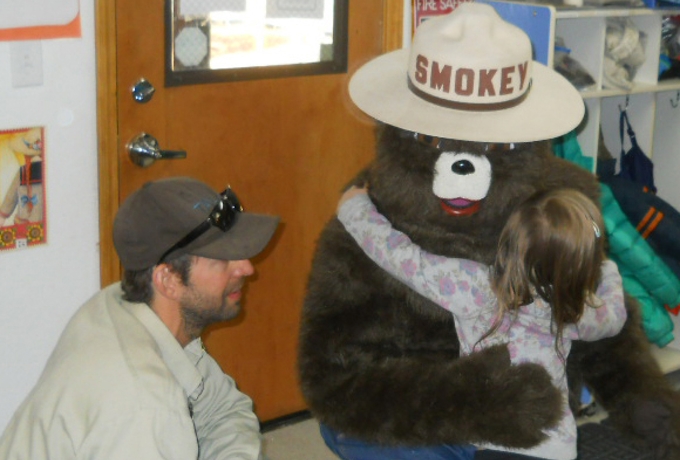
Smokey Bear warning kids about illegal fires

Photo/Dave Marion/U.S. Forest Service.

Photo/Dave Marion/U.S. Forest Service.

Smokey Bear and U.S. Forest Service crew members visited Jubilee Kids’ Academy in South Lake Tahoe on April 9  to teach preschool kids about campfire safety.

Illegal and unattended campfires cause more than 90 percent of wildfires in the Lake Tahoe Basin. The Forest Service asks the public to be mindful of the current fire danger and help prevent human-caused wildfires by not building illegal campfires.

— U.S. Forest Service


I-580, Hwy. 50 connector to be done in 2017

By Anne Knowles

CARSON CITY— The Carson City Freeway project to connect Interstate 580 to Highway 50, creating a nearly seamless drive from Reno-Tahoe International Airport to the South Shore, is entering its final phase this summer.

The Nevada Department of Transportation is expected to award the contract to Road and Highway Builders, the Spark-based company that submitted the low bid of $42 million, at NDOT’s May 11 board meeting.

“We have the federal funds now so you can expect to see the award in two to three weeks and then see equipment here in two to three months,” said Reid Kaiser, NDOT’s assistant director of operations, at an April 9 event here dubbed Stand Up 4 Transportation.

It was designed to draw attention to the need for long-term federal financing of transportation. Current federal transportation funding ends next month.

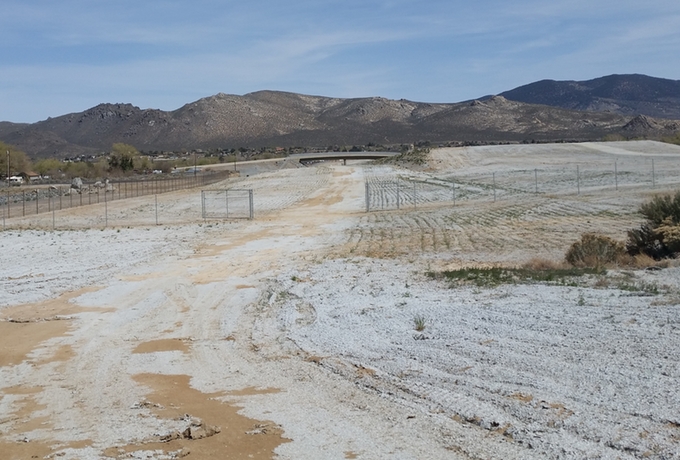
The freeway project will pave the final four or so miles between Fairview Drive in Carson City, where I-580 currently ends, to Highway 50 where it intersects with Highway 395 at Spooner junction.

The project is scheduled to be completed in 2017.

The project will pave a 4-mile connection between Interstate 580, which currently ends at Fairview Drive in Carson City, and U.S. 50 at Spooner junction.

The project will connect Interstate 580, which currently ends at Fairview Drive in Carson City, and Highway 50 at Spooner junction. Photo/Anne Knowles

“Accessibility is an important aspect to our tourist economy,” Carl Hasty, district manager of Tahoe Transportation District, told Lake Tahoe News. “South Shore accessibility is important.”

Hasty said he didn’t have data on how the extension would reduce travel time between the Reno airport and South Lake Tahoe. “But (580) saves me 10 to 15 minutes now and I anticipate the same savings,” with the new Highway 50 connection, Hasty said.

Hasty also didn’t know if the convenience would encourage more visitors to travel to the South Shore rather than up Mt. Rose Highway or Interstate 80 to the North Shore of Lake Tahoe.

“I think it’s up to South Tahoe to redevelop itself or keep losing to the north, with what’s being done in Alpine Meadows, Squaw, Northstar, Truckee,” to attract travelers, Hasty said.

The Carson City Freeway was initially planned to be an interchange with a bridge that would allow drivers to connect to Highway 50 by driving over Highway 395 without stopping. But that was deemed too costly and the connection now is an at-grade intersection and the traffic light there will be turned into a four-way light.

NDOT, however, says the project is engineered so that a bridge elevating the traffic can be added later if funding becomes available. At the transportation event Thursday, officials from NDOT, TTD, Carson City Regional Transportation Commission and Regional Transportation Commission of Washoe County said the region was facing a serious drop in transportation funding if Congress doesn’t act to pass long-term legislation.

The Nevada counties’ portion of the Lake Tahoe area, according to NDOT, has an estimated need of $708 million in transportation funding through 2035. Current revenue to fund that is estimated to be $116 million, leaving a possible shortfall of $592 million. The projects within that budget include the Stateline to Stateline bikeway, Highway 50 South Shore community revitalization and the cross-lake ferry.


Snippets about Lake Tahoe

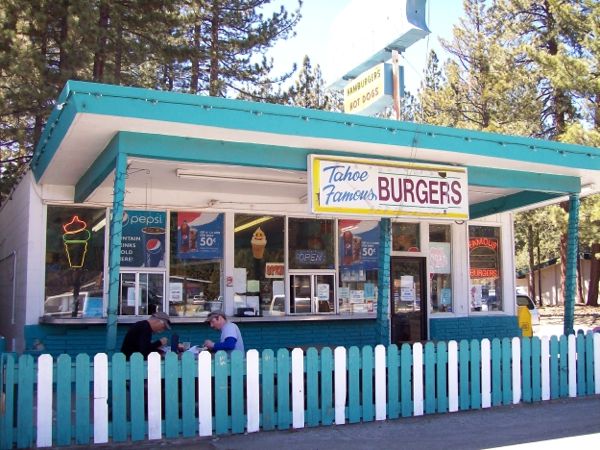
snoflake nu• Sno-Flake restaurant in South Lake Tahoe has new owners – Titiam and Raia Anning. They just moved to town.

•April 11 is  Bring Your Own Cup Day at 7-Eleven. Between 11am and 7pm any device that is clean, leak proof and fits into a 10-inch cut out will be filled to the brim for $1.49.

• Lake Tahoe made TripAdvisor’s list of top 10 cabin vacations you never thought of.

• Here is a letter the South Tahoe Chamber of Commerce sent to the El Dorado County Board of Supervisors regarding representation involving Meyers.

• South Lake Tahoe City Councilwoman JoAnn Conner stepped down from the Cal-Tahoe JPA and Councilman Tom Davis took her place.


Report: Burning Man population slightly richer than before

By Jenny Kane, Reno Gazette-Journal 

Burners have a little more change in their dusty pockets than they used to.

Burners of 2014 were about $5,000 wealthier per Burner than those of 2013, according to the Black Rock City census released Friday. Fewer of the Burners were first-timers, as well.

The Black Rock City census is an annual report that sheds light on any shifts in the Burning Man demographic, whether it be their income, gender, race, sexuality or how they experience the Burn.

Since 2001, Burning Man has asked Burners to share information about themselves in order to help Burning Man assess how it is changing.

Read the whole story