The West can learn about forest fires from Fla.

By Kyle Dickman, Outside

Fire has always been a part of the landscape. The mistake we made was trying to stop it—something Florida never did.

Joe O’Brien, a research ecologist with the U.S. Forest Service, tucks his helmet into his chest, steals a breath of clean air, and steps closer to the fire now engulfing a $23,000 camera. Overhead, a drone that sounds like angry bees is darting in and out of the smoke column. A flock of nearby scientists are radioing to each other as they drag a boxy gadget on a pulley through dancing flames.

O’Brien is one of several dozen scientists who traveled from around the country to a half-acre plot of longleaf pine forest north of Tallahassee, Florida, for the privilege of burning it all. He and all the scientists here are trying to answer the complex and poorly understood question of how fire burns. If they succeed, they hope to set more of America ablaze.

Read the whole story


Are friendships giving you a boost or bringing you down?

By Tara Parker-Pope, New York Times

Are you spending time with the right people for your health and happiness?

While many of us focus primarily on diet and exercise to achieve better health, science suggests that our well-being also is influenced by the company we keep. Researchers have found that certain health behaviors appear to be contagious and that our social networks — in person and online — can influence obesity, anxiety and overall happiness. A recent report found that a person’s exercise routine was strongly influenced by his or her social network.

Read the whole story


Fire restrictions in the Tahoe National Forest

The Tahoe National Forest enacted fire restrictions on July 16 based on an analysis of current fuel conditions and weather observations. This analysis revealed the potential to support large fire growth across the Tahoe National Forest.

Tahoe National Forest Fire Restrictions are as follows:

·           No open fires, campfires, or charcoal fires are allowed on Tahoe National Forest lands outside of designated areas, even with a valid California Campfire Permit.

·           Lanterns and portable stoves using gas, jellied petroleum, or pressurized liquid fuel are allowed, unless otherwise restricted, with a valid California Campfire Permit.

·           No smoking, except within an enclosed vehicle, building, designated recreation site or while stopped in an area at least 3 feet in diameter that is barren or cleared of all flammable material.

·           Internal combustion engines are restricted to National Forest System roads, trails, and areas, as identified on the Tahoe National Forest Motor Vehicle Use Map (including the Prosser Pits Developed Off-Highway Vehicle Area). Motorized cross-country travel between roads, trails, and areas is prohibited.


Snippets about Lake Tahoe

·      The three-day American Century Championship that ended July 15 set an attendance record at 57,097. This is the fourth consecutive year for a record. Last year’s record was 55,801 people.

·      Here is the El Dorado-Tahoe roadwork schedule from Caltrans for the week.

·      The Tahoe Tattoo Show will be July 20-22 at Harrah’s Lake Tahoe. For more info, go online.

·      Friends of the West Shore is having community party/fundraiser on Aug. 16 at West Shore Pizza from 5-8pm. RSVP to jmtornese@aol.com


Road Beat: 2018 GS F best Lexus sedan

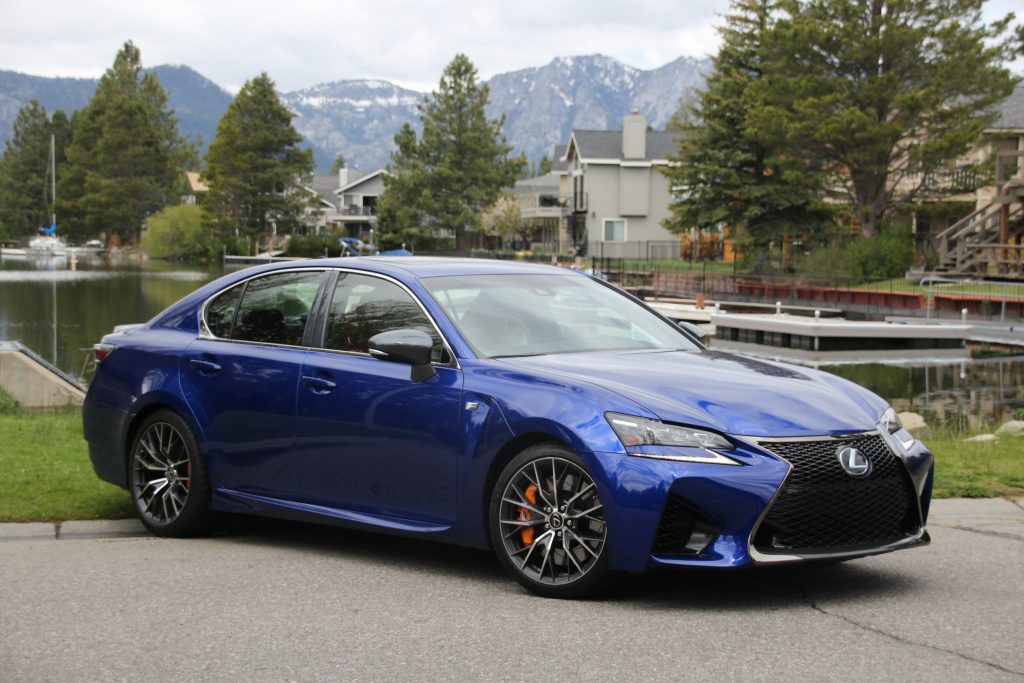
The 2018 Lexus GS F may be the best sports sedan ever. Photos/Larry Weitzman

By Larry Weitzman

Lexus has a reputation of producing exquisite cars, beautifully finished with highly polished road manners, never mind occupant comfort. While that is still quite true, Lexus has never had a super high-performance automobile, a car you could almost take to the track and compete with. Yeah, sure they had an SC400, a performance GT coupe, but it wasn’t a raucous, balls to the wall, pedal to the metal super sedan. That started to change with the introduction of the LFA super car, but the price was that of your first born ($375,000).

Then Lexus surprised us with the recently introduced LC500 super coupe. Yeah, it had four seats, but the rear seats were for the severely vertically challenge or perhaps members of the Cirque de Soleil. But it was the best car I had ever driven, period. And it stickered for a base of just over $90 large. Not only was it the best car I have ever driven, it was the best buy in a super car. Now Lexus has produced the best Super sedan I have ever driven — GS F. So good, that because of its ease of entry and exit, bigger size, true five-adult passenger capacity (I had a guy 6-foot-4 in the back seat that had at least half a foot of rear knee room), that I would rather drive the GS F. And it stickers for under $85 large. Let me explain.

To create the GS, Lexus took a regular GS body (perhaps its only weakness as the GS design while still quite attractive, isn’t my favorite as the roof shape is a bit tall and not well shaped) and installed the same 5.0L DOHC, 32 valve normally aspirated V-8 as found in the LC500. Knocking down 467 hp at a sky high 7,100 rpm and a peak twist of 389 pounds between 4,800 to 5,600 rpm. It makes sounds befitting a champion NASCAR. Nothing, and I repeat nothing has ever sounded better. It even comes with a switchable enhancement system called ASC (Active Sound Control) that enhances the melodious, sweet music this V-8 produces.

Performance is of super car, world class quality with an average 0-60 mph elapsed time of 4.18 seconds. With some further testing and improved technique 4.1 seconds would be the target as reflected by the F’s astounding passing times of 1.79 and 2.19 seconds respectively in 50-70 mph simulated passing runs on the level and up a 6-7 percent grade. The 1.79 second time is the best ever achieved by the Road Beat, besting the Lexus LC500 V-8 (which ran 0-60 mph in 3.91 seconds) level 50-70 mph run by a tenth of a second and tying its 50-70 mph run up a grade. Perhaps a four second flat 0-60 mph is possible? It is the quickest sedan ever tested by the Road Beat.

Specifications
Price $85,345 to about $90,000
Engine
5.0L DOHC, 32 valve normally aspirated V-8 467 hp @ 7,100 rpm
389 lb.-ft. of torque @ 4,800-5,600 rpm
Transmission
Eight-speed torque converter automatic
Configuration
Longitudinal front engine/rear wheel drive
Dimensions
Wheelbase 112.2 inches
Length 193.5 inches
Width 72.6 inches
Height 56.7 inches
Track (f/r) 61.2/61.4 inches
Ground clearance 5.1 inches
Fuel capacity 17.4 gallons
Trunk capacity 14.0 cubic feet
Passenger volume 90.8 cubic feet
Curb weight 4,034 pounds
Weight distribution 53/47 percent
Wheels (f/r) 19X9/19X10 inches
Tires (f/r) 255/35X19/27535X19 inches
Steering lock to lock 2.84 turns
Turning circle 36.8 feet
Performance
0-60 mph 4.18 seconds
50-70 mph 1.79 seconds
50-70 mph uphill (6-7 percent) 2.19 seconds
Top speed Governed at 168 mph
Fuel economy EPA rated 16/24/19 mpg city/highway/combined. Expect 21-22 mpg in rural/suburban driving and 29 mpg on the highway at legal speeds.

And when running these tests, the sounds were literally intoxicating. The absolute best. Throttle response was linear and the engine really came alive when hitting about 4,500 rpm pulling like an F-15 on full afterburner right to red line. It doesn’t get any better. If you love cars, you will marry this one without a prenup.

As to buying stock in Chevron or Exxon, that shouldn’t be a problem as this world class super car returns reasonable fuel economy considering its other attributes. EPA numbers are 16/24/19 mpg city/highway/combined. In 500 miles of nearly delirious euphoria created by the exhaust and induction sounds (I had the superb Mark Levinson sound system off during much of the test) the “F” averaged 21.4 mpg. Highway fuel economy at 70 mph with the engine turning a low 1,750 rpm averaged 29.1 mpg in a two-way run. In a 200-mile round trip from Placerville to Carson City and return, the “F” averaged 24.9 mpg and it was an aggressive 200 miles. It’s hard to stay out of that throttle. I must comment as to the smaller 17.4-gallon fuel tank. Even a Camry gets an 18.5-gallon fuel tank, although you could stretch things out for about 500 miles before you have to push. Your own tank will probably require a stop before then.

But the “F” story doesn’t end there. Handling is also spectacular, with an Adaptive Linear Suspension system using double wishbones up front and a multilink in the rear. Wheels are 19-inch gorgeous BBS manufactured forged alloys that are 9 inches wide up front and 10 inches wide in the rear shod with Michelin Pilot Super Sports, 255/35 and 275/35 tires respectively. Steering is a quick variable power electric rack that is 2.84 turns lock to lock and the turning circle is a tight 36.8 feet. Needless to say, it goes around corner like water in a hose. And it does it with a flat nimble precise attitude that defies its 4,034 pounds. It gets it done, easily as well, if not better than the Kia Stinger GT AWD of last week. It feels better than an “M” BMW when the road bends. You can shut off all the systems and slide and drift like no tomorrow in a totally controlled manner although the re-tire might be expensive. F inspires confidence. Best handling sedan Road Beat ever drove, end of story.

But wait, there is more, a whole lot more. Ride quality defies its handling capabilities. In other words, its supple and quiet like a Lexus. When cruising the engine is only a faint murmur and there is absolutely no wind or surprisingly no road noise from those super high-performance Michelins. It’s perfect with a perfect Lexus demeanor.

And there are four noticeable drive modes, Eco (yeah, with this car, who are they kidding with Eco?), normal, Sport S and Sport S plus which control steering, suspension and throttle mapping and shift points and action. Sport was perfect as you had paddle shifters as well that really were quick acting. In fact, the eight-speed torque converter auto cog swapper shifted like a dual clutch maybe faster. In Sport or Plus under hard throttle it shifted like a NASCAR, like banging through the gears but doing it quickly, smoothly and perfectly. One drive and you will understand.

Safety begins with every acronym which I switched off as the systems when operated acted too strongly against the steering actually making the car uncomfortable. Brakes are spectacular and huge Brembos 15- and 14-inch rotors surrounded with six piston and four piston calipers respectively. They are strong.  Headlights are excellent.

Inside were superb, super comfortable red leather seats with black trim (Nice Lexus), that held you in place with the support necessary for the kind of driving one would expect this vehicle to do. Rear seating is similar. Instrumentation comes with a heads-up display a huge center tach that has a digital speedo in its center and a smaller back up analog speedo in the lower right. On the left is a trip computer. Materials are unbelievable with alcantara leather on the dash, headliner, inside the instrument bezel and more. Lexus outdid themselves.

OK, there is one knock and that is the controls for the otherwise beautiful sound system. It’s a mouse and it sucks. It’s requires too many steps and is too hard to control. Almost dangerous in a car like this. Find a station you like and leave it. The trunk is a large, well-shaped 14 cubic foot.

Pricing is not cheap with a sticker of $84,350 plus $995 for the boat from Aichi, Japan, factory. But when compared to its German competition, it becomes a bargain. My tester had a few options like a Mark Levinson sound system ($1,380), orange painted calipers ($300), flawless ultrasonic Blue Mica paint ($595), Heads up display ($900) and those beautiful BBS alloys ($600) bringing the Monroney total to $89,120 for what I consider the very best performance sedan you can buy and at the sticker it is a bargain compared to the competition.

Larry Weitzman has been into cars since he was 5 years old. At 8 he could recite from memory the hp of every car made in the U.S. He has put in thousands of laps on racetracks all over the Western United States.


Tahoe Beach Bash not just a beer event

Tahoe Beach Bash is a fundraiser for the Tahoe Homeless Coalition.

The event will be July 28 from noon-4pm at Tahoe Beach Retreat in South Lake Tahoe. It is a kid friendly event with activities like obstacle course, kids games, and face painter and bounce house.

Twelve home brews will be available. Participants will be asked to vote for their favorite.

Tahoe Blue Vodka will also be there sampling their Moscow mules. Crystal Basin Cellars and the Boisset Collection will be pouring wine and bubbly. Other vendors include Kona Brewery, Lagunitas, Lake Tahoe Aleworx, and Sierra Nevada Brewing.

Tahoe Beach Bash is a $40 ticket; $20 is if you don’t want alcohol AND $10 for kids under 12. They are available online.

There is no onsite parking. A bike valet will be available.


Opinion: Time to oust some Tahoe incumbents

Updated 3:45pm:

By Kathryn Reed

Today is one of the most important days on the calendar. In many places it is the official start of the election season.

California candidates for races in November may take out papers today; this includes in South Lake Tahoe, El Dorado County and Placer County.

There are myriad offices to run for. Just on the South Shore there is the South Lake Tahoe City Council, South Tahoe Public Utility District, Lake Tahoe Unified School District, Lake Tahoe Community College, Lake Valley Fire District, Tahoe Paradise Recreation and Park, and Tahoe Resource Conservation.

I admire anyone who runs. It takes guts to put yourself out there, to have your personal and professional lives scrutinized, to be criticized, and basically be a verbal punching bag for the next several months. And then someone has to lose; and losing is never easy or fun no matter the contest.

Something to think about when evaluating incumbents is what they have accomplished in the last four years, as well as their entire tenure. Attendance is another criterion. No local board meets more than twice a month unless there is a special meeting.

Of the 25 meetings from July 6, 2017, through July 5, 2018 – Kelly Sheehan missed six meetings, Chris Cefalu five, Duane Wallace three, and Jim Jones and Randy Vogelgesang each one. It is the seats of Cefalu, Wallace and Jones that are up this fall.

According to the STPUD board policy, “Members of the board of directors shall attend all regular and special meetings of the board unless there is good cause for absence. After a total of three consecutive absences the board president will discuss any problems with the offending director.”

On the council it is the seats occupied by Wendy David, Tom Davis and Austin Sass that are up this November. Earlier this year I advocated for the removal of all three. I still stand by that belief. All have indicated they intend to run for re-election.

The deadline to file is Aug. 10. That will be extended to Aug. 15 if an incumbent does not file. This is true for all the races.

Unfortunately, I was wrong in my prediction that David wouldn’t run. She is the only one of the three to have publicly declared her intention to run. She made the announcement earlier this month via social media.

She has been mayor or mayor pro tem the four years she has been on council. This is highly unusual, especially in a first term. Those two positions have more access to the city manager, are more involved in the agenda planning, and have early insight into things. “Just” councilmembers have to do a little more leg work, don’t know what is on the agenda until it arrives in his or her in box at the same time it is available to the public. So, David has had it a bit cushy this term.

One would expect her to be a little more versed on how things work, especially since she spent eons on the LTUSD board – many of those as president. But there isn’t a meeting that goes by that she doesn’t appear to be in over her head.

Then look to the demise of the relationship the city had with the former city manager and how it cost taxpayers more than $200,000. The finger-pointing goes to all five council members for that. For now, though, only three can be held accountable.

To this day there have been no straight answers explaining why Nancy Kerry isn’t the city manager of South Lake Tahoe.

It is common for councils to tire of a city manager, want to go in a new direction, seek new blood. There is also a professional way to go about parting ways. The council managed to do so with Dave Jinkens. That didn’t happen with Kerry. Instead, Kerry’s name was dragged through the mud, and her reputation tainted for no apparent good reason. If Kerry had done something so egregious, she would not have been paid out what she was owed per her contract.

The settlement agreement prevents her from explaining to potential future employers that the city clerk who was in rehab is the one who brought her down, along with a weak mayor – that would be David, and Sass, a councilman who has issues with women and wants to be the supreme ruler of South Lake Tahoe.

And yet every council member still has his/her job as does the city clerk.  

Before voting for the incumbents you should demand they each explain why they chose to get rid of Kerry, why it was worth more than $200k.

I don’t trust this council to do the right thing. They didn’t with Kerry. I’m fine with getting rid of her, but be professional in how you conduct yourselves and the business of the city, and be forthcoming with the public who has put you into office.

South Lake Tahoe deserves better than it is getting today. Run for office. We need people who are smart, engaged, honest, have integrity, follow the law, make decisions for the greater good, and aren’t in it for their ego, the perceived prestige, the health care benefits or some other perk. And be sure to vote out the City Council incumbents.


Opinion: Government-funded publishing house

By Amanda Laugesen

In 1952, a group representing the most important trade, university, and educational publishers in the United States met in New York City to incorporate Franklin Publications. 

Some of the men (and they were all men) had been active in the Council of Books in Wartime during the World War II. Then, they had helped to produce the Armed Service Editions that took popular books to the fighting troops, and the Overseas Editions that had taken American books in translation into liberated Europe.

At this meeting, with the Cold War setting in, publishers once again decided to support the U.S. government. The new Franklin Publications would “win hearts and minds” across the globe.

As in World War II, publishers initially thought this could help develop truly global markets for American books while also demonstrating the patriotism of the publishing industry. But the Cold War was a very different kind of war, and publishers quickly found themselves involved in a more complicated situation.

Franklin Publications (later Franklin Book Programs) was funded by money from the U.S. government, and for a number of years it worked closely with the United States Information Agency (USIA) to promote American values through print across the world. Its work involved securing translation rights with American publishers (such as Alfred A. Knopf Inc., Macmillan, D. Van Nostrand, and McGraw-Hill) for particular books, and organizing contracts with publishers and printers in countries where its offices operated to produce them.

Franklin’s publications were sold, rather than distributed free of charge, to ensure that they helped to develop a commercial capitalist book infrastructure of bookshops and distributors. Franklin opened offices around the world, including in Egypt, Iran, Nigeria, Indonesia, Pakistan, Bangladesh, and Afghanistan. These offices were run by citizens of the home country, many of whom had studied in the United States or had some other tie there. These offices employed prominent local educators and cultural figures from their countries to help with translation, and in the promotion of Franklin publications. Franklin’s headquarters were in New York, with a small staff who frequently traveled to the field offices to provide advice and monitoring. Back home, they liaised with Washington and the book industry.

Franklin’s effort to promote American books was not purely a Cold War propaganda exercise, although the USIA tended to regard it as such. From the start, Franklin’s dynamic leader, Datus Smith, former director of Princeton University Press, was careful to establish a degree of autonomy for the organization and to ensure that book choices were made by the overseas offices and not dictated by the USIA. But as time went on, Franklin staff (and the publishers and scholars who served as directors on its board) chafed at the control the U.S. government placed on them. Book choice in particular was a source of continuing tension. Franklin sometimes stood up to USIA—and paid the price in reduced funding.

What did Franklin publish? Franklin’s focus reflected both the popular USIA choices of classic American literature, such as Louisa May Alcott’s “Little Women,” as well as practical texts and nonfiction considered useful for developing nations. Many texts weren’t just straight translations, but also included prefaces by notable intellectuals that explained the book’s relevance.

In some cases, whole sections might be replaced by locally written content. When Franklin decided to produce Arabic and Persian editions of Edward R. Murrow’s popular anthology “This I Believe” (based on his radio show where famous people discussed their beliefs), some chapters were replaced with those that highlighted the views of prominent Islamic and Middle Eastern figures. The text also helped to assist the United States’ broader vision of promoting Islam and religious faith as a counter to Communist irreligiosity.

Those who worked with Franklin believed in the power of books and reading as a means to create a better world. But they also believed that a subtler approach to the promotion of American culture—that is, to recognize and respect the cultures of the countries they operated in—was more effective than heavy-handed propaganda. Franklin officers in the field were anxious not to be seen as “Ugly Americans.” They increasingly aimed to show that their work was development work, helping to foster a book industry where previously there was none (or very little of one). Once they had succeeded in this, they would depart. When the Franklin office in Cairo eventually was closed in 1978, Datus Smith reflected that he felt “no sadness about our withdrawal from Cairo. Our objective from the beginning has been the establishment of local capability, and this is the crowning proof of our success.”

But as much as Datus Smith declared that he was in no way an American imperialist or an Ugly American, the realities of operating abroad made such assertions questionable. For example, Franklin’s work came under fire in Egypt from nationalists who saw American culture as a fundamental threat to Arabic culture and the sale of imported books crippling to an Egyptian cultural industry. As one Egyptian journalist wrote: “National thought must be allowed to live and flourish.” In Indonesia, initial public support for a program to help the country reach its educational and literacy goals changed as Indonesian nationalism increased: under the Sukarno regime, educational and cultural development was to be state-directed and not imposed or aided from without. Like the USIA’s libraries, which were sometimes the target of protests, Franklin books, even if in translation, were regarded as potent symbols of American power.

American (and British) dominance in publishing in the developing world, as well as the Soviet attempt to distribute, free of charge, communist texts, circumscribed the choices of readers. Despite Franklin’s efforts, this publishing imperialism tended to stunt the growth of indigenous publishing in many countries. But imported books did, nevertheless, still play an important role in the lives of the common reader in developing nations. What readers made of books such as “Little Women” remains a mystery, but textbooks and nonfiction were popular reading choices in developing nations throughout this period. Such books matched the needs of students, professionals, and other aspirational readers who used these texts for practical purposes.

As Franklin distanced itself from the USIA through the 1960s, it sought funding from other sources, including the governments in countries where they operated, American foundations such as Ford and Rockefeller, and other agencies, notably the U.S. Agency for International Development (USAID). Franklin’s focus accordingly shifted to building publishing infrastructure, as well as meeting the requests of foreign governments. Notably, Franklin worked closely with the Iranian government and the Tehran office became its most successful operation. Franklin helped Iran establish a printing press with an American loan, secured paper supplies, and helped to produce vast numbers of textbooks for Iranian schools and literacy programs.

The Iran story demonstrates the complications of these kinds of book programs. The close relationship with the Shah’s regime was beneficial insofar as it secured profitable contracts for the books it produced. Franklin had some cooperation with the Shah’s twin sister, Princess Ashraf, in the production of a Persian version of Benjamin Spock’s “Baby and Child Care.”

But the Iranian regime was not a democracy, and the books it translated ultimately did little to promote democracy, even if they may have helped buttress the uneven modernization efforts of the Shah’s regime (which, arguably, may well have hastened the 1979 revolution). Perhaps even more problematically, working with the Shah’s regime, a violator of political and human rights, undermined the very principles that Franklin purported to stand for—intellectual and political freedom.

Franklin’s real legacy was less with the books it helped to publish and more with its push to develop book infrastructure. The Iranian offset printing plant that Franklin helped to fund appears to still be operating, and Iranian publishers today acknowledge the work the Franklin office did (under the directorship of Homayoun Sanati) in modernizing the Iranian book industry. Franklin had more mixed results elsewhere. In Africa, for example, it was difficult to make any kind of headway as Franklin confronted both British publishers—well entrenched even after independence—and issues such as the multiplicity of African languages that made translation a challenge and the production of sufficient numbers of books unprofitable.

The story of Franklin shows the contradiction that the Cold War posed for the United States: a desire to assert American values abroad, along with the need to compromise those values in a complicated political reality. And although some Americans may have had good intentions in getting involved abroad, those on the receiving end of their philanthropy didn’t always want it (or wanted to fashion such aid in ways that best reflected their own needs and desires).

In the late 1960s, it was revealed that the CIA was covertly funding a range of cultural organizations. The revelation only compounded the increasing skepticism toward cultural efforts abroad. Franklin defended itself by saying it had only received funds from the Asia Foundation (which had indeed been funded by the CIA) and had not knowingly received CIA money.

But the damage was done. Franklin struggled on through the 1970s, but funding dried up. Publishers questioned the business value of Franklin, and lost the patriotic intent that had inspired their support for Franklin early in the Cold War.  Contentious leadership at Franklin after Datus Smith’s departure made it even harder for the organization to survive. And, in 1978, Franklin Book Programs (as it was then known) ceased operations.

Amanda Laugesen is director of the Australian National Dictionary Centre at the Australian National University and is author of several books, most recently “Taking Books to the World: American Publishers and the Global Cold War” (University of Massachusetts Press, 2017).


State grant helps SLTPD increase enforcement

A $95,519 grant from the California Alcoholic Beverage Control allowed the South Lake Tahoe Police Department in the last year to target alcohol related problems and problems at locations that serve alcohol.

The department was able to make additional officers available for events like SnowGlobe, Live at Lakeview and holiday weekends including the 4th of July, Labor Day, New Year’s Eve, and Memorial Day.

Officers made 26 arrests and issued 96 citations while conducting operations with the grant money.

Arrests included: driving under the influence, drunk in public, resisting arrest, probation violation, stolen vehicle, assault with a deadly weapon and grand theft.

Citations included: fireworks, smoking, open container, minor in possession, fake ID, illegal camping, furnishing alcohol to minor, trespassing, possession of a controlled substance, and being on a scooter without a helmet.

Money was also use to educate businesses, servers, and schoolchildren.

“SLTPD was able to conduct a minor decoy and shoulder tap operations that would not have been possible without the grant,” Officer Johnny Spaeth told Lake Tahoe News. “SLTPD conducted two ‘bait bike’ operations to reduce the theft of bicycles from locations that have alcohol licenses.”

— Lake Tahoe News staff report


Romo captures first Tahoe celebrity golf tourney

Tony Romo at the driving range before the 2018 ACC tournament. Photo/Kathryn Reed

Former Cowboys quarterback Tony Romo on July 15 won the American Century Championship at Edgewood Tahoe.

This is the first time for Romo, who has played in the celebrity golf tournament five times, to win the event. He had finished second three times.

The Tahoe tourney uses the Stableford scoring format. Romo finished with 71 points, while former Cardinals pitcher Mark Mulder was second with 68. Mulder was the champion for the last three years.

Joe Pavelski, San Jose Sharks captain, finished tied for third with former NBA player Ray Allen with 66 points. Pavelski was atop the leader board the first two days.

Romo declined the $125,000 first prize check so he could retain his amateur status. The money will be donated to the tournament’s charities. He will be attempting to qualify for the U.S. Amateur on Monday at Mascoutin Golf Club in Berlin, Wis. 

— Lake Tahoe News staff report