Opinion: Dead lawn isn’t so terrible

By Joe Mathews

Forgive me for bragging, but my front lawn looks a lot worse than yours.

As the drought deepens and the state Water Board revises plans for mandatory restrictions, California’s lawn culture has flipped, dirt-side up. Your local community pillars, once celebrated for lawns and gardens even greener than their money, run the risk of becoming social outcasts.
Joe Mathews

Joe Mathews

On the other side of this flip is your columnist, who is allergic to lawn watering and pretty much all other forms of lawn maintenance. Now, at the dawn of this drier California era, I have become an accidental avatar of civic virtue. It used to be that if you didn’t keep your lawn a pristine green, you didn’t care. Now, you don’t care if you do.

“More and more people want to move away from having to spend weekends mowing lawns,” Sierra Club California Director Kathryn Phillips told KQED recently, thus heralding my own aversion to lawn care as forward-thinking. She also said: “It’s sort of a learning moment for all of us.”

And so I hope my own story can teach those who may be wondering whether life can go on when your green grass starts to turn to dust.

When we bought our home in South Pasadena four years ago, schools for our kids — not lawns — were on our minds. The house itself was, and remains, a mess. But we also inherited a lovely lot with several fruit-giving trees and an unpretentious Bermuda grass front yard served by an automatic sprinkler system.

Then came the shocking water bills — nearly $200 in some months. We cut back watering to twice a week. We installed low-flow toilets and a washing machine. But the bills stayed high. The problem was that our small city has raised water rates more than 170 percent over the past seven years to fund updates to a long-neglected water infrastructure.

So last year, I stopped watering altogether.

Money was the biggest motivator. Lack of time was another — with three kids and a demanding job, lawn care wasn’t a priority. The drought provided a justification for a shut-off. And my own travels through this water-stressed state, particularly in the San Joaquin Valley, reinforced my determination to avoid watering my Southern California lawn.

As a descendant of Okies, I was prepared for the front lawn to go full Dust Bowl. But, on the south side of the lawn, the grass still grows green, protected by shade from a neighbor’s trees and a magnolia along the street. But the sunbaked north half is now a mix of yellow grass and dirt. Weeds have a foothold. Relatives and neighbors agree: My lawn looks awful.

At first, I felt guilty. But that didn’t last. Two people on the block sold homes for high prices, so I wasn’t hurting property values. And my bills have come down to about $70 a month.

Now, with the full force of the state Water Resources Control Board and Gov. Jerry Brown’s mandatory 25 percent reduction behind me, I feel pride when I look outside my front door. When the state disclosed that my city was using too much water and would be required to cut down by 35 percent, my pride swelled. Some of us need an intervention, but not in my household.

Yes, I can hear the horrified screams of the gardeners and homeowners associations and the good neighbors across our state: Not watering is not an answer! You can’t just let your lawn become an eyesore! I know. I know. The change in lawn culture will require more from me.

But what exactly is required? After months of investigating the possibilities, I’m uncertain.

Many water agencies will pay Californians to take out their turf and replace it with drought-resistant landscaping, which sounds good. Except that the reimbursement rates cover only a fraction of the cost. If you do what’s most responsible and aesthetically pleasing, it could run $20,000 for even a smaller lawn. Cheaper options typically replace grass with unsightly plantings that annoy neighbors and hard surfaces that add to the “heat island” effect of cities. And then some experts argue that the right kind of grass, maintained with little watering, is environmentally better than some drought-resistant landscaping.

Reading the contradictory advice, you can see that the arguments during this shift in lawn culture will be as much about ideals of beauty as about water. That’s fine, but for the legions of us who don’t care about looks, the water worthies need to get their stories straight and give clear guidance. How do I — cheaply — keep the front of my house presentable and water-wise?

If no answer is forthcoming, I’m perfectly happy to keep the water off. Let others bemoan the eyesore I’ve created. I’ll be celebrating my civic-mindedness.

Joe Mathews wrote this Connecting California column for Thinking L.A., a project of UCLA and Zócalo Public Square.


Snippets about Lake Tahoe

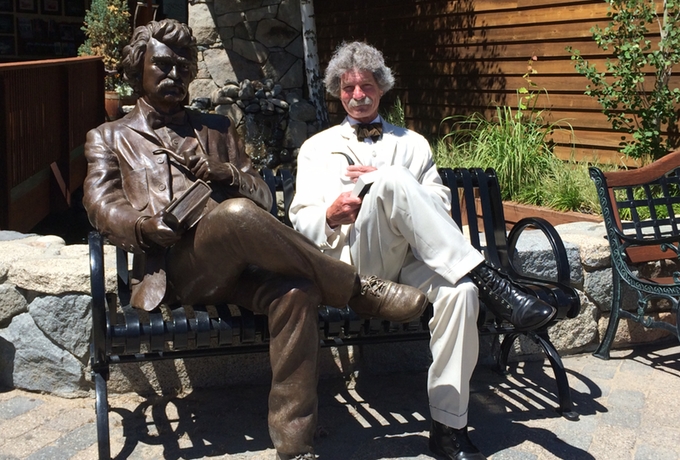
twains• This is a photo of the two Twains together at Ski Run Marina. The sculpture is by Jon Hair at the entrance of Riva Grill.

• Lake Tahoe’s Paint and Sip Studio is hosting a fundraiser for the League to Save Lake Tahoe on May 4 from 6-8pm. The painting will be of Bonsai Rock. Cost is $40, with half of the proceeds donated to the League. To register, call 530.600.0662.

• A representative from Rep. Tom McClintock’s office will be available for questions April 16 from 10am-noon at the South Lake Tahoe Public Utility District, 1275 Meadow Crest Drive, South Lake Tahoe.

• The passage of Measure F for Lake Tahoe Community College requires the formation of a Citizen’s Oversight Committee to ensure all expenditures of public funds are in compliance with the bond language approved by voters in November 2014. The first meeting is April 16 at 6pm in the college board room. The public is welcome.

• Sand Harbor boat ramp will not open this season because of the drought.


Former Stateline school may be rented

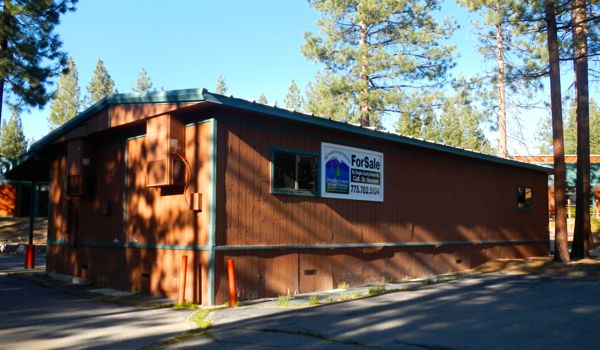
No signs indicate this was once a school; on a for sale sign exists at the property. Photo/LTN school

No signs indicate this was once a school; only a for sale sign exists at the property. Photo/LTN

STATELINE — A local government agency is interested in leasing the former Kingsbury Middle School in Stateline.

Lisa Noonan, superintendent of Douglas County School District, told the board on April 14 that an entity has expressed interest in potentially taking over the site for 30 years. The school and accompanying acreage have been on the market for a number of years; ever since it closed because of declining enrollment.

While people have expressed interest in buying the property, no one has made an offer.

Noonan on Tuesday said a potential buyer is still in the wings.

The board on Tuesday (Tom Moore was absent) agreed to open the process to potential renters. What a contract like that would mean remains to be seen. The structure needs a new roof and other upgrades that a potential tenant is likely to pay for in lieu of rent, at least at the get-go.

Noonan is not releasing names of any of the interested parties.

July is the next time the board meets at Tahoe, which is when the bidders are likely to be made public; this is assuming they make an offer.

— Lake Tahoe News staff report


Tahoe Nordic SAR using crowd sourcing to fund raise

The Great Ski Race, which has been the Tahoe Nordic Search and Rescue Team’s bread and butter fundraiser, has been canceled three out of the last four years due to poor snow conditions.

While TNSAR’s annual operating costs are relatively modest, the team needs to find other sources of revenue in order to support its mission of saving lives.

Enter Crowdrise, a crowd sourcing website. TNSAR setup a fund-raising campaign called RescueTheRescuers2015. For more information or to donate, go online.


Lincoln well-remembered in Nevada

By Guy Clifton, Reno Gazette-Journal

Abraham Lincoln never set foot in Nevada, but the histories of the state and the nation’s 16th president are forever intertwined.

“It’s hard to think of a president who had a bigger impact on Nevada,” Michael Green, a history professor at UNLV, said about the president who was shot by assassin John Wilkes Booth 150 years ago today.

“Without Lincoln, we don’t have a Civil War, we don’t have statehood, we don’t have laws that were passed during the Civil War that affected Nevada.”

We might not even have Mark Twain — the pen name Samuel Langhorne Clemens picked up while working for the Territorial Enterprise in Virginia City. If Lincoln hadn’t appointed Clemens’ brother, Orion, to be the first secretary of the Nevada Territory, Sam might have never followed his brother West. No “Roughing It,” no “Fairest picture the whole earth affords” musings about Lake Tahoe, no tall tales from the Comstock.

Lincoln wanted Nevada to become a state, in part to help ensure his re-election in 1864, but ultimately to help him secure the needed votes in Congress for the 13th Amendment to end slavery.

Read the whole story


Applebee’s, cops helping Special Olympics

Special Olympics Nevada, local law enforcement agencies, and Applebee’s Restaurants are teaming up to raise money for the nonprofit through tip-a-cop.

Officers will trade their handcuffs and badges for aprons and menus this month at Applebee’s in the region.

Applebee’s Restaurants for 11 years has helped raise more than $55,000 for Special Olympics Northern Nevada. Special Olympics Nevada is a free year-round sports training and competition program for children and adults with intellectual disabilities. There are 3,000 athletes who compete in 20 competitions throughout the region in eight sports.

Locations: April 30 — lunch 11am-3pm, dinner 5-9pm

  • 3987 Lake Tahoe Blvd., South Lake Tahoe; California Highway Patrol.
  • 4805 Kietzke Lane, Reno; Reno Police Department Sparks
  • 693 North Mccarran Blvd. Sparks; Sparks Police Department
  • 3300 S. Carson Street, Carson City; Carson City Sheriff’s Department.


USFS: Expired Nestle water permit a priority

By Ian James, Desert Sun

U.S. Forest Service officials on Friday said they are making it a priority to examine a long-expired permit that Nestle has been using to pipe water out of a national forest to use for bottled water.

Nestle Waters North America has long drawn water from wells that tap into springs in Strawberry Canyon north of San Bernardino. The water flows through a pipeline across the national forest and is hauled by trucks to a plant to be bottled as Arrowhead 100 percent Mountain Spring Water.

In an investigation last month, The Desert Sun found that Nestle’s permit to transport water across the San Bernardino National Forest expired in 1988 and that the Forest Service hasn’t assessed the impacts of the bottled water business on streams in two watersheds that sustain sensitive habitats.

“Since this issue was raised and I became aware of how long that permit has been expired, I have made it a priority to work on this reissuance project,” San Bernardino National Forest Supervisor Jody Noiron said in a telephone interview.

Forest Service officials recently announced plans to take up the issue and carry out an environmental analysis after a group of critics raised concerns in emails and letters, and after the Desert Sun inquired about the expired permit.

Read the whole story


As population ages, hospice care grows

By Sammy Caiola, Sacramento Bee

Mary Miller is full of opinions. During her weekly visits with hospice volunteer Joe Lenihan, the 88-year-old doesn’t hesitate to speak her mind – solicited or not. She’ll talk the ear off of a wrong-number caller, and she’s known affectionately around the neighborhood as “Mean Old Mom.”

“There are days when Mary is a little cantankerous – it’s not all sunshine and lollipops,” Lenihan said. “It can be a difficult time for some folks, and to share that with people is a real joy.”

Miller has been in hospice, an at-home care service provided to patients in their final days, since her congestive heart failure was deemed terminal in January. She chose the option because she wanted to remain in the McKinley Park house where she’s lived for 37 years, the past 15 without the company of her late husband, Henry.

Over the past decade, the hospice industry has seen substantial growth with the aging baby boomer population. Adults over 50 are expected to make up 20 percent of the population by 2030, and 90 percent of Americans want to grow older at home, according to a recent report by AARP, formerly the American Association of Retired Persons.

Read the whole story


Artwork sought for Champions Plaza

South Lake Tahoe is seeking an artist to create an original art piece and/or flag design to be permanently displayed at the city’s newly established Champions Plaza, located on the corner of Highway 50 and Lakeview Avenue within the Lakeview Commons area.

On the heels of the 2014 Winter Olympics, in which several local athletes earned Olympic medals, the idea of creating a Champions Plaza was born. To honor and recognize these athletes, and all local athletes who have achieved national and world titles, the City Council approved the construction and design of a Champions Plaza.

Proposals are due by noon June 12.

For more information, go online.


In a cameras-everywhere culture, science fiction becomes reality

By Tracey Lien and Paresh Dave, Los Angeles Times

Science fiction writer David Brin calls it “a tsunami of lights” — a future where tiny cameras are everywhere, lighting up everything we do, and even predicting what we’ll do next.

Unlike George Orwell’s novel “1984,” where only Big Brother controlled the cameras, in 2015, cheap, mobile technology has turned everyone into a watcher.

A snowboarder with a GoPro can post a YouTube video of a friend’s 540-degree McTwist in the halfpipe. But also — as happened recently — a Penn State fraternity can upload Facebook photos of partially naked, sleeping college women.

A San Jose homeowner cowers behind a locked door while she watches an intruder stroll through her home on a surveillance video. A man launches a drone to spy on his neighbor tanning by her pool. Pet owners monitor their dogs.

That includes the police, whose actions can be recorded by anyone with a camera phone. In South Carolina, a cellphone video released last week showed a police officer firing eight shots at a fleeing man’s back. In San Bernardino County, news choppers captured footage of deputies punching and kicking a man as he lay face-down on the ground with his hands behind his back.

“Painting a picture that cameras are everywhere and anywhere is pretty provocative,” said Ryan Martin, a technology analyst at 451 Research, but it can also present opportunities to increase accountability and improve safety.

Read the whole story