Drought ‘devastating’ for Tahoe ski industry

By Kathryn Reed

Adapting to change is the only way ski resorts are going to survive.

That was the message John Rice, general manager of Sierra-at-Tahoe, delivered to more than 40 people on Wednesday afternoon at Lake Tahoe Community College.

He refused to engage in the debate of why things are changing, but he said there is no denying things are changing.

Sierra averages 480 inches of snow a season. It received 140 inches this season – a record. The resort near Echo Summit was open for 94 days. Another record. It closed March 16 – the earliest on record. These aren’t the kinds of records any resort wants.

Sierra had 1,200 people from Intel booked in March. The resort had to cancel because of conditions.
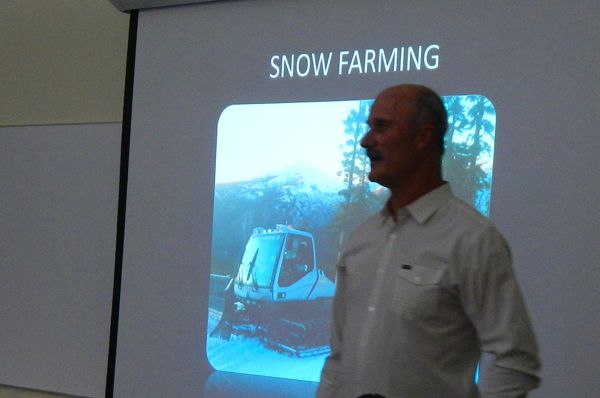
John Rice with Sierra-at-Tahoe on April 15 talks about the impact of drought on ski resorts. Photo/LTN

John Rice with Sierra-at-Tahoe on April 15 talks about the impact of drought on ski resorts. Photo/LTN

Rice said the drought is having a “devastating” affect on the industry. Less money being generated means fewer people to hire, which ultimately affects so many businesses in town.

It used to be people would book ski trips months, even years in advance. Now it’s more spontaneous. With weather data at people’s fingertips and more accurate ski reports from resorts, the guesswork has been eliminated. People can go to where the snow is or stay away from the sparsely covered slopes.

For the resorts without snow this is not a good thing for the bottom line. And with the greater Lake Tahoe area suffering from its fourth winter of lousy conditions, Rice said, all resorts are dealing with a slump in season pass sales and group sales. Skiers aren’t willing to take a gamble on Tahoe right now even though in winter 2010-11 Sierra had 869 inches of snow.

Snow totals at Donner Summit have been kept since the late 1800s. Multi-winter low snow years are not unusual, Rice pointed out. But there is no crystal ball to know when Mother Nature will change her ways.

To cope with dry cycles resorts are going to have to be creative with what they offer. Sierra was bringing in people to its 30,000-square-foot plaza with music and events. People who often avoid Tahoe in the winter because of the roads could come experience snow. It’s about providing an experience they can’t get at home.

Sitting by a fire pit surrounded by pine trees, roasting s’mores, wine tasting, tubing, ice skating are all things various Tahoe resorts offer. It’s not just about the skiing and snowboarding.

A resort in Vermont has an indoor water park. Camp Woodward, the nearest being at Boreal, is extreme sports indoors.

While many resorts boast about their snowmaking capabilities, Sierra can only cover 4 percent of its slopes with man-made snow. Industry numbers are that between 17 and 25 percent of the water used for snowmaking is lost, the rest returns to the aquifer.

Sierra is more known for snow farming – taking the white stuff off parking lots and areas of the mountain and repurposing it on skiable terrain. Last winter an employee used a 5-gallon bucket from home and a resort shovel to start filling in bare spots.

Rice praised his initiative that turned into a 100-person bucket brigade. It was about employees trying to be resourceful, stay employed and doing their part.

Summer grooming helps Sierra open with a decent layer of snow. Take a look at a run like Lower Main. It’s pretty smooth. Without boulders and uneven terrain, it means it will be covered faster and sooner than some other runs.

Places like Northstar and Heavenly are turning to active summer activities like ropes courses and mountain biking. Rice said without a closer bed base Sierra does not see this as a viable option. It will, though, be expanding into the wedding business in the summer.

Resorts are also putting together season pass programs that involve multiple resorts. This is good when the home resort’s conditions are sketchy. While it means free skiing, the resorts benefit because people buy food, souvenirs and may extend their stay. Plus, people see this as added value.

—–

Notes:

• The next Tahoe Talks Brown Bag lunch is May 20, noon-1:30pm in LTCC’s board room. It will be a panel discussion about cycling’s impact on Tahoe’s economy
Ceremony at Truckee baseball field to honor former player, coach

By Jim Krajewski, Reno Gazette-Journal

Truckee will honor two former members of the baseball team with an appreciation ceremony on Saturday at the baseball field.

Former coach Mike Ellis, who died April 5, 2014, and former player Andrew Metlenko, who was killed in a car accident in spring of 2013, will both have plaques dedicated to their memories at the ceremony.

Truckee principal John Carlson said the ceremony will be held between games of a doubleheader against Lowry starting at 11am Saturday.

Read the whole story


Workshop to focus on online branding

The Lake Tahoe South Shore Chamber of Commerce in partnership with South Lake Tahoe is offering a workshop called How to Protect Your Brand and Your Bottom Line from Negative Buzz on May 13 from 9am to noon.

The goal of the workshop is to teach attendees how to protect the reputation of their businesses online. Workshop topics include why you should care about your Yelp and other social review site ratings, why negative reviews are a huge opportunity for your business, how to craft and manage a winning presence on social media sites, proven strategies for responding to reviews — good and bad alike – and free tools and resources for monitoring what people say about you online.

The workshop costs $20 for chamber members and $40 for non-members. The workshop will be at the chamber, 169 Highway 50, Stateline.

For more detailed information or to register, call 775.588.1728.


LTCC launching 2 art exhibits

There will be a reception at Lake Tahoe Community College on April 16 from 5-7pm for two art shows.

In the Fine Arts building’s Foyer Gallery, will be an array of drawing, paintings, and assemblage by Michael Murillo in One Man’s Show: An Eclectic Body of Work by One Artist. The Haldan Art Gallery, in the library building, will be hosting the group exhibition Humboldt/San Jose Connect. Ceramic sculpture created by seven artists from the undergraduate and graduate programs in fine art at San Jose State and Humboldt State universities will be featured.

Light refreshments will be served and the artists’ talk will be in the gallery at 5:30pm.

The Haldan Art Gallery is open Tuesday through Thursday, 11am-5:30pm and Fridays 11am-2pm. The Foyer Gallery is open when the school is open. Both exhibitions are on display until mid-June.


Bills renew California’s anti-smoking effort

By Patrick McGreevey, Los Angeles Times

California has become a battleground between the tobacco industry and health groups as lawmakers push proposals that include increasing cigarette taxes by $2 a pack and raising the legal smoking age from 18 to 21.

The state once led the nation in snuffing out smoking, but health activists say a strong tobacco lobby and a lack of political will have blocked new efforts in recent years.

“We used to be leaders, and we are not anymore,” said Stanton A. Glantz, a professor of medicine at UC San Francisco.

California lawmakers have responded to such criticism with a flood of legislation on the issue.

In addition to making California the first state to raise the smoking age, the measures would bar electronic cigarettes from public places where smoking is prohibited, ban single-use filters on cigarettes and prohibit the use of chewing tobacco in pro baseball stadiums and recreational league games.

Read the whole story


Firewood permits available from USFS

The U.S. Forest Service Lake Tahoe Basin Management Unit will begin the sale of fuelwood permits at the Forest Supervisor’s office at 35 College Drive in South Lake Tahoe today.

Although weather conditions allow for the early sale of permits, areas to obtain fuelwood will be limited because not all gates and roads are open. As gates and roads open, more areas will become accessible.

The public should purchase permits and collect wood early as fire restrictions are likely to go into effect early and there may be days when no cutting is allowed.

The Forest Service North Shore office will begin selling permits in May.

Permits cost $20 per cord, with a two-cord minimum purchase and a limit of 10 cords per household. Permits have specific conditions and complete information is provided when the permit is issued. Maps to designated cutting areas are provided and must be in the permit holder’s possession along with the valid permit.

The permit is for collection of “down-dead” wood up to a 30-inch maximum diameter in designated fuelwood areas within the Lake Tahoe Basin. “Down-dead” means the tree is down on the ground and dead, rather than dead and standing. Cutting any standing tree, whether dead or green, is not allowed.

No off-road travel is allowed and permit holders must comply with all permit conditions.


Efforts under way to preserve old Tahoe toll house

By Lake Tahoe Historical Society

Neomiah Osgood built the toll house in 1859. It is the oldest commercial building still standing in the Tahoe basin.

It was built at the foot of Meyers Grade where the Echo Lake Creek flows into the Upper Truckee River.

During the Comstock Load era there are reports of 400 to 500 people a day coming through South Shore on their way to Virginia City. It is stated that in bad weather the road could be backed up from the toll house all the way to Placerville, and that if someone broke a wheel on a wagon, it could take two days to get back in line.

The toll house operated until the late 1800s and then stood empty for three decades. In 1910 the spring thaw following a very severe winter broke the dam on Echo Lake Creek and sent tons of water down upon the toll house, washing it from its foundation. It was rescued by the Celio family and placed on Celio land in Meyers near the old golf course. It remained on their land until the Celio family sold that land for the renovation of the golf course.

At that time the Celio family contacted the Lake Tahoe Historical Society and basically gave us the toll house if we could move it off their land. After extensive fund raising (about $8,000), the building was moved to the site of a proposed museum adjacent to the new county library. Funds for the new museum were never raised and the toll house was again moved and now sits behind the current museum building.

The toll house is considered to be the oldest commercial building in the entire Lake Tahoe Basin and is thought to be the only remaining toll house in the Sierra.

Although the Toll House has been under the care of the Lake Tahoe Historical Society since 1974 we do not qualify for any state or federal grants under the historic guidelines because the toll house has been moved. Neither our city nor the county feels any responsibility toward the toll house and so the Lake Tahoe Historical Society is seeking monetary help from our community to restore the toll house.

Keith Klein is a longtime member of the LTHS and is donating his expertise as an architect to help us with plans, permits, etc. His estimate to restore the building to a capacity where it could be used as another building for our museum is $25,000 to $30,000. We have received a grant of $3,000 from the El Dorado County Foundation and to date we have used about half of that money in stabilization.

We have received about another $1,500 in donations marked for the toll house and are about $500 away from meeting Bob Harms matching $5,000 challenge. Once that is met we will have another matching challenge of $2,500 by long-time member John McDougal.

Those dollars will bring us about half of the money needed to restore this historic old building. We are hoping the community will see the value in this project and contribute to it.

On April 18, the Tahoe Douglas Rotary will be helping us clean the toll house and catalog items that have been in the toll house for many years.

For further information on the Toll House project, contact the Lake Tahoe Historical Society at 530.541.5458.


Drip irrigation helps conserve water

By Melinda Myers

Reduce your workload, increase productivity and be water wise, whether you are planning, planting or already harvesting produce or enjoying beautiful floral displays from your garden.

Container gardeners may want to invest in self-watering pots. These containers have built-in reservoirs to reduce watering frequency. Commercial and homemade self-watering devices can also reduce watering frequency. Just make sure to test their effectiveness before leaving town. Or consider a one-time investment in a drip irrigation system especially designed for container gardens.

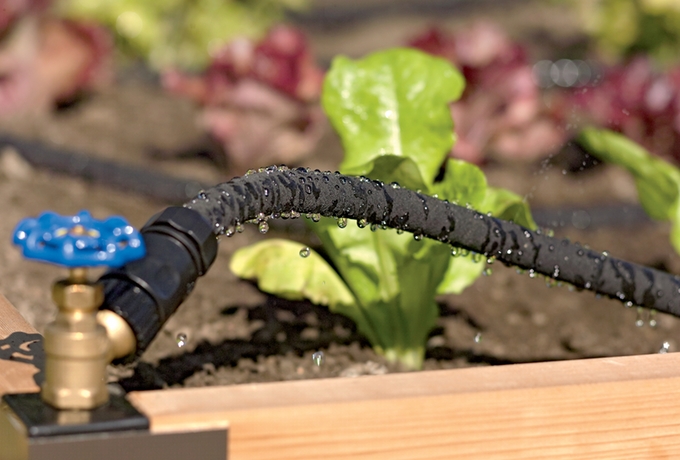
Drip irrigation and soaker hoses are also a great way to water in-ground plantings. These irrigation systems apply the water directly to the soil which reduces water lost to overspray, evaporation and runoff. They also reduce the risk and spread of disease by preventing water from settling on the leaves of the plants.

Drip irrigation systems apply the water directly to the soil which reduces water lost to overspray, evaporation and runoff. Photo/Gardener’s Supply Company

Drip irrigation systems apply the water directly to the soil which reduces water lost to overspray, evaporation and runoff. Photo/Gardener’s Supply Company

Opt for a micro irrigation system if your water has a high mineral content. These minerals can build up and clog soaker hoses. Micro irrigation systems experience fewer problems and the nozzles can be cleaned to prevent clogs. Because the nozzles can be clipped onto stakes, tomato towers or other supports, this system makes it easy to deliver water right to the plants.

Raised bed gardens will also benefit from irrigation systems. Elevated gardens often dry out more quickly than their in-ground counterparts and need more frequent watering. Some, like the Raised Bed Snip-n-Drip soaker system, are easy to assemble and allow you to water when needed. Further save time by using preformed corners with built-in spigots when constructing raised beds. Simply slide the boards into the metal corner pieces to create the raised bed. Some corner systems, like Aquacorner, have built-in spigots to make irrigation even simpler.

Correctly installed irrigation systems can help conserve water by ensuring you water properly and only when needed. Plus, using a timer and an irrigation system allows you to apply water at the best time for the plants. Just set the timer for early in the morning – when less water is lost to evaporation – and the plants will be watered even if you are not home.

Always water thoroughly and only as needed to encourage plants to develop deep root systems that are more drought-tolerant. Be sure to avoid high nitrogen, fast release fertilizers that promote lush succulent growth which needs more frequent watering.

Further conserve water and time spent watering by grouping moisture-loving plants together. You can provide needed water more efficiently and avoid overwatering nearby drought-tolerant plants.

And remember to mulch your garden. A thin layer of shredded leaves, evergreen needles or other organic matter helps conserve moisture and reduces erosion. As the mulch breaks down, it helps improve the soil, while decreasing its’ water needs.

So make this the year you take a break from watering, while continuing to enjoy beautiful and productive gardens.

Gardening expert, TV/radio host, author and columnist Melinda Myers has more than 30 years of horticulture experience and has written more 20 gardening books.


Road beat: Elantra has comfort over sport

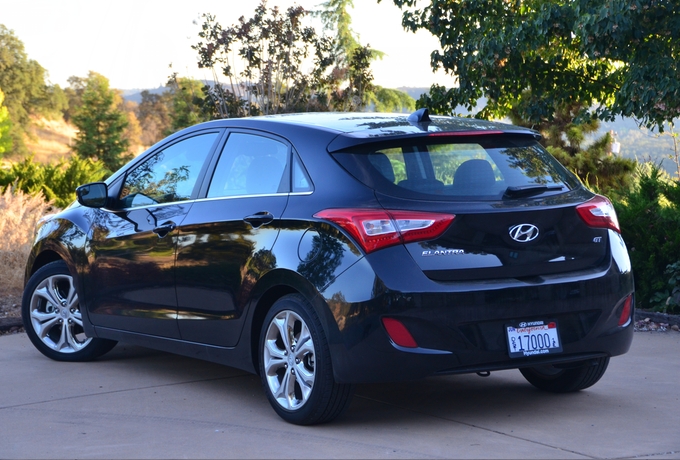
Hyundai continues to improve Elentra. Photos/Larry Weitzman

Hyundai continues to improve Elentra. Photos/Larry Weitzman

By Larry Weitzman

You may think a Hyundai Elantra is a middle of the road compact sedan that competes for one of the largest segments in the auto market which includes the likes of Corolla, Civic, Cruze, Mazda 3, Sentra and several more. It’s heady competition so you must offer something a bit unique with special qualities.

Hyundai Elantra GT fits that billing. While I have been a fan of its swoopy and edgy styling, the GT adds a bit of sportiness in the hatchback rear end, which also multiplies its utility. It is convenient. While it might not quite have the stunning styling of the new Mazda 3, it has a bit more performance (over the 3’s 2.0L version) and will appeal to those looking for more comfort over sport, although this new GT did acquit itself very well at the drag strip and in the twisties regardless.

Specifications Price $19560 to $25,500 all in Engine 2.0L DOHC, 16 valve inline four   173 hp @ 6,500 rpm 154 lb-ft of torque @ 4,700 rpm Transmission Six speed Automatic Six speed manual Chassis layout Front transverse engine, front wheel drive Dimensions Length 169.3 inches Wheelbase 104.3 inches Width 70.1 inches Height 57.1 inches Track (f/r) 61.0/61.5 inches Ground clearance 5.5 inches Weight 2,855 to 2,983 pounds Fuel capacity 13.2 gallons Cargo capacity (rear seats down/up) 51.0/23.0 cubic feet Passenger volume 96.1 cubic feet Steering lock to lock 2.8 turns Turning circle 34.8 feet Co-efficient of drag 0.308 Performance 0-60 mph 7.57 seconds 50-70 mph 4.55 seconds 50-70 uphill 7.43 seconds Fuel economy EPA rated 24/34/28 mpg city/highway/combined. Expect 38.1 mpg on the highway and 30-31 mpg in rural country driving.

Specifications
Price $19560 to $25,500 all in
Engine 2.0L DOHC, 16 valve inline four 173 hp @ 6,500 rpm
154 lb-ft of torque @ 4,700 rpm
Transmission
Six speed Automatic
Six speed manual
Chassis layout
Front transverse engine, front wheel drive
Dimensions
Length 169.3 inches
Wheelbase 104.3 inches
Width 70.1 inches
Height 57.1 inches
Track (f/r) 61.0/61.5 inches
Ground clearance 5.5 inches
Weight 2,855 to 2,983 pounds
Fuel capacity 13.2 gallons
Cargo capacity (rear seats down/up) 51.0/23.0 cubic feet
Passenger volume 96.1 cubic feet
Steering lock to lock 2.8 turns
Turning circle 34.8 feet
Co-efficient of drag 0.308
Performance
0-60 mph 7.57 seconds
50-70 mph 4.55 seconds
50-70 uphill 7.43 seconds
Fuel economy EPA rated 24/34/28 mpg city/highway/combined. Expect 38.1 mpg on the highway and 30-31 mpg in rural country driving.

While the GT rides on a special European developed chassis exclusive to the GT that has a wheelbase of 104.3 inches, it is two inches shorter than the sedan’s wheelbase. Overall length is only 169 inches long making it about 9 inches shorter than the sedan and what could be called a sub-compact in length. Width is the same at 70 inches, but here is the kicker, the cabin volume of the GT is 119 cubic feet making the GT one cubic foot short of being classified as a large car. In other words it has an interior that is bigger than most mid size cars while being 20 inches shorter. The average midsize car is 190 inches.

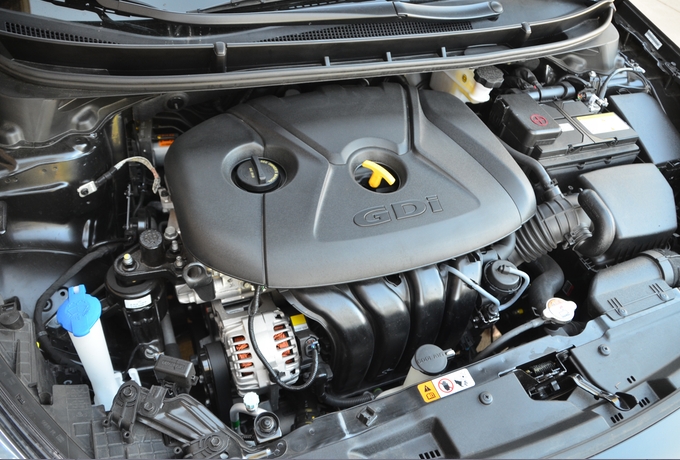
Instead of the still powerful 1.8L, 148 hp inline four of the standard Elantra and last year’s GT, the new GT version gets a 10mm stroking and GDI which brings the boil up to 173 hp at 6,500 rpm and 154 pounds of twist at 4,700 rpm. Now the GT is showing some GT credentials. The engine has some other features, one worth noting is the adding of some aluminum to the lower engine block reducing NVH and increasing block rigidity by 30 percent. I mention this because this is one of the quietest and smoothest four bangers I have ever encountered.

While a six-speed auto cog swapper is available, my tester had the sportier six-speed manual that has something to be said for it. It shifts so smoothly that upshifting rarely requires using the clutch. You can downshift the same way, but in relaxed driving it takes too long, so the clutch makes it easier. It’s as close to warm butter without being yellow.

Performance of this 2,900 pound sporty ride is also commensurate with the specs as several 0-60 mph runs averaged 7.57 seconds. Passing performance (50-70 mph) stopped the chrondex at 4.55 seconds and the same run up a six percent grade lasted 7.43 seconds. Certainly significantly better than your average compact and the standard 148 hp Elantra and a smidgen better than the Elantra Coupe with the 173 hp engine tested a few months ago (times were 7.84, 4.80 and 7.73 seconds). While the engine is revvy and smooth, even at or near redline (about 7,000 rpm) it the engine feel a bit soft, but it isn’t. It will pull in the top three gears from about 2,000 rpm and acceleration is brisk at that rpm in the lower gears. Hit 4,700 (peak of the torque curve) and it pulls smartly in any gear.

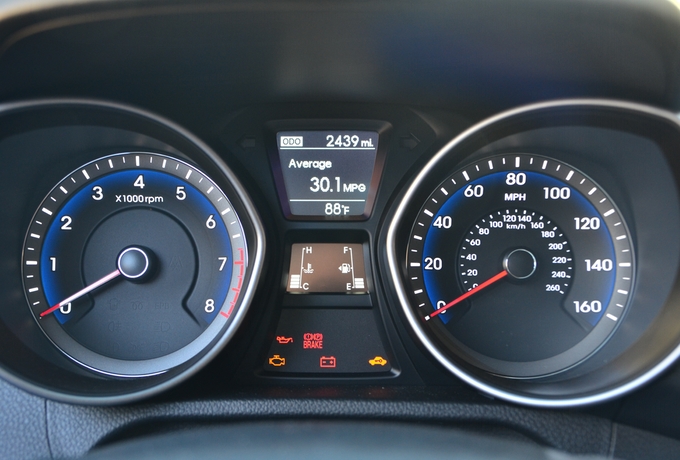
Fuel economy is EPA rated at 24/34/28 mpg city/highway/combined. The GT does about 10 percent better with 38.1 mpg at 70 mph on a level highway. Overall fuel economy averaged 30.6 mpg with very little time on the highway. Interestingly, the numbers for the Elantra Coupe discussed above were essentially identical. In real life testing highway mileage for the more powerful-engined GT is the same as the 148 hp engine Elantra as it should be, but overall driving might suffer by an mpg or two. The GT is a guilt free sporty compact car with a dash of style and utility. Also contributing to the GT’s fuel economy is a 0.30 co-efficient of drag.

Suspension is compact car standard MacPherson struts up front with a torsion beam bringing up the rear. Gas filled shocks and coils are at all four corners. With the Style package ($2,550) besides the upgraded 17 inch alloys and wider (215/45) tires, the components are sport-tuned which means springs and shocks are a bit stiffer and have different ratings which adds some firmness and stability in the corners. I still felt the package was a bit soft, but the cornering power was still very good. This GT will still out corner the non GT Elantra with no ride penalty.

That’s what endears the GT to the regular driver, its adds to its handling with no loss of ride quality or quiet. The GT gives you that quiet, smooth ride you look for without any detriment to handling. Even outside the car, the engine is almost inaudible. On the highway at 70 mph the engine revs a bit high at 2,700 rpm (300 more rpm than the automatic) but the cabin remains totally free from engine, road and/or wind noise.

Braking is by large four-wheel discs with all the acronyms and does an admirable job at arresting foreign progress in the benchmark of 40 feet. Also in its complement of safety devices are seven airbags and most every other acronym including TPMS. But one thing missing especially considering this GT was a manual, was Hill Start Assist which prevents rolling backward when starting out on a hill. Yes, it’s a crutch, but it’s a nice crutch.

The vehicle goes from 0-60 mph in 7.57 seconds.

The vehicle goes from 0-60 mph in 7.57 seconds.

Inside is a very high quality leather interior which is part of the style package. Interior quality is excellent giving one the feeling of luxury. It is amazing how Hyundai in 20 years has vaulted to near or at the top of the class in quality.

Seats are comfortable (driver’s is power, part of the Style pack) with plenty of rear seat leg room. Instrumentation is clear and complete with a big tach and speedo plus ancillary gauges and a full trip computer. All appointments are top quality. Cabin volume is huge including 51 cubic feet with the rear seats down and 23 cubic feet with the rear seats up. That’s more truck room than a Crown Vic or a Towncar.

Pricing for this ride is a bargain at $18,750 plus $810 for the boat ride from Ulsan, Korea. I would add the Style pack for $2,550 and the sort of obligatory nicely monogrammed carpeted floor mats ($125) bring to total to $22,235. That’s a lot of car that has an aversion to gas stations. And standard equipment includes a five-year/60,000 mile bumper-to-bumper warranty plus a 10-year/ 100,000 miles powertrain warranty. Hyundai certainly puts their money where their mouth is. Now this is value.

Larry Weitzman has been into cars since he was 5 years old. At 8 he could recite from memory the hp of every car made in the U.S. He has put in thousands of laps on racetracks all over the Western United States.


Planners plotting Tahoe’s cycling future

By Kathryn Reed

Cycling in the Lake Tahoe Basin can be compared to driving in rush hour traffic. It’s a lot of stop and go, along with frustration.

With the lack of connectivity, routes abruptly stopping and harrowing experiences when having to interact with vehicles, two-wheelers in Tahoe are often relegated to second-class citizens – at least on the roads. Planners, with the help of the public, want to change that reality.

“We are transitioning into an active transportation plan,” Nick Haven, transit planner with Tahoe Regional Planning Agency, told Lake Tahoe News. “Historically, we’ve been focused on circulation and transportation.” Now health and other modes of transit like skateboarding are part of the bigger picture.

The bi-state agency is updating its bike and pedestrian plan – something that is done every four years.

On April 14 more than 20 people gathered at the South Lake Tahoe Library to offer input about what planners should focus on when designing trails, what overall goals should be, where missing links in the trail system exist, and where bike racks should be installed.

Greg Kendall of Marla Bay voted for buffered or protected bike lanes, as did many others. While he prefers a separated bike path, he told Lake Tahoe News he knows that isn’t realistic for his part of the South Shore where the roads are narrow. Kendall also believes it’s necessary to accommodate the different types of cyclists – those out for a leisurely ride, and those who are more serious, going faster and would be encumbered by a multi-use path.

Morgan Beryl, who is TRPA’s project manager for what is now called an active transportation plan, told Lake Tahoe News the document would prioritize projects for funding, be a guide for what should be implemented and be a source for designers.

TRPA has found that people are sticking to their vehicles because they don’t feel safe on the roads or in intersections – whether on a bike or foot. Working to make intersections safer is a goal. Caltrans recently added a class 4 designation to bike trails. This allows for two-way travel on the same side of the street along the road. Bike boxes are being tested in Sacramento and Davis. These put cyclists in front of vehicles at an intersection. Removable signs in the roadway and flashing lights to alert motorists of the presence of cyclist are other innovations.

—–

Notes:

• Feedback on the bike-pedestrian plan is also being sought via an online survey that will be up through June.

• A draft plan – which will seek more public comment – should be ready by October, with the final document completed by the end of the year.

• There is a meeting at Kings Beach Elementary on April 16 from 5:30 to 7:30pm about the plan.