Pollock Pines woman accused of hitting ex-boyfriend with car

By Cathy Locke, Sacramento Bee

A Pollock Pines woman is in El Dorado County jail, accused of hitting her ex-boyfriend with her car.

Terrie Crampton, 45, was booked on suspicion of assault with a deadly weapon, felony domestic violence and felony hit and run. Also included was an enhancement for having prior felony convictions, according to an El Dorado County Sheriff’s Office news release.

Read the whole story


Why student athletes continue to fail

By Daniel Oppenheimer

Seventy-four college underclassmen have been declared eligible for the NFL’s upcoming draft, but Ohio State’s quarterback Cardale Jones won’t be among them. A few days after winning the national championship game in January, Jones shocked fans and football analysts by saying he wasn’t ready to go pro, that it was important for him to graduate from college first. What made the announcement all the more surprising, beyond the fact that Jones may never again be as desirable an NFL prospect as he is the year he won a national championship, was that his previous claim to fame was a notorious tweet posted two years ago in which he complained about the “college” part of being a college football player. He wrote that he’d gone to Ohio State to play football, not “to play school,” and that classes were pointless.

Jones now regrets and disavows that tweet. Earlier this month, he was tweeting that nothing is more important than education, under the hashtag “StudentBeforeAthlete.” It’s hard to know how sincere his attitude adjustment has been, or how sincere his initial dismissal of academics was. What is clear is that Jones and his conversion represent a messaging coup for his university and for the NCAA, which has maintained for decades that its primary goal is to help scholar-athletes receive an education that would prepare them for life beyond sports.

Despite the NCAA’s insistence that it is concerned about student athletes’ academic growth, it often feels as though “student” plays second fiddle to “athlete.” Indeed, on a typical day, a visitor to the NCAA homepage will be overwhelmed by the articles (and videos) about athletics but will not find a single article (or video) about the academic achievements of the athletes.

This also seems to hold true for many of the NCAA’s member schools. The University of North Carolina and Syracuse are just two of the most recent universities to be under the spotlight for academic scandals involving student athletes. UNC offered a “no show” class for student athletes (where students received grades for phantom classes that they didn’t attend), and Syracuse allowed academically ineligible athletes to compete. And while these cases are the ones currently grabbing headlines, they are hardly unique; the “Chronicles of Higher Education” is reporting that 20 additional schools are being investigated for academic fraud.

And what about the student athletes themselves?  Student-athletes tend to take easier classes and get lower grades than non-athletes. This is not only true for schools from power conferences in big-money sports, it has been observed in Division III liberal arts colleges and Ivy League schools, neither of which even offer athletic scholarships.

It’s tempting to believe that student athletes care only about their sport, and not about their schoolwork, as many popular commentators have suggested – and as Ohio State’s Jones once tweeted — except that in the dozen years that I’ve been teaching in university settings, that hasn’t been my experience at all.  I’ve taught hundreds of Division 1 student athletes at several different schools, and they have been among the hardest working students I’ve encountered.  The student athletes I’ve worked with have viewed their sport as a complement to, not a replacement for, their studies.

My observations were hardly unique. One of my students, Josh Levine, ran a youth hockey clinic and was upset by the widespread perception that the students he worked with did not care about school.  After several conversations about the issue, we decided that the only way to find out the truth was to run a study.  And so we did, surveying 147 student athletes (including some still in high school) involved in various team sports from football and basketball to lacrosse and golf about how much both they and their teammates cared about sports and academics.”

Here’s what we found: When student athletes were asked how much they care about athletics, they rated their interest a healthy 8.5 on average, on a scale of 1 to 10. But when asked the value they place on academics, the result was higher than 9 on average. If anything, the average student athlete cares more about his studies than his sport. #StudentBeforeAthlete indeed.

So why do they underperform in their classes?

One possible and intriguing reason suggested by our study is that student athletes don’t think their teammates take academics as seriously as they do. When asked to assess how much their teammates cared about athletics, the athletes were close, guessing 8.8. However, when asked to evaluate how much their teammates cared about academics, those same athletes guessed only 7.8 – far below the 9+ average.

Why is this important?  Because when an athlete thinks that the rest of the team doesn’t care about academics, that athlete tries to fit in by pretending not to care either. In a perverse form of peer pressure, Cardale Jones’s tweet about classes being worthless may be what student athletes tell each other in an effort to fit in, based on the mistaken belief that if they care about academics, they are in an uncool minority.

All of this creates a distressing and self-perpetuating cycle. Tight-knit student athletes will seek ways of fitting into a culture that they perceive as neglecting academics (by defaulting into majors of dubious merit and spending less time doing homework), knowing that their habits are observed by teammates. When their teammates observe those habits, it reaffirms the (false) conviction that caring about academics is an unfortunate aberration, best suppressed.

One of my co-authors on this project, Sara Etchison, has described this process particularly well: “There are student athletes who want to excel in the classroom, but think their teammates would judge them for it, so they study a little less, or take an easier major. And it turns out, that’s how virtually everyone on the team feels, but there’s never an opportunity to realize, ‘Oh wait, all of us really care about what’s happening on the academic side.’”

This is a phenomenon that psychologists call “pluralistic ignorance” – when private preferences differ from perceptions of group norms. It leads people to engage in public behaviors that align more with the perceived norms than with their true preferences. The tragedy is that the norms are false – in reality, everybody would be happier if they just behaved in line with their true preferences.

Pluralistic ignorance has also been shown to underlie the phenomenon of binge drinking on campuses. A study conducted at Princeton University revealed that a majority of students who drink excessively did so not because they wanted to, but because they felt that was what their friends wanted to do. Once they all had a more accurate assessment of what the group norm was, the amount of alcohol consumed declined.

This suggests that helping student athletes do better in the classroom may be as simple as letting them know that their teammates care as much about academics as they do. Many of them care deeply about the education they are receiving, and should care, because financial success in professional sports will elude the vast majority of them.

As the NCAA and the media focus more attention on athletes’ academic performance, one of the best ways to improve the education of student athletes is to give them license to pursue their academic goals by making it clear that their teammates, and society as a whole, support them in their academic endeavors. For this to happen, we will need many more stars like Cardale Jones speaking out about the importance of education, instead of tweeting about the pointlessness of going to class.

Daniel Oppenheimer is a professor of psychology and marketing at the Anderson School of Management at UCLA.  He is the author of over 30 peer-reviewed journals, and several books, including Democracy Despite Itself: Why a System that Shouldn’t Work at All Works so Well.  In addition to numerous awards for his teaching and research, he won the 2006 Ig Nobel science humor award. He wrote this for Zocalo Public Square.


Nevada embraces its paranormal tourist treasures

By Anne Knowles

MINDEN –“We’re sitting in a haunted building.”

That’s how Janet Jones began her talk on paranormal tourism Thursday at Rural Roundup, the Nevada Division of Tourism’s annual conference.

“There’s an older man and woman and I suspect they’re the original owners,”Jones said, referring to the Brick House near the Carson Valley Inn where the breakout session was conducted. “She’s warm and welcoming, but he wants to know why there’s all these people here. But they’re fine. They’re just curious.”

Jones, a ghost tour operator who says she is also a psychic, was speaking to a crowded, overflow room of attendees, some anxious to learn how to turn local legends into live heads in beds, but most just eager to hear more tales of eerie apparitions.

Maybe Jones should have known she’d need a bigger room.

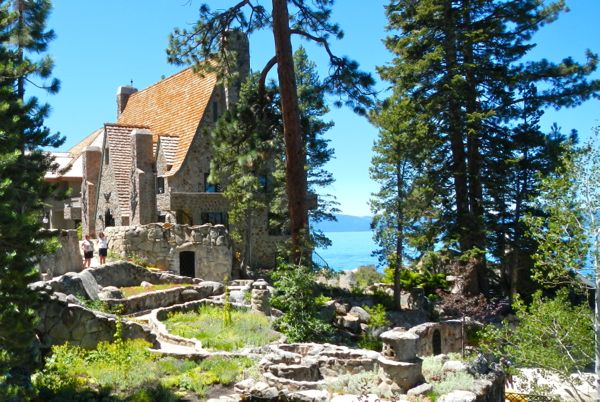
The Thunderbird Lodge in Incline is said to be haunted. Photo/LTN file

The Thunderbird Lodge in Incline is said to be haunted. Photo/LTN file

Jones, who worked with the Carson City Visitors Bureau for 18 years, conducts public tours and private events in local haunts, including dinners at the Mackay Mansion and overnights at St. Mary’s Art Center, both in Virginia City.

“We do an elegant dinner with Champagne. We dress in costume, eat at the original dining room table, on china. We use candles, no electric lights,”said Jones, talking about the one-time home of silver mining magnate John Williams Mackay. “Everyone brings a camera and when the ghosts come in the room, I let them know so they can take pictures.”

Jones rents out St. Mary’s for the night and hosts potluck dinners and sleepovers.

“Every room has a ghost,”she said.

But it can be less hospitable than the mansion, and sometimes more thrilling.

“I’ve been chased out of there three times,”said Jones.

The building once housed a hospital run by nuns, some of who allegedly hang around still.

“There’s Sister Regina,”she said. “I always say something to make her mad.”

Jones also hosts local ghost walks through the Stewart Indian School compound in Carson City, a boarding school where Native American children throughout the West were forced to live. The school operated for nearly a century, from 1890 to 1980.

“It is probably one of the most haunted places in Carson City and can be scary,”she said.

Jones often sees shadow people —a human figure appearing as a shadow —at the school and the spirits of children in a field long-rumored to be an unmarked cemetery.

“They bulldozed it and there’s no sagebrush, no place for the children to hide,”said Jones. “It broke my heart.”

Jones backed up her stories with a slideshow of photographs showing mysterious figures in places she tours, including Mackay Mansion and Stewart Indian School, as well as places she’s visited, such as Gettysburg, Pa., the Civil War site overrun with history and phantoms, where Jones photographed what she said is a shadow soldier.

“It’s like Disneyland to me,”said Jones.

Nevada is filled with places possessed by the dead, claims Jones —from the Mizpah Hotel in Tonopah to the Cal Neva Lodge and Casino straddling Nevada and California at the North Shore, and Thunderbird Lodge in Incline Village.

In fact, Jones said there’s a business opportunity for a smart tour operator to run a Nevada-wide ghost tour, shuttling guests from one haunted hotel or site to the next across the state.

Jones told her listeners April 16 that the audience for ghost tours is all ages and broad, covering those who want a light, somewhat humorous tour like the Carson City Ghost Walk operated by actress Mary Bennett, who runs Reno’s Bruka Theater, to people who want more of an “experience.”

And every municipality, she promised, has some supernatural attraction it can capitalize on to pull in visitors.

“Every town has a ghost,”she said. “There are haunted places in every, single city.”


Letter: TAP says thank you

To the community,

Tahoe Arts Project would like to extend a tremendous thank you to our Dancing with the Tahoe Stars participants and to the community for making our biggest fund-raiser such an enormous success. The event was lively and entertaining and the audience amazing. The funds raised will enable TAP to continue to bring professional performing arts into the schools and community of South Lake Tahoe.

A huge thank you to the 10 couples who put so much time and energy into their dancing: Jenn Boyd and Josh Comprendio, Rita Wang and Jorge Orozco, Joe Laub and Robyn Lindner, Corinna Osborne and Adam Hopkins, Howie Nave and Michelle Langlois, Jason Collin and Rhonda Keen, Ginger Nicolay-Davis and Dino Elias, Paul Bruso and Catherine Arens, Martin Goldberg and Sarah Guzman, and Lisa McDaniel and Sebastiani Romagnolo. You were all incredible.

The event wouldn’t have been complete without our illustrious judges: Don Bosson, Joan Elias, Paul Middlebrook and Marcia Sarosik and of course the applause queen herself, Roberta Benvenuto. Thank you to MontBleu and their crew for hosting the event and to Dreu Murin and his team for producing such an unforgettable show. We had wonderful entertainment provided by Marcia Sarosik Dance Studio, Forever Dance Studio, South Tahoe High School drama students and dance team, Drought Relief, Angie Zajac and Prestige Productions. Thank you to Lauren Lindley for the wonderful photos and thank you to Taylor Flynn for publishing them in the Mountain News.

Peggy Blowney, TAP executive director


Park City officials to talk tourism at Tahoe forum

Economic and Community Revitalization is the theme of this year’s South Shore tourism forum.

It will include lessons learned from Lake Tahoe South Shore Chamber of Commerce’s trek to Park City and how the South Shore can tackle its challenges through Park City’s example. Guest speakers Ken Fisher, Park City recreation manager, and Jonathan Weidenhamer, Park City economic development manager, will discuss unique issues and solutions mountain towns face in today’s economy.

Presentations will also address ways South Shore can improve its visibility as a world-class recreation destination.

The forum is April 21 at Lake Tahoe Resort Hotel from 3:30-5:30pm. Cost is $5 for chamber members, $10 for non-members.

For more information, email Emily Abernathy at emily@tahoechamber.org.


Teen use of e-cigarettes continues to soar

By Karen Kaplan and Eryn Brown, Los Angeles Times

The use of electronic cigarettes by high school students tripled from 2013 to 2014 — a surprising boom that threatens to wipe out hard-won gains in the fight against teen smoking, a new government report says.

The percentage of American high school students who smoked traditional cigarettes on a regular basis dropped from 15.8 percent in 2011 to 9.2 percent in 2014, according to a study by a team from the Centers for Disease Control and Prevention.

But that drop has been more than offset by increases in e-cigarette use, which increased from 1.5 percent of high school students in 2011 to 13.4 percent in 2014, the study says.

Read the whole story


Snippets about Lake Tahoe

caltrans• Caltrans and Southwest Gas are hosting a public open house April 23 from 6-8pm at Lake Tahoe Airport to discuss upcoming construction work on a 2-mile stretch of Highway 50 in South Lake Tahoe.

• South Tahoe Wooden Boat Classic will be July 24-25 at the Tahoe Keys Marina in South Lake Tahoe.

• There will be a public hearing May 21 at 6pm to discuss changing the water and snow removal fees for Kingsbury General Improvement District customers. The meeting is at the district office, 255 Kingsbury Grade, Stateline.

• The High Fives Foundation’s 5th annual Charity Golf Tournament is May 14 at the Golf Club at Gray’s Crossing in Truckee. To register, go online.

• “Plastic Paradise: The Great Pacific Garbage Patch” movie will be at the Tahoe Art Haus & Cinema in Tahoe City on May 13. For more info and tickets, go online.


Baking saved North Shore man during Holocaust

By John M. Glionna, Los Angeles Times

Of all the guilty culinary pleasures that Ernie Feld whips up at his tiny pastry shop in the forest, one is particularly bittersweet: the popular poppy-seed strudels.

That’s the delicacy Feld made for the Nazi SS officers who held him captive as their personal baker during the final years of World War II, a time when Feld literally cooked for his life, using empty champagne bottles to spread his dough because rolling pins were in short supply.

At 90, he still runs Ernie’s International Pastries on the North Shore of Lake Tahoe, artfully preparing the treats he has made for seven decades — his signature strudels, Austrian Sacher torte and lemon Napoleons.

He’s a wartime survivor who has kept his sweet, grandfatherly sense of humor, whether he’s serving up one-liners to customers or recalling his painful past. While Feld was held at a makeshift German-run airport in Budapest, three dozen of his family members — including his beloved mother, Sara — went to the gas chambers at Auschwitz.

Read the whole story


Wildfire burning in Carson Valley

Updated 5:15pm:

A wildfire has burned nearly 4 acres in the Carson Valley.

Forward progression has been stopped, according to officials.

It started about 4pm April 17 north of Stephanie Lane in Minden. The fire quickly spread to the dry sagebrush along Highway 395, closing the northbound travel lane from Minden to Carson City. The traffic has been diverted down Genoa Lane for all northbound travel. No estimate has been given when the road will reopen.

It is unknown what caused the fire.

— Lake Tahoe News staff report


Nev. eyes $9.5M for tech job training

By Riley Snyder, AP

There’s a small issue with large technology companies like Tesla and Switch expanding to Nevada — the state doesn’t have nearly enough qualified and trained workers to meet the expected demand.

The shortage has led Nevada lawmakers to consider bills that would allocate nearly $10 million toward high-tech workforce development at state community colleges.

Supporters say the measures would provide badly needed grant funding to help meet the need of emerging industries in the state.

Sen. Joyce Woodhouse introduced three bills this week to the Senate Finance Committee that would fund science, technology, engineering and math programs. She said the proposals would help prepare the state for Tesla and other major businesses. The committee took no action on the bills.

SB496 would allow Nevada community colleges to apply for up to $6 million in grants to help fund curriculum that corresponds to emerging industries. The bill would also allow funds to be used for equipment or facilities.

No one testified against the bills, though Sen. Pete Goicoechea raised concerns that the majority of funds would go toward southern Nevada schools and skip over community colleges in rural Nevada.

SB493 would allocate $3.5 million to a matching grant program for colleges, nonprofit groups and private businesses to support industry programs.

Mike Willden, chief of staff for Gov. Brian Sandoval, said the governor’s budget already includes $3 million for such workforce grants and contains funds for a staffer to oversee the program. Woodhouse said she was open to combing the two proposals.

SB236 would require a state council devoted to promoting the new jobs to meet more often and hold events to recognize high-achieving students.