Calif. releases revised water consumption rules

By Adam Nagourney, New York Times

LOS ANGELES — In case there was ever any doubt, forcing a 25 percent cut in urban water use by Californians in the fourth year of a searing drought is not going to be easy.

That became clear Saturday morning when, after a 12-hour delay, state regulators took their second crack at a draft of community-by-community water reduction rules intended to cut urban potable water use by 25 percent statewide, as ordered by Gov. Jerry Brown this month. This latest version came after the State Water Resources Control Board was confronted with 250 comments complaining about the first rationing proposal, and it reflects, in part, its effort to credit communities that had a record of conservation while stepping up pressure on big water users.

The original set of four tiers, with cuts ranging from 10 percent to 35 percent, has been expanded to nine tiers, with cuts ranging from 4 percent to 36 percent. The amount of water that communities would have to conserve was reduced for some, like Los Angeles and San Francisco, and was slightly increased for others, like Beverly Hills.

Read the whole story


Truckee Donner PUD doing its part to conserve water

Truckee Donner Public Utility District has taken action to implement state water reduction regulations. Compliance is mandatory and there are provisions for penalties and fines.

The key impacts to Truckee Donner PUD customers from the SWRCB’s 2015 emergency drought regulations currently include:

Restriction on irrigation with potable water of ornamental landscapes and turf to every other day. This applies to all Truckee Donner PUD potable water customers.

Violators throughout California can face a fine of up to $500 for each day in which a violation occurs, against:

  • Runoff when irrigating with potable water;
  • Using hoses with no shutoff nozzles to wash cars;
  • Using potable water to wash sidewalks and driveways;
  • Using potable water in decorative water features that do not recirculate the water;
  • Using outdoor irrigation during and 48 hours following measurable precipitation;
  • Restaurants and other food service establishments can only serve water to customers upon request;
  • Hotels and motels must provide guests with the option of not having towels and linens laundered daily.

“It is important to note that, although the Truckee region is in a drought, Truckee Donner PUD is not experiencing a water supply shortage,” said Michael Holley, Truckee Donner PUD general manager, said in a statment. “That being said, long-term drought will impact us all and we must all comply with the mandatory state emergency drought regulations and do our part to conserve.”

To help with enforcement of drought regulations, the Truckee Donner PUD has established a formal procedure to receive complaints regarding observations of noncompliant incidents. Staff will investigate complaints and take action where appropriate. Complaints must be in writing and can be filed online, then click on drought link.

The Truckee Donner PUD conservation department is available to help customers save water through their water-efficient toilet rebate/exchange, customer leak-repair rebate, free handouts of low-flow plumbing fixtures and hose-spray nozzles, as well as conservation garden concepts. There are many opportunities to save water, money and live more comfortably. For additional information, call 530.582.3931.


School districts, parents at odds over breakfast in class

By Christine Armario, AP

The number of breakfasts served in the nation’s schools has doubled in the last two decades, a surge driven largely by a change in how districts deliver the food.

Instead of providing low-income students free or reduced-price meals in the cafeteria, they’re increasingly serving all children in the classroom. Food policy advocates say the change increases equity, however, it’s fueled a backlash from parents and teachers. They contend that it takes up class time that should be devoted to learning and wastes food by serving it to kids who don’t want or need it.

Lilian Ramos, a mother of two elementary school children in a working-class Los Angeles neighborhood, said she takes offense at the district’s assumption that she hasn’t fed her children: She serves them a traditional Mexican breakfast each day.

“They say if kids don’t eat they won’t learn,” Ramos said. “The truth is that many of our kids come to school already having eaten. They come here to study.”

The Los Angeles Unified School District, the nation’s second-largest with about 650,000 K-12 students, has been aggressively expanding its program, and by the end of the school year, will be serving breakfast in class at nearly every school. That growth mirrors an increase nationwide. Since 1994, the number of breakfasts served has climbed from about 1 billion annually to 2.3 billion, according to the U.S. Department of Agriculture.

Across the country, 51 percent of children are considered low-income, up from 32 percent in 1989, according to the Southern Education Foundation. In a number of school districts, the vast majority of those children qualify for a free or reduced-price meal. In Los Angeles and Detroit, about 80 percent are eligible.

Proponents believe shifting breakfast from the cafeteria to the classroom is the most effective way to make sure all children are ready to learn. Students who come to school hungry, they argue, are likely to have a harder time paying attention.

There’s also a financial incentive for districts to expand breakfast. The federal government reimburses schools for each meal served. At LA Unified, the number of participating children has grown from 29 percent to 81 percent in three years, generating an additional $16 million, according to Laura Benavidez, the district’s deputy director of food services.

At Stanley Mosk Elementary, regarded as having a model breakfast program, teachers help distribute the meal, check off which students are eating and show a video to incorporate a nutrition lesson, all in 10 minutes. On a recent morning, students were given apples, cereal and a small, packaged breakfast sandwich. At the end of breakfast, there was a large cooler filled with uneaten breakfast sandwiches.

“I think it’s a good way for students to eat here because sometimes at home they’re in such a rush,” said Fatima Nassar, 10. “Sometimes I see students throw it away.”

In Los Angeles, parents from wealthier schools organized against it, winning a concession permitting 32 schools with less than 20 percent of children who fall below the poverty threshold to opt out.

Parents at UCLA Community School, where Ramos’ children attend, also organized. They said the initiative took away instructional time from low-income and English-learner students, a group that scores persistently lower in reading and math. They also worried about unsanitary classrooms. The district temporarily delayed implementation but plans to soon start breakfast in the classroom at the school.

LA Unified board member Monica Garcia, who sponsored the breakfast resolution, acknowledged a one-size breakfast solution probably doesn’t fit all.

“Does it help the majority of kids? I think it does,” Garcia said. “Do we still need to figure out what to do when people want to opt out? Probably.”

About a decade ago, school and food policy advocates began drawing attention to the low participation in the nation’s school breakfast program. Some districts didn’t offer it, while others provided it before class, forcing students to arrive early.

“Breakfast in the classroom evolved as a smart response,” said Jim Weill, president of the nonprofit Food Research and Action Center.

A 2013-14 survey by Weill’s organization found 52 of 62 districts nationwide offered free meals to everyone, regardless of income, at some or all schools. Fifty had breakfast in classrooms.

Not everyone has embraced it. In New York City, former Mayor Michael Bloomberg opposed serving breakfast in class over concerns that children would eat twice. Current Mayor Bill de Blasio has expressed support, but it has only been implemented in 301 schools of about 1,600 districtwide.

At the UCLA Community School, parents plan to continue fighting the decision.

“We want them to serve it in the cafeteria,” Raquel Martinez, a mother of three, said. “That’s what the cafeteria is for.”


‘Motherhood Out Loud’ at Valhalla

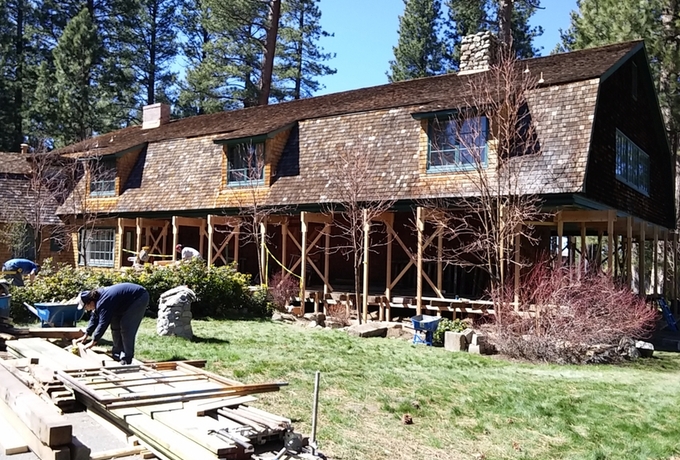
“Motherhood Out Loud” will be at the Valhalla Boathouse Theatre for one night for a fundraiser on May 9.

The evening will begin with a dessert and wine reception with live music. Cakes by Grace and Flour Girl Wedding Cakes will provide the desserts, Thrans will decorate the Grand Hall and Vinny Berry will serenade the crowd with original music.

The show will include an all-star local cast and crew:
Producers: Ginger Nicolay-Davis and Diana Evans
Directors: Pam Taylor, Niv Nivens, Teri Levy, Ann Swallow
Cast: David Anderson, Diana Evans, Michelle Hirschfield, Ginger Nicolay-Davis, Ann Swallow, Pam Taylor.

Tickets for the dessert and wine reception and the play are $50 with proceeds going to support the mission of Valhalla Tahoe to provide world-class arts programming to the community and to preserve and restore the Heller Estate (Valhalla). A limited number of tickets to the play only are available for $25.

The dessert and wine reception will start at 6pm in the Grand Hall at Valhalla and the play will begin at 7:30pm in the Boathouse Theatre.

To purchase tickets, go online.


Susanne ‘Sue’ Stout — 1940-2015

Lake Tahoe Maritime museum friend and board member Sue Stout died April 16, 2015, from an unexpected cerebral hemorrhage. Her husband, Richard, and son, Christopher, were with her at Renown Medical Center in Reno.

Sue was Tahoe Maritime Museum’s marketing guru and editor of the member newsletter “Tahoe MariTimes.” Working an untold number of hours on each issue, she made sure all the publications were at their best. Sue was well known amongst the Friends of the Museum, as she and Rich often hosted Friends’ events at their home. Sue was also the smiling face greeting members and visitors at the annual Launch Party and other Museum events. Her thoughtfulness and boundless energy will put us in her debt forever.

Boating became her avocation and hobby starting with sailboats, “woodies”, and later an express cruiser known as Navy Blue. She and Rich spent time relaxing and entertaining aboard during summers at Lake Tahoe and winters on San Francisco Bay. Married to an avid downhill skier, Sue saw herself as an Iowa flatlander who loved the apres ski fun of alpine winters.

Sue was born Nov. 2, 1940, to Wilma Haines and Elmer “Steve” Steff in Davenport, Iowa. A graduate of Davenport High School, Sue earned her bachelor’s in journalism with an emphasis in public relations and advertising from the University of Iowa. Her career started at the Iowa City Press Citizen where she rose through the ranks. The Iowa City Press Citizen was a member of the transcontinental Speidel Newspapers group and Sue was selected to be Speidel’s promotion manager and first woman executive at their corporate headquarters in Reno in 1974.

Sue married Speidel executive, Richard M. Stout in Reno on June 20, 1977. After Speidel’s merger with the Gannett Newspaper Group, Sue retired and followed her husband’s career, which took them from Reno to St. Cloud, Minn., and St. Thomas, U.S. Virgin Islands. Returning to Davenpor,t Sue gave birth to their son, Christopher, in January of 1981. Retiring from Gannett, the Stouts returned back to Reno in early 1982. In 1983, she and her husband purchased and ran Reno Printing Inc. until they sold it in 2004.

Sue’s generosity and kindness touched many and she will be remembered for her joyous sense of humor and her unfailing graciousness. She also served on the boards of the Nevada Opera Association and the Nevada Women’s Fund. Although “formally” retired from both newspaper and commercial printing businesses, Sue still was meeting deadlines. She did pro bono publication and collateral design for several nonprofit groups, such as Tahoe Maritime Museum, Tahoe Yacht Club, and Tahoe Yacht Club Foundation, where she and her husband were both involved.

She leaves behind her husband, Richard, son Christopher, daughter-in-law Stephanie, grandsons Ryan and Garrett, and granddaughter, Savannah.

The family will have a memorial service to be announced at a later date. In lieu of flowers, the family suggests donations in Sue’s name to the Nevada Women’s Fund, Tahoe Yacht Club Foundation, and Tahoe Maritime Museum.


Lack of pediatric care forces families to leave Nev.

By Siobhan McAndrew, Reno Gazette-Journal

Nate Christy’s medical journey started in Reno with a routine appendectomy on Jan. 13.

What has followed for Nate, 9, were six more surgeries, having to be revived seven times when his heart stopped and three blood transfusions.

And now recovery involves a road out of town.

Nate and many other children in Nevada leave the state in search of better care, specialists, second opinions and established medical communities with teams of doctors that collaborate.

Some leave for things that are considered a given in cities the sizes of Reno and Las Vegas, including to see dermatologists, rehabilitation and treatment for adolescent arthritis. Some leave looking for second opinions and answers.

“Children in our state are at a high risk because there aren’t enough pediatricians and specialists,” said Barbara Atkinson, planning dean of the University of Nevada, Las Vegas Medical School.

Creating a better Nevada system of public medical education is the top priority of the Nevada Board of Regents, the governing body over the state’s public colleges.

Read the whole story


Report: Drought won’t hurt Calif. economy

By Chris Megerian, Los Angeles Times

California’s drought has threatened farmers, ski resorts and golf courses, but it’s unlikely to do much damage to the state’s overall economy or budget, according to a new report.

“We currently do not expect the drought to have a significant effect,” said the report, released Tuesday by the nonpartisan Legislative Analyst’s Office, which provides budget advice to state lawmakers.

The minor impact is explained by the lopsided relationship between water use for farming and agriculture’s overall contribution to the state economy.

Farmers consume four times as much water as California’s cities and towns, and they produce a huge portion of the country’s crops.

But they contribute only 2 percent to the state’s gross domestic product, according to the seven-paragraph report.

Read the whole story


Snippets about Lake Tahoe

valhalla• Crews at the Valhalla Estate on the South Shore are replacing part of its foundation.

• Former South Lake Tahoe City Manager Dave Childs is retiring from public service. His last day as city manager of Palmdale will be June 18.

• Here are the El Dorado-Tahoe and Sierra roadwork schedules from Caltrans for the week.

• An item on the April 21 South Lake Tahoe City Council agenda is for Councilman Tom Davis to be reimbursed $75.04 for driving to Placerville to watch Supervisor Sue Novasel be sworn in.

• The Tahoe Regional Planning Agency’s Lake Tahoe Sustainability Action Plan is being recognized this month with a National Planning Achievement Award for Environmental Planning from the American Planning Association.


Controlled fire operations set for this week

Weather permitting, the U.S. Forest Service Lake Tahoe Basin Management Unit may continue prescribed fire operations starting April 20. Operations may take place in Blackwood Canyon between Tahoe City and Tahoma, at Ski Run Boulevard near Heavenly and on the East Shore near Logan Creek Drive. Operations may last through the next several weeks as conditions allow.

Each operation follows a prescribed fire burn plan, which considers temperature, humidity, wind, moisture of the vegetation, and conditions for the dispersal of smoke. This information is used to decide when and where to burn.

Smoke from prescribed fire operations is normal and may continue for several days after an ignition depending on the project size. Agencies coordinate with state and local county air pollution control districts and monitors weather conditions closely prior to prescribed fire ignition. They wait for favorable conditions that will carry smoke up and out of the Basin.

The Forest Service updates the local fire information line at 530.543.2600, No. 6.


Then and now: Kingsbury Grade not always a paved road


Highway 50 in

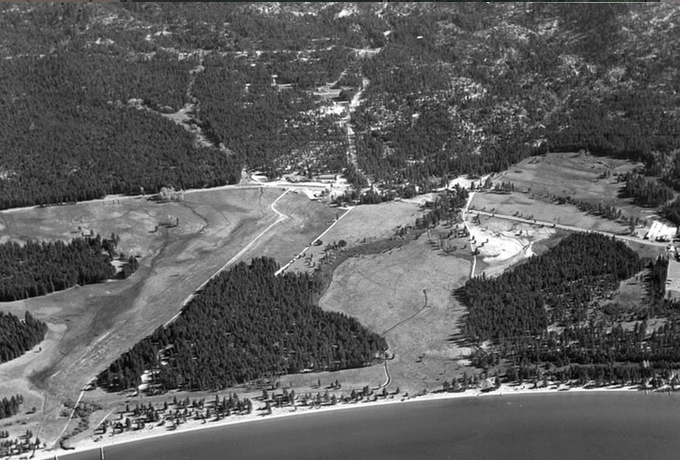
Highway 50-Kingsbury in the late 1950s. Photo/UNR Library

In the 1950s, Highway 50 at Stateline was a two-lane mountain road where it met unpaved Kingsbury Grade, then labeled State Route 19, a twisting dirt road going to the Carson Valley. It was gated at the Daggett Pass summit for winter closure until the 1960s.

The two white diagonal streaks between the junction and the lake are today’s Kahle Drive and 4-H Road. Just left of the highway junction is Casino De Paris or Oliver’s Club in Tahoe Village. Early gaming endeavors at the state line appear at the right edge of the photo.

Highway 50 remained as two lanes in this area until 1957. Kingsbury Grade was paved only part-way up and only on the Tahoe side by then.

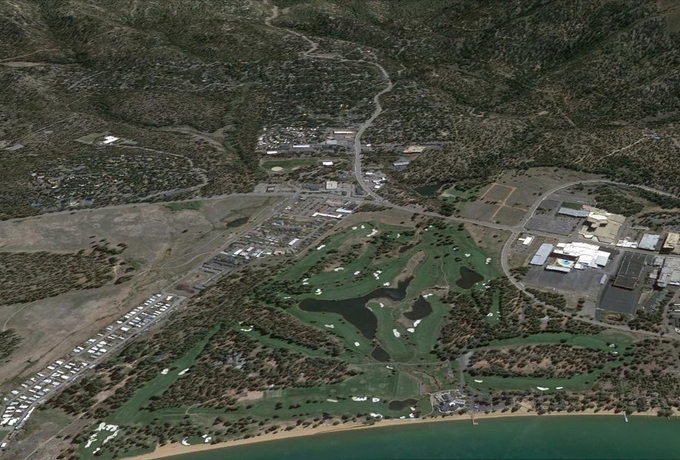
Development surrounds Highway 50-Kingsbury Grade. Photo/Google Earth

Development surrounds Highway 50-Kingsbury Grade. Photo/Google Earth

Today, Kahle Drive and 4-H Road are enclosed by various businesses, including Lakeside Inn, plus diverse housing in Oliver Park and Tahoe Shores.

On the north side of Kahle Drive is Rabe Meadow and the Lam Watah walking trail to Nevada Beach. The large center green area is Edgewood Golf, seen nationwide every July via NBC-TV coverage of the American Century Championship golf tournament. The Nevada portion of the loop road encircles the Stateline casinos along Highway 50.

All of Kingsbury Grade was paved to the Carson Valley floor in 1967. Then it was realigned to join Foothill Road about three miles south from its original junction near Mueller Lane

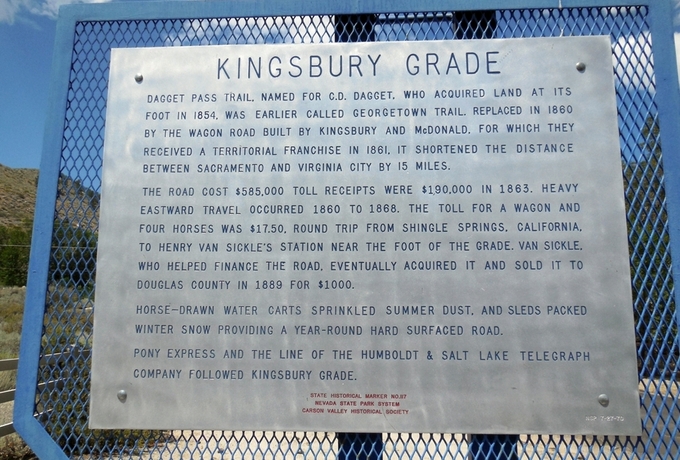
A sign captures the road's history. Photo/Bill Kingman

A sign captures the road’s history. Photo/Bill Kingman

Kingsbury Grade was renamed State Route 207 in 1976. Today it handles an annual average daily traffic count up to 10,000 vehicles daily, according to the Nevada Department of Transportation. Highway 50 in the same area counts up to 22,000 vehicles daily, according to NDOT.

— Bill Kingman