Diaper drive in South Lake Tahoe

Choices for Children is hosting a Mother’s Day diaper drive to benefit the Healthy Bottom Line diapers and wipes distribution program.

Diapers contributed during this drive will go to families in need. Many families in town have trouble making ends meet and being able to get an emergency supply of diapers once every three months can help stretch tight budgets.

The diaper drive is from May 1-15. There are donation bins at: The El Dorado County Library, Boys & Girls Club of Lake Tahoe, Under the Magic Pine Tree, South Lake Tahoe Recreation Center/Pool Complex, Lake Tahoe Airport, Bright Beginnings Inc., Tahoe Parents Nursery School, Tahoe Tot Spot, Tahoe Montessori School, First Baptist Church, and the LTCC Child Development Center. Any size diapers may be contributed.

For more info, call Heather Della Ripa at 530.541.5848.


Class to focus on dealing with trees in a drought

Prolonged drought can have severe and long-lasting effects on trees. University of Nevada Cooperative Extension, in partnership with the Nevada Division of Forestry will provide information on current threats to trees, how trees respond to water stress and strategies to make trees more drought resilient.

According to Heidi Kratsch, University of Nevada Cooperative Extension horticulture specialist, trees may exhibit visible damage from drought in the short term. In the long term, they may reduce flower and fruit production and eventually die if damage is severe. Drought-stressed trees are also less able to protect themselves and become more susceptible to invasion by insects or disease.

Keeping Your Trees Alive During a Drought will be May 1 from 8:30am-4:30pm. The workshop will be held in Reno, at 4955 Energy Way, and will be available via interactive video at several Cooperative Extension offices throughout the state. Workshop cost is $10 and covers certificates of attendance, refreshments and International Society of Arboriculture and Pesticide Applicator Continuing Education Units. Participants must register by April 29.

For more information or to register, go online.


Road beat: Mirage gas mileage is impressive

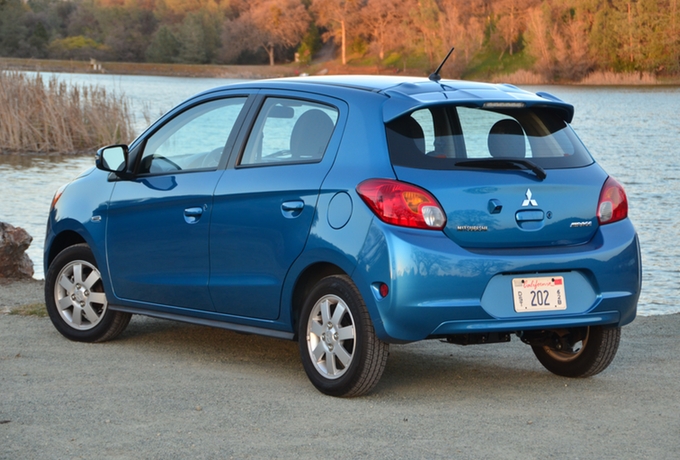
The Mirage would make for a great commuter car. Photos/Larry Weitzman

The Mirage would make for a great commuter car. Photos/Larry Weitzman

By Larry Weitzman

Let’s get one thing straight from the beginning, the Mitsubishi Mirage makes gas stations a mere mirage as it is the highest mileage conventional car for sale in the United States. EPA rates the Mirage at 37/44/40 mpg and in fact it did a bit better in my testing. It also has one of the lowest acquisition costs of any new car for sale in the U.S., with a starting MSRP of $12,995.

And no, that doesn’t mean that the front seats are recycled orange crates. That price includes niceties such as keyless entry and power windows, locks and mirrors. Even seven airbags, ABS, a vehicle stability system, traction control, TPMS and a lot more are also standard. It is a well equipped car.

Mirage is a small car, a rounded two-box design to maximize its space efficiency. While devoid of lots of complex lines, the Mirage has a pleasant, softly rounded simple modern look with decent proportions. The slopping top line adds a dash of sport. It rides on a long 96.5-inch wheelbase, while its length is only 148.8 inches, making it about a hand longer than 12 feet. A Mini Cooper is slightly longer. Width is relatively wide at 66 inches while standing tall at 59 inches, dimensions almost fitting of a small SUV.
Specifications  Price Engine 1193 cc DOHC 12 valve inline three cylinder 74 hp @ 6,000       74 lb.-ft. of torque @ 4,000 Transmission Five speed manual CVT automatic Configuration Transverse front engine/front wheel drive Dimensions Wheelbase 96.5 inches Length 148.6 inches Width 65.6 inches Height 59.4 inches Ground Clearance 6.3 inches Track (f/r) 56.3/56.7 inches Fuel capacity 9.2 gallons Trunk capacity rear seats up/down 17.2/47.0 cubic feet Tires 165/65/14  Turning circle 32.1 feet Weight (ES CVT) 2,051 pounds  Performance 0-60 mph 10.52 seconds 50-70 mph 5.87 seconds 50-70 mph uphill (6%) 12.89 seconds Top speed beyond sanity Fuel economy EPA rated 37/44/40 mpg city/highway/combined Expect about 40-41 mpg in rural county driving; 44-45 on the highway at legal speeds

Specifications
Price
Engine 1193 cc DOHC 12 valve inline three cylinder 74 hp @ 6,000
74 lb.-ft. of torque @ 4,000
Transmission
Five speed manual
CVT automatic
Configuration Transverse front engine/front wheel drive
Dimensions
Wheelbase 96.5 inches
Length 148.6 inches
Width 65.6 inches
Height 59.4 inches
Ground Clearance 6.3 inches
Track (f/r) 56.3/56.7 inches
Fuel capacity 9.2 gallons
Trunk capacity rear seats up/down 17.2/47.0 cubic feet
Tires 165/65/14
Turning circle 32.1 feet
Weight (ES CVT) 2,051 pounds
Performance
0-60 mph 10.52 seconds
50-70 mph 5.87 seconds
50-70 mph uphill (6%) 12.89 seconds
Top speed beyond sanity
Fuel economy EPA rated 37/44/40 mpg city/highway/combined Expect about 40-41 mpg in rural county driving; 44-45 on the highway at legal speeds

Under the short hood is unique three-cylinder long stroking DOHC, 12 valve 1,200 cc engine (1.2 liters) cranking out all of 74 horses at 6,000 rpm and an equal amount of torque at 4,000 rpm. The rule of thumb for estimating an engine’s torque production is a pound per cubic inch. The 1,200 cc Mirage engine equates to about 74 cubes, the exact peak torque number for the Mirage. But remember the engine only has to deal with 2,051 pounds. Still not exactly a powerhouse as my Kawasaki ZRX motorcycle has 1,200 ccs in four cylinders and makes about 125 hp (at 10,000 rpm). Weighing 535 pounds the Kawi has the edge on performance. More on that later.

Power is transferred to the front wheels via a CVT tranny. A five-speed manual is standard.

Performance is about as you would expect in that this vehicle wasn’t designed with NASA in mind unless earthbound NASA employees wanted to save gas. Zero-60 mph times averaged 10.52 seconds which is about two seconds quicker than a 1955 Chevy V-8, a car once thought to be sort of a hot rod. Simulated passing times from 50-70 mph on a level road averaged 5.87 seconds and up a steep grade (6 percent) that time slows to 12.89 seconds. During a trip to South Lake Tahoe up Highway 50 I was able to make several passes in the many passing zones during the uphill climb; just do a little planning. For most people, especially flatlanders, the performance is more than adequate.

Throttle response is good, but one thing I noticed is the tranny keeps the rpms between 5,200 and 5,600 rpm during maximum performance which restricts hp by perhaps a few ponies. When you ask for flank speed the computer that controls the tranny should allow max hp which is 6,000 rpm. When you are at 6,000-7,000 feet and are already down 20 percent on max power an extra 5-7 hp would be nice.

Now to the raison d’être for the Mirage, fuel economy. You already know the EPA numbers, but what is it like in real life. The Mirage averaged 41 mpg in 350 miles of driving with only 20 miles on a level freeway during highway mileage testing when the Mirage averaged 44-45 mpg, about equal to your average small hybrid. In that 150-mile roundtrip from Rescue to South Lake Tahoe and back where speeds averaged about 60 mph even up the Western Slope, the Mirage averaged about 45.2 mpg. Remember that Kawasaki ZRX1200 motorcycle? It averaged about the same mpg during the same trip averaging the same speeds. While the Mirage engine spins a low 2,300 rpm at 70 mph, that Kawasaki spins about 3,800 at the same speed.

Mirage achieved the highest fuel economy numbers of any conventional car tested by the Road Beat (about 850 cars) and even beat most hybrids tested except for some later model Priuses. The Mirage not only outperformed the hybrid Honda Insight in acceleration, it returned overall better fuel economy by a couple mpg (Insight was tested in 2010).

Mirage’s biggest handling asset is that it is lightweight. Light cars change directions easier than heavier cars all else being equal. Suspension is a state of the art MacPherson strut up front plus a semi-independent torsion bean in the rear, pretty standard for most compact cars and smaller. Wheels and tires are rather small at 14 inches with 165/65 rubber. I’ve seen bigger glazed doughnuts. Actually, 14-inch wheels and tires were standard on most 1957 and later U.S. made cars for about 10-15 years. That means most full size GM, Ford and Chrysler products, like Chevy Impalas, Ford Crown Vics and Plymouth Furies. Even my 1972 Camaro SS came with 14 inch/70 series wheels and tires.

Handling because of its size, weight and front and rear track of 56 inches is nimble up to about seven-tenths cornering. Yes, there is some body roll, tire squirm and understeer going into a slight oversteer, but unless pushed beyond eight-tenths, drivers will say the Mirage is nimble. If you want more, spend $10K more for a Mini, lose a good 5-7 mpg plus the Mirage’s 100,000-mile powertrain warranty. Wall-to-wall turning circle is a dime sized 32 feet. Steering had excellent on center feel as if it were locked on a target. It is fun to drive.

You might think a small car like the Mirage would have a choppy ride and find every expansion joint on the freeway. But that is not the Mirage. It rides like most every good quality compact car, smooth on the highway and it can smooth out more severe road punishment. It really surprised me. About the only complaint is a bit of road noise on rougher surfaces, but going down the highway at 70 mph is a pleasure, smooth and reasonably quiet. Even the engine is unobtrusive.

And safety is not compromised as the front disc/rear drum brakes stop the Mirage in 41 feet from 40 mph, one foot off the benchmark 40 feet. Seven airbags are standard as well as all the safety acronyms. A buffet of safety.

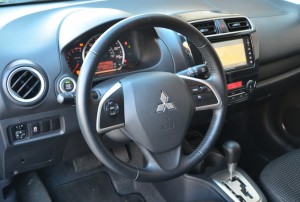
Now to the inside. It’s purposeful with a simple binnacle dash with a large speedo and smaller tach plus digital readouts for fuel, fuel economy, trip meters and alike. In the ES model, entry is push button as is the start, no key necessary but the fob in your pocket. Seats are done in an upscale cloth and are comfortable. I spent nearly two hours each way to Tahoe with no fatigue and good support. And the back seat is amazing considering how small this car is. It is comfortable for two good sized adults.

With the rear seats up there is 17 cubic feet of cargo capacity. Fold the seats flat and cargo volume expands to 47 cubic feet which is close to the size of a compact SUV. Mirage has one small issue; it only has a 9.2-gallon gas tank. Another half a cubic foot would give it 13 gallons and much more convenience.

While pricing starts at a fin below $13,000 plus $810 for the boat from Thailand, my loaded tester stickered at $15,395 plus $900 for the trick NAV system and backup camera plus destination. Even Bluetooth is standard. Mirage is inexpensive to buy, inexpensive to run and really inexpensive to maintain, never mind that five-year 60,000 mile bumper to bumper warranty plus Mirage’s 10-year 100,000-mile powertrain warranty. Even the tires for this Mirage are inexpensive, more than a large glazed doughnut, but probably about a quarter of the price of a full-size car or truck tire.

Larry Weitzman has been into cars since he was 5 years old. At 8 he could recite from memory the hp of every car made in the U.S. He has put in thousands of laps on racetracks all over the Western United States.



South Shore bike trails, ball fields may expand

By Kathryn Reed

A multi-pronged approach is being taken to speed up the process of laying down the Greenway Bike Trail on the South Shore as well as improve other recreation amenities and the connection between areas.

California Tahoe Conservancy, the lead agency in the Meyers to Stateline trail, is working with South Lake Tahoe and Lake Tahoe Community College in a potential land swap that would have the government bodies owning more contiguous acreage and put a stream environmental zone into state ownership.

The college board on Tuesday night had a study session about possibly being a partner in applying for a state grant that could bring $2 million to town to help build a chunk of the bike path that follows the old Caltrans right-of-way that the Conservancy acquired in 2000. Also discussed was the future of the community ball field.

The Active Transportation Program (ATP) is a combo of state and federal dollars that the state is administering. To receive the grant it’s imperative to approach the proposal as a team and have a chunk of cash to assist with the project.

The Conservancy has $1 million to put toward the project beyond the work that will be done this summer. (The trail from Herbert Avenue to the edge of Bijou Meadow at Glenwood Way will break ground next month.)

The city and college would also each need to put in about $1 million. A commitment, though, from the electeds still needs to be obtained. The city and LTCC each has a subcommittee of two members working the trails issue as well as the community ball field.

Sue Rae Irelan, who has been spearheading the Greenway trail for the CTC for years, told the college board that even if the South Shore is awarded the grant, it’s possible to turn it down, so the college is not committed to spending money until it accepts the state money. The deadline to apply for the grant is late May.

At the April 21 meeting the college board was lukewarm in agreeing to pursue the conversation.

In Measure F, the voter approved facilities bond from 2014, there is money for trails. Any bond money must only be used for improvements on land the college owns. LTCC, with the multimillion-dollar donation for the university center, has even more cash for this bike project if the board decides it’s a worthy project.

The next phase of the Greenway – that the grant would help pay for – goes from Glenwood Way to Al Tahoe Boulevard. This brings the trail right to the college, to the community ball field and the path on Al Tahoe.

The city is contemplating going after a separate ATP grant to further the South Tahoe Middle School connectivity plan. This would provide a trail along Al Tahoe to Johnson Boulevard. This would hook up with the Greenway.

Part of all the discussion is the future of what is a community ball field that has become the more exclusive use of the college for its soccer program. The field was built with Measure S money, the recreation bond. Two other fields were supposed to have been built.

The college and city are talking about building another field adjacent to the current one as well as a smaller practice field. It’s estimated a second field, on land the city owns, would cost about $1 million.

It will be at the college board’s May meeting that a vote likely will be taken on whether to prepare a letter of support for the grant, whether to exchange property, allocate bond money to the bike trail project, and finalize plans for the future of the current ball field and construction of a new one.

CTC officials will be making a presentation to the City Council on May 5. At that same meeting the council is scheduled to hear about the grant proposal. The CTC board is likely to receive an update on the Greenway at its April 30 meeting.


Opinions: Ways to deal with bears

Publisher’s note: The following letter was sent to the South Lake Tahoe Basin Waste Management Authority from Ray Jarvis the director of Public Works for South Lake Tahoe, Jeanne Lear the Human Resource manager for South Tahoe Refuse, and Catherine Cecchi the executive Director of Clean Tahoe Program.

The South Lake Tahoe service area covers the City of South Lake Tahoe, unincorporated El Dorado County East Slope and American River Watershed and Douglas County Tahoe Township, generally from south of Emerald Bay to Spooner Summit. All three jurisdictions have ordinances addressing nuisances caused by animal disturbance of trash and similar code compliance procedures, involving notices, fines and/or installation of animal resistant trash boxes.

Currently, South Tahoe Refuse provides clean up of trash messes during regular collection routes. This has been a long time customer service practice, reflecting STR’s respect for our customers and our environment. However, STR is now tracking and taking photos of trash messes through its customer account system. Last year, STR changed the residential start time from 5 am to 7 am to encourage residents to put garbage out the morning of pickup. This does not, of itself, change the bears’ behavior or resolve the problem, but it does make it more reasonable for residential customers to put their garbage out the morning of pickup.

Clean Tahoe, a non-profit organization operating in California, provides additional response to calls from the public on individual properties where wildlife has had access to trash. Clean Tahoe has been cleaning up messes, without compensation, and also provides courtesy notices to property owners with information that refers to applicable ordinance violations. Clean Tahoe responded to, and cleaned up, 265 animal-in-trash incidents last year and reports multiple infractions on at least 100 properties a year in the California areas. These are usually properties that have placed trash out days before their collection day, often vacation and long-term rentals. Neighbors call them into Clean Tahoe. Repeat offenders and problem properties are eventually referred to City of South Lake Tahoe’s Code Enforcement Division or El Dorado County’s Environmental Management Division for code enforcement. Douglas County code enforcement staff responds to and issues violation notices in the Tahoe Township area.

The South Lake Tahoe Solid Waste Management Joint Powers Authority, comprised of elected representatives from the three jurisdictions, oversees a wide range of solid waste issues, including recent discussions of coordinating and improving policies to reduce bear interaction with the human environment. At the JPA’s direction, City and County staff and staff from STR and Clean Tahoe have been meeting and submit the following update:

Preliminary strategies include:

• Utilize STR and Clean Tahoe databases to collect data on location and number of incidents at problem properties, including photos of incidents. Add Douglas County incident records, consolidate data and map through City GIS department to identify problem areas. STR will merge Clean Tahoe’s data into its customer data base so that incidents can be sorted by property address. Incline Village, which has been actively addressing these issues for years, has taken a similar approach by mapping problem locations and animal movement.

• Make jurisdiction ordinances as compatible as possible on compliance procedures. A three tiered notification process is recommended as a reasonable level to make property owners aware and initiate compliance. Tighten ordinance language to limit the time that residential trash can be placed at curbside; the morning of pickup, not the night before. Require locking of dumpsters at commercial properties. Clarify language on suitable refuse containers.

• Discuss the efficiency and effectiveness of civil compliance, i.e., fines, versus administrative compliance, i.e., service fees leading to installation of animal resistant enclosures. Pursuing civil penalties requires staff time from compliance personnel and ultimately legal staff and may not be as effective in reaching the ultimate goal of reducing animal interaction with trash as the administrative process of tiered notification and requiring enclosure installation. Likewise, collecting fines and then rebating them back for enclosure installation requires additional administrative time. Make the message straightforward and clear – three notifications means installation of a residential animal resistant metal trash enclosure.

• Include waste management as part of vacation rental regulations. Many vacation rentals are overseen by property management companies, which, by and large, handle the solid waste responsibly. Many have the cleaning staff remove the garbage and bring it directly to the South Tahoe Transfer Station. Others may have arrangements with neighbors or friends to place the garbage out on collection day. Vacation rental regulations should address problem properties, using the tiered notification process to eventually require installation of an animal resistant metal trash enclosure.

• STR to work with individual commercial properties for appropriate resources and equipment, i.e., locking dumpsters and/or installing compactors at resorts and retail complexes. Ordinances should require that dumpsters located at these commercial properties must remain closed and locked when not in use or be subject to fines if problems develop because of access to open dumpsters. Multi-family complexes have a particular problem with metal dumpsters that are both animal resistant and still manageable for young and senior residents. STR is testing several designs that integrate hand leveraged metal doors on dumpsters so that tenants are not struggling with metal lids. In the meantime, ordinances should require that multi-family complex owners, or their managers or a designated tenant, close and lock dumpster lids each night before dark. This may be another area where a fine schedule is necessary to reinforce compliance.

• Clean Tahoe has as existing service fee of $35 for various services, such as picking up bulk items. It is recommended that this service fee should also apply to cleaning up animal in the trash incidents at properties. As a fee, not a fine, it can be administered by Clean Tahoe and STR through existing billing mechanisms to cover the cost of staff time and disposal of the material.

• Coordinate among our jurisdictions and with other Lake Tahoe and Sierra region jurisdictions on educational platforms that provide a strong and consistent message that “a fed bear is a dead bear”. Incline Village General Improvement District has excellent educational material that can be modified to address our particular community needs. IVGID is also developing a bear/human conflict management plan by working with other resources and agencies. The Tahoe Fund includes bears and trash in its new “Take Care” campaign. Linking with area resources to get the word out can help create the public and community support necessary to move from reactive bear management to a proactive approach that reduces bear deaths and improves public safety.


SLT vacation home rental permit fees increasing

South Lake Tahoe is about to charge a more realistic fee for vacation home rental permits.

That is the major change to the ordinance that was amended on Tuesday.

As with all ordinances, they must be read and voted on a second time before becoming the law of the land. And while usually items on the consent agenda sail through without discussion, that wasn’t the case for something so controversial.

Still, only four people spoke at the April 21 City Council meeting. This compares to the April 7 meeting when 30 people voiced their opinions.

The council, with Tom Davis recusing himself because of his ownership in Tahoe Keys Resort, did not make any changes to what had been voted on two weeks ago.

Fees will go up starting June 1. They are based on the number of bedrooms and the number of violations an owner has incurred the previous 12 months. It also involves the manpower required to deal with the fees – including the city attorney’s office and other departments that were not previously included.

Money raised will also support the hiring of additional enforcement personnel and a full-time auditor.

—–

 In other action:

  • No one made a motion to grant Councilman Tom Davis’ request to be reimbursed for driving to Placerville to see Supervisor Sue Novasel sworn in, so he has to foot the bill and not taxpayers.
  • Awarding of the contract for the multi-million dollar Sierra Tract erosion contract was delayed because one of the bidders is challenging the process. The dispute will go to a hearing board and then be brought back to the council.
  • The mid-year budget was approved.

           — Lake Tahoe News staff report


Letter: DA needs to play fair in Ready Mix case

To the community,

Prosecutorial misconduct in the Michael Wallace matter?

The El Dorado County District Attorney’ Office approved issuance of a false press release incorrectly stating that concrete poured by Sierra Tahoe Ready Mix could fail. This created unnecessary hysteria in our community.

In contrast, all concrete was tested prior to being poured, and all of the concrete passed.

The assistant DA handling the case wrongfully withheld information from Mr. Wallace for over four months. She falsely promised Mr. Wallace that if he agreed to her third continuance request, she would finalize a misdemeanor offer for him, and the additional time was “to Mr. Wallace’s advantage.” Instead, she used the delay to attempt to amend her complaint, and increase her offer substantially. At an April 3, 2015, hearing, she further misrepresented her conduct to Judge Suzanne Kingsbury when trying to file additional charges without complying with the law.

Prosecutor overreaching: The majority of charges against Mr. Wallace involve conduct that was done with permission of his supplier and is a common industry practice: “Bing Materials gave Mike permission to use the mix design criteria for his mix design” “this is not uncommon in the Ready-Mix Industry.” Mr. Wallace had permission to take the actions he did. Despite this, the DA ignores Mr. Wallace’s lack of culpability and instead pursues multiple felonies based on this legitimate conduct.

Even the alleged “victim” in the DA’s case supports Mr. Wallace: “[STPUD] does not consider there to be any potential damage or resulting required restitution, from the use of concrete from Sierra Tahoe Ready Mix on the projects referenced in the above lawsuit.” Richard Solbrig, STPUD general manager.

The DA should do the right thing, particularly in light of the inexplicable prosecutor actions in this case. Offer Mr. Wallace the promised misdemeanor. That alone would be commensurate with what happened in this case.

Jacqueline Mittelstadt, Tahoe Law Center


Religion complicates Calif. vaccine debate

By Jeremy B. White, Sacramento Bee

Nick Johansen arrived at a Capitol hearing on vaccinations last week carrying a Bible.

Johansen, who said he hasn’t yet decided whether to vaccinate his 10-month-old daughter Savannah, argued government shouldn’t impose a reverence for science over his faith in God.

Senate Bill 277, a bitterly contested California bill eliminating the state’s personal belief exemption for vaccines, doesn’t apply just to parents who believe they are dangerous. It also would eliminate parents’ ability to skip vaccinations for religious reasons.

In what Johansen described as an affirmation of his faith, his daughter has overcome severe medical issues. He considers her survival miraculous and warned SB 277 would harm devout Californians like him.

Read the whole story


Tips for growing tomatoes

By Melinda Myers

Nothing beats the flavor of fresh-from-the-garden tomatoes. Make this your biggest and tastiest tomato harvest yet with proper planting and care.

Reduce pest problems and increase the harvest by growing tomatoes in a sunny location with well-drained soil or in a quality potting mix for container gardens. Improve your garden soil by adding several inches of organic matter to the top 8 to 12 inches of soil prior to planting. Compost, aged manure, and other organic materials help improve drainage in heavy clay soil and increase the water holding ability of sandy soil.

Add a slow release organic nitrogen fertilizer according to label directions at planting. Slow release fertilizers provide a constant diet that is better for your plants and less work for you.  Save yourself more time by mixing the fertilizer into the soil when incorporating the organic matter. Then give your plants a midseason boost as needed.

Once the soil is prepared, wait for the air and soil to warm to plant your tomatoes. Planting too early when the soil is still cool and the nights are chilly can stress the plant and delay your harvest.

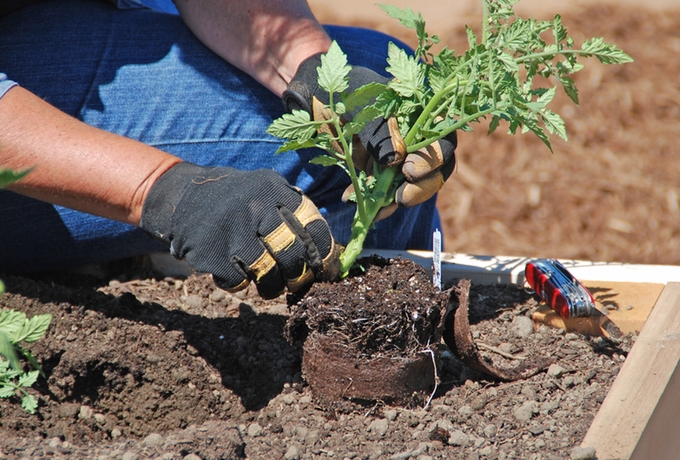
e. Photo credit: "Melinda Myers, LLC."    Photo line:  Myers recommends planting tomatoes slightly deeper or in a trench for better rooting.

It’s best to plant tomatoes slightly deeper or in a trench for better rooting. Photo/Melinda Myers LLC

Plant your tomatoes slightly deeper or in a trench for better rooting.  Trench tomatoes by digging a shallow trench about 3 to 4 inches deep. Remove the lower leaves and lay the plant on its side in the hole. Roots will eventually form along the stem. Carefully bend the stem, so the upper leaves will be above the soil.  Fill the trench with soil and water.

Stake or tower your tomatoes to reduce insect and disease problems and make harvesting easier.  The type of tomato and your schedule will help determine the training system that works best for you.

Determinate tomatoes (look for the D on the tag) grow a certain height and stop.  They work well in towers, containers or even hanging baskets.  Indeterminate tomatoes, labeled with an I, keep growing taller, producing more flowers and fruit until the end of the growing season.  These do best when grown on tall sturdy stakes or extra tall strong towers.

Towering tomatoes is easy. Simply place the tower over the tomatoes at planting. Tomatoes grown in towers produce a larger, but later harvest than staked tomato plants.

Allow a bit more time if you decide to stake your plants. Place the stake in the ground at planting. Be careful not to injure the roots. As the plants begin to grow prune off all side branches, suckers, that develop between the main stem and leaves. Loosely tie the remaining one or two stems to the stake. Cloth strips, twine or other soft ties work well. Keep tying up the plants as they continue to grow. Staked tomatoes produce the earliest and smallest harvest.

Check new plantings every few days and water often enough to keep the developing root system moist. Reduce frequency as plants become established. Water established plants thoroughly whenever the top few inches of soil are slightly moist. Mulch the soil with evergreen needles, shredded leaves or other organic mulch to keep the soil consistently moist and suppress weeds. Consistent soil moisture encourages more flowering and fruiting, while reducing the risk of blossom end rot, cracking and misshapen fruit.

Harvest your tomatoes when fully colored. Leave them on the plant an extra 5 or 6 days for even better flavor. Unfortunately, the animals often move in and feast on the ripening fruit. In this case, you may need to finish ripening tomatoes indoors.

And once you taste that first red ripe tomato, you’ll be looking for more sunny spots for containers or to expand your garden.

Gardening expert, TV/radio host, author and columnist Melinda Myers has more than 30 years of horticulture experience and has written more 20 gardening books, including “Can’t Miss Small Space Gardening” and the “Midwest Gardener’s Handbook”. 


Trail running shoe demo in Tahoe City

On April 26 from 9am-2pm Alpenglow Sports and trail running brand Hoka One One will host a fun run and demo event in Tahoe City.

Known for the creation of the “maximalist” trail shoe category, Hoka One One will be on hand with demos. Since 2010, Hoka One One has been on a quest to bring groundbreaking and elevated benefits to all runners.

The demo event is free to all and runners are encouraged to take the demos to their favorite trailhead to test.

In conjunction with the demo, Alpenglow Sports will lead a community fun run on the Tahoe Rim Trail at 10am. The run will be mellow, 5-6 miles long, and possess plenty of fun, technical singletrack to try the shoes on. While the demo is free, a credit card and driver’s license are required to test equipment. Runners of all ages and ability levels are encouraged to attend.

Meet at Alpenglow Sports, 415 North Lake Blvd., Tahoe City.