Bill calls for inventory of Nev. water rights

By Sandra Chereb, Las Vegas Review-Journal

CARSON CITY — With drought gripping Nevada and much of the West, the state’s top water official and a state senator said it’s time to inventory how much water there is and who owns what by tidying up the books on water rights that pre-date state law.

“Clearly if we’re going to establish a water inventory … we have to understand what water is available, what is permitted,” state Sen. Pete Goicoechea, R-Eureka, told members of the Assembly Government Affairs Committee during a hearing Wednesday.

At issue are so-called “vested” rights initiated by putting water to beneficial use before state law was enacted setting regulations for surface water use in 1905, artesian groundwater in 1913 and percolating groundwater in 1939.

Read the whole story


New boom ahead for Boomtown area

By Bill O’Driscoll, Reno Gazette-Journal

Nearly 800 acres of open land along Interstate 80 near Verdi have new owners who are targeting much of it for development to meet demand anticipated with the region’s resurgent economy.

Reno Land Development Company LLC recently closed on a $13.1 million purchase of 780 acres from Las Vegas-based Pinnacle Entertainment, which sold the nearby Boomtown Casino and Hotel in 2012.

Chuck Reeves, a Reno Land Development Company partner, said the timing is right given the parade of new businesses coming to Reno-Sparks, led by Tesla Motors’ $5 billion battery gigafactory, bringing thousands of new jobs.

Read the whole story


Tahoe boat inspections to resume in May

Roadside stations for inspections and decontaminations of motorized boats and watercraft in Lake Tahoe open in May.

The dates are:

Opening  May 1:
8:30am-5:30pm, seven days a week
Meyers: at the junction of highways 50 and 89
Spooner Summit: at the junction of highway 28 and 50 in Nevada
Alpine Meadows: Highway 89, off Alpine Meadows Road north of Tahoe City.

Opening May 21:
8:30am-5:30pm, Thursday-Sunday
Truckee-Tahoe Airport: Highway 267, off Airport Road

The Homewood inspection station is closed this season. The Northstar station has ben replaced with the Truckee Airport location.

All motorized boats and watercraft require inspection for aquatic invasive species (AIS) prior to launching into Lake Tahoe. Invasive species, such as quagga mussels, New Zealand mudsnails, and hydrilla, are known to multiply quickly and colonize underwater surfaces, including docks and piers, water supply and filtration systems, buoys, moored boats, and even the beautiful rocky shoreline. They destroy fish habitat, ruin boat engines, and can negatively impact water quality and the local economy, recreation, and ecosystem.

For more information, go online.


Study: The Big One could trigger series of large quakes

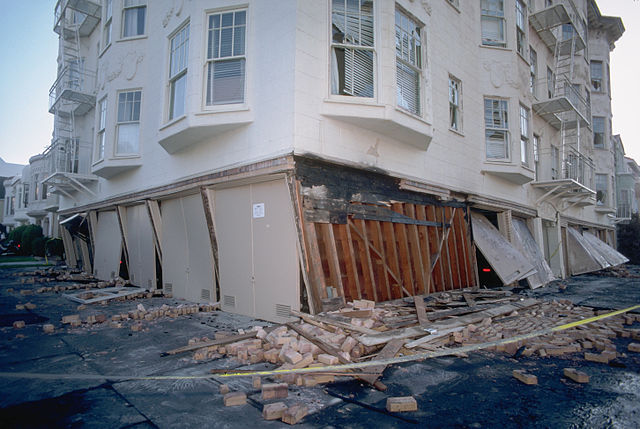
"LomaPrieta-Marina" by J.K. Nakata, United States Geological Survey - http://pubs.usgs.gov/dds/dds-29/web_pages/sf.html, http://pubs.usgs.gov/dds/dds-29/tif/img0007.tif. Licensed under Public Domain via Wikimedia Commons - http://commons.wikimedia.org/wiki/File:LomaPrieta-Marina.jpeg#/media/File:LomaPrieta-Marina.jpeg

The San Francisco Marin District after the 1989 Loma Prieta earthquake. Photo/J.K. Nakata, U.S. Geological Survey

By Rong-Gong Lin II, Los Angeles Times

Research released Wednesday suggests the shaking from “the Big One,” the long-predicted major earthquake on the San Andreas fault, could trigger additional large temblors on nearby faults, intensifying the overall seismic impact.

The study suggests that such a quake “could presage a flurry of ‘other Big Ones’ on other faults,” said USC earth sciences Professor James Dolan, “as stresses related to the original San Andreas fault earthquake are redistributed on other faults throughout Southern California.”

The study, presented by Dolan at a meeting of the Seismological Society of America in Pasadena, focuses on whether earthquakes are generated in “super cycles.” A super cycle refers to when a large number of quakes rupture on a single fault system in a relatively short period of time in seismic terms, over a matter of decades or a few centuries.

Read the whole story


Snippets about Lake Tahoe

Northstar Zephyr Lodge Bill Rock, Ted Gaines• Ted and Beth Gaines have moved to El Dorado Hills with the likelihood of the assemblywoman running for El Dorado County supervisor in 2016 and then being ready to run for her husband’s state Senate seat when he is termed out in 2020 — assuming he’s re-elected in 2016.

• CouponsDaily.com has named Lake Tahoe one of the 10 Affordable Honeymoon Destinations.

• Fall sports athletes in the Tahoe area are eligible to receive a free pre-participation physical through Barton Health on June 1. Forms may be picked up in the school front office or through the athletic coach. For details, call 530.543.5615.

• Tahoe Douglas Firefighters will be having a free child safety seat workshop on April 30 from 11am-noon in the parking lot at Kahle Community Center in Stateline. For more information, call 775.586.7271.

• The state Department of Water Resources has canceled the May 1 snow survey because nothing has changed since April 1 survey when the ground was barren.


Photo exhibit captures Nevada mines

The Comstock History Center Museum is hosting a photo exhibit entitled Vanishing Icons: A Look Back at Comstock Mines and Mills.

In 1980, a documentation project was undertaken on the Comstock to record the remains of historic mine and mill sites originally built throughout Virginia City, Gold Hill, Silver City and Dayton during the late 1800s and early 1900s. The exhibit features 16 large-format, black and white photographs from this project.

As part of the Historic American Engineering Record, the project was sponsored by the U.S. Department of Interior and conducted by the National Park Service. It involved surveying, photographing and creating a written description for the structural remains of each mine or mill, including historical, operational and architectural data. Until now, these images have never been publicly displayed.

The Comstock History Center Museum is located at 20 N. E St. in Virginia City, two blocks downhill from the Bucket of Blood Saloon. Admission is free and the museum is open on Thursdays and Fridays from 10am-4:30pm and Saturdays from 10am-5pm.


Compost expert to talk about drought

The Douglas County Public Library in Minden is sponsoring a special program called Organic Gardening with the Drought.

Craig Witt from Full Circle Compost will be the speaker April 28 at 5pm. He will give tips on how to have a successful garden when water is in short supply. Heirloom tomato plants will be available for a small donation.

Full Circle Compost manufactures organic compost, topsoil and mulches. It began as a manure management system and means of increasing crop production at the Milky Way Dairy Farm in Minden. Witt has become a leading expert in soil and composting science.

The Douglas County Public Library is located at 1625 Library Lane, Minden.


Stranded Truckee River trout relocated

By Sage Sauerbrey, Moonshine Ink 

“Fish on!”

A fisherman yells out as Mike Wier, outreach coordinator for California Trout, hooks into a behemoth rainbow trout in a pool just above the Fanny Bridge in Tahoe City.

This 31-inch monster is one of roughly 40 trout that have become stranded in a short section of the Truckee River since Lake Tahoe dropped below its natural rim in August 2014. Community concern grew through the winter as the dissolved oxygen in the 75-foot stretch of water started to drop and the pool neared unlivable levels for the trapped trout.

“The habitat here is just becoming unsuitable for fish to live in, so either they die or we move them,” Trout Unlimited California field director David Lass said.

A collaborative effort between Trout Unlimited, the California Department of Fish and Wildlife (CDFW), and California Trout brought 20 volunteers to Fanny Bridge the morning of April 21. The mission was to relocate the stranded trout to the cleaner waters of Lake Tahoe, but it also offered a once in a lifetime opportunity to fish for the prized trout.

Read the whole story


Opinion: Time to stand up for public lands

By Todd Tanner, High Country News

As Google Earth flies, it’s five miles and change from the Echo Lake Café in the Flathead Valley, one of Montana’s great little restaurants, up to a parking area at a trailhead that leads to Jewel Basin. Down here in the valley, we’re at 3,000 feet. Up where the gravel road dead-ends, you’re looking at 5,700 feet. If you make it all the way to the top of 7,500-foot-high Mount Aeneas, you’ll be rubbing elbows with some top-of-the-world views, not to mention mule deer and mountain goats.

We’re talking about almost a mile of elevation change, yet the amazing thing is that once you leave the valley floor, all that land stretching on seemingly forever belongs to you and me and all of our fellow Americans. It doesn’t matter whether you live here in Montana, or in Colorado, Wyoming, New Mexico or New Jersey. All that acreage, which is administered on our behalf by the U.S. Forest Service, is ours. We can roam where we choose, we can hike, we can fish the lakes and pick fresh huckleberries for lunch and pitch our tents under all that Big Sky. We’re free to wander to our heart’s content on public land, and for a lot of Americans, that’s an incredible thing.

I’d go so far as to say that here in Montana and across the West, our public lands, which make up 50 percent or more of our states, equate to freedom. Let’s make that freedom and prosperity, because almost everything of substance, from our Western heritage to our economy to our recreation, flows from the bounty of our public lands.

That is why it’s so disappointing that 51 U.S. senators, every single one of them entrusted with our nation’s well-being, recently cast a vote that could help destroy the West — one that could turn over America’s public lands to multinational corporations, lock out hunters and hikers, and shift control of our timber, our grazing rights, and our minerals, along with the very lifeblood of the West — our water — to profiteers and foreign interests.

Read the whole story


Truckee among the top polluting mountain towns

By Teton Gravity  Research

When we set out on our quest to find the mountain towns with the largest carbon footprint, it was not an easy task. The hardest factor was to find a common denominator for all of these different areas. That’s when we discovered an interactive map of the United States created by researchers at UC Berkeley, who weighed over 37 variables, including household energy use, consumer expenditures, and transportation to provide the average metric tons of carbon pollution produced by each household in every county in the United States.

We used this data to rank over 30 mountain towns and, as a jumping-off point, to discover what is going on in these mountain communities.

What we discovered is that the two factors that lead to pollution in most mountain towns are housing and transportation. This usually stems from an inadequate public transit system or large vacation homes that are not occupied for the entire year.

Truckee came in at No. 9.

Read the whole story