Living with devastating reality of year-round fire season

By Julia Prodis Sulek, San Jose Mercury News

BISHOP — The fire came up quickly here in the eastern Sierra Nevada, destroying 35 homes and taking the mountainside community of Swall Meadows by surprise. Who would expect a roiling wildfire — throwing fireballs and whipping up flame whirls through 7,000 acres of sagebrush, piñon and Jeffrey pine — in the dead of winter?

“Three years before, I had 12 feet of snow at my house on that exact date in February,” said volunteer Fire Chief Dale Schmidt, whose Wheeler Crest station in the remote Swall Meadows neighborhood is surrounded by carcasses of burned homes. “Four years ago, they would have had a couple to 3 feet of snow where the fire started. That’s the mental state people were in: Winter is not the season for fire danger.”

As California enters its fourth year of drought, communities across the West are confronting a new reality — a year-round fire season. Perhaps nowhere are the consequences as obvious as in Swall Meadows, where the 300 residents are now shoveling ash instead of snow.

Read the whole story


Golf tournament benefits Truckee High athletes

The Truckee Wolverine Boosters Club is hosting its third annual golf tournament on May 31 at the Golf Club at Gray’s Crossing.

It will be a four- person scramble format and the cost is $125 per person. Check in at 9am, with a shotgun start at 11am.

This event includes raffle prizes, silent auction, putting contest, closest to the pin and long drive contest.

Sign up online at or call Sharon Fereira at 530.582.9181 or email truckeehighboosters@yahoo.com.

All proceeds benefit the Boosters Club and the students of Truckee High School.


Laura Ingalls Wilder finds stardom in old-fashioned way

By Nora Krug, Washington Post

One of the most coveted books of the season is not a thriller or a celebrity tell-all but an oversize, 472-page annotated autobiography with hundreds of detailed notes and several appendixes. It weighs roughly three pounds and is printed on specially cut paper.

Unlike typical New York Times bestsellers, it is not available as an e-book — and might not be for some time. Finding a hardcover edition has been for many an exercise in frustration. Amazon.com can barely keep the book in stock, and one secondary seller on the site is hawking a first edition for $499 (plus shipping), or about 12 times the cover price of $39.95.

The book is “Pioneer Girl: The Annotated Autobiography,” an expanded version of a memoir by celebrated “Little House on the Prairie” author Laura Ingalls Wilder. Wilder herself couldn’t find a publisher for the memoir 85 years ago. So, working with her daughter, she used it as the basis for the series of novels still so popular today.

Read the whole story


Deputies apprehend felon after chase

An El Dorado County man was arrested April 24 after leading El Dorado County sheriff’s deputies on a chase.

Abram Sassenberg

Abram Sassenberg

Abram Sassenberg, who was wanted on a felony warrant, was spotted by a deputy driving in Pollock Pines. Sassenberg also had a suspended driver’s license and was not supposed to be operating a motor vehicle. Deputies said Sassenberg refused to stop.

Sassenberg led deputies on a pursuit through Camino that ended in Placerville. Deputies deployed two sets of spike strips to disable Sassenberg’s vehicle.

Deputies said Sassenberg was in possession of ammunition, methamphetamine and a methamphetamine smoking pipe.

He booked into the El Dorado County Jail in Placerville on the felony charges of evading of a peace officer with a disregard for safety of persons/property, felon in possession of ammunition and post release community supervision revocation, and misdemeanor charges of possession of methamphetamine and possession of narcotics paraphernalia.

— Lake Tahoe News staff report


Van Sickle provides beauty steps from casinos

Mount Tallac from the vista point at Van Sickle Bi-State Park. Photos/Kathryn Reed

Mount Tallac from the vista point at Van Sickle Bi-State Park. Photos/Kathryn Reed

By Kathryn Reed

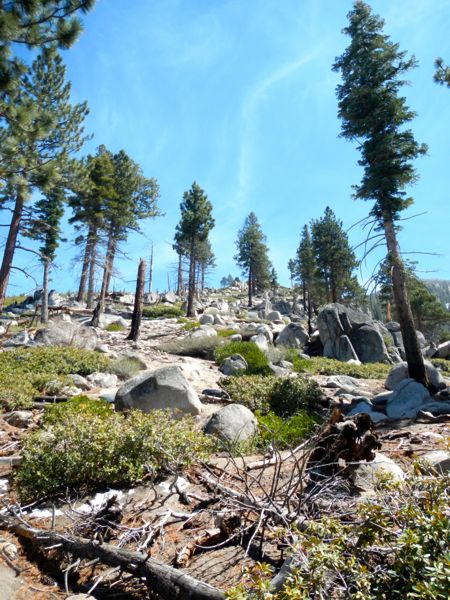
STATELINE – Immersed in a kaleidoscope of blues and greens, the landscape is mesmerizing. Perched on a slab of granite, its an unobstructed view of the hues of Lake Tahoe that complement the pale blue sky. Wispy clouds dance in the sky. Pines hover overhead, with branches dangling down as though to hug all those who enter the forest.

While Van Sickle Bi-state Park is always beautiful, it is even more so without many people accessing it. A few people were out Sunday – mostly walkers, plus a dude on a fat mountain bike.

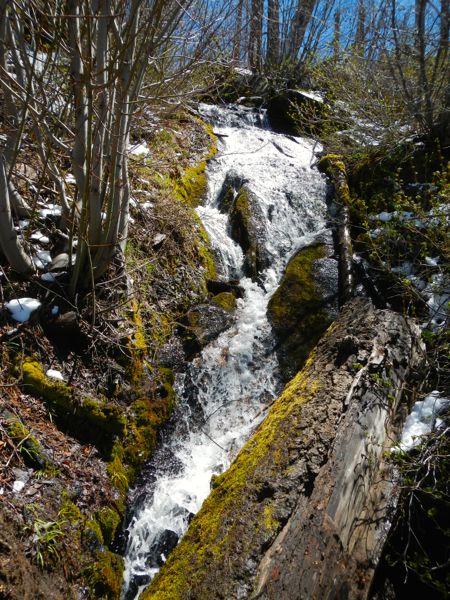
The waterfall at Van Sickle.

The waterfall at Van Sickle.

Signs of winter and spring dotted the trail April 26 with remnants of the previous day’s snowstorm and wildflowers starting to bloom.

It was the long dream of rancher Jack Van Sickle, who donated more than two-thirds of the land for the 725-acre park to the state of Nevada, to have his property be enjoyed by the masses. His old barn still sits on the land underneath the Heavenly Mountain Resort gondola line.

The park opened in summer 2011.

The path hooks up with the Tahoe Rim Trail.

The path hooks up with the Tahoe Rim Trail.

With how fast the waterfall if flowing, it would be hard to know this is year four of a drought. Now there are symbols on the signposts directing people to the falls, which are about 1.5 miles from the trailhead.

The gates open today. Vehicle access is from California near the intersection of Montreal Avenue and Heavenly Village Way. A footpath is accessible from there or it’s possible to park at Harrah’s and walk out the back entrance and get onto a trail on the other side of the road.


Dollar Tree settles hazardous waste disposal dispute

By Mark Glover, Sacramento Bee

Dollar Tree Inc. is the latest company to pay millions of dollars to California counties and cities to settle claims that its stores illegally disposed of hazardous waste.

The order for payment of $2.7 million was issued by Alameda County Superior Court Judge Morris Jacobson and announced Friday by 46 California district attorneys and the city attorneys of Los Angeles and San Diego. Those jurisdictions stand to receive a portion of the funds. The settlement included the district attorney offices of Sacramento, El Dorado, Placer and Yolo counties.

Read the whole story


STPUD in the market for new vehicle

South Tahoe PUD's hydorvac truck is nearly 20 years old. Photo/LTN

South Tahoe PUD’s hydorvac truck is nearly 20 years old. Photo/LTN

South Tahoe Public Utility District has a vehicle that is so old the state Air Resources Board says its days are numbered for being able to legally be on the streets.

It has been around since 1997. By 2017 is has to be pulled from service because the parts to upgrade it to state standards cannot be found.

A business in another state, like Nevada with its less stringent air regulations, is where a buyer for this apparatus will likely be found. Brand new it cost $174,000. Today the price tag is $330,000.

“Wherever this goes, it never turns off,” explained Randy Curtis of STPUD. That only exacerbates the air quality issue.

He gave the district board a demonstration earlier this month about how the hyrodvac truck works.

“If we do have a spill, this is what we use to clean it up with,” Curtis said.

Another use is excavation work on streets. It can clean out a 4-foot-by-4-foot area down 6 feet without impacting other infrastructure below ground. It can clean up to a 24-inch line.

It sucks all the material out so crews can get the water or sewer line. The material it collects is then deposited at the district’s South Lake Tahoe headquarters in what is called the “bone yard.”

The board has yet to approve the expenditure of funds on a new piece of equipment.

—–

Notes:

• The South Tahoe Public Utility District board of directors will have a public hearing on the budget May 7 from 6-7:30pm in the district board room, 1275 Meadow Crest Drive, South Lake Tahoe.

— Lake Tahoe News staff report


Study explains sugar-stress correlation

By Gabrielle Canon, Mother Jones

Here’s something that won’t come as a surprise to anyone who has ever devoured a pint of Rocky Road after a miserable day at work: Researchers at UC Davis recently found that 80 percent of people report eating more sweets when they are stressed.

Their study, published in the the Journal of Clinical Endocrinology & Metabolism, offers a possible explanation.

Sugar, the researchers found, can diminish physiological responses normally produced in the brain and body during stressful situations. With stress levels on the rise, this could explain why more people are reaching for sweets.

Read the whole story


Linking ag-food-nutrition on global-local levels

By Kathryn Reed

INCLINE VILLAGE – The average person now lives farther from where her food is produced than at any other time in history. And, yet, without food, people won’t survive.

Feeding a world of nearly 9 billion people is not easy. And while there are 100 million fewer people classified as hungry today compared to 10 years ago, there are still approximately 800 million hungry people in the world. In California, 16 percent of the households suffer from hunger. One percent of youth in the United State have chronic nutrient deficiencies.

Josette Lewis

Josette Lewis

Hunger, malnutrition, poor diets and associated diseases were the topic of a lecture at Sierra Nevada College last week. Josette Lewis, associate director of the World Food Center at UC Davis, talked about the link between agriculture, food and health.

She said if diet is not addressed on a global scale, then the next burden would be chronic disease. It’s already evident. South Asia, Lewis said, is the No. 2 area in the world for the highest number of people with diabetes and it has some of the highest areas of malnourishment.

Worldwide women and children are more likely to be undernourished.

Lewis pointed out how obesity and malnourishment go hand-in-hand. Many high caloric, high fat foods are cheap.

Next month the World Food Center and Brookings Institution are having a conference to look at the cost of obesity on low-income families in the United States.

“If we want a healthy diet, it needs to be available,” Lewis said.

That is one of the problems – especially in Third World countries – the access to a well-balanced, nutrient rich diet is not available.

Water will increasingly be part of the discussion with food production, especially with California in its fourth year of drought. Lewis said 70 percent of the fresh water in the world is applied to agriculture.

“The majority goes off into the environment; into the soil or into surface water,” Lewis said.

With drip irrigation and other applications, the water is going where it’s intended to go instead of carrying soil nutrients and chemicals into other locations.

Lewis said the ag industry has made great strides in reducing water consumption. From the 1960s to the early 2000s there has been a decrease of 14 percent of applied water in California, while at the same time crops per acre have increased 85 percent.

“We need to be more efficient with the use of water. We are working on technology for irrigation and food processing technology,” Lewis said. “We are working to help faculty develop larger scale research programs.”

Climate change is also being incorporated into the equation because it is affecting what can be grown where.

“Nut crops are particularly sensitive to temperatures. They need a certain number of near freezing temperatures at night to hibernate so they produce in the spring,” Lewis said.

Nighttime temps are increasing, which is worrisome for those growing nuts.

There may be a geographic shift, Lewis said, in where things are grown. There has already been a shift north when it comes to growing wine grapes.

However, moving an entire industry is expensive and may not even be physically possible.

Lewis said the goal of the World Food Center is to “create transformational solutions to feed and nourish the world for decades to come.”



Opinion: Immigration law’s unrelenting heartbreak 

By Rebekah Rodriguez-Lynn

On Nov. 20, 2014, President Obama gave a historic speech on immigration. Despite how profoundly personal this issue is to me, I didn’t watch. For the past decade, I have avoided any mention of immigration reform — hearing or reading about it causes my stomach to churn.

The topic brings me back to a window in Ciudad Juarez, Mexico, in 2004. The five minutes I spent there damaged my life irrevocably. With the swipe of a pen, a blank-faced clerk denied my husband’s application for a marriage visa and shattered our family.

We had met four years earlier, working at a Mexican restaurant in a small town in Southern California. We fell in love, spending hours talking after the restaurant closed. He told me about how his mother had died when he was young, and his father descended into alcoholism. He and his nine brothers and sisters had to fend for themselves. He arrived in the U.S. at 17, finished high school, and got three jobs to support his younger siblings in Mexico. And because he had entered the country illegally, he did all this without documents.

We got married in 2002, then moved to Cambridge, Mass., so I could earn a master’s degree at Harvard University. We had a beautiful baby boy. On the weekends, we’d go to the park and I would watch my husband do cartwheels for our giggling baby. At night, we would pile into the cheap black futon in our one-bedroom apartment. We were happy.

But we knew we couldn’t build a stable life for our son without regularizing my husband’s immigration status. So we applied for a marriage visa and, one year later, got an appointment at the American Consulate in Ciudad Juarez on April 17, 2004. At the time, anyone applying for a visa needed legal standing to receive an appointment inside the U.S.

So we flew to California, left our son with family, and hopped a bus to Ciudad Juarez. The morning of our appointment we found the waiting room of the American Consulate filled with couples like us.

The clerk called us to the window. My husband raised his right hand and promised to tell the truth. She only asked one question: Have you ever crossed illegally besides your initial entrance? Yes, he answered. He had returned to visit his ailing grandmother. The clerk informed us that my husband was barred from entering the United States for life. Can we appeal? No. She called the next couple.

I couldn’t care for a toddler alone while studying and working two jobs, so I left my son in Mexico, too. I returned home to an empty crib and an empty bed. I felt as though my limbs had been torn from my body. My family was gone. I found a top immigration lawyer who agreed to see me pro bono. He told me there was absolutely nothing he could do.

My husband had not broken any criminal laws. By visiting his grandmother, he had violated immigration regulations. For that, he was given a life sentence with no parole. My marriage seemed worthless in the eyes of the law — a law that left my innocent son with parents broken apart against their will.

Our justice system is weighted toward keeping families together. Children are often sent back to abusive homes on the principle of the sanctity of family. But this was not the case with my family. In my son’s eyes, his father is a superhero. Yet for over a decade now, my government has thrown up roadblock after roadblock to keep them apart.

Months later, I finally read Obama’s speech on immigration. His executive order prevents people from being deported if they have American children. It’s designed to protect kids like my son until Congress passes something more permanent. But a federal judge in Texas has put the executive order on hold; an appeals court heard oral arguments on April 17 and will rule soon, but the case may eventually go to the Supreme Court. In the meantime, I pray for a ruling that will keep other families from suffering as we have.

Rebekah Rodriguez-Lynn studied politics at UCLA and public policy at Harvard’s Kennedy School of Government. She lives in Southern California with her son and her Chihuahua. She wrote this for Thinking L.A., a partnership of UCLA and Zócalo Public Square.