Tahoe Tails — Adoptable Pets in South Lake Tahoe

Jodi

Jodi

Jodi is a 3-year-old Husky mixed with a cattle dog — is the best guess. She shows many of the characteristics of both dogs — she is very energetic, smart, and generally well-mannered. But as is typical of both breeds, she has a strong prey drive and can play a bit rough, and will be best in a home without small kids, small dogs or cats.

Jodi is spayed, microchipped, tested for heartworm, and vaccinated. She is at the El Dorado County Animal Services shelter in Meyers, along with many other dogs and cats who are waiting for their new homes. Go to the Tahoe animal shelter’s Facebook page to see photos and descriptions of all pets at the shelter.

Call 530.573.7925 for directions, hours, and other information on adopting a pet.

For spay-neuter assistance for South Tahoe residents, go online.

— Karen Kuentz


STPUD encouraging residents to remove sod

By Kathryn Reed

More than 270,000-square-feet of grass have been eliminated in the six years since South Tahoe Public Utility District has had the turf buyback program. This equates to a savings of approximately 3.5 million gallons of water.

Last week the board agreed to put in $300,000 of district money into the program to be split between this season and next for residential customers and another $75,000 for businesses.

“We are committing our own resources to run the program irrespective of if the grant is approved,” General Manager Richard Solbrig told Lake Tahoe News.

To date the district has spent $400,000 on the program, with 95 percent of the money coming from grants. More grants have been applied for, but it’s not known yet if those dollars will be forthcoming.

The district is mandated by the state to reduce its water consumption by 28 percent. Turf buyback is a step toward meeting that requirement.

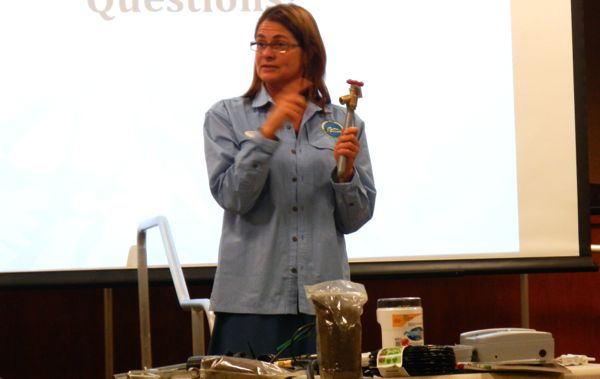
Jennifer Cressy with Tahoe Resource Conservation District explains various irrigation methods that don't use much water. Photo/LTN

Jennifer Cressy with Tahoe Resource Conservation District explains various irrigation methods that don’t use much water. Photo/LTN

The board on May 7 also agreed to keep the number of watering days to three, though that could change to two. The time to irrigate has been changed to between 6pm and 6am, with a maximum of 20 minutes per zone.

“The rebate program is an incentive to remove water intensive lawns with natural or adapted vegetation,” Donielle Morse explained at a turf buyback meeting last week. Morse is in charge of the district’s water conservation program.

She and Jennifer Cressy with Tahoe Resource Conservation District spent a couple hours telling about 20 people how the program works.

It is open to any STPUD water customer. It may be open to sewer customers if more money is available. About 200 households have participated going into this season.

It starts with getting your name on the list and then having Morse do a site visit. In years past the district insisted people have a living yard to be dug up. Because of the drought the district doesn’t want people watering something that will be removed, so dead lawns can be part of the program.

“We don’t want you to water your lawn. You will quality even if the lawn is brown. If it’s dirt, you won’t qualify,” Morse explained.

Another requirement is that at least 400-square-feet of turf must be removed. Residents don’t have to take all of their grass out, though. And it cannot be relocated to another area of the yard.

While the district doesn’t say exactly how people must fill in what will be a bare area, there are some requirements. The plot must be covered with 35 percent living plants at maturity. This is down from past years when it was 50 percent.

“When you remove the lawn you need to revegetate,” Morse said. “There needs to be efficient irrigation.”

A new watering system is usually in the form of drip irrigation. Sprinkler heads can be capped or retrofitted to comply.

Final inspections require having names of the plants that were used and the water capacity of the irrigation system.

Any dirt areas must be covered with a permeable mulch or ground cover like thyme or strawberries. Artificial turf is not an option. Rock, bark and woodchips are good choices.

While the district won’t be looking at Tahoe Regional Planning Agency best management practice rules or defensible space regulations, those policies should be followed, Morse said.

Rebate checks are not issued until STPUD verifies the lawn is out, and the new plants and irrigation system are in place. The rebate is $1.50 per square foot of turf that is removed, with a maximum of 2,000 square feet being eligible or $3,000.

Because of the uncertainty of cash flow for the program, it’s possible some people won’t receive checks until 2016. This also means people have two summers to complete the program, whereas previously it had to be done in one season.


Opinion: Promoting positive mental health

By Betsy Glass

According to California’s Mental Health Movement and the Centers for Disease Control, half of us will experience a mental health concern in our lifetime.

It is important to learn how to cope with these challenges. Wellness can be achieved when we implement activities to improve our mental and physical health. When we intentionally plant wellness seeds and nurture them with ingredients outlined below, our wellness and quality of life blossom.

Betsy Glass

Betsy Glass

Mood boosting strategies every person should try:

·         Practice relaxation skills. Try progressive muscle relaxation, focused breathing, guided imagery, or meditation. Take a break each day from activities and people, and focus on yourself and what makes you happy.

·         Socialize. Call a friend or family member, join a group or organization, volunteer, or offer a random act of kindness.

·         Strive for growth. Follow your heart, and try activities or choose occupations which use your strengths and express your passions.

·         Develop a balanced diet of foods which balance brain chemicals responsible for mood regulation, such as foods high in omega-3, vitamin B12, magnesium, vitamin D, and folic acid, including proteins, vegetables, fruits, and whole grains.

·         Try something new and creative. Pick up a hobby, take a class, or explore a new area. Studies show changing your routine can boost your mood.

·         Exercise regularly, particularly with others. Join a gym, community center, or gather friends and family for aerobics, walks, yoga, biking, or other activities.

·         Practice gratitude. Identify something you’re grateful for each day. Demonstrate appreciation towards yourself, others, and for what you have. This improves physical and mental wellness.

·         Aim for at least seven to eight hours of sleep. Develop an evening routine an hour before laying down. Reduce caffeine intake throughout the day, go to bed and wake up the same time each day, and avoid television or other visual electronics.

·         Recognize when you evaluate yourself and others. Remember everything is as it should be and everything is as it is.

·         Do one thing at a time with your undivided attention. Practice letting go of distraction, whether they are thoughts, feelings, or actions. Recognize the distraction without judging it and return to the task at hand.

·         Surround yourself with nature. Place plants or flowers in your home or office, garden, hike, sightsee, or find a quiet place to sit outdoors while soaking in the sun.

Wellness screenings are effective for prevention and intervention. If you are concerned about your wellness for more than a few weeks and find it difficult to complete everyday tasks, consult your primary care provider to discuss treatment options.

If you or someone you know has thoughts of harming themselves or another person or has a sudden and unexplained change in mood or behavior, immediately call a national or local crisis hotline at 800.273.8255 or 800.929.1955, visit Barton Hospital’s Emergency Department, or call 911 and request a “welfare check.”

Betsy Glass provides counseling and social work services at Barton Community Health Center.



Tahoe Paradise Park to host summer events

The Tahoe Paradise Park is trying to reinvent itself and be more of a destination.

The district’s board last week agreed to have OnCourse Events produce two music events this summer. The park at the base of Echo Summit is going to have what’s called Music in the Park on Aug. 23 and Sept. 13 from 4:30-8pm.

People are encourage to bring a picnic and chairs to the free concerts.

To help spruce up the park, there will be community cleanup days on May 16, May 23 and June 6. Bring gloves, garden tools, power tools, wheel barrels, ladders, paintbrushes and sandpaper. Also needed are volunteer stump grinders, welders and backhoes and chippers.

To celebrate the park’s 50th birthday, there will be a bash July 11 from noon-8pm. There will be food, art and craft show, music all day, and car shows. People are encouraged to bring kayaks and paddleboards.

Park founder and developer of the park Mary Jo Wilson, wife of Jim Wilson, and family members will be the special guests.

The park’s history will be on display in the clubhouse.

Tahoe Paradise Park is at 1101 San Bernardino Ave., Meyers. For more info, email tahoeparadise50@gmail.com.


Liberty making progress on solar facilities

Liberty Utilities is looking for permission from the California Public Utilities Commission to build two solar projects in Nevada; one in Minden, the other in Mineral County.

The renewable energy would be transmitted to Liberty’s California customers, which includes the Lake Tahoe Basin and Truckee, via NV Energy’s transmission lines. Liberty buys most of its energy from NV. The solar plants would make it less dependent on NV Energy and help meet future mandates from California in regards to renewables.

The Minden Sunrise Solar Project would be a 20 MW solar photovoltaic project at 760 Muller Lane.  The site is adjacent a wastewater treatment facility.

The Luning Solar Energy Center would be a 40 MW solar photovoltaic project located near Luning in Mineral County on Bureau of Land Management land.

Pending CPUC approval, Liberty intends to enter a contract with Greenstone and SunPower for the Minden project, and Invenergy for the Luning project.  Construction is expected to begin in early 2016 and operational by end of that year.

— Lake Tahoe News staff report


Worrack wins women’s Tour of California

The overall race leader changed three times Sunday, with Velocio-SRAM’s Trixi Worrack’s winning the inaugural three-day, three-stage Amgen Tour of California women’s race.

Sixty-five cyclists battled in Sacramento in a 17 lap all-out race totaling 34 miles.

Amgen 2015:

Trixi Worrack

Worrack, the 2013 German National Road Race Champion who placed third Saturday in South Lake Tahoe, swept the first three of four sprints. This put her at a 6-second advantage leading to the final laps. She finished the three days with a time of 6:24.16.

“It was such a really nice race, especially with the organization,” Worrack said in statement. “It was a really nice [Amgen] Tour of California. The first two stages were really hard for us because it was at altitude and today was a crit, also really hard. But with lots of spectators, it was really good.”

Optum’s Leah Kirchmann was second (6:24:21), and also claimed the stage for the second day in a row as well as the Visit California Sprint Jersey.

Kirchmann said, “It really means a lot for women’s cycling that the organizers have stepped it up and held an internationally sanctioned race with such a quality field. The venues were spectacular this week. The crowds were enthusiastic and big every day. And I just can’t wait to return to this race next year. It’s been awesome.”

Twenty16’s Lauren Komanski, the only rider of the top three overall to podium every day, earned third place overall – 6:24:22.

Katie Hall with UHC, the race leader after riding around Lake Tahoe on Friday, finished in fourth place.

— Lake Tahoe News staff report


Calif. environmentalists sue over oil industry water practices

By Rory Carroll, Reuters

California environmental groups filed a lawsuit on Thursday that seeks to halt oil industry injections of drilling wastewater into nearly 500 wells, a practice they say threatens fresh water supplies and is particularly critical in light of a prolonged drought.

The lawsuit was filed in state court against California’s oil drilling regulator, the Division of Oil, Gas and Geothermal Resources (DOGGR), by the Center for Biological Diversity, the Sierra Club and Earthjustice.

Oil drilling in California produces far more water than oil, most of which is not suitable for drinking. The wastewater is typically injected back underground.

The lawsuit also wants the DOGGR to stop allowing oil companies to pump steam into about 2,000 additional wells injecting into aquifers, which they say are protected under federal law. Oil drilling companies inject water and steam to increase the flow of oil to the surface.

Read the whole story


Study: Stressing the mind helps train the body

By Bradley Stulberg, Outside

In an until-recently classified report funded by the UK’s Ministry of Defence, researchers revealed something remarkable: you can reap enormous performance gains by altering your perception of effort—and anyone can do it.

Historically, scientists and athletes have thought of the stress that leads to fitness gains as being physical—training longer, running faster, or jumping higher. In recent years, researchers have begun to explore the mental component of training—how visualization can improve performance. But until now, few researchers have examined how mental stress can lead to training adaptations similar to physical stress.

In the MOD study, thirty-five soldiers trained three times a week on stationary bikes for the experiment, riding each time for the same duration and intensity relative to their own baseline fitness. In addition to the physical effort, half of the soldiers were also asked to engage in a mentally demanding task—watching combinations of letters appear on a computer screen and clicking only when certain combinations appear—while they pedaled.

Read the whole story


Douglas deputies to launch new patrol boat

Nearly a year after Douglas County Sheriff’s Department’s patrol boat sank at Lake Tahoe, the new one will be plying the waters.

It should be in service by Memorial Day weekend.

The old boat sank in June 2014 when a weld failed on the hull. This was attributed to normal wear and tear.

The $245,000 boat is being paid for from the sheriff’s department’s drug seizure fund and savings in salaries.

— Lake Tahoe News staff report


Reclaiming federal land has strong allure in West

By Nigel Duara, Los Angeles Times

American Lands Council promises cash-strapped Western communities a chance to win back federal acreage
Utah has passed legislation demanding return of all federal land; experts say it will never happen
Proponent sums up Western land transfer movement: ‘It’s the principle’
Spread over 6,500 miles of sparse scrub and alkaline soil, Millard County is one of Utah’s poorest. But for five years, the cash-strapped county so remote it was the site of a Japanese American internment camp in World War II still found $1,000 to send to the American Lands Council.

The Lands Council’s goal is grand but simple: to wrest control of vast swaths of land from the federal government and turn them over to the states.

At stake are hundreds of millions of dollars, even billions, that could be made off land administered by the federal government. The big-dollar opportunities include oil leases in Utah grassland, all-terrain vehicle tourism in Arizona and rare-earth mineral mining in Nevada.

Read the whole story