Building El Nino could soak parched Calif.

By Christopher Weber, AP

These latest wet storms aren’t expected to provide much, if any, relief from California’s historic drought. But there is hope for a serious drenching next year in the form of El Nino, a tropical weather pattern over the Pacific Ocean that typically brings rain to the West Coast.

Climatologists say the system forming near the equator looks like a big one that has the potential to provide relief from the yearslong dry spell.

Here are some things to know about El Nino:

What is it?

An ocean-warming phenomenon that builds in the Pacific during springtime. Moderate-to-strong events typically bring winter rain and snow to California and the rest of the southwest.

Wasn’t there one this year?

Yes, but it arrived too late to help the drought. There’s a 90 percent chance the current El Nino will last through the summer and a greater than 80 percent chance it will stick around through the end of the year, according to the National Oceanic and Atmospheric Administration. While NOAA says it’s too soon to determine the strength, other scientists say it’s turning out to be quite strong.

Is next year’s El Nino a sure thing?

Definitely not, says climatologist Bill Patzert of NASA’s Jet Propulsion Laboratory. But he says the increasingly warm temperatures in the Pacific along the equator recall conditions back in the spring of 1997, the prelude to a record El Nino year that brought heavy rains to California. “It’s definitely a couple of notches above where we’ve been. Right now it looks like there might be some potential, but there are no guarantees,” he said.

What’s the deal with La Nina?

El Nino’s flip side, La Nina, is a cooling of the central Pacific. It’s been much more common for the past decade or so. From 2005 to 2014, there have been twice as many months with a La Nina than with El Nino, weather records show.


Where is the best place to raise a family in Nevada?

By Kristen Desilva, Las Vegas Review-Journal

When it comes to raising a family, many have different opinions about Nevada’s two major cities of Las Vegas and Reno.

Turns out neither Clark County nor Washoe County are ranked as the best in Nevada to raise a family — it’sLander County located toward the center of the state.

Data site FindTheBest ranked the counties with a Family Score out of 100 based on high amounts of homeowners and children and teenagers, low amounts of vice outlets (strip clubs and liquor stores) and unemployed residents, as well as high levels of college degree-holding residents.

Read the whole story


WHS baseball runner-up to state champs

The Whittell High School baseball team is No. 2 in the state.

The Warriors made it to the championship round on Saturday after winning two of three games in the previous two days.

Ultimately the boys succumbed to Virginia City 14-3 on May 16 in Las Vegas.


LTCC hosting Malcolm X event

To help mark the late Malcolm X’s birthday, Lake Tahoe Community College is hosting a screening of his most famous speech followed by a faculty panel discussion on May 19 from noon-2pm.

The free event begins with a screening of “The Ballot or the Bullet,” one of Malcolm X’s most famous speeches, delivered at the Cory Methodist Church in Cleveland, Ohio, in 1964. In the speech, the civil rights leader discusses how participating in elections through the act of voting provides a pathway for addressing inequality in America. At the same time, he also cautions that if the government continues to stand in the way of equal rights, then other avenues of addressing inequality must be pursued.

After the screening, three LTCC faculty members will host a discussion about the speech and its relevance to today, 50 years after Malcolm X’s assassination. LTCC sociology instructors Scott Lukas and Yasmin Sayyed will be joined by political science and ethnic studies instructor Albert Ponce in the discussion.

The event will be in the board room at the college.


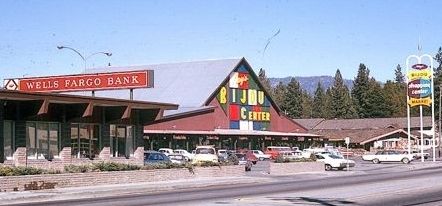
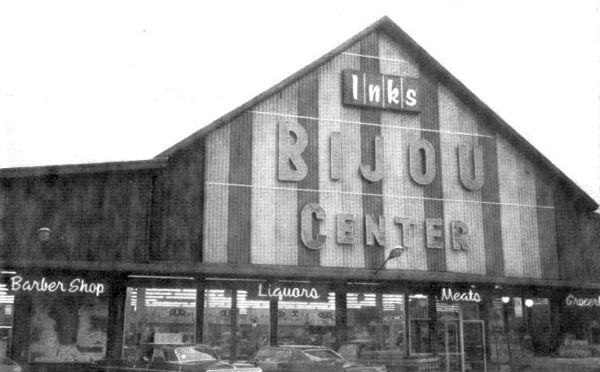
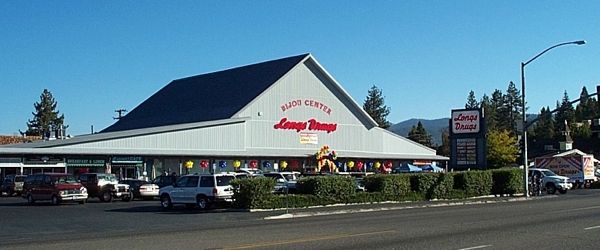
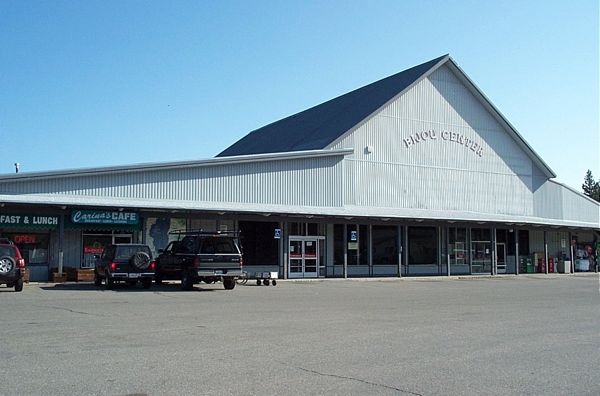
Then and now: Same building, different businesses

Sign ordinances might prohibit such color today. Photo/Bill Kingman

Sign ordinances might prohibit such color today. Photo/Bill Kingman

Constructed in the 1930s as the Bal Bijou cornering Highway 50, this building featured a dance hall. It hosted  many prominent dance bands and performers into the 1950s.

The photo above is from 1965 in a later incarnation as Nay’s Bijou Center Market.

xxxxx

Photo/Bob Rockwell Collection

By the 1970s, it had become one of the three local Inks Markets.

In the succeeding years, it housed the Liquor Barn, followed by Smart & Final. Long’s Drugs opened one of their South Shore locations there in 2004, and today it is CVS Pharmacy.

— Bill Kingman

It was a Long's drug store until that company was bought by CVS. Photo/Bill Kingman

It was a Long’s drug store until that company was bought by CVS. Photo/Bill Kingman

In 2004, the building was a nondescript blue. Photo/Bill Kingman

In 2004, the building was a nondescript blue. Photo/Bill Kingman

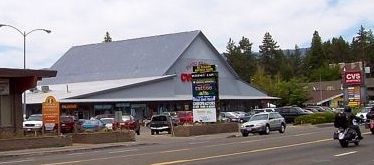
This is one of three CVS stores on the South Shore. Photo/Bill Kingman

Today this is one of three CVS stores on the South Shore. Photo/Bill Kingman


TVES 5th-grader lucky to be alive

By Kathryn Reed

Crystal Ann Aguilar is no ordinary 11-year-old.

She was born with a crushed aortic valve and three holes in her heart. Two were repaired within days of her birth. She has spent months at a time in the hospital. For an entire year she was on a feeding tube. Doctors said she would be considered terminal until age 12, at which time the thought was medical advancements would have improved to help her live longer.

She was in a stable period medically until last month.

aguilar fundraisers

Crystal almost died on the playground at Tahoe Valley Elementary School in South Lake Tahoe.

“Crystal is not to do any running. Her teacher ran her on the track with other students,” Todd Aguilar, Crystal’s father told Lake Tahoe News. “She complained her chest was hurting. The teacher said keep running. She collapsed with a heart attack.” This was halfway through the first lap.

Crystal Aguilar

Crystal Aguilar

Aguilar says everyone at the school is aware of Crystal’s medical condition and her limitations. She usually is allowed to walk while the other kids run.

While she is in the fifth-grade, her skill level is that of a second-grader, her dad said. One of her handicaps is the inability to speak well. Her parents understand her, but not everyone else can.

“She is now back fighting; again trying to stay alive,” Aguilar said. “She is back in the same situation as a couple years ago.

“We are going to hold the school accountable for what happened.”

The Aguilars have an attorney.

“In terms of privacy and so forth we can’t make a comment,” Lake Tahoe Unified School District Superintendent Jim Tarwater told Lake Tahoe News.

Crystal was able to return to school May 14.


Opinion: Can two people hold Calif.’s higher ed hostage?

By Daniel J.B. Mitchell

As its official budgeters measure it, the University of California has a $27 billion operating budget — of which a little less than $3 billion comes from the general fund of the state. Each of those state dollars is roughly matched by a tuition and fee dollar from students. You can argue about the accounting. You can hold legislative hearings. You can demonstrate at regents meetings. You can demand more “efficiencies.” But that doesn’t change the fact that most of the support for the university doesn’t come from the state. The bulk of the budget comes from sources like research grants, patient revenues in university hospitals, and fees for managing the U.S. Department of Energy labs.

When you get down to it, the current conflict between the university and the governor over budgets and tuition, dramatic though it may be, deals with a small fraction of the overall cost of running UC. The second fact to appreciate is the budgetary multiplier effect. Apart from any indirect stimulus to the economies near the UC campuses, the state is putting in under $3 billion of funding into UC, and getting $27 billion in direct economic activity out of it.

That return seems like a good deal.

So what’s the problem? Or put another way, what would the current governor’s dad see as the problem, if he saw one at all? Would it be that the UC budget is insufficiently transparent? Would it be that the university is being disrupted by new technology and isn’t reacting fast enough? Would it be that university administrators are overpaid? Would it be that those administrators are “tone deaf,” as the Assembly speaker put it, to state politics?

My guess is former Gov. Pat Brown would not see these as key problems. My guess instead is he would see the key problem as a lack of strategy regarding public higher education in California.

What we have today – instead of a process to develop a new master plan to follow Pat Brown’s 1960 master plan – is an ad hoc arrangement known as the “Committee of Two,” consisting of Gov. Jerry Brown and UC President Janet Napolitano, who have held much-discussed meetings this spring. The Committee of Two reflects Brown’s hang-ups about UC, and his personal engagement with it; he has been attending regents meetings previous governors skipped. The Committee of Two may come up with a budget agreement. But the Committee of Two does not include the Legislature, which must enact whatever the state allocates to UC, or any of the interests that have a stake in UC.

The Committee of Two is limited to UC issues. In contrast, the old master plan sought to look at higher education in California more generally. It considered what are now the California State University system and the community colleges and tried to carve out roles for each of the three segments. With hindsight, we know that not every element of the old master plan was retained. But the master plan was an attempt at developing an overarching strategy and public consensus. That is why it still hovers over all California conversations about public higher education. It is hard to imagine that 55 years from now, Californians will still be referring to the Committee of Two.

By itself, the narrowly focused Committee of Two can’t produce a new master plan. It can’t produce a higher education strategy for California. It can’t produce the kind of wide consensus needed to back such a strategy.

Pat Brown’s legacy today is largely seen as a major state water project, transportation (expansion of the freeways), and a higher ed strategic plan (the master plan). Jerry Brown, now in his last term, seems also to be thinking about legacy. He has a water project (the tunnels) and a transportation project (high-speed rail). If he wants to complete the package, he’ll need something more than his personalized Committee of Two. To get to a new master plan – a legacy – he would need to back off from personal engagement and open the process to the legislature and key interest groups. And he would need to widen the agenda to encompass all three segments of California higher ed. Producing a new master plan will take time and political skill. The clock is ticking.

Daniel J.B. Mitchell is professor emeritus at the UCLA Anderson School of Management and the Luskin School of Public Affairs. He co-teaches a course at UCLA each winter on California Policy Issues with Michael Dukakis.
U.S. Ski Team embracing college programs

The U.S. Ski and Snowboard Association is taking a deeper look at college ski racing as a viable component of the U.S. Ski Team pipeline with the introduction of a national university team for alpine ski racing. The National University Team will aim to provide support for athletes as well as a stronger post-university transition to the U.S. Ski Team.

There have been numerous athletes who have transitioned out of the university system to the U.S. Ski Team, but the USSA has identified a significant gap in physical development between these athletes and that of national team athletes. With the introduction of the national university team, the U.S. Ski Team hopes to provide continuity of elite-level programs while athletes attend university.

The new team will be led by former team America coach Peter Lange. Athletes will also receive coaching support from Lange during NCAA and NorAm competition and other tours, and will be eligible for scholarships through the U.S. Ski Team’s Borgen-Swartz Education Endowment.

In a triangle agreement between the USSA, the athletes and their individual NCAA coaches, the nominated athletes will still compete for their respective university teams while having expanded year-round access to and support at training camps and additional races.


Craft beer contributes $6.5 bil. to Calif. economy

By Allen Young, Sacramento Business Journal

California produces more craft beer than any other state, and the number of in-state breweries grew by over 24 percent last year to 519, according to research from the California Craft Brewers Association.

Total sales last year were $6.5 billion, up 18 percent from 2013.

No single factor can be attributed to why craft beer is exploding across the Golden State. But it’s worth noting that California is credited with creating the craft beer movement, and the regulatory climate for entrants to the industry is actually better here than in other states, said Tom McCormick, the association’s executive director.

Read the whole story


Time to sign up for youth summer library program

Every Hero Has a Story is the theme of the summer reading program for kids at the Douglas County Public Library. Unmask is the theme for the teen summer reading program for ages 12-18.

Registration starts June 1 at the Minden and Zephyr Cove libraries. The program continues through July 31. Go to the library’s website to fill out a registration form and then bring the printed form to the library.  The website also has program information and a place to sign up to receive email/text reminders.

For more information, call 775.782.9841.