Campaign under way to enforce seat belt use

Truckee and South Lake Tahoe police officers along numerous other agencies nationwide, including the California Highway Patrol, will be participating in the annual Click It or Ticket campaign now through May 31.

During this period officers will be specifically looking for seatbelt violations to remind drivers to buckle up. Of particular emphasis is child restraint use. All children in a vehicle who are under the age of 8 or weigh less than 80 pounds must be in an appropriate child safety seat that is properly installed.

Authorities say approximately 90 percent of child seats they inspect are improperly installed. Call 530.582.7570 to make an appointment to have the seat inspected for free.

Here are some of the most important aspects of proper installation and use of child safety seats and other restraints:

• Your child safety seat must be securely anchored.
• If your seat belts are door-mounted, or the inboard belt buckle is too far forward, you may need a special device that helps to properly secure the seat. Ask your car dealership or call one of the inspection agencies listed above for more information.
• Do not install car seats in the front passenger seat of any vehicle. The only exception to this rule involves pickup trucks in which the front passenger airbag can be manually turned off.
• Rear-facing infant seats must not be placed in any seat protected by an air bag.
• As a normal rule, small children should not occupy seats protected by an airbag.
• Shoulder belts should restrain a child at the shoulder and should not come across the child’s throat.
• Lap belts should fit across the thighs, not around the child’s stomach.
• Some seat belts are free sliding and may need a special locking clip for security.
• For infants, a five-point harness offers the best fit. An “infant only” seat is also recommended.
• Harness straps should fit snugly over the child and should directly touch the child. Blankets or other covering can be placed over the straps. To keep the straps snug, children should wear clothing no heavier than a light jacket or sweater while in the safety seat.


Gunman robs Kings Beach pharmacy

A Rite-Aid in Kings Beach was robbed Saturday.

suspectThe suspect walked into the store May 16 about 5:30pm, brandished a gun and demanded Norco and methadone. He left on foot after receiving the pills.

The suspect is described as Hispanic or Caucasian, 5-feet-11 to 6-feet, with dark hair. He was wearing a light blue surgical mask.

On May 1, a man believed to be the same suspect robbed the pharmacy inside the Sierra Market in Colfax. He was wearing a surgical mask and asked for the same pills.

There have also been pharmacy robberies in Incline Village and Reno.

Anyone with information is asked to contact Placer County sheriff’s Detective Sage Bourassa at 530.581.6322. To remain anonymous and be eligible for a cash reward of up to $1,000, call Placer County Crime Stoppers at 800.923.8191.

— Lake Tahoe News staff report


LTCC instructors tackle racial inequality

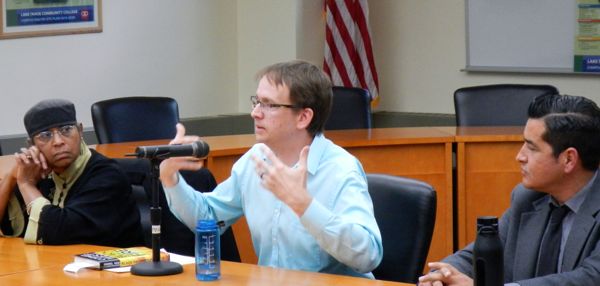
LTCC instructors, from left, Yasmin Sayyed, Scott Lukas and Albert Ponce, on May 19 discuss racial issues. Photo/Kathryn Reed

LTCC instructors, from left, Yasmin Sayyed, Scott Lukas and Albert Ponce, on May 19 discuss racial issues. Photo/Kathryn Reed

By Kathryn Reed

White privilege. It’s a concept that 50 years removed from the heyday of the Civil Rights movement is still hard for some people to grasp.

This was obvious by the questions being asked during a 90-minute seminar at Lake Tahoe Community College on May 19 on what would have been Malcolm X’s 90th birthday. The civil rights activist was gunned down in 1965 at the age of 39.

“When you watch the coverage of what went down in Waco it’s a system of privilege,” LTCC sociology instructor Scott Lukas told the nearly 70 people in attendance.

Had the deadly biker gang fight on Sunday in Texas been between blacks instead of whites, Lukas believes the response by police and the media would have been much different.

Albert Ponce, political science instructor, said, “Relationship today exist vertically. It needs to be horizontally. We need intercultural dialogue – and not be told what we should become. That is assimilation.”

He believes interculturality is the answer to people understanding and respecting one another, not multiculturality.

Yasmin Sayyed, LTCC sociology instructor, stressed the need for people to not lose themselves as they blend in with the majority. It’s about never losing your own story and not taking on someone else’s.

“If education means you lose your mother tongue, then it is a hollow victory,” Sayyed said.

Sayyed grew up in New York, where she knew Malcolm X. She met him in 1964 after she returned from Mississippi where she was getting people to register to vote. It was the summer before her 18th birthday. She said she returned to Harlem broken – having been beaten and sexually assaulted in the South.

She embraced much of what Malcolm had to say.

“Who are we to let our oppressors define how we fight our oppression against them. His words started having a different implication for me especially after my experience in Mississippi,” Sayyed said.

“We stapled our picket signs to baseball bats. It was amazing we never got spat on again,” she said. She never took a swing at anyone, but the gesture made people take notice.

From there the discussion in the Malcolm X camp became less about what drinking fountain blacks could drink out of, and more about moving away from protests and seeking political power.

Sayyed said the fight then and today is not against white people, but it’s against whiteness.


2 people flee SLT drug lab explosion

By Kathryn Reed

Two people are being sought in connection with a drug lab that blew up in South Lake Tahoe on Tuesday night.

The suspects were seen running from the apartment on Larch Avenue after the 8:20pm explosion on May 19.  Glass was blown out and a small fire started. However, the damage was minimal. The building inspector did not condemn the residence.

“Sometimes the violence of the explosion is enough to extinguish any type of flame,” Police Chief Brian Uhler explained.

The two suspects were using butane to extract THC. Stems, seeds and other byproducts of a marijuana plant that are not sellable can have the honey oil extracted from them to be made into edibles or it is smoked. The process to get this concentrated THC, though, is “extremely dangerous”, according to Uhler.

“We live in a forest. With the oncoming season of what is expected to be worst fire season ever, we need to do things to get control of what is an excess production going on,” Uhler told Lake Tahoe News.

He encourages people to report suspected illegal marijuana grows as well as if people see neighbors with a large number of butane canisters. Estimates are more than 400 illegal grows exist in the city limits.

South Lake El Dorado Narcotics Enforcement Team is handling the investigation into Tuesday’s blast. Area hospitals have been notified in case someone with injuries that may be consistant with that of a butane fire show up.


USDA allocates $21 mil. to help farmers battle drought

By Matt Stevens, Los Angeles Times

A branch of the U.S. Department of Agriculture will provide $21 million to help farmers and ranchers in California and other states install new irrigation systems, plant cover crops and implement other water conservation practices, officials said Monday.

The funds, made possible by the 2014 farm bill, will be distributed to the most severely drought-stricken areas of eight states, as determined by the U.S. Drought Monitor.

It is not clear how much of the money will go to California, but in a call with reporters, Agriculture Secretary Tom Vilsack said the state has already received more than $27 million from the Natural Resources Conservation Service for drought management practices this fiscal year.

Read the whole story


Road beat: Sonata boasts world-class interior

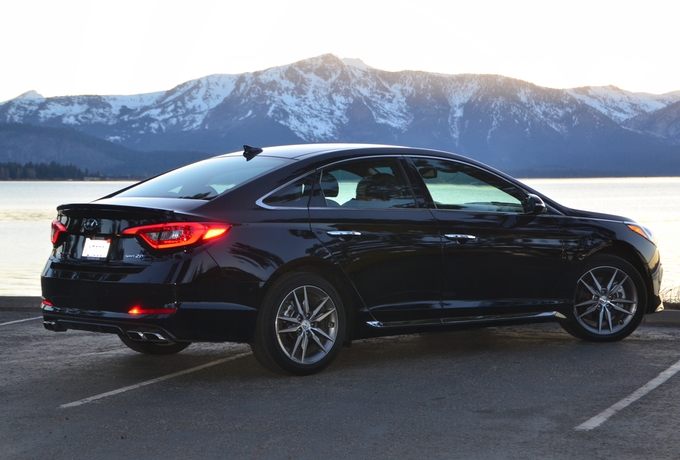
Sonata continues to make  improvements with 2016 model. Photos/Larry Weitzman

Sonata continues to make improvements with 2016 model. Photos/Larry Weitzman

By Larry Weitzman

About two months ago I spent some time with the all-new 2015 Hyundai Sonata Limited powered by the Theta 2.4L direct injected inline four-cylinder engine. For a detailed discussion of the new refined Fluidic Sculpture 2.0 see that story. Suffice it to say the new refined look is more pleasing in every way, with a more aggressive grille, straighter lines showing off its sleekness and improved proportions with a better cabin line.

As reported, the size of the Sonata has grown by about an inch in wheelbase, length, width and track improving balance, stability and handling.
Specifications Price $21,150 to about $35,000 Engine  Four cylinder inline 16 valve 2.4L 185 hp @ 6,000 rpm   	                 178 lb.-ft. of torque at 4,000 rpm Four cylinder inline 16 valve 2.0L 245 hp @ 6,000 rpm 				  260 lb.-ft. of torque @ 1,350-4,000 rpm Transmission Six speed torque converter automatic with a semi manual mode Configuration Transverse mounted front engine with front wheel drive Dimensions (Sport) Wheelbase 110.4 inches Length 191.1 inches Width 73.4 inches Height 58.1 inches Track (f/r) 62.9/63.1 inches Ground clearance 5.3 inches Cabin volume 106.1 cubic feet Trunk volume 16.3 cubic feet Fuel Capacity 18.5 gallons Weight 3,505 pounds Steering lock to lock2.78 turns Turning circle 35.8 feet Wheels 18X7.5 inch alloys Tires 235/45X18 Co-efficient of drag 0.27 Performance 0-60 mph 7.21 seconds 50-70 mph3.22 seconds 50-70 uphill 4.41 seconds Top Speed Beyond sanity Fuel economy EPA rated at 23/32/26 city/highway/combined. Expect 26-27 mpg in suburban driving and 35 plus mpg on a level highway at 70 mph.

Specifications
Price $21,150 to about $35,000
Engine
Four cylinder inline 16 valve 2.4L 185 hp @ 6,000 rpm
178 lb.-ft. of torque at 4,000 rpm
Four cylinder inline 16 valve 2.0L 245 hp @ 6,000 rpm
260 lb.-ft. of torque @ 1,350-4,000 rpm
Transmission
Six speed torque converter automatic with a semi manual mode
Configuration
Transverse mounted front engine with front wheel drive
Dimensions (Sport)
Wheelbase 110.4 inches
Length 191.1 inches
Width 73.4 inches
Height 58.1 inches
Track (f/r) 62.9/63.1 inches
Ground clearance 5.3 inches
Cabin volume 106.1 cubic feet
Trunk volume 16.3 cubic feet
Fuel Capacity 18.5 gallons
Weight 3,505 pounds
Steering lock to lock2.78 turns
Turning circle 35.8 feet
Wheels 18X7.5 inch alloys
Tires 235/45X18
Co-efficient of drag 0.27
Performance
0-60 mph 7.21 seconds
50-70 mph3.22 seconds
50-70 uphill 4.41 seconds
Top Speed Beyond sanity
Fuel economy EPA rated at 23/32/26 city/highway/combined. Expect 26-27 mpg in suburban driving and 35 plus mpg on a level highway at 70 mph.

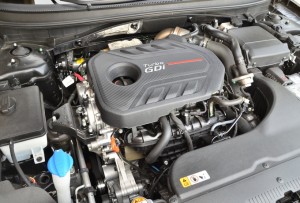
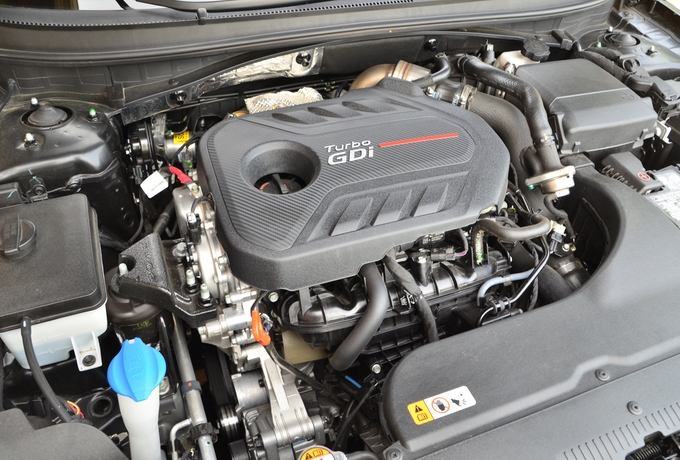
But the new Sport 2.0LT also gets a new engine or a new version of Hyundai’s 2.0L direct injected turbo engine which uses a twin scroll turbocharger, which doesn’t mean twin turbo but a turbo with smaller twin internal impellers of different sizes. Such a system improves turbo response. It produces 245 hp at 6,000 rpm and 260 pounds of twist from an off idle 1,350 to 4,000 rpm meaning it is making 198 hp at 4,000 rpm as well. At peak hp, torque has already fallen off to 214 pounds of twist. The engine runs a high for a turbo, 10:1 compression helping low speed response.

This is not Sonata’s only turbo engine. There is another 1.6L turbo designed for the ECO model for improved fuel economy. Although not tested, it shouldn’t be a performance slouch in any way shape, matter or form as it knocks down 177 hp at a low 5,500 rpm and 185 pounds of torque between 1,500 and 4,500 rpm or about the same numbers produced by the normally aspirated 2.4L Theta engine. But the ECO gets a seven speed dual clutch tranny which should give it as good if not better performance than the Theta powered Sonata while picking up a couple of mpg. Power in the Sport is sent to the front wheels via its six-speed torque converter auto cog swapper with paddle shifters which I mostly ignored.

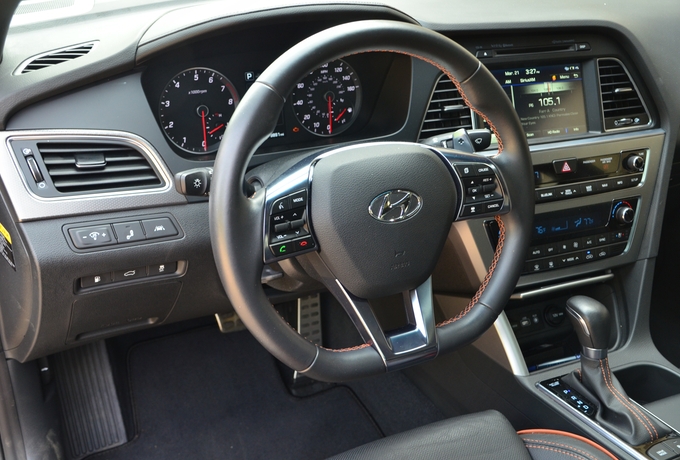
The Sport model gets some other niceties like a chrome rocker strip that accentuates its length, a fabulous, heavily bolstered interior which we will discuss later, a dual pinion steering rack, sporty tightened-up suspension, a trick flat bottom steering wheel with paddle shifters, mechanical gauges and more.

Performance is most improved in the midrange as 0-60 mph improves about half a second with an average time of 7.21 seconds. But passing times are much improved with a 50-70 mph time on the level of 3.22 seconds and 4.41 seconds up a six percent grade. Compared to the Theta powered Sonata whose times were 7.82, 4.25 and 6.56 seconds respectively, you can see the huge passing performance improvement with the Sport turbo engine. But a comparison should be made to the Camry V-6 which sports only 23 more hp and 12 pounds of less torque from its 3.5L V-6, yet posts performance times as if has 50-100 more hp. This example and comparison just demonstrates that there is no replacement for displacement. The Camry V-6 posted times of 5.35, 2.67 and 3.53 seconds. There is horsepower and then there is horsepower. The Camry V-6 gives up a couple of mpg to the Hyundai Sport Turbo, however. Maybe the Toyota motor has underrated hp and torque numbers as well.

Fuel economy is EPA rated at 23/32/26 mpg city/highway/combined. Overall the Sport 2.0 Turbo averaged about 26-27 mpg and achieving 35.2 mpg on a level highway two way run at 70 mph. In a round-trip from Placerville to South Lake Tahoe the Sport averaged 30.6 mpg, which is excellent and there was no feathering of the throttle as speeds were kept near 60 mph. Sonata’s large 18.5 gallon fuel tank is a real benefit when long distance cruising.

Suspension is by state of the art MacPherson struts up front with a sophisticated revised and improved multilink system in the rear. Sport is more than name only as the stab bars are thicker by a millimeter, springs are stiffer, the trick Mando dual flow shocks have been revised and the whole system is retuned for changing direction and the Sport does just that and does it extremely well. Track is actually down by two-tenths of an inch because the wheels are wider by half an inch (18×7.5 inch alloys) and the tires grow from 215/55×17 to some real meaty 235/45×18, which is substantial. The improved dual pinion power rack steering remains very quick at 2.78 turns lock to lock. With the extra rubber on the road and lower profile tires and fortified suspension, the Sport flat out corners. Grip is vice-grip like and steering accuracy is spot on. Body roll is also well controlled. I would give the handling nod to the Sonata Sport over the Camry V-6.
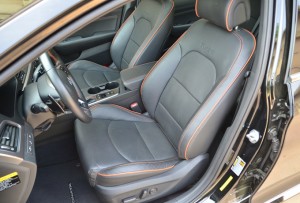
 

The interior of the Sonata sets it apart from others.

The interior of the Sonata sets it apart from others.

Ride quality is a bit firmer than say a Sonata Limited or even the Camry V-6. And that is good as the Sport while still extremely smooth and quiet is preferred by me, an excellent balance of handling and ride. Sport is also solid, feeling as if it was carved out of an ingot. The engine spins a low 2,050 rpm at 70 mph in sixth gear and there is no road noise and wind noise. It is a quiet car.

Sport also gets bigger front ventilated discs and in braking tests, possibly due also to the bigger wheels and wide rubber, the Sport stops in a benchmark 40 feet from 40 mph. Fantastic brakes. All the safety acronyms are standard including a rear view camera and blind spot detection. Superb HID headlights are very good. Only the lane departure warning and forward collision avoidance was optional, which might be advisable if you’re an inattentive driver, but I found the collision avoidance a sometime annoyance and distracting in its own right.

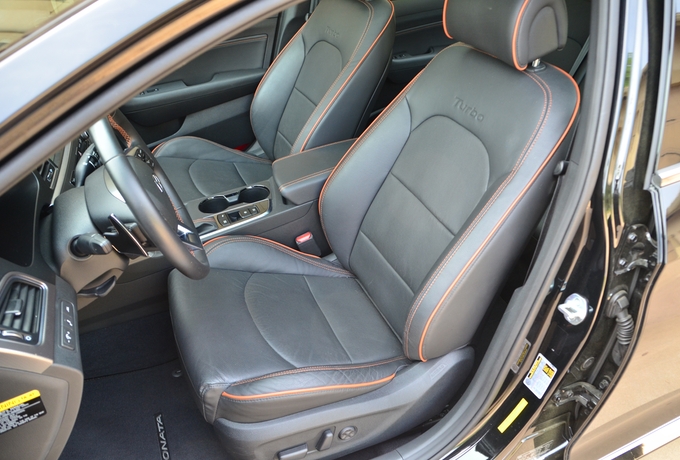
Now to the best part, the Sonata’s world-class interior. The leather is soft and luxurious, the design is sharp with superb side bolster and the dark orange piping and double French stitching on the seats, the aforementioned, flat bottom steering wheel, door panels and shifter. One of the best interiors out there, especially for a sticker of $28,575. Fit and finish is excellent.

Instrumentation couldn’t be better, clear, clean and concise. Big tach and speedo flank an information center which includes a trip computer which gives you both average and instantaneous fuel economy info simultaneously.
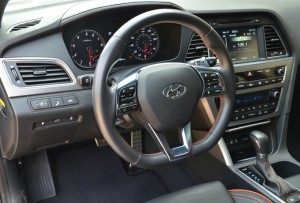
 

Sonata provides smooth handling on mountain roads.

Sonata provides smooth handling on mountain roads.

Rear seating is huge as the Sonata is classified as a large car. In my tester with the Ultimate Package ($4,950), they were also heated. Truck capacity is also large at over 16 cubic feet.

While a base Sonata starts at $21,150 plus $810 for the train and truck from its Montgomery, Ala., assembly plant, this super well-equipped Sport will set you back $28,575 plus destination. If you want the ECO model with the smaller turbo four plus the seven speed dual clutch and improved fuel economy that will cost $23,275. My tester came with two options, the obligatory embroidered carpeted floor mats for the bargain price of $125 and the $4,950 Ultimate package which I would live without. The standard sound system is fabulous and has XM and I certainly could easily live without the smart cruise, auto high beams and some other niceties. This Sport is so well equipped right out of the box, unless you need the trick LED interior lights, save the five grand. But you can decide for yourself.

Larry Weitzman has been into cars since he was 5 years old. At 8 he could recite from memory the hp of every car made in the U.S. He has put in thousands of laps on racetracks all over the Western United States.

SLT making it easier to access Connolly Beach

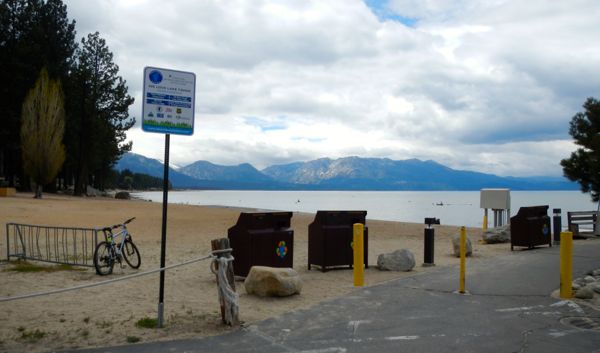
South Lake Tahoe officials want to ensure the public has access to Connolly Beach. Photos/Kathryn Reed

South Lake Tahoe officials want to ensure the public has access to Connolly Beach. Photos/Kathryn Reed

By Kathryn Reed

Three bear boxes, boulders and a beat up bike rack are what welcome the public to Connolly Beach from the parking lot. The pavement is in disrepair. Vehicle access is through the hotel maze.

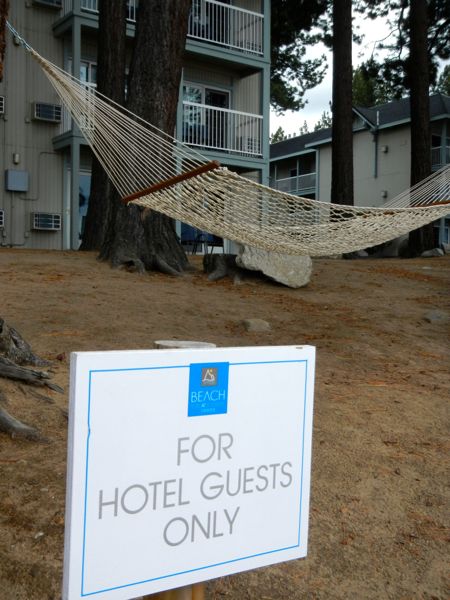
A sign says no alcohol is allowed on the beach, but the owners of the Beach Retreat Hotel have set up a bar. Farther down are four hammocks with signs saying they are only for hotel guests.

This stretch of sand in the middle of South Lake Tahoe has been contentious for years. And even though the state Supreme Court has weighed in on the topic, the city and current owner – Urbana Realty Advisors – are still not on the same page.

“I feel excluded even though I know my feet treaded there as a kid,” Sue Hoy told the City Council on Tuesday. She said the beach is now “totally unwelcoming.”

Hotel owners have strung private hammocks on the public beach.

Hotel owners have strung private hammocks on the public beach.

As with all beaches in California, the public has a right to access the sand below the high-water mark at any hour of the day, every day of year.

The court, though, ruled the public also has access from the high-water mark – 6,229.1 feet – to 100 feet toward the hotel. No one bothered to survey this at the time of the 1985 decision. The city recently did. That 100 feet goes into the buildings.

This is why the city wants all of the beach to be accessible to the public. The courts said so. However, access to the 100 feet from the high-water mark is only available June 1-Sept. 30, sunrise to sunset.

The South Lake Tahoe City Council on May 19 was updated on where things stand regarding what is better known as Timber Cove Beach and gave staff direction on how to proceed.

No one from the property attended the meeting.

“They can’t ask the public to leave unless they are disruptive,” City Manager Nancy Kerry explained.

The gate at Bal Bijou is coming down by the end of May.

The gate at Bal Bijou is coming down by the end of May.

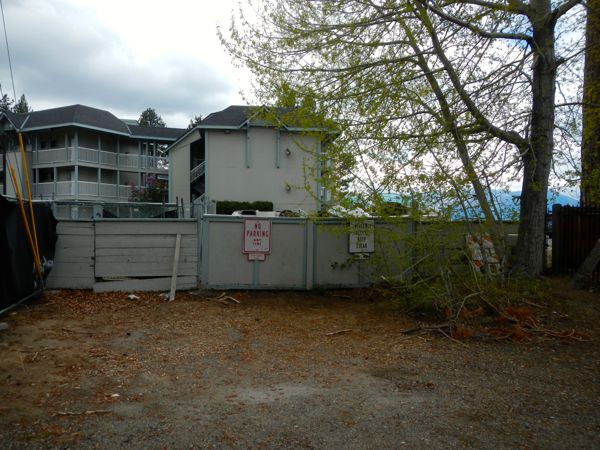
The gate at Bal Bijou will be removed before June 1 so the public has access to the beach parking area without having to drive through the hotel property. A tree needs to come down and paving in some areas will occur.

Eighteen of the parking spots are public.

Signage will be placed on the beach to help explain ownership and usage issues.

The California Tahoe Conservancy is also interested in ensuring the public has access. It owns a tiny lot to the west of the Beach Retreat property. With the lake so low, it’s possible to walk from the CTC lot to Connolly Beach without any obstruction.

Chris Mertens, an environmental planner with CTC, said his agency wants to provide another access point to Connolly Beach. To make that happen talks need to be initiated with the hotel owners as well as Tahoe Shores, which is on the other side of the CTC lot.

Another issue the city is working on is how to actually spell Connolly.

—–

In other action:

  • The council accepted a $98,000 donation from Lisa Maloff for the purchase of a K-9. The money will also pay for the four-legged officer’s training and equipment.
  • Pump Trax was awarded the $60,550 bid to design and oversee the construction of the Bijou Bike Park.


Opinion: Drought makes wildfire more of a threat

By Joanne Marchetta

It’s Wildfire Awareness Month at Tahoe, and with the summer tourist season around the corner, we must all remember that drought has left our region with severely dry forest conditions and an extreme risk of wildfire. This summer we need to think about “when” not “if” another fire will happen. All of us have important roles to play in preventing the next wildfire, and in making sure our homes, families, and communities are prepared for it.

The ongoing drought has brought unprecedented warm, dry weather to much of the American West, and California’s drought is like none we have ever seen. It is the most severe in California’s recorded history, and according to some scientists, may be the most severe drought California has experienced in more than 1,000 years. Hundreds, if not thousands of communities, including our own, are at increased risk of wildfire.

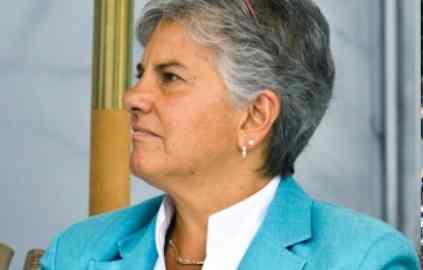
Joanne Marchetta

Joanne Marchetta

The winter of 2014-15 was the warmest ever recorded in California, breaking a record set the previous winter. April snowpack was also at a record low, measuring just 5 percent of average in the Sierra Nevada and just 3 percent of average at Lake Tahoe. Now entering its fourth year, the drought shows no sign of ending and has already brought the driest three consecutive years ever recorded for statewide precipitation.

Drought is taking a toll on California’s forests as well as its dwindling water supplies for farmers and cities. Experts have been reporting exceptionally dry forest conditions at Lake Tahoe this spring that normally would not be seen until mid-summer or later. Trees are stressed and mortality from bark beetle outbreaks is expected to spread throughout the Sierra.

Notably, more than half of California’s 20 largest wildfires have occurred during years of drought. The massive Rim and King fires that burned in the Sierra in recent years show how catastrophic wildfires can grow out of control and devastate tens if not hundreds of thousands of acres in areas where hazardous fuels have built up. The Angora Fire at Lake Tahoe in 2007 showed us how even comparatively small wildfires, at least when compared to the Rim and King fires, can wreak havoc in short order, charring 3,100 acres, destroying 254 homes and structures, and causing $150 million in property damage.

Government agencies and fire protection districts within the Lake Tahoe eegion have been collaborating and working together for years to reduce the risk of a catastrophic wildfire, and that work remains a top priority. Last August, TRPA and other members of the Tahoe Fire and Fuels Team updated the Multi-Jurisdictional Fuel Reduction and Wildfire Prevention Strategy, a blueprint to improve the safety of our communities and the health of our forests.

More than 55,690 acres of forest in the Lake Tahoe Basin have been cleared of hazardous fuels through the Environmental Improvement Program, with more than 36,890 acres treated since 2008. More projects continue this spring, and our Region is on track to meet targets to reduce hazardous fuel loads in the roughly 117,000 acres of wildland urban interface in the Tahoe Basin where our communities and our forests meet.

All private properties in wildland urban interface areas at Lake Tahoe need to create adequate defensible space by 2020. It’s an ambitious goal, but entire neighborhoods are stepping up, creating defensible space, clearing hazardous fuels, and installing fire breaks for improved community protection. Your participation can make the goal achievable.

Fire protection districts are inspecting properties for defensible space, educating residents about the importance of wildfire preparedness, and holding evacuation drills this spring so residents are as ready as they can be for the next wildfire.

TRPA works collaboratively with regional fire officials to reduce our wildfire risks. That means we’re continuing to educate the community about the importance of creating defensible space on private properties and implementing fire adapted community concepts so our homes and businesses are as fire-resistant and prepared as possible.

People must be vigilant reporting wildfires so they can be put out quickly when they are small. Webcams at Alert Tahoe are making citizen vigilance possible. Report anything of concern to fire officials. People must also be responsible with any activities that could start a fire while out recreating on our region’s treasured public lands. Illegal campfires start more than 90 percent of the wildfires on public lands at Lake Tahoe, and caused the devastating Rim and Angora fires. Curtailing that one preventable human cause of wildfire, while also better preparing our own properties, would significantly improve our odds this wildfire season. And let’s not forget about the Gondola Fire at Lake Tahoe in 2002, when the careless toss of one lit cigarette started a blaze that destroyed nearly 700 acres. The scar of that fire remains visible more than a decade later, and we can all take responsibility to remind locals and visitors alike of these preventable actions.

The reality is that wildfire risk will remain with us regardless of drought. We live in a region that is prone to wildfire as a natural process, and that hazard is only expected to increase with climate change, making it more important than ever for all of us to be vigilant, be responsible, and work together now to be prepared.

Joanne Marchetta is executive director of the Tahoe Regional Planning Agency.


LTUSD students shine at spelling bee

Students at the magnet school excelled at the El Dorado County Spelling Bee.

The fifth-grade team of Sophie Aronoff, Marley Befu, Kiara Furrer, Alexa Hall, Khushi Panchal and Katie Riffel placed first.

Taking second was the first- and second-grade team comprised of Tyler Dore, Tiffany Cutting, Ryder Preston, Ava Selger, Ella Schweitzer and Scott Yamaoka. Also taking second was the third- and fourth-grade team of Paden Magdeleno, Abigail Sandorff, Kade Schrauben, Kyla Schrauben, Sophie Waldie and Erin Yamaoka.


Reid: Raise cap on rooftop solar limits

By Amber Phillips, Las Vegas Sun

The cap limiting how many homeowners in Nevada can provide solar power to the energy grid is “way too low,” said Sen. Harry Reid, the Democratic minority leader.

Reid’s comments are the first from a member of Nevada’s congressional delegation on the matter and come as Nevada’s largest rooftop solar companies — SolarCity and Sunrun — lobby state lawmakers to raise the current 3 percent cap.

If the cap is not raised, the rooftop industry will shed thousands of jobs in a state that touts itself as No. 1 per capita for solar jobs, industry lobbyists say.

Read the whole story