By Joann Eisenbrandt
“I feel trapped in Paradise. I live in Tahoe in the mountains, but I live by an asphalt plant. I want the spectacular clean air and water that was the Tahoe promise.”
–Jeff Marcus, Julie Lane resident
Tahoe Asphalt is the only asphalt plant in the Lake Tahoe Basin. It produces the asphalt used by public agencies, businesses and individuals to pave the roads, parking lots and driveways. It began as a rock quarry and has been in operation at its 12-acre location on Industrial Avenue at the Y in South Lake Tahoe since the mid-1960s.
Many South Shore residents don’t even know Tahoe Asphalt exists. But for Jeff Marcus and others who live in the residential neighborhoods on its east border, it is an ongoing source of concern. More than 150 residents living on streets like Julie Lane, Dedi, D Street, Tata Lane, Bonanza, and Margaret or in the Tahoe Verde Mobile Home Park signed a petition first circulated by Marcus in 2015 asking that the air and water pollution and noise they say the plant generates be addressed.
Adam Henriques moved from Dedi because of the plant.
“I was living in a neighborhood affected by noise and air pollution. I had to sleep with my windows closed. They would run trucks out to construction sites that needed fresh asphalt at 2am,” Henriques said. “They accept fill soil there. Trucks would unload it and then drop the truck gate and make loud noises throughout the neighborhood at 5am”
Tahoe Asphalt plant manager Dale Linkous told Lake Tahoe News, “We are a good steward of the land. Everyone who works here is local and we all moved here for the same reasons—what we have around us at Lake Tahoe. We have an open door policy. There is nothing toxic on the property. We wouldn’t have the permits we do if we were doing anything wrong. It is absolutely necessary to have an asphalt plant in this area. The closest other plant on the California side is in Sacramento. There is a small plant in Gardnerville, Nev., but it can’t meet the California specifications for state paving jobs.
“Without the plant here, it would be a three-hour turnaround just to do pothole maintenance … it would triple the cost of the infrastructure in town. There would also be no place to recycle the asphalt that is torn up from old projects or from roadbeds. We currently have an agreement with South Tahoe Refuse to take and recycle almost 100 percent of the concrete and broken asphalt they receive.”
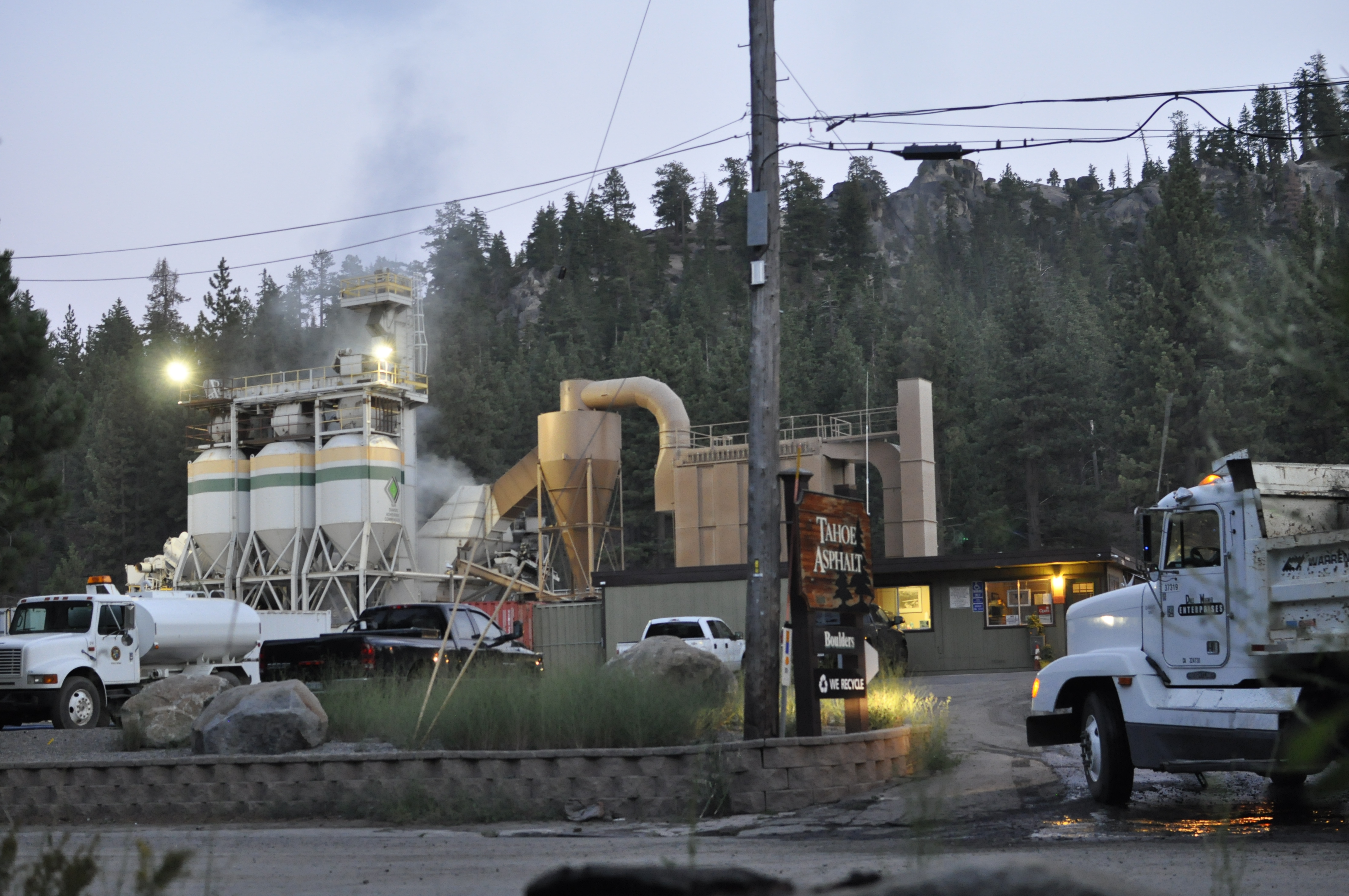
Tahoe Asphalt plant has been operating in South Lake Tahoe for more than 50 years. Photo/Provided
Plant upgrade brings questions
In 2016, Tahoe Asphalt requested a special use permit from the city of South Lake Tahoe to replace its aging facility which had “outlived its usefulness.” The new plant would be constructed at the same location; the materials they produced would remain the same but the way they were produced would change.
Residents near the plant believed the better option would be to relocate it away from any residential neighborhoods or even move it out of the basin entirely. In a letter to the city regarding Tahoe Asphalt’s request one resident insisted, “The smell is so bad you can’t open your windows or go outside. There is no way that it is not dangerous to be breathing the air during those times. Please say no to the special permit and relocate this cancer causing, environmentally harmful plant somewhere else.”
The South Lake Tahoe Planning Commission approved the Tahoe Asphalt replacement project in August 2016, and the new plant began operation in late July 2017. The plant operates to produce asphalt from May through October of each year.
Marcus believes the years of exposure to dangerous emissions from the plant are a contributing factor to his many health issues and to those of a number of his neighbors. He calls those who live near the asphalt plant the “living proof” that it is a danger to them and to the larger community. “The politicians are hiding behind written rules that have nothing to do with our reality.”
Diana Bowler, a Julie Lane resident for 40 years, has MS and is in a wheelchair. “You can’t even go out on the back deck and have a cup of coffee and enjoy Lake Tahoe,” she said. “The odor is so bad in the summer, you want to leave, but I have no way of leaving. I have to close all my doors and windows because of the dust in the air. (Tahoe Asphalt) sent out a letter saying the plant was perfectly fine. We went to the meetings and said we wanted it closed and moved. I recently sent a letter to the president. We’ve tried all the other avenues but nothing has worked.”
City Planning Manager John Hitchcock disagrees.
“The plant has been modernized and is a more efficient and cleaner plant than the one constructed in 1965. I am aware of residents’ concerns but the plant met all the standards (of the special use permit) and with the mitigation measures required it showed there would be no negative effects. There were no grounds to deny the permit,” Hitchcock told Lake Tahoe News.
How asphalt is produced
Hot mix asphalt (HMA) is a mixture of aggregate (crushed rock, gravel and sand) and liquid asphalt cement, an oil-based product, which is heated and mixed in a burner in measured amounts. The aggregate often includes RAP (reclaimed asphalt pavement) taken from old road beds and other construction sites.
Emissions from the asphalt production process can come from the steam that evaporates from the aggregate or from the products of the combustion process itself. They can also come from truck beds during the loading or unloading process or from the dust created by vehicular traffic at the plant.
Linkous explained the process. “We dry and preheat the aggregate material in a natural gas burner. In the process, steam is discharged. There is no free-flowing dust coming off the belts. Once it is preheated, blue smoke is created when the oil hits the hot aggregate. The ‘baghouse’ is a collection container for dust particles with two capture systems. The heavier particulates fall out and are reintroduced into the asphalt. What is left goes into 364 bags on a wire frame in the baghouse. The dust hits the bags and the bags hold it. A pulse hits the bags and it goes down and out and into the finished asphalt. The pulse creates an air burst and that is what escapes out of the baghouse. The only problem comes if a bag is broken.”
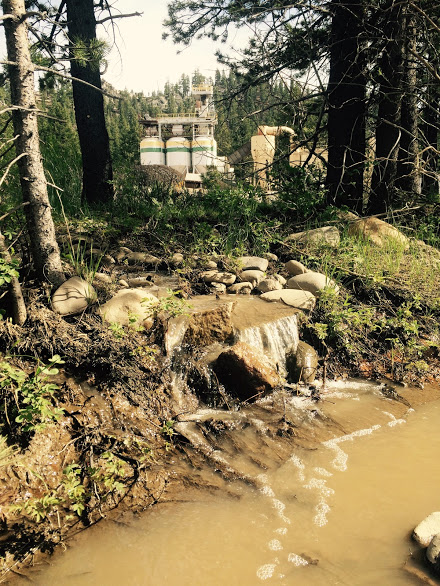
Storm water runoff near the asphalt plant. Photo/Provided
Who’s minding the store?
Asphalt plants are regulated by an often-confusing array of federal, state and local agencies including the city of South Lake Tahoe, Tahoe Regional Planning Agency, EPA, California Air Resources Board, El Dorado County Air Quality Management District (AQMD) and Lahontan, the local office of the California Water Quality Control Board. In addition to the special use permit approved by the city and TRPA, Tahoe Asphalt has a permit to operate from the AQMD and a Storm Water Pollution Prevention Plan (SWPPP) and an industrial wastewater discharge permit from Lahontan.
These are intended to mitigate any potential hazards to people or negative impacts on the sensitive Lake Tahoe environment. Hazardous emissions found at different levels in asphalt plants can include hydrogen sulfide, benzene, chromium, formaldehyde, polycyclic aromatic hydrocarbons (PaHS), cadmium and arsenic.
Untangling the regulatory matrix
Because there are so many fingers in the regulatory pie it can be challenging for residents to know where to report concerns. Marcus has been struggling to work his way through the public agency quagmire for the16 years he’s lived on Julie Lane. His written comments submitted in opposition to the project argue, “The common layperson (community citizens) does not use legalese or terms like ‘mitigated negative declaration’ or ‘batch plant.’ This language is confusing to the general public.”
The mitigated negative declaration (MND) he refers to is the environmental document prepared for the replacement project under the requirements of the California Environmental Quality Act (CEQA). It assesses a project’s potential for significant effects on the environment and ways they can be mitigated.
There are different levels of environmental review under CEQA. The lowest level is a categorical exemption reserved for projects generally considered to have no significant environmental effects.
Hitchcock explained, “We considered a categorical exemption under replacement of an existing facility. Then we heard the specific concerns people brought up including noise, emissions and the height and stability of the tailings (piles of material) on the property. At that point, we thought it was best to slow down. There was enough controversy to do an IS/MND.”
Role of the city and TRPA
Project approvals are coordinated through an MOU (memorandum of understanding) between the two agencies. As Tom Lotshaw, TRPA spokesman, explains it, “The city of South Lake Tahoe reviewed and approved the Tahoe Asphalt project under TRPA’s delegation MOU with the city. In these cases, it is not just a matter of the city taking the lead in reviewing and permitting a project. The city is entirely responsible to review proposed projects and to ensure that they meet both city of South Lake Tahoe requirements and TRPA requirements.”
Two public hearings were held by the city Planning Commission and a community meeting was sponsored by Tahoe Asphalt. Henriques attended the meetings and communicated frequently with Hitchcock, raising a number of technical questions about the level of environmental review and the adequacy of the mitigation measures proposed.
“I not only had the general desire to protect Lake Tahoe, but I was also personally impacted. It was in my back yard. I had the right skill set and I wanted to use it,” Henriques told Lake Tahoe News. He has a bachelor’s in environmental management with a focus on soil and water quality conservation.
He also contacted Midkiff and Associates, a consultant for Tahoe Asphalt that prepared the plant’s responses to the environmental document.
“As a result of your questions at the public hearing,” Nick Exline, senior planner for Midkiff and Associates, told Henriques in an email, “the project is going through the CEQA review as we speak.”
Exline told Lake Tahoe News, “John Hitchcock was very supportive of the idea to take it to a higher level of environmental review to try to provide more confidence to the entire community.”
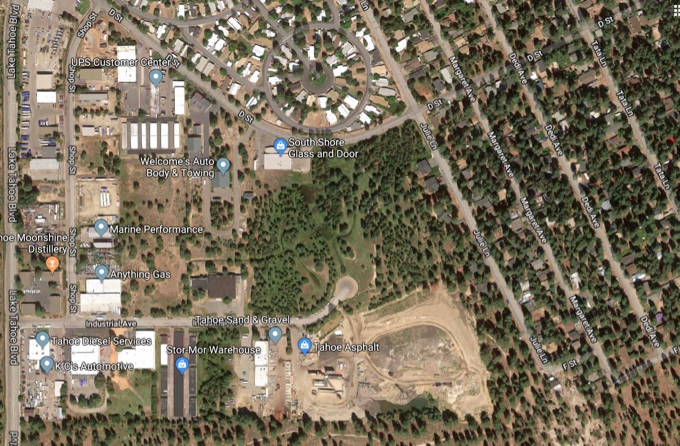
A map of South Lake Tahoe showing the asphalt plant in the residential neighborhood. Image/Provided
Is it a good tradeoff?
Despite the view of the city, Tahoe Asphalt, and their consultants that the environmental review would “instill confidence in the community,” not everyone is convinced the plant is safe or that the tradeoff is a fair one. Henriques terms it an example of the failure to ensure “environmental justice.” The Tahoe Valley/Y area of the city where Tahoe Asphalt and adjoining residential neighborhoods are located was identified in the 2010 Census as a “severely disadvantaged community.” Residents of such lower-income or industrial areas often bear the environmental impacts of development at a greater rate than others.
Marcus agrees, contending that residents living near the Tahoe Asphalt plant are not getting the equal protection under the law they deserve, especially those who are most vulnerable such as pregnant women, young children, seniors, the disabled and those with compromised immune systems.
Two separate questions
There are approximately 3,500 asphalt plants located throughout the country. Are they being sufficiently regulated and monitored? Even when they comply with all regulations, do their emissions still constitute short or long-term health hazards to those living in close proximity to them or damage to the environment?
NAPA, the National Asphalt Pavement Association, says there is “misleading and often daunting information about asphalt plants and asphalt products. Hundreds of communities across the country coexist peacefully with asphalt plants … most of them are known as good neighbors.” The industry, its website says, is well-regulated, with closely monitored emissions control systems. Asphalt plants provide local employment and are essential to the country’s infrastructure. Their emissions, it adds, are well below those from other common community and industrial sources such as fireplaces or gas stations.
In its 2001 Minority Report on Fugitive Emissions from Asphalt Plants to the EPA, a multi-state coalition of environmental groups reached a very different conclusion.
“Hot mix asphalt plants (HMA plants) and asphalt terminals have numerous characteristics that result in a large number of the general public being exposed to their hydrocarbon and particulate emissions … such plants are often located in urban areas close to homes, schools and playgrounds with minimal setbacks. Further, the plants operate around the clock when fulfilling certain types of contracts so that the neighbors breathe in the fumes day and night. While the operation of an asphalt plant might be seasonal, particularly in northern latitudes, the intensity of exposure during the peak production months is quite acute.”
Lake Tahoe News reached out to all the agencies that have some oversight of Tahoe Asphalt for their input on how the local plant is regulated and how its potential impacts are mitigated.
Water quality impacts
“There used to be a big sludge pond the size of a football field on (the Tahoe Asphalt) property between the fence and a big dirt pile,” a resident noted. “There was oil on the pond. The aquifer off of Twin Peaks runs through the plant and this gets into the water system.” Another resident agreed, “Things are seeping from the retention ponds. There is oil and grease in the water and it runs through the meadow down to D Street and ends up in Taylor Creek or Lake Tahoe.”
Cathe Pool, senior water resource control engineer at the Lahontan office in South Lake Tahoe, told Lake Tahoe News that she has visited the plant when it was operating and, “there was no runoff” and no violations were written up. “There are two retention basins that are designed to catch overflow. The way the permit is written, there has to be specific weather conditions. It can’t have rained in the last 48 hours and the storm had to cause runoff. Then they have to sample (for contaminants).”
In the late 1990s, Lahontan investigated reports of contaminated storage tanks remaining underneath the site. It found that seven underground storage tanks, including two used oil underground storage tanks, were removed from the property in 1993. TPH (total petroleum pydrocarbons) and PCE (tetrachloroethene) were found in extracted soils. Subsequent excavation activities were found to have removed the majority of the PCE source. The Industrial Well No. 2 affected by the PCE was taken offline and later decommissioned. The case was closed in 2004.
In June 2015, Lahontan made a site inspection at the plant and listed work items that needed to be completed including a revision of their SWPPP, completion of a Facility Water Generation and Discharge Systems Report, and stabilization of their on-site stockpiles of materials.
“We identified some issues. We told them to fix them and they have,” Pool explained. “I feel like this is a success story.”
Jeff Brooks, Lahontan senior engineering geologist, is now in charge of Tahoe Asphalt’s compliance with its permits. He said there are currently no violations or outstanding investigative orders for the new plant. Brooks said he plans to send an inspector out to the plant once the snow melts.
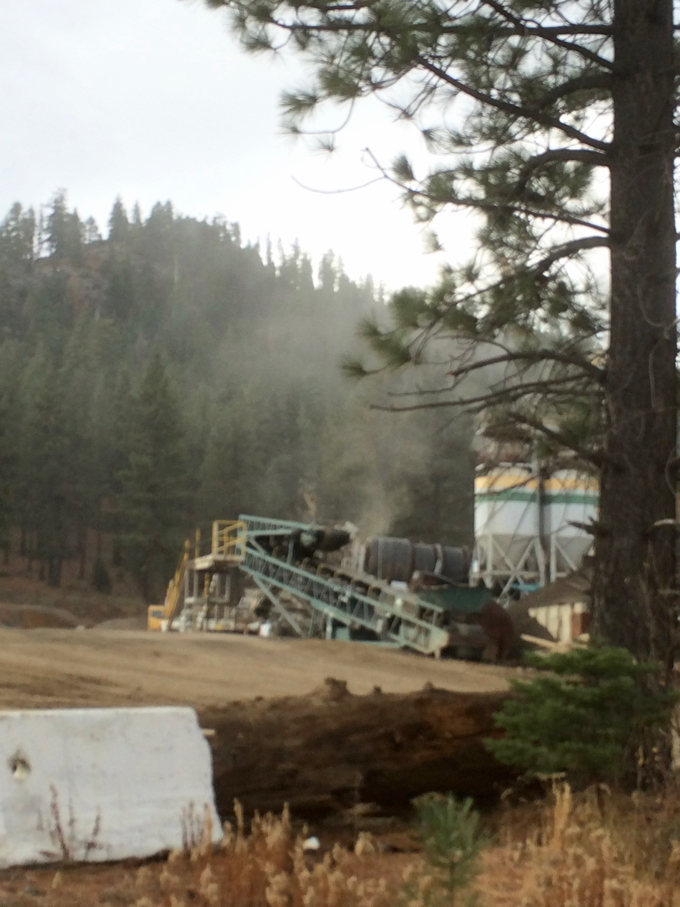
Dust rises from Tahoe Asphalt in summer 2017. Photo/Provided
Air quality impacts
The EPA sets nationwide air quality and emissions standards and oversees state efforts and enforcement. The California Air Resources Board (CARB) is focused on California’s air quality and sets the state’s own stricter emissions standards. It oversees the 35 local air pollution control districts that are in charge of local regulation and enforcement. The El Dorado County AQMD is the responsible agency for the air control district that includes Lake Tahoe.
Marcus reached out to a number of EPA officials in Washington, D.C., the San Francisco Region 9 office, and to the local Lake Tahoe EPA liaison. He wanted his concerns to also be addressed at the regional and national levels. He told Lake Tahoe News that he was referred back to the county AQMD or Lahontan. Lake Tahoe News made inquiries to four of the EPA officials Marcus had contacted, but was referred to the Region 9 public information officer. “EPA doesn’t have a role in the local permitting decisions made by the city,” she said, adding that residents concerned with Tahoe Asphalt’s Clean Air Act or Clean Water Act compliance should contact the AQMD or Lahontan. “The public is also welcome to contact EPA Region 9s’s environmental information center at 415.947.8000 and r9.info@epa.gov with general questions.”
The county response
Dave Johnston, AQMD air pollution control officer, did respond in detail to Lake Tahoe News’ questions: “Our role is to assist all source operators with achieving and maintaining compliance with the applicable requirements in order to minimize exposures to residents. We are very proactive in that role.”
Before equipment can be installed or replaced, he explained, the operator submits an Authority to Construct (A/C) application to AQMD, which is evaluated for compliance with all applicable state, federal and local rules and regulations. Once the equipment is installed, AQMD issues a permit to operate (PO). An initial inspection is conducted to verify compliance with the PO. Compliance inspections are conducted annually and re-inspections verify that required corrective actions have taken place.
On July 19, 2017, an initial compliance inspection for the new upgraded plant took place. The most recent site visit was on Sept. 13, 2017, as the plant does not operate during the winter season.
How emissions are calculated
On-site “source testing” is not a regulatory requirement for Tahoe Asphalt. Emissions are calculated based on a standardized mathematical formula which considers the potency, toxicity, quantity and volume of all hazardous air pollutants that are emitted from a facility based on how many tons of asphalt they produce, the specific design of the plant and how close a facility is to complainants. Scores for acute, chronic and cancer effects are also calculated. A “prioritization” is then done based on the scores, with plants being rated from low priority to high priority according to their overall facility score.
AQMD performed a “prioritization” of Tahoe Asphalt in 2013. It was rated as a “low priority facility.” In April 2016, a “full toxics emissions screening” generated lower scores than those for the old plant. Johnston noted, “We do not and we are not aware of any federal, state or local air agency that has conducted toxicity determinations on each individual batch of asphalt produced by a plant.”
The Blue Ridge Environmental Defense League, a nonprofit focused on environmental issues in rural areas, finds this unacceptable. “In the majority of cases, it is unknown whether the ‘theoretical’ air emissions predicted by computer models and used by plant owners accurately reflect air emissions from a plant’s daily operations. We must put safety first and shut down or overhaul the current system that fails to protect communities from the daily health hazards of asphalt plant pollution.”
In 2002, the EPA “delisted” emissions from asphalt plants from the hazardous air pollutant (HAP) list under the federal Clean Air Act. The EPA is required to list all categories of major sources emitting HAP and those that warrant regulation. The initial list of 174 categories was published in 1993. The Feb. 12, 2002, update in the Federal Register notes, “…we are deleting the source category Asphalt Concrete Manufacturing because available data indicate that no asphalt concrete manufacturing facility has the potential to emit HAP approaching major source levels.”
The Blue Ridge website notes, “Organizations are working to improve federal and state standards and add asphalt plant fumes to the hazardous air pollutant (HAP) list under the federal Clean Air Act.”
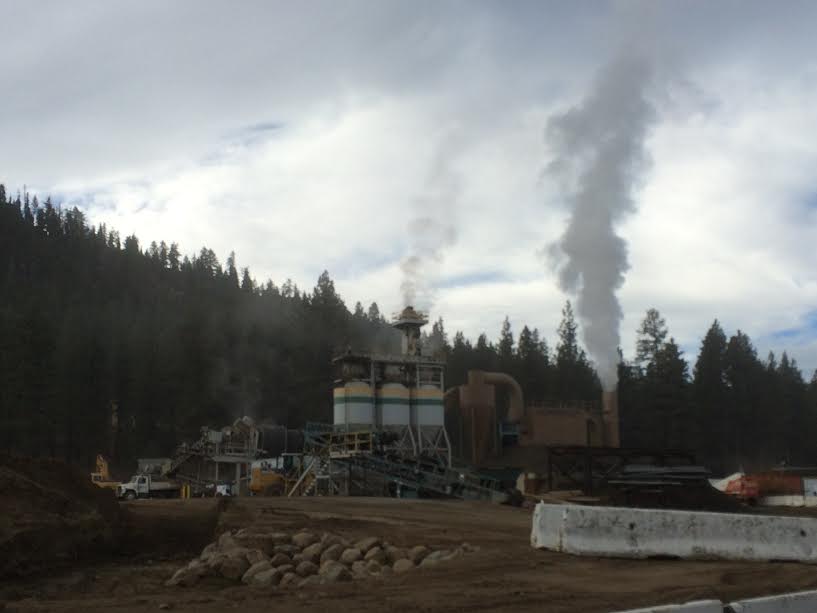
Steam is a byproduct in the manufacturing of asphalt. Photo/Provided
The numbers
Lake Tahoe News asked Johnston how many complaints have been received and violations issued to Tahoe Asphalt in recent years. In the 2015 operating season they received 17 complaints from five complainants; in 2016, they received 17 complaints from six complainants and in 2017, they received 49 complaints from 25 complainants.
The AQMD issued three violation notices to the new Tahoe Asphalt plant during the 2017 operating season. The last one was on Sept. 20, 2017. “AQMD staff confirmed odors coming from the asphalt plant concurrent with the receipt of a considerable number of public complainants. A mitigation plan was submitted by the operator. The plan was determined to be insufficient and was returned to Tahoe Asphalt for revision.”
Visits but not enough action
Like Diana Bowler, Marcus contacted the White House. His October 2017, letter to President Trump pointed to visits to his neighborhood by the South Lake Tahoe Fire Department as evidence there were serious issues. “Now, with our fire marshal, battalion chief, fire chief and several other firemen all as eye witnesses to our toxic environmental problems,” it stated, “would it be possible for you to help us get a proper investigation from the correct federal agency for further action. Again, the EPA has refused!”
Jeff Meston, South Lake Tahoe fire chief, and now acting city manager, told Lake Tahoe News about visits by his department to the Julie Lane neighborhood.
“When the plant first starts up, it produces a lot of heavy smoke, so neighbors would call 911. We went to make smoke check calls. A gentleman pulled us aside and said it was a public safety hazard with pollutants and discoloration of ground water and he wanted us to do something about it,” Meston said. “We told him about Environmental Health and Lahontan and directed him down that path. He shared photographs. The water didn’t look clean to us. When you see a picture of the ground with brackish water, it’s not what we normally see. It leads me to believe there is possibly something there. But the hazard is in the county’s hands.”
Dave Johnston indicated his agency has visited the area numerous times. “In 2016 AQMD staff began performing frequent unannounced odor patrol observations in the neighborhood where the complainants reside. We did not verify an odor violation.”
This also continued in 2017, with staff visiting the site and surrounding area 76 times during the last two years “to determine compliance/noncompliance,” including one day in which staff drove from Placerville to South Lake Tahoe twice to investigate odor complaints.
The city’s Hitchcock has also visited the Y neighborhood during the daytime and looked at Tahoe Asphalt from the residential and industrial sides. He noted that all the planning inspections of the new plant are not complete since some of the special use permit’s mitigation measures have longer terms for implementation.
Better or worse?
The city, Lahontan, county AQMD and Tahoe Asphalt all believe the new plant is an improvement. Linkous points to the differences between the old batch type plant and the new continuous drum mix plant. “The old plant would run not quite all day, depending on the tons (of asphalt) ordered for that day. With the new plant, we make the tonnage first thing, then store it in silos and shut down operations.”
Still, residents in the immediate area of the plant see noise as a continuing problem. The plant’s permits with the AQMD limit the total hours they can operate each day, quarter and year and how much tonnage of asphalt can be produced. It does not limit what time of day they operate.
Linkous says night operations are necessary because paving jobs on major roadways are now being done more at night to avoid traffic congestion and impacts on local businesses. He points to the ongoing three-year Caltrans Highway 50 project as an example. Trucks are not allowed to dump on the side of the plant nearest the residential neighborhood at night. “I don’t want the noise going out to the neighborhood.”
But according to residents, it clearly is. “It’s the banging on the tanks in the middle of the night,” one resident complained. “That should not have to happen; if they could just muffle that in some way.” Another agreed, “They need to make it so we don’t hear their trucks all night: beep, beep, beep.”
A Y area resident told Lake Tahoe News, “I have awakened at 3am and they are still working at the asphalt plant with all their big equipment. There should not be noise after 10pm. That’s what the city noise ordinance says. They should not be running excavators at night when those in the residential neighborhood have to get up and go to work. They are not paving at that time. They are just moving dirt and grinding up cement. Saying they are paving at night is just an excuse.”
One of the mitigation measures required by the special use permit is the installation of a 24-hour noise complaint line at the plant. Complaints must be referred to the city and noise monitoring equipment put on the plant site closest to the complainant’s location. Linkous said these requirements are in place. Hitchcock noted that residents can also file noise complaints directly with the city either online or in person at city offices. He plans to follow up to ensure that the noise monitoring procedures are in place for the upcoming season.
Other concerns
Some have said that the city and county approvals for Tahoe Asphalt are a conflict of interest. Both of them use the plant for their paving projects and don’t want to lose the convenience. They also make significant sales tax revenue from the plant.
Others questioned how homes were even allowed to be built so close to an existing asphalt plant. While large residential subdivisions do require the preparation of environmental documents and review under CEQA, single family homes do not. They also do not require a finding of no significant environmental effects by TRPA.
“In a nutshell,” one resident said, “the plant just doesn’t belong here anymore. The smells are ghastly. The stuff that’s vaporized and is flying through the air isn’t healthy. A lot of people in South Lake Tahoe don’t even know there’s an asphalt plant here. I hope now the fire’s lit. We need to keep it lit. The more the public knows about it being here the more the city will need to take action to get it out.”
The plant is currently in its off-season and will resume the production of asphalt in May.