Tolerance diminishes for letting bears eat trash

By Kathryn Reed

Bear boxes on the South Shore may become more common because of potential enforcement of those who leave trash out for critters and a loan program that is being contemplated.

The Waste Management Joint Powers Authority on Thursday ironed out some details about the ordinance that this summer is expected to be voted on by the jurisdictions that make up that body – South Lake Tahoe, El Dorado County and Douglas County. The ordinance would only affect the South Shore area of the counties that is serviced by South Tahoe Refuse.

The ordinance the JPA is putting together mimics much of what the counties have on the books. One major difference still to be resolved is El Dorado County requires bear boxes be installed during new construction or a major remodel, while the other entities don’t have this rule.

“The city doesn’t want to punish people who aren’t doing anything wrong,” JoAnn Conner, South Lake Tahoe’s rep on the JPA board, said in regards to not wanting a blanket mandate for residents to have bear containers.

Conner wants there to be an appeal process in case a neighbor ran over the trash can or something like that where the resident with the violation didn’t actually create the problem.
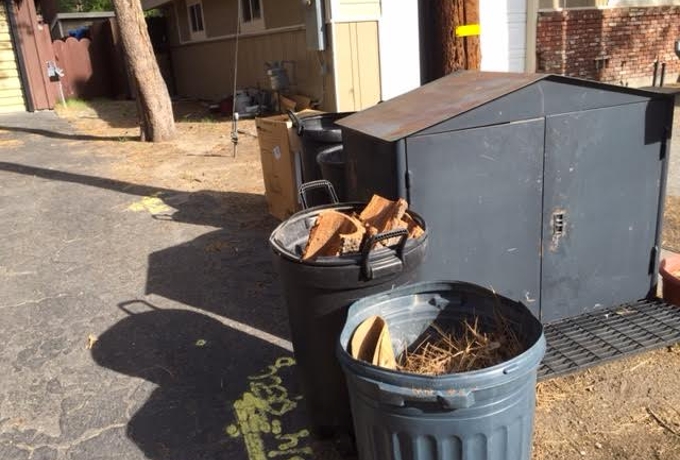
Not always is a bear box big enough for all the garbage. Photo/LTN

Not always is a bear box big enough for all the garbage. Photo/LTN

New regulations would likely require a homeowner who has a second violation in a two-year period be required to have a bear-resistant receptacle. That won’t necessarily mean a bear box.

STR officials are tasked with coming up with a list of containers that would deter bears from getting into the garbage.

“We think many times people don’t know they have a problem because we clean it up,” Jeff Tillman, president of STR, said May 28. “We need an education component.”

The refuse company is going to devise a flyer that it will send to all of its customers about the consequences of bears in trash. The JPA board will review it before it is mailed.

Any fines levied will be tied to the property, with liens placed on it.

STR employees have the ability to photograph a problem residence. That information can then be forwarded to officials in that city or county, with the jurisdiction then responsible for issuing a warning on the first violation and mandate a container after the second infraction.

Clean Tahoe is also cleaning up the streets on the California side where critters have gotten into trash. In March there were 38 such cases in the city and six in El Dorado County.

Catherine Cecchi, who runs Clean Tahoe, said she believes an ordinance like the one being drafted will help to drastically reduce the number of calls her workers respond to. When it comes to who the culprits are Cecchi said it’s a mixed bag of offenders – locals, tourists, second homeowners.

The JPA agreed to alter how those offenders are billed so Clean Tahoe can recoup what it is charged by STR to dump the “bear” trash it picks up.

For those residents serviced by STR who want a bear box it may be possible to buy one through a loan program. Tom Bruen, counsel for the JPA, is looking at the program Placer County adopted earlier this spring that allows residents to buy a bear box for about $1,200, pay it back over five years, with a one-time administrative fee of $120, but zero interest.

The JPA board likes this idea and directed Bruen to come back with a more concrete plan.

While board member Conner said she hears people don’t want bear boxes all over town, Sue Novasel, representing El Dorado County and the president of the Lake Tahoe Wildlife Care board, said her constituents tell her the opposite. She said personally she is an advocate of the containers. Nancy McDermid, Douglas County’s rep on the JPA, concurred with Novasel.

Novasel called the whole bear in trash issue a people problem.


Opinion: Senate race highlights California’s differences

By Joe Mathews

Are you a Kamala or a Loretta?

Attorney General Kamala Harris and Rep. Loretta Sanchez — the leading candidates for U.S. Senate next year — confront Californians with a choice. But it’s not a choice about competing policies or visions. Californians don’t have political arguments about what we believe anymore. Harris and Sanchez are both Democrats in a one-party state, where disputes these days are over just how many resources to devote to the causes we favor.

Joe Mathews

Joe Mathews

No, this is a choice about identity, personality, manners, and culture.

This is about who you are.

And where you live.

The contest between Harris — who grew up mostly in the Bay Area and has made her adult life there — and Sanchez — a Southern Californian to the core — shows how the differences between San Francisco and greater Los Angeles have changed, and endured.

And while our race- and ethnicity-obsessed media prefer to emphasize that Harris is black and South Asian, and that Sanchez is Latina, the heart of the difference between the candidates, and the two regions, is class.

Harris comes off as a 21st century aristocrat — poised, disciplined, distant. Her shorthand bio: born and raised in the Bay Area by two academics (who also were immigrants), one a professor at Stanford. Then she graduated Howard University — the so-called “Black Harvard” — and got a law degree at Hastings. In all this, she’s representative of the rising Bay Area, an upper middle-class island of advanced education in a struggling state. (Every single Bay Area county has a median income significantly higher than the state average).

Sanchez was born in Lynwood, a poor city in southern Los Angeles County; she graduated high school in working-class Anaheim. One of seven children born to Mexican immigrants, a machinist and a secretary, she earned her degree from Chapman, an underdog college that more recently gained renown. In this, she represents a Southern California that has become more working-class, with education levels stagnant, median income falling, and fewer payroll jobs than two decades ago.

In these two regions, people rise differently. Harris has climbed one of the Bay Area’s many established ladders — in the legal field. Her political rise has been supported by Northern California elites of all sorts — her book, “Smart on Crime,” even acknowledges Reagan treasury secretary, George Shultz.

By contrast, Sanchez emerged out of nowhere to take on Orange County’s entrenched Republicans and knock Bob Dornan out of Congress in 1996.

Harris, with the security of someone who knows where she stands in the Bay Area’s clear pecking order (people there know who their politicians and billionaires are), is direct and decisive. She entered the U.S. Senate race quickly and with a well-articulated plan. Sanchez, from a Southern California where status is far from clear and the powerful can be invisible (Quick: could you recognize billionaire Donald Bren, who built much of Orange County, on the street?), played Hamlet for months before getting in the race.

While you won’t find much difference between the liberal positions of Northern and Southern Californians, there are differences in style and speech. Harris follows the Bay Area fashion by inventing jargon to obscure more than explain — her book talks endlessly about “rocking the crime pyramid,” whatever that means. Like her Silicon Valley neighbors, she uses the word “disrupt” as if being disruptive to other people’s work and lives were a good thing.

Sanchez is earthy, bawdy, SoCal. She sent holiday cards with illustrations of herself riding a motorcycle and wearing a tank top. Southern Californians are pretty blasé about loose-talking political figures, and Sanchez has gotten away for years with saying impolitic things that touch on race and ethnicity. Now running statewide, she’ll need to dial back; she got into trouble for making a “war cry” gesture to describe Native Americans recently.

The reaction to Sanchez’s candidacy has split along geographic lines. Northern pundits question whether someone so gravitas-deficient can be considered a serious candidate. But farther south — where people know that politicians practically have to set themselves on fire to get on TV — pundits have responded with versions of, “What’s the Big Deal?”

Of course, not all of us are Kamalas and Lorettas. You might be a San Diegan Republican from the military (and thus a Rocky Chavez). I had a Kamala education, but, as a bombastic Southern Californian with working class roots, I’m a Loretta at heart.

For now, the Kamalas are ascendant. (So is Kamala Harris in the polls). Northern California politicians, businesses and unions are in charge because northerners cast ballots far more often than we do in the South, a voter turnout wasteland.

But one day, working class Los Angeles might awaken, and assert itself at the polls. If that happens, California might be a messier place, but more freewheeling and more fun. More like Loretta.

Joe Mathews is California and innovation editor for Zócalo Public Square, for which he writes the Connecting California column.


Work at Spooner Lake to limit trail access

A meadow restoration and road rehabilitation project will close the first 1.5-mile segment of North Canyon Road at Spooner Lake State Park to recreational traffic.

The road closure will affect access to the Flume Trail via North Canyon Road and the Marlette Lake Trail June 1-July 12, Mondays through Thursdays from 7am-5:30pm.

Access to the Spooner Lake Loop Trail will not be affected.


Nev. lawmakers unveil plan to close entertainment tax loopholes

By Associated Press

CARSON CITY — Lawmakers are unveiling changes to Nevada’s live entertainment tax that they say will capture revenue from an evolving entertainment landscape and close confusing loopholes.

Republican Sen. Mark Lipparelli presented the much-anticipated changes on Thursday as an amendment to SB266.

The bill proposes a 9 percent tax on live entertainment and an 8 percent rate for boxing matches. The existing system imposes a 5 percent or 10 percent tax depending on the size of the venue.

The measure would include escorts but not prostitutes, and also clarifies that outdoor entertainment events such as festivals would be taxed.

Lipparelli said the existing law is confusing and full of exemptions. He said SB266 would clear up ambiguities and help broaden the tax base.

The bill is expected to get a committee vote Friday.


Tahoe literary fest lining up authors, events

Writers, readers and performers from all around the country will appear at South Lake Tahoe Oct. 9-11, 2015 for WordWave, a three-day festival on the grounds of Valhalla at the Tallac Historic Site.

This literary mash-up will feature oral storytelling, theater performances and free readings, panels on craft, yoga, and a novel writing camp for kids. Highlights include a one-act playwriting contest, a Maker’s Station demo with bookbinding, letterpress, drum making, and found poetry and art. Ticketed events include a steampunk ball, workshops, and a hike.

For more info on the playwriting contest, check out this flyer. Submissions are being accepted through June 30.

Presenters include the internationally bestselling author Garth Stein, whose book “The Art of Racing in the Rain” has sold more than 4 million copies and been published in 35 languages. His newest book, “A Sudden Light,” is set in a large historic house in the woods similar to Valhalla’s Grand Hall, the site of WordWave’s Friday night steampunk ball.

Other speakers confirmed include author Pam Houston (“Contents May Have Shifted,” “Cowboys Are My Weakness”), Gayle Brandeis (“The Book of Dead Birds,” “Delta Girls”), award-winning poet Camille T. Dunghy and Christian Kiefer (“The Animals”) on songwriting.

Native American storytellers NEA award recipient Ralph Burns of the Paiute Tribe and Ben Rupert of the Washoe Tribe will also present. The Sierra Showcase will feature 20 writers from the greater Tahoe region on subjects as diverse as travel and adventure writing, Tahoe history, and writing nature.

In addition to the free festival on Saturday, WordWave will offer paid workshops on craft and agent sessions.

For up-to-date information, go online. You can also find TahoeWordWave on Twitter, Facebook, and Instagram. For more information or to volunteer, email tahoewordwave@gmail.com.


USDA declines to investigate alleged violations at major organic farms

By Peter Whoriskey, Washington Post

Aerial photographs taken last summer of some of the largest organic egg and dairy farms in the United States showed few animals outside on pasture, but the USDA will not investigate whether these operations are violating rules for organic agriculture, officials wrote last week.

The photographs of the 14 operations, according to the watchdog group that had them taken,  is evidence that these large farms were not really “organic.” Under USDA rules, organic farms must allow animals to engage in their natural behavior and have free access to the outdoors. Cows, goats and sheep are supposed to be able to get to pastures for grazing.

While the investigations will not go on, the photography presented by the group belied the picturesque images of red barns and green fields that organic brands often present to consumers. The photographs show industrial-scaled operations, a distinct contrast to advertising.  The farms – five dairies and nine chicken operations – supply well-known store brands such as Walmart, Target and Costco, according to the group.

Read the whole story


Snippets about Lake Tahoe

live at lakeview· Live at Lakeview Summer Music Series is June 25-Aug. 27 on Thursdays from 4;30-8:40pm. The South Lake Tahoe concerts are free.

· Golf Advisor recently released its list of the top 50 U.S. Golf Courses in 2014. Incline Village Championship Course was rated No. 19.

· Local Superheroes Day at South Lake Tahoe Library is July 3 at 2pm. Superheroes will include South Lake Tahoe firefighters and police officers, U.S. Forest Service wildland firefighters and South Tahoe Refuse workers. No cost to attend.​ The library is at 1000 Rufus Allen Blvd.

· June 27 is the Summer Kick Off Concert at Northwoods Clubhouse at Tahoe Donner. The free concert is from 6-8pm. Northwoods Clubhouse is located at 11509 Northwoods Blvd., Truckee.

· Leon Malmed of South Lake Tahoe will be interviewed on June 19 and June 21 on PBS in regards to his book about surviving the Holocaust.


Vineyard water consumption being studied

By Felicia Alvarez, Davis Enterprise

At a time when agriculturists are looking for ways to cut back on water usage, researchers at the UC Davis viticulture and enology department are paving the way for sustainable techniques in winemaking and grape-growing.

To make a gallon of wine, it takes 4 to 6 gallons of water under current production techniques. Researchers such as UCD’s David Block, however, are strategizing ways to use a quarter of this amount to create a 1-to-1 ratio of water to wine.

Out in the field, viticulturists are searching for ways to deliver water to plants effectively. Every plant is unique, meaning every vine doesn’t need the same amount of water, Block said. If a grower knows exactly how much water needs to be given to each plant, not a single drop of water needs to be wasted.

Read the whole story


Calif. may make it easier to vote

By John Wildermuth, San Francisco Chronicle

Alex Padilla is looking beyond the state’s borders for programs that could dramatically change the way Californians vote.

Among the ideas that California’s new secretary of state hopes will boost anemic turnout: automatically registering people through the Department of Motor Vehicles and mailing a ballot to every registered voter.

“It will take two big steps to tackle the problem,” said Padilla, a former Democratic legislator from the San Fernando Valley who replaced the termed-out Debra Bowen after winning election in November.

“First we have to register the estimated 6.7 million Californians who are eligible to vote but not registered,” he said. “Then we need to have them actually cast ballots.”

Voting officials across the state agree that something has to be done to get more people to the polls. The 42 percent turnout in November’s general election and the 25 percent for the June primary were both record lows for California.

Read the whole story


Meyers golf course embracing music, bikes

Lake Tahoe Golf Course will be the site of two new events this summer.

The 10th Tee Summer Music Series will be the third Sunday of each month — June 21, July 19, Aug. 16 and Sept. 20.

The free concerts will be from 4-8pm at the Meyers golf course.

Tahoe Games Bike Nights will be July 31, Aug. 15 and Sept. 26. Registration starts at 8pm.

On Course Events, which is putting on the music and bike events, will illuminate a custom cross country course under a full moon for ages 10 and up. Decorating bikes with lights is strongly encouraged.