By Andrew Donohue and Bernice Yeung, Reveal
California continues to allow one of agriculture’s most popular and potent chemicals to be used under rules its own toxicologists have said aren’t scientifically sound.
As a result, residents in farming counties such as Kern, Fresno and San Joaquin are being put at a higher risk of cancer than state scientists believe to be acceptable, internal documents and interviews show.
A Reveal investigation last year showed how the state’s Department of Pesticide Regulation gutted regulation of 1,3-Dichloropropene at the request of its manufacturer, Dow AgroSciences. In the past year, state officials have begun to rein in the use of the pesticide, a gas injected into the soil before planting crops such as strawberries and almonds.
This has limited the most excessive use in Ventura, Monterey and Merced counties, which went beyond what even Dow had envisioned. But the recent changes don’t mean the department closed the loophole that allowed the excess use.
It simply has gone back to enforcing the original outlines of the Dow loophole, meaning growers in communities across the state still legally can use the pesticide at levels that state scientists have said are unacceptable, newly released data for 2014 shows.
Last year, growers went past the original safety limits in 20 communities in Fresno County and in communities in Monterey, Santa Barbara and Kern counties, among others.
In total, growers in 54 townships went over the cap in 2014, according to department documents. That’s an increase from 2013, when 47 did. In the areas that went over the cap, the most common crops were almonds, grapes and strawberries.
Joseph Frank, a retired state toxicologist who oversaw the department’s review of 1,3-D, said top state officials chose Dow’s analysis over their own scientists’ analysis.
“It is playing games with numbers, and we’ve told management this,” he said.
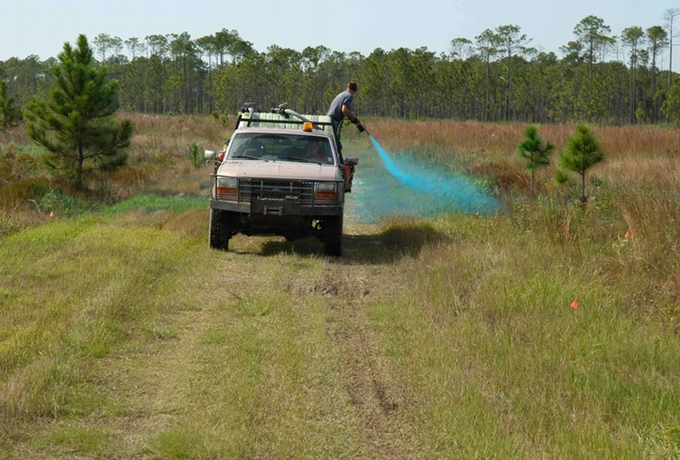
Pesticides are regularly being used despite health concerns. Photo/USFWS
The department said it’s doing a new analysis of the health impacts of 1,3-D, an exercise known as a risk assessment. Staff toxicologists are reviewing the science around 1,3-D and will issue safety guidelines to top managers. From there, managers will balance that science with a pesticide’s benefits to design rules about how it can be used.
“The risk assessment will provide the scientific basis for a new plan to manage the use of this pesticide,” said department spokeswoman Charlotte Fadipe.
Dow said the original state limits are based on conservative estimates and outdated science. Recent real-world air monitoring and studies on how long people live in one place show that the loophole doesn’t cause public health concerns, the company said.
That 1,3-D is considered a cancer-causer in California doesn’t on its face have to be alarming. We’re constantly surrounded by things that could cause cancer, like the sun or arsenic in rice.
As the saying goes, the dose makes the poison.
The 1,3-D loophole highlights a core tension in how the government handles these doses.
While the pesticide regulation department’s mission is to protect human health and the environment, its regulations often reflect a compromise between scientists’ recommendations and the benefits a pesticide gives to the powerful agricultural industry.
This is generally how governments handle industrial chemicals. The name of the process manages to be at once bureaucratic and straightforward: risk management.
However, in the case of 1,3-D, there was little compromise. In the early 2000s, growers needed something to fill the gap left by an international ban on what was once their go-to pesticide, methyl bromide.
1,3-D fit the bill. It’s a byproduct of plastic manufacturing that Dow has turned into an effective pesticide. But the state says it can cause cancer. Some 1,3-D eventually escapes into the air and can be breathed in by neighbors and workers.
Because of concerns over how much 1,3-D lingered in the air, the pesticide faced tight restrictions. The state had gone through a rigorous process to decide how much 1,3-D could be used. That limit already was stretching the boundaries of what state scientists thought was acceptable, Frank said.
But those limits didn’t last long. Despite warnings from his own scientists, the department director at the time, Paul Helliker, signed off on Dow’s request to loosen the rules. He and his successors then stopped enforcing the rules altogether, allowing excess 1,3-D use in agricultural communities across the state.
Because of all the different factors that can cause cancer, there’s little way of knowing definitively whether anyone has gotten or will get cancer because of 1-3,D. But the excess use does increase the probability, the state scientists say.
The state already had a complicated history with 1,3-D.
In the early 1990s, it pulled 1,3-D from the market after learning how much lingered in the air after it had been applied. Air monitors at a Merced middle school picked up levels that were 800 times what the state said was acceptable on one day.
After five years of research, Dow persuaded state officials to put it back on the market. The state, though, needed a way to limit the amount of 1,3-D that could be used in each community. So regulators divided the state into small grids, 6-by-6-mile squares known as townships, and capped the amount of 1,3-D that could be used by growers in each township at 90,250 pounds a year.
At this level of use, scientists projected it could cause one extra cancer case per 100,000 people. The rules management put into place, Frank said, already were pushing the boundaries of what scientists thought was appropriate. State scientists previously had suggested that the department try to limit that risk to one cancer case per 1 million people. But state officials said Dow had argued that those restrictions would make it impossible to use 1,3-D.
A couple of years later, Dow and growers began pressuring the state to loosen those restrictions.
The proposed Dow plan worked like cellphone rollover minutes: If growers in a township didn’t use all of their annual 1,3-D allotment in previous years, they could save it in a bank and use that much more in future years.
Each year, growers could use up to double the amount of 1,3-D that the original rules allowed – 180,500 pounds, so long as they had that amount saved up in the bank.
Dow and the department directors said that because cancer risk is averaged over 70 years, allowing a few years of increased use was fine as long as it all averaged out over time.
Scientists objected, saying anything over the annual limit violated the science underpinning the regulations. They said the concept of banking didn’t hold water. Just one year of high exposure, Frank said, could provide the catalyst that may eventually give someone cancer.
Here’s how one outside expert described it in our November story:
Chensheng Lu, an associate professor at Harvard University’s School of Public Health, likened the averaging idea to drinking and driving. If you get pulled over once and you are sober, but you are pulled over a second time and your blood alcohol level is twice as high as the legal limit, you can’t average the two incidents and say everything is fine. “This is a very dangerous approach,” Lu said.
In 2002, Helliker, the department director at the time, agreed with Dow, adopting the heart of its plan.
Once the Dow loophole was in place, top department officials essentially stopped regulating 1,3-D. In 2004, they began allowing growers to exceed the limits they had set – to the point that the exception became the rule. Agricultural businesses essentially had unfettered access to the chemical.
Over 12 years, growers in one Merced community used 1 million pounds more 1,3-D than they were supposed to even under the Dow plan.
Growers near Oxnard’s Rio Mesa High School, which is surrounded on all four sides by strawberry fields, far surpassed the 180,500-pound limit under the Dow plan. In 2006, they used 267,000 pounds. Over 12 years, they used 317,000 more pounds 1,3-D than they had in the bank.
1,3-D use increased by more than 200 percent across the state. As it became a hit with strawberry growers, it increasingly was used near schools, homes and businesses in more populated areas like Ventura County.
Between 2002 and 2012, 1,3-D use in Ventura jumped 1,174 percent.
All told, people in more than 100 California communities have been at greater cancer risk, interviews with former state scientists and internal documents show.
Scientists with the Department of Pesticide Regulation have analyzed this system twice since Dow began floating the concept. Both times, state documents show, they objected to the basic plan put forth by Dow and top officials.
“We are unaware of a defensible scientific rationale justifying such a practice,” staff toxicologist Linda Hall concluded in a 2009 study.
Frank, who was Hall’s boss at the time, said his team consulted experts at Harvard and the Massachusetts Institute of Technology. “We could not find anyone in the field who disagreed with us,” he said. “It wasn’t even debatable.”
Department leaders have been unable to provide a competing scientific analysis, outside of Dow’s, that justifies the loophole.
Early last year, following inquiries from Reveal, Department of Pesticide Regulation Director Brian Leahy said the department would stop issuing 1,3-D exemptions.
The new state data reveals the limits of that decree.
Growers still may go above the 90,250-pound annual limit if they have 1,3-D in the bank. And the growers who accrued negative balances won’t be monitored to ensure that they pay back their debt.
The department appears to be hoping that things eventually average out.
Fadipe, the department’s spokeswoman, said simply holding the most prolific 1,3-D users to under 90,250 pounds “will not increase the average concentration.” She continued: “You are either reducing the average air concentration (over 70 years) or not increasing it.”
But that doesn’t mean it will all add up.
Take the Merced community where growers used 1 million more pounds than they were supposed to under Dow’s plan. In 2014, they used 80,377 pounds of 1,3-D.
If growers there used that amount each year for the next 50 years, the township’s 70-year average since 1995 still would be more than the 90,250-pound cap – 97,841 pounds. But there’s no fixed year that the 70-year average starts and stops, so choosing a timeframe for averaging becomes arbitrary.
Still, Leahy has trumpeted his decree as if it were a get-tough regulation, rather than a return to following the rules of the loophole.
In Leahy’s response to pointed questions from school officials in charge of Rio Mesa, here’s how a department fact sheet described the regulatory history of 1,3-D and other pesticides:
“Based on its scientific analysis of monitoring data and computer modeling, DPR (the Department of Pesticide Regulation) implemented a series of requirements beginning in the mid-1990s, including restrictions on application methods, buffer zones, limits on use, and other protection measures for metam (sodium), methyl bromide, and 1-3,D. In February 2014, DPR implemented additional restrictions to further reduce long-term exposure to 1-3,D. DPR will implement restrictions for chloropicrin in 2015. DPR is likely to further update its restrictions for 1-3,D in 2016.”
The fact sheet skips straight from the 1990s to Leahy’s February 2014 decree, leaving out the loosened regulations and broken rules in between.