IRS may lower threshold for reporting slot winnings

By J.D. Morris, Las Vegas Sun

The national casino industry and its allies in Congress are trying to send a message to the IRS: Lowering the threshold for reporting slot winnings is a bad idea.

Geoff Freeman, president of the Washington, D.C.-based American Gaming Association, said in a conference call today that about 13,000 people from across the country had spoken out against the potential threshold change. The IRS has been seeking public input on the possibility of someday lowering the amount at which casinos must report slot winnings from $1,200 to $600.

The idea comes as the IRS considers changes that would “update and simplify” gaming-related regulations. The agency plans to keep the current slot winnings threshold in place for now, but it’s accepting comments on the feasibility of a lower reporting requirement.

Read the whole story


Work on Hwy. 28 to begin next week

Two stretches of Highway 28 in North Lake Tahoe will be repaved starting next week.

The work includes a five-mile section from Sierra Terrace Road in Tahoe City to Carnelian Bay and a half-mile stretch east of Kings Beach to the Nevada state line.

Work is scheduled from 6pm-6am Sunday through Friday and should be completed by the end of July. However, unexpected weather or other events could extend the project. The work will be performed under one-way traffic control with delays up to 10 minutes in each direction.

The construction contract was awarded to VSS International, Inc., with a low bid of $815,375.


Snippets about Lake Tahoe

stpud·       South Tahoe Public Utility District’s board is expected to vote June 18 on an ordinance that would change elections to be at-large. If it passes, the change would be effective for the 2016 elections.

·       The High Fives Foundation awarded 25-year-old Jeff Andrews an Empowerment Grant to help aid in his recovery from a snowboarding accident resulting in quadriplegia. The money allows Andrews and his trainer Jack Powell rehab at the CR Johnson Healing Center in Truckee.

·       Magic Dan will be at the South Lake Tahoe Library on July 17 at 2pm for a free magic show with a message that enhances and reinforces education, reading and self-esteem. The library is at 1000 Rufus Allen Blvd.

·      South Lake Tahoe Family Resource Center is conducting a tamale fundraiser. Call 530.542.0740 or email dhooper@tahoefrc.org to order the chicken, cheese or pork tamales. The deadline in June 10. They are $20 per dozen.

·      Here at the Caltrans roadwork schedules for the week for El Dorado-Tahoe and Sierra.


Nevada wiretap law covers cell calls, texts

By Associated Press

Nevada’s state wiretap law was written before wireless devices came into everyday use.

But a state Supreme Court panel says it still gives police access to cellphone calls and text messages.

The ruling Thursday by a three-justice panel means police can continue to seek and obtain court warrants to intercept calls and texts.

The high court rejected an appeal by Phillip Douglas Sharpe, who’s serving 10 years to life in state prison on a Lyon County drug trafficking conviction.

Sharpe’s attorney is Paul Quade in Reno. He says he may ask the entire seven-member high court to reconsider the decision.

In the opinion, Justice Mark Gibbons writes that cellular telephone calls and text messages meet the definition of wire communications in state law written in 1973.


Calif. is sinking, and it’s getting worse

By Nathan Halverson, Reveal

California is sinking – and fast.

While the state’s drought-induced sinking is well known, new details highlight just how severe it has become and how little the government has done to monitor it.

Last summer, scientists recorded the worst sinking in at least 50 years. This summer, all-time records are expected across the state as thousands of miles of land in the Central Valley and elsewhere sink.

But the extent of the problem and how much it will cost taxpayers to fix are part of the mystery of the state’s unfolding drought. No agency is tracking the sinking statewide, little public money has been put toward studying it and California allows agriculture businesses to keep crucial parts of their operations secret.

The cause is known: People are pulling unsustainable amounts of water out of underground aquifers, primarily for food production. With the water sucked out to irrigate crops, a practice that has accelerated during the drought, tens of thousands of square miles are deflating like a leaky air mattress, inch by inch.

Groundwater now supplies about 60 percent of the state’s water, with the vast majority of that going to agriculture. Tens of thousands of groundwater pumps run day and night, sucking up about 5 percent of the state’s total electricity, according to a Reveal analysis of the increased pumping resulting from the historic drought. That’s an increase of 40 percent over normal years – or enough electricity to power every home in San Francisco for three years.

The sinking is starting to destroy bridges, crack irrigation canals and twist highways across the state, according to the U.S. Geological Survey.

Two bridges in Fresno County – an area that produces about 15 percent of the world’s almonds – have sunk so much that they are nearly underwater and will cost millions to rebuild. Nearby, an elementary school is slowly descending into a miles-long sinkhole that will make it susceptible to future flooding.

Private businesses are on the hook, too. One canal system is facing more than $60 million in repairs because one of its dams is sinking. And public and private water wells are being bent and disfigured like crumpled drinking straws as the earth collapses around them – costing $500,000 or more to replace.

The sinking has a technical name: subsidence. It occurs when aquifers are drained of water and the land collapses down where the water used to be.

The last comprehensive survey of sinking was in the 1970s, and a publicly funded monitoring system fell into disrepair the following decade. Even the government’s scientists are in the dark.

“We don’t know how bad it is because we’re not looking everywhere,” said Michelle Sneed, a hydrologist with the geological survey. “It’s frustrating, I’ll tell you that. There is a lot of work I want to do.”

Some places in the state are sinking more than a foot per year. The last time it was this bad, it cost the state more than a billion dollars to fix.

In the 1920s, farmers began transforming desert lands into verdant crop fields by pumping groundwater to the surface. At the time, these farmers were not just head and shoulders above their modern-day counterparts – they were actually as much as three stories above them. But then the land started to sink.

In the 1930s, scientists first noticed the land was sinking. At the time, the cause was a mystery. A legendary hydrologist, Joseph Poland, was assigned to solve the puzzle starting in the 1940s.

He realized that underneath the sinking land, groundwater was being pumped rapidly to irrigate crops. It created massive sinkholes that stretched for miles in every direction. In the farming community of Mendota, the land sunk about 30 feet between 1925 and 1977.

The sinkhole is so vast that it is essentially impossible for residents to see that they are standing in one. Poland used a utility pole to build a temporary monument to show them just how much the land had sunk.

The sinking, which peaked in the late 1960s, wreaked havoc on the state’s rapidly expanding infrastructure, damaging highways, bridges and irrigation canals. One estimate by the California Water Foundation put the price tag at $1.3 billion for just some of the repairs during that time.

The sinking did not slow until the 1970s, after California had completed its massive canal system – the most expensive public works project in state history. It delivered water from wetter parts of the state to farmers in the Central Valley and elsewhere, relieving their reliance on groundwater. The problem was fixed – at least for a while.

‘When we looked back, whoa – it had gotten bad’
In 2012, Sneed, the hard-charging geological survey scientist, received a startling report. Land was subsiding along the San Joaquin River at a rate worse than during the 1987-92 drought. It was nearing the historic rates of sinking recorded by Poland in the late 1960s. She couldn’t believe it.

“Is this even real?” she asked. “We hadn’t seen rates of subsidence like that in a long time.”

She and others began assembling what little public data was available. They got funding to analyze satellite data for parts of the San Joaquin Valley. They discovered that in one of the worst observed areas, around the town of El Nido (Spanish for “The Nest”), land was sinking at a rate of about 1 foot per year in 2012.

“It’s incredible,” Sneed said, expelling a puff of air as if she still couldn’t believe it. “We looked away for a long time. And when we looked back, whoa – it had gotten real bad.”

The El Nido subsidence bowl was sinking so fast that the satellite couldn’t keep pace.

No one has monitored it since. But Sneed and others contacted by Reveal said they expect it now could be sinking by 2 feet per year. That would be an all-time record.

Chris White, general manager of the Central California Irrigation District, said that last year, a farmer near El Nido sent him a photo of a gas pipe that had protruded more than 18 inches from the ground in less than a year as the land sank around it.

White said Californians now might have the opportunity to witness firsthand the devastation Poland chronicled in the 1960s.

“There is that potential,” he said.

Sneed is practically begging to expand her limited research. A hodgepodge of about 350 ground-elevation monitors – many leftover from the 1960s – are all she and other researchers have to track tens of thousands of miles that are sinking. This includes vineyards in Sonoma and Napa counties, areas around Paso Robles and Santa Barbara, and agricultural regions encircling Los Angeles, all which have shown signs of sinking, according to a California Department of Water Resources report.

To draw awareness to the problem, Sneed replicated Poland’s 1977 photo. Her photo captures the early stages of today’s worsening subsidence problem, she said. But she and others expect that it will get much worse.

U.S. Geological Survey scientist Michelle Sneed shows where a farmer would have been standing in 1988, before a six-year drought triggered sinking in California’s San Joaquin Valley. It also shows how sinking accelerated in 2008.Credit: U.S. Geological Survey
Bridges are sinking and canals are cracking
Many businesses and state agencies appear to be unaware of the problem.

Sneed and her boss at the U.S. Geological Survey, Claudia Faunt, have tried reaching out to various government agencies and private businesses to warn them and inquire about the extent of damage being done to infrastructure.

“We tried calling the railroads to ask them about it,” Faunt said. “But they didn’t know about subsidence. They told us they just fixed the railroads and categorized it as repair.”

Thousands of miles of highways snaking through the state also are being damaged, she said.

“They go to repair the roads, but they don’t even know it’s subsidence that is causing all the problems,” Faunt said. “They are having to fix a lot because of groundwater depletion.”

A spokeswoman for the state Department of Transportation said the agency does not track costs related to subsidence and was not aware of any current bridge repairs resulting from it.

But Faunt pointed to the Russell Avenue bridge that crosses the Outside Canal in the Central Valley. It sank during two previous droughts – one in the late 1970s and then again between 1987 and 1992. Now with the current sinking, the 60-year-old bridge is almost totally submerged by canal water.

Down the road about a mile, Russell Avenue crosses another irrigation canal, the Delta-Mendota Canal. That bridge is sinking, too, and now is partially submerged in water. Plans to replace it are estimated to cost $2.5 million, according to an estimate by the Central California Irrigation District.

The bridge is part of an $80 million list of public and private repairs already needed near the El Nido subsidence bowl because of sinking, White said.

Last year, the state passed its first law attempting to regulate groundwater, but farmers won’t be required to meet goals until 2040 at the earliest. And the information on who is pumping what will be kept private.

“A doomsayer would say we will run out of water,” said Matt Hurley, general manager of the Angiola Water District, near Bakersfield. “But I don’t believe we’re heading there. We’ve been given a good opportunity with the sustainability law.”

But Devin Galloway, a scientist with the geological survey, sees devastation of a historic proportion returning to California. He says that even if farmers stopped pumping groundwater immediately, the damage already done to aquifers now drained to record-low levels will trigger sinking that will last for years, even decades.

“This could be a very long process. Even if the water levels recover, things could continue to subside,” he said. “This is a consequence of the overuse of groundwater.”


Vikingsholm access available to those with disabilities

For people who have a valid ADA placard, special arrangements are necessary to reach the Vikingsholm area.

Call 530.525.9529 to check on the availability of the shuttle service that escorts people with mobility disabilities to the historic home and beach area. Reservations must be made at least 24 hours in advance, and a $10 parking fee is charged.

This service is offered during the Vikingsholm tour season, which is now until September.


Study: Bullying is a public health problem

By Karen Kaplan, Los Angeles Times

Bullying may be responsible for nearly 30 percent of cases of depression among adults, a new study suggests.

By tracking 2,668 people from early childhood through adulthood, researchers found that 13-year-olds who were frequent targets of bullies were three times more likely than their non-victimized peers to be depressed as adults.

Even when the researchers accounted for factors like a teen’s record of behavioral problems, social class, child abuse and family history of depression, those who were bullied at least once a week were more than twice as likely to be depressed when they grew up.

The findings, published Tuesday in the BMJ, should prompt parents, teachers and public health authorities to get serious about cracking down on bullying, the study authors wrote.

Read the whole story


Jeffrey pine beetles taking toll on Tahoe trees

By Kathryn Reed

Jeffrey pine beetles love drought. It means trees are weaker and unable to fend off this species that is native to the Lake Tahoe Basin. It means they get to proliferate.

What it means for the trees is more will die. This in turn creates more fuel for wildfires.

Officials throughout the Western United States are concerned about the proliferation of beetles as the wildfire season gets under way in what is now the fourth year of one of the worst droughts on record.

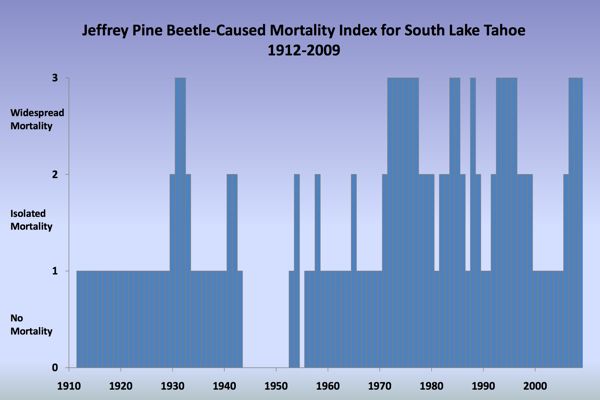
The Jeffrey pine beetles are black and are no more than one-quarter-inch long. They have a history of wreaking havoc in Tahoe. There was a huge outbreak in the basin from 1991 to 1996 that wiped out nearly 40 percent of the Jeffrey pines in the basin.

“We need to react to the outbreak quicker than we did in the 1990s,” Kit Bailey, fire chief for the Lake Tahoe Basin Management Unit, told Lake Tahoe News. “We won’t stop it, but we may moderate the negative affects.”

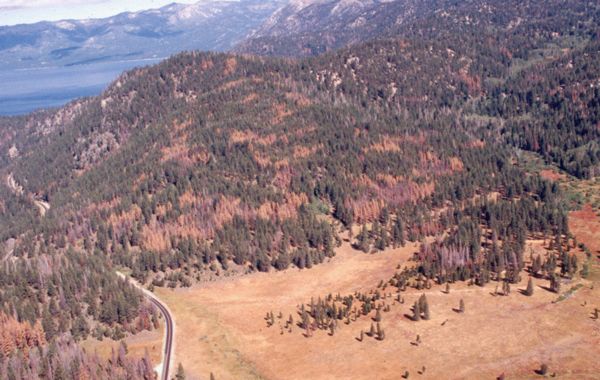
Aerial photograph of Spooner study site and surrounding area in 1995 following extensive Jeffrey pine beetle-caused tree mortality exhibited by discolored Jeffrey pine crowns

Orange trees at the Spooner Lake area in 1995 show the devastation of the Jeffrey pine beetle. Photo/U.S. Forest Service

Not leaving the tinder dry wood is one way to deal with the carnage.

Dave Fournier, vegetation specialist with the LTBMU, said removing the infested trees in the fall would be key to keeping the infestation in check and reducing the mortality rate of trees. Felling the trees and hauling them out of the basin removes the beetles that continue to lay their eggs in the dead or dying tree. This kills off the next generation of beetles before they can hatch in the spring.

During the drought in the early 1980s a beetle outbreak affected mostly fir trees. Because there were osprey nests no trees were removed, Fournier said. This was in Slaughterhouse Canyon on the East Shore.

Two decades later the powers that be finally realized trees needed to be removed because they were so thick. Trees were so close together and others were scattered about the ground that it took an hour to walk 100 feet, Fournier said.

No trees were removed in the ’90s during the Jeffrey beetle outbreak. This, too, created an overabundance of fuel for a fire.

Policies and philosophies have changed in the intervening years. Now thinning projects are seen as a way to combat the beetle problem.

The denser the tree stand, the less water there is to go around. Less water means a tree is not completely healthy and is therefore more susceptible to being overtaken by a beetle.

About 60 percent of the wildland urban interface in the basin has been thinned. The Forest Service has the funds to complete about half of what is left. The problem is these areas are heavy fuel loaded stands that are 100 years old.

“My prediction is that these stands that have been thinned using current standards should not see a sea of red providing the thinning was sufficient,” Fournier told Lake Tahoe News.

Another issue the Forest Service is contending with is that until about 10 years ago large diameter trees were not removed. This is a problem because their roots are deep and they need more water than smaller trees.

The U.S. Forest Service annually surveys its land by air. In 2014, 800,000 acres of tree mortality were found in California. This compares to 2013 when there were 350,000 acres.

Charles Goldman at a talk June 4 in Incline Village touched on forest health, saying, “Up to 70 percent of the trees in some areas are dead or dying” from bark beetles.

Fournier is already documenting evidence of the resurgence of these beetles. They are ravaging trees at Kiva Beach on the South Shore.

Source: U.S. Forest Service

                                                                                                                                                   Source: U.S. Forest Service

A sea of red trees is the telltale sign of beetle infestation. By fall it will be easier to see the devastation. However, with so little moisture for the past few winters, the dead needles are likely to first be evident this summer to the average person.

The Jeffrey pine beetle is one of 220 species of beetles. Of those, 12 like to burrow into the various pine trees. Usually the different beetles are confined to a select area of the state.

A good winter normally kills off many of the beetles – keeping their populations in check. But that hasn’t happened for a few years. This has given the beetle population an opportunity to grow.

They bore into the trees in the late fall. A healthy tree can use its pitch to extract the beetle so it never takes hold. But the drought has weakened trees’ ability to fend for themselves and therefore the beetles are winning.

“Once they lay eggs the tree is girdled,” Fornier explained. “Then it’s just a matter of time for how long it takes for that tree to shutdown.”

While the Jeffrey pine beetles are native to the basin, in a normal winter about one tree in every 3 acres dies – not groves, as is happening today.


Opinion: Have Democrats pulled too far left?

By Peter Wehner, New York Times

Among liberals, it’s almost universally assumed that of the two major parties, it’s the Republicans who have become more extreme over the years. That’s a self-flattering but false narrative.

This is not to say the Republican Party hasn’t become a more conservative party. It has. But in the last two decades the Democratic Party has moved substantially further to the left than the Republican Party has shifted to the right. On most major issues the Republican Party hasn’t moved very much from where it was during the Gingrich era in the mid-1990s.

To see just how far the Democratic Party has moved to the left, compare Barack Obama with Bill Clinton. In 1992, Clinton ran as a centrist New Democrat. In several respects he governed as one as well. He endorsed a sentencing policy of “three strikes and you’re out,” and he proposed adding 100,000 police officers to the streets.

In contrast, President Obama’s former attorney general, Eric H. Holder Jr., criticized what he called “widespread incarceration” and championed the first decrease in the federal prison population in more than three decades. Obama, meanwhile, has chosen to focus on police abuses.

Read the whole story


S. Tahoe police working on community outreach

The South Lake Tahoe Police Department is making a concerted effort to better interact with the public outside of detaining individuals.

There will be an open house June 11 from 3-7pm at the department, 1352 Johnson Blvd. There will be a variety of police equipment and vehicles on-hand. The goal is to promote transparency and have the community meet with police officers and unsworn staff.

Coffee with a cop will be every Thursday this summer from 8-10am at the Starbucks in the Village Center. Sergeants and above will be engaging the public.