Residential hot tub destroyed by fire

A hot tub in Stateline is no longer usable because of an early morning fire today.

“The skirting of the hot tub burned, the fiberglass melted and the cover burned up,” Eric Guevin, fire marshal with Tahoe Douglas Fire, told Lake Tahoe News.

The flames reached the house, but firefighters were able to quickly douse them. They pulled some of the siding off and found that the fire had not extended into the interior.

Someone passing by the house on Seminole Way at 4:48am June 8 spotted the fire and altered the homeowners.

The cause of the fire is under investigation.

— Lake Tahoe News staff report


Plenty of faults with ‘San Andreas’

By Joe Mathews

After sitting through the new earthquake movie “San Andreas”, I experienced my own dark seismic fantasy: as the Big One hits California, a giant hole opens up under Burbank, and Warner Bros. disappears into it forever.

I had been prepared by advance publicity for Warner’s “San Andreas” to be a dumb film full of pseudoscientific nonsense about earthquakes. But “San Andreas” is much worse than that. The film is so profoundly cynical and callous that to call it reprehensible might be too kind.
Joe Mathews

Joe Mathews

I am not talking about the nonsense spewed onscreen about chasms and tsunamis that are life-and-death subjects in many parts of the world. My main beef with “San Andreas” is its treatment of California and its people. It trivializes the loss of human life and offers thinly disguised contempt for us Californians, who are portrayed — with few exceptions — as foolishly panicked, cowardly or corrupt.

Then there are the glossy lead characters, who — amidst indescribable tragedy — talk mostly about themselves and their relationships. They also do a lot of kissing and — call me a prude — show off considerable cleavage as two cities are destroyed and tens of thousands of people perish around them.

For those lucky enough not to have seen the film, it stars Dwayne Johnson — the artist formerly known as The Rock — as a Los Angeles Fire Department rescue helicopter captain. After the first of a historic earthquake swarm hits L.A., this public employee ignores millions of suffering Angelenos who pay his salary to save his estranged wife from a skyscraper. Since she is played by the wonderful Carla Gugino, I was willing to cut him some slack. But then, after rescuing her, the couple — without a second thought — abandons my devastated city to fly to San Francisco to find their daughter.

The film portrays California as many very rich people here see it — two cities, Los Angeles and San Francisco — with not much else of importance anywhere else. We learn nothing of lives lost along the San Andreas between those cities — no tears are shed for the Central Coast, or even San Jose. A brief scene in Bakersfield is mainly an opportunity to slur that city’s people, who — just minutes after a great disaster — are devoting their energy to looting.

Our self-involved protagonists arrive in San Francisco by jumping out of a stolen plane and into AT&T Park, allowing Johnson to quip inappropriately — in the midst of disaster — that it’d been a while since he’d taken his wife to second base.

In the City by the Bay, no one can think straight in the panic — except two young brothers, who, in keeping with the anti-Californian bias of the movie, are British.

Then, just minutes after a tsunami destroys what was left of San Francisco after the earthquakes, the older British brother and Johnson’s daughter do some kissing.

Who knew mass casualties were such a turn-on?

Yes, it’s true that over the last century Hollywood has destroyed parts of California to create moments of cinematic wonder. Hollywood filmmakers seem to like portraying their neighbors as expendable folks, whose extinction can be enjoyed by worthier Americans in the heartland.

But “San Andreas” feels especially cruel, particularly in the way it ignores the victims. (In contrast, at the end of the classic 1936 film “San Francisco”, the people get to march arm-in-arm back into their earthquake-ruined city as they defiantly sing “The Battle Hymn of the Republic”). There is also a whiff of political ambition amidst the film’s cynicism. When I was covering Gov. Arnold Schwarzenegger, Hollywood friends of his told me that “San Andreas’” star Johnson — The Roc k— was patterning his career after Schwarzenegger — from a muscle business (wrestling) to action films, comedy, philanthropy — and eventually, maybe politics.

That seemed crazy at the time. But now comes a movie where Johnson plays the hero in a calamity. Johnson even concludes the movie by promising, in gubernatorial tones, “Now we rebuild.” Even in this stinker, you can smell what the Rock is cooking.

The ugly truth is that “San Andreas” isn’t the only evidence of Hollywood’s contempt for its home state. The entertainment industry summoned all its influence to secure $1.6 billion in state tax incentives over the past five years. The money is supposed to bring back to California big-budget productions like “San Andreas”, which was filmed mainly in Australia. But putting taxpayer money into movies like this is horrifying, particularly when the state has more pressing needs — including billions in seismic retrofitting for buildings and infrastructure.

At least the timing of “San Andreas” is good. The awful film, arriving during state budget season, makes a convincing case for stripping Hollywood of those tax incentives, and putting the money into rebuilding our state.

Joe Mathews wrote this Connecting California column for Thinking L.A., a project of UCLA and Zócalo Public Square.

Tahoe Tails: Adoptable Pets in South Lake Tahoe

Ginger

Ginger

Ginger and her sister Mary Ann are 8 to 10 month old pit bull mixes who are a bit on the shy side. Ginger is more outgoing, but both are very sweet, get along well with other dogs, and walk nicely on the leash. They do not have to go home together.

Both girls would do best in a patient home where they’ll get lots of exercise and some obedience training, plus gentle socialization.

Ginger and Mary Ann are spayed, microchipped, tested for heart worm, and vaccinated. Both are at the El Dorado County Animal Services shelter in Meyers, along with many other dogs and cats who are waiting for their new homes. Go to the Tahoe animal shelter’s Facebook page to see photos and descriptions of all pets at the shelter.

Call 530.573.7925 for directions, hours, and other information on adopting a pet.

For spay-neuter assistance for South Tahoe residents, go online.

— Karen Kuentz


Donner Museum captures region’s history

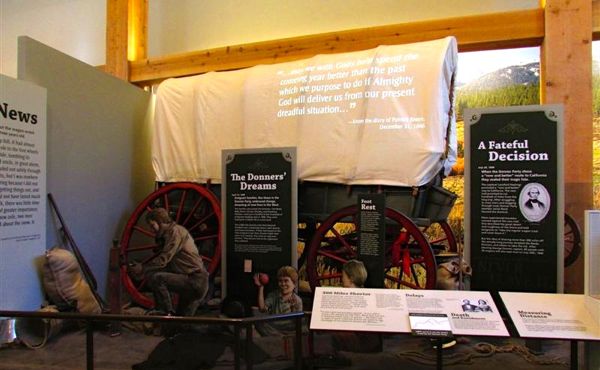
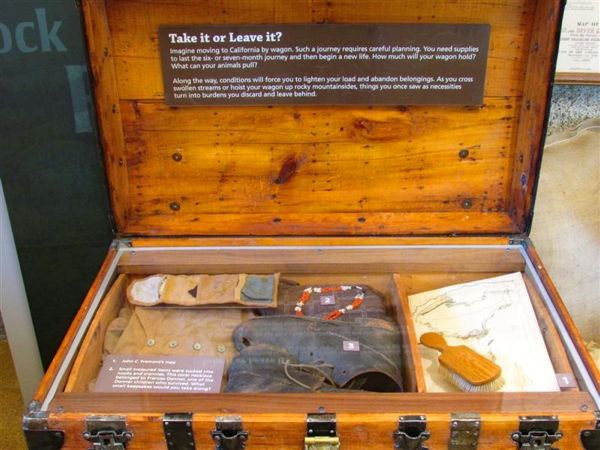
Exhibits at the Donner Museum tell the story of the region's past. Photos/Denise Haerr

Exhibits at the Donner Museum tell the story of the region’s past. Photos/Denise Haerr

By Denise Haerr

TRUCKEE – Hundreds gathered to be a part of history in the making in the impressive shadow of the Pioneer Memorial, whose own dedication occurred 97 years ago to the day. The grand opening of the Donner Memorial State Park Visitor Center on June 6 was a 20-year, $9.6 million endeavor that was a testament to collaboration.

Even its theme, “Crossing Barriers Changes Lives”, was clearly evidence by the emotional blessing prayer given by Washoe elder Steven James, encouraging everyone to continue to work together the make things better.

The High Sierra Crossing Museum – a 9,400-square-foot structure – has sat empty for about a year because of lack of funding to operate it. It replaces the Emigrant Trail Museum.

The state-of-the-art facility is full of innovative and engaging programs and exhibits. It is destined to be a much-visited park. It honors the ill-fated Donner Party, telling the history of the Donner region, including: Washoe settlements, Chinese workers building the transcontinental railroad, and early motoring experiences over Donner Pass. This is not just a look at museum. It’s something to experience, a place to learn about those who came before us.

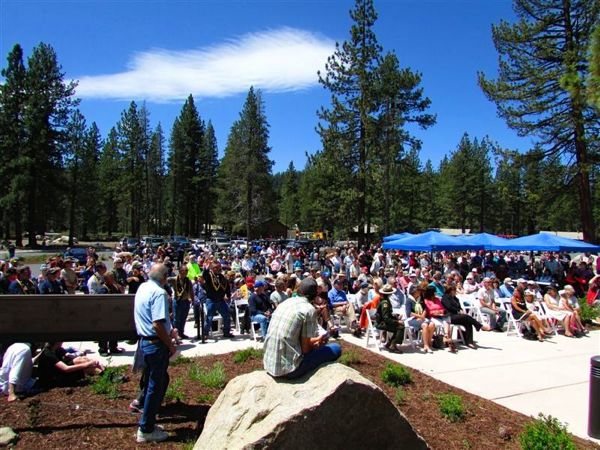
Hundreds of people turn out for the June 6 museum opening.

Hundreds of people turn out for the June 6 museum opening.

The audience was asked to raise a hand if anyone was a descendant of the Donner Party. Dozens of hands rose.

Later, Tamara Anderson told of her relative, Sarah Graves, who was part of the Forlorn Hope, an offshoot of the original group. Graves was one of the few survivors. An exhibit in the museum titled “Why Women Survive?” gives insight into Anderson’s family legacy.

More women than men lived through the Donner Party ordeal.

While there were many dignitaries present on Saturday, the ceremony began with a flag raising, with the help of two little girls, Cora Medhurst and Abigail Quadros. They are the great-great-granddaughters of Louis De Rome, a pioneer bronze manufacturer and the caster of the Pioneer Memorial. While De Rome created the impressive statue, it was the Native Sons of the Golden West that secured the lands for the location in 1918. Members from all over California convened for this the 139th Grand Parlor Annual Meeting. As tradition dictates, the members combined sand, gravel and water from the far reaches of California to make cement. They then affixed part of the historic marker with the cement, a custom symbolic of the society’s original mission since its forming in 1875 – to preserve California’s historic resources with informational markers and fundraising for landmark restoration work. It was a memorable display of the magnitude of this endeavor.

Displays show items from  days gone by.

Displays show items from days gone by.

“Donner Memorial State Park is a jewel in our system, and it’s recognized worldwide for its historical value. The new visitor center will enhance our visitors’ experience, and will allow us to showcase the significance of the park in a more interactive and innovative manner,” Lisa Mangat, acting director of California State Parks, said. “Giving our visitors an array of different experiences will help us instill a strong sense of pride for the wonderful cultural and historical resources there are at Donner Memorial State Park.”

Truckee Vice Mayor Joan deRyk Jones added an economic element to the dedication. She shared that for every $1 spent at a California State Park, $17 goes into the local community’s economy.

Team effort was the key description of the work involved for the grand opening.

Moderator Don Schmidt quoted past National Park Service Director William Penn Mott Jr., “A vision is a powerful thing. It is a dream based on a clear perception of the future combined with a commitment to take the necessary steps to make it happen.”

—–

Notes:

·      More information about the park may be found online.


Opinion: Calif. economy depends on Latino schooling

By Rob Lapsley, Sacramento Bee

Latinos are now the largest ethnic group in California and will continue growing. Half of all children under 18 in California are Latino.

The demographic change impacts just about every aspect of our society, none more critically than our economy. With this young and growing population, California has a consumer market and workforce rivaled only by entire nations.

The future of California’s economy will be determined by how well we educate our Latino population and develop our workforce. It’s not just a matter of preparing our workforce. We are also concerned about creating a two-tier economy, or a two-class California that will threaten our prosperity.

Read the whole story


Calif. poised to change traffic ticket payments

By Christopher Cadelago, Sacramento Bee

California court officials plan to let those with traffic tickets across the state appear in court without paying up front.

The new rule, expected to win approval from the state Judicial Council at a special telephone meeting Monday, is viewed by policymakers as a preliminary move in a broader effort to expand access to the court system.

It was spearheaded by Chief Justice Tani Cantil-Sakauye, who pushed for the change on an urgency basis in response to concerns about disparities in how courts notify defendants and handle bail when someone challenges a citation in court.

While many counties, including Sacramento, San Francisco and Los Angeles, generally do not require payment to contest a ticket, some do. Marin County, for example, tells motorists they must post the full bail, considered a guarantee of appearance, before a trial date will be set. El Dorado County requires motorists to first post bail, according to its website. If found not guilty, motorists are refunded the amount in four to six weeks.

Read the whole story


Letter: EDC assessor challenges counselor’s facts

Publisher’s note: This letter was sent June 4 to El Dorado County Counsel Robyn Drivon from county Assessor Karl Weiland explaining how she gave misinformation to the Board of Supervisors.

Robyn,

At today’s budget hearing, you made the statement that the longevity for prior service clause was not added, it was in the resolution all along. I disagree with your assertion for the following reason:
Here is §901 from the May 19th redline version which is item  5)  in file 15-0634 Version 2
Inline image 2

Inline image 3

And here is §901 from the redline version 6/2/15 which is item 2:
Inline image 4

Inline image 6
Inline image 7

First note that the language in question is not present in the May 19 version. Second, the language recognizing prior service is highlighted in red and underlined as are all other additions. Obviously, if the language were present in previous versions, the text would be in black with no emphasis.
I see that only the original contract routing sheet is part of the agenda item. Clearly, a significant change was allowed to be made to the document with no additional review by county counsel being posted as part of the agenda item.
As I expressed in a prior email, my concern is with process. If more evidence is needed to convince everyone that the process has serious flaws, consider this: This longevity reinstatement language is also contained in Resolution 235-14. This is the resolution that was intended only to restore longevity and CPA differential for the elected department heads. There was no publicly stated intent to adjust longevity of appointed department heads.
I am not at all familiar with the agenda process or CAO/county counsel or HR’s internal review procedures. There might be some validity in the argument that a new administration, new counsel and relatively new board all combined to allow such a glaring change to slip through … once. But twice?
There is no argument that the salaries of public officials and executives is a sensitive issue that must be administered in a manner above reproach. If there is a time for complete, honest  and full disclosure, this would be where those attributes need to be present though out the entire process. There is no place here for any taint of deceptive practice, intentional or accidental.
That this was almost allowed to occur points to the need for strengthening the process to be more inclusive and deliberative.


Nevadans can expect tax hikes July 1

By Sandra Chereb, Las Vegas Review-Journal

CARSON CITY — A few pennies here, a couple of dollars — or millions — there.

From higher cigarette taxes, entertainment levies and the state’s first gross receipts tax on commerce, Nevada businesses and residents will pay more under tax measures approved by the 2015 Legislature to fund Gov. Brian Sandoval’s $7.3 billion general fund budget.

It’s too early to say how far Nevada consumers will have to dig into their pockets. But it’s a safe bet things will cost more under the levies, most of which take effect July 1.

“There are too many factors to be able to predict with any certainty how much the impact is going to be,” said Bryan Wachter of the Retail Association of Nevada, a trade group that opposed Sandoval’s gross receipts tax.

He said a lot will depend on an individual’s lifestyle and buying habits but added, “Certainly through consumer goods and utility providers, there will be an increase.”

The biggest component of the tax package — and a first in state history — is Sandoval’s gross receipts tax on business revenue. The second-term Republican won a hard-fought battle to get his plan through a tax-averse Assembly, a move Sandoval said will provide the state a more stable revenue stream with enough elasticity to expand as the state’s economy and needs grow.

Read the whole story


Taking the mystery out of fresh corn

By Russ Parsons, Los Angeles Times

While winter may be coming on “Game of Thrones”, at the farmers market, summer is here. How do I know? Because I saw fresh corn from the Imperial Valley stacked deep Sunday.

Summer has many signifiers — tomatoes, melons, peaches — but perhaps none ignites a shopping frenzy the way corn does. Buyers crowded around the table, ripping off husks, tossing good ears one direction and less-good another.
In the corner, the farmer whimpered (please, folks, use the tips below for choosing corn rather than shredding through the pile, leaving half of them unsalable).

People believe all kinds of silliness about fresh corn: that it needs to be cooked as soon as its picked or it won’t be sweet; that white corn is better than yellow, or vice versa.

Read the whole story


Study: Most in U.S. could eat food grown nearby

By Roberto A. Ferdman, Washington Post

There are so many mantras of the modern day food movement that keeping track of any one single goal can be a tall task. But no matter whom you ask, there seems to be at least one concern that arises time and time again. The ascent of big food companies, which have allowed Americans to eat more foods, more cheaply, and at more times of the year than ever before, has led to a massive decline in the amount of food we source from nearby farms.

The response to our current, largely commercial food system is often a simple reminder that feeding this many finicky people is a job too big for localized food systems. All the romantic things that come with local food—small farms, seasonal produce, less guilt—are difficult to provide when cities like New York house almost 10 million people.

As much as 90 percent of Americans could eat food grown within 100 miles of their home, according to a new study by professors Andrew Zumkehr and J Elliott Campbell, who teach engineering at the University of California. More than 80 percent of mouths could be fed with food grown within 50 miles.

Read the whole story