Kings Beach offering summer of free music

Music on the Beach, the free seven-week concert series at Kings Beach State Recreation Area, kicks off June 19 from 6-8:30pm.

It will continue every Friday evening until Aug. 7, excluding July 3. A variety of music genres, with mostly local and some regional performers, will be featured including the first three concerts with North Tahoe’s own, Drop Theory on June 19, funk-soul band Groove Foundry on July 26, and Honky Tonk/Rock & Roll band Miss Lonely Hearts on July 10.

“Music on the Beach is a great way to get your summer weekend started and has a laid-back feel in one of the most beautiful, natural settings with spectacular sunsets unlike any other Tahoe/Truckee music venue,” explains Joy Doyle, executive director of the North Tahoe Business Association. “If you haven’t experienced Music on the Beach, add it to your summer bucket list,” Doyle urges.

Food will be available for purchase. The North Tahoe Business Association will be serving Sierra Nevada beer on tap, wine and non-alcoholic beverages.

Bring a low-back beach chair and blankets.


For more information about Music on the Beach, go online.


Children needed for ‘Aladdin’ auditions

Auditions for Missoula Children’s Theatre production of “Aladdin” are July 6 from 10am-noon at the South Tahoe Middle School multipurpose room.

There are roles for approximately 60 children in K-12. Participants must be 5 and have completed kindergarten.

Among the roles to be cast are Aladdin and his Mother; the Princess Dory and her father, the Sultan; along with his adviser the Grand Vizier; the keeper of the Book of Answers; Dinazade and her sister Scheherazade; the Mysterious One; some mischievous genies; a stubborn donkey; a spunky goat; scheming Cassim; Ali Baba; Sinbad and his sailors; wise-cracking palm trees and fleet footed camels; a cave of wonders; vagabonds; a pack of lost penguins and assistant directors.

There is no charge to audition. If cast, a $50 per child fee will be charged to participate in this weeklong
theater program. A limited number of scholarships are available.

The first rehearsal (depending on role) begins approximately 30 minutes after the auditions. Rehearsals will be conducted Tuesday-Thursday from 10am-2:30pm at STMS. The performances will be July 10 at 3pm and 6pm at STMS.

Contact Peggy Thompson at 530.542.3632 for more info.


Truckee pet lodge helping military K-9

Truckee-Tahoe Pet Lodge is teaming up with the U.S. War Dogs Association, Chapter No. 1 in an effort to fundraise for Postage for Paws.

The campaign, which runs through Independence Day weekend, raises money to help purchase needed items and cover mailing costs for Operation Military Care K-9. Operation Military Care K-9 provides care packages for military working dogs and their handlers during deployment overseas.

The projected mailing costs for 2015 are estimated to be in excess of $100,000 and are the most costly part of the program. The care packages provide medical supplies, canine care equipment and comfort items including personal care items, snacks for the handler and treats and toys for the hardworking dogs.

The organization supports approximately 5,000 military working dog and handler teams. U.S. War Dogs Association, Chapter No. 1 shipped approximately 4,000 packages to troops in 2014 and will ship close to 5,000 packages in 2015.

It is estimated that a military working dog will save more than 150 lives over the course of its career.

Donations can be made in person at Truckee-Tahoe Pet Lodge or may be taken over the phone with a credit card by calling Truckee-Tahoe Pet Lodge at 530.582.7268. Truckee-Tahoe Pet Lodge will be giving away one free night of pet lodging or two free days of daycare at its facility to every donor who contributes $100. Donations of $25 will receive a coupon worth $10 for any service offered by Truckee-Tahoe Pet Lodge.

Truckee-Tahoe Pet Lodge is located at 10960 West River St., Truckee.


Loss of community college credits a problem

By Ashley A. Smith, Inside Higher Education

One of the largest barriers to completing a bachelor’s degree is losing credits when transferring from a community college. Even with articulation agreements between two-year and four-year institutions, a significant number of credits may end up lost in the shuffle.

These missing credits are driving colleges from one side of the country to the other to try to fix a problem educators have been trying to fix for years and in the process boost completion rates across the board. Now, with more political and education leaders convinced that smooth transfer is essential to more people earning more degrees, the issue is attracting more attention.

Last month Gateway Community College in New Haven, Conn., released a study that followed 479 two-year students who transferred last year from Connecticut community colleges to the University of Connecticut. The transfer students had an average of 54.17 credits earned at community colleges, but only 42.57 credits per student were applied by the university toward major or general education requirements.

Read the whole story


Hiker airlifted from Cascade Falls to hospital


A Fairfield man had to be airlifted from the Cascade Falls area on Monday after injuring his leg in a fall.

Authorities said the 32-year-old was hopping between boulders above Cascade Falls when he slipped and fell into the water on June 8.

A California Highway Patrol helicopter took him to Lake Tahoe Airport. From there Calstar flew the victim to Renown Medical Center in Reno.

— Lake Tahoe News staff report


Timberlake to bring A List star power to ACC

By Kathryn Reed

“There aren’t many places I can go where I don’t feel like I’m being watched. But the golf course is one of them. It’s my refuge. It’s where I get a chance to be alone in the world.”

Justin Timberlake clearly had not played the American Century Championship when he said those words to Golf magazine in 2012.

The music powerhouse and sometimes actor will be hitting the links at this year’s celebrity golf tournament at Edgewood Tahoe in Stateline. It’s a first for this nine-time Grammy Award winner and four-time Emmy Awards recipient to play in the 26-year-old tournament.

He might find the reception he receives more like being live on stage instead of a more staid atmosphere. The tournament, while serious in nature for some of the players, is a party for others. And it is definitely a party for those watching on the 17th from their boats and the beach. And the practice rounds are all about fans getting autographs from the celebrities and taking photos with their favorites. The popular players have a gallery following them.

Justin Timberlake will make his ACC debut this July. Photo/Michael Albov

Justin Timberlake will make his ACC debut this July. Photo/Michael Albov

Golf, though, is a serious endeavor for Timberlake. The 34-year-old has been playing since he was 12. He has a 6 handicap. Timberlake was host of the PGA’s 2008 Las Vegas tour stop. The tournament was renamed the Justin Timberlake Shriners Hospitals for Children Open from 2008-12.

“I think he has a chance to finish in the top 20, maybe top 15, but he has to play well,” Phil Weidinger, spokesman for the ACC tournament, told Lake Tahoe News.

Weidinger believes Timberlake could be in the hunt early if he plays up to his handicap.

Winners of this tournament, though, tend to have a zero handicap.

Timberlake is bound to put some points on the board because a modified Stableford scoring system is used. The tournament has a $600,000 purse.

While NBC and American Century always try to have 15 to 20 percent of the field be newbies, it can be hard to get athletes and entertainers who are in their prime to play because of conflicts with their jobs. Timberlake has been invited multiple times, but until now has not been able to fit the ACC into his schedule.

The tournament is July 14-19.


Road beat: Price of Prius hard to justify

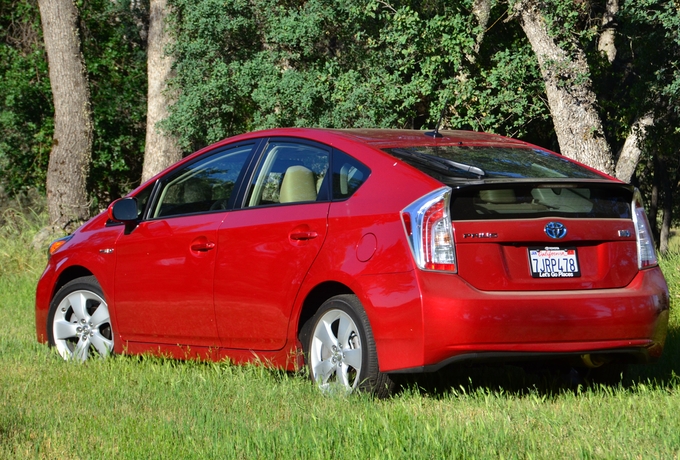
The Prius is on its third generation. Photos/Larry Weitzman

The Prius is on its third generation. Photos/Larry Weitzman

By Larry Weitzman

Prius has been with us for 15 years, through three generations and have more than 4 million in sales, a more than remarkable achievement especially considering its high tech complexity. Even more remarkable is the reliability of the Prius, about as bullet-proof as you can buy. Because of their high tech controls, even the hybrid components/battery system while guaranteed for eight years/100,000 miles never seem to fail even well beyond the warranty period. Toyota has cycled test batteries a 150,000 cycles with still no loss of efficiency.

In designing this updated third generation, Prius still retains the shape of the second generation. But it is crisper and much more refined giving it a more sporting look. But its basic shape hasn’t changed as it is so identified as a Prius Hybrid which is important to people who buy them. Drivers of Prius want to maintain their feeling of virtuosity and caring (certainly for their wallets, among other things).

Prius is a compact car with a short length of just 176 inch and a long wheelbase of 106 inches. And it is narrow at 69 inches. If it looks like it can cheat the wind, it does with a very low co-efficient of drag of 0.25.

Specifications Price About $21,000 to $36,000 Engine and Motor Engine  1.8L Atkinson cycle 16 valve DOHC inline four cylinder 98 hp @ 5,200 rpm            105 lb-ft of torque @ 4,000 rpm Motor  80 hp permanent magnet synchronous  Power supply 27kWh (36 hp) nickel metal hydride battery Combined HP 134 hp Transmission CVT Configuration Transverse front engine/front wheel drive Dimensions Wheelbase 106.7 inches Length 176.4 inches Width 68.7 inches Height 58.7 inches Ground clearance 5.3 inches Track (f/r) 59.6/59.4 inches Turning circle 36.0 feet  Trunk capacity 21.6 cubic feet Fuel Capacity 11.9 gallons Curb Weight 3,072 pounds Wheels std/opt 15X6/17X7 inch alloys Tires std/opt 195/65X15/215/45X17 Coefficient of drag 0.25 Performance 0-60 mph 9.45 seconds 50-70 mph 6.00 50-70 mph uphill 11.01 seconds Top speed 112 mph (factory number and governor limited) Fuel economy EPA rated 51/48/50 mpg city/highway/combined. Expect 44 mpg overall and 50 plus mpg on the highway at legal speeds

Specifications
Price About $21,000 to $36,000
Engine and Motor
Engine
1.8L Atkinson cycle 16 valve DOHC inline four cylinder 98 hp @ 5,200 rpm
105 lb-ft of torque @ 4,000 rpm
Motor
80 hp permanent magnet synchronous
Power supply 27kWh (36 hp) nickel metal hydride battery
Combined HP 134 hp
Transmission
CVT
Configuration
Transverse front engine/front wheel drive
Dimensions
Wheelbase 106.7 inches
Length 176.4 inches
Width 68.7 inches
Height 58.7 inches
Ground clearance 5.3 inches
Track (f/r) 59.6/59.4 inches
Turning circle 36.0 feet
Trunk capacity 21.6 cubic feet
Fuel Capacity 11.9 gallons
Curb Weight 3,072 pounds
Wheels std/opt 15X6/17X7 inch alloys
Tires std/opt 195/65X15/215/45X17
Coefficient of drag 0.25
Performance
0-60 mph 9.45 seconds
50-70 mph 6.00
50-70 mph uphill 11.01 seconds
Top speed 112 mph (factory number and governor limited)
Fuel economy EPA rated 51/48/50 mpg city/highway/combined. Expect 44 mpg overall and 50 plus mpg on the highway at legal speeds.

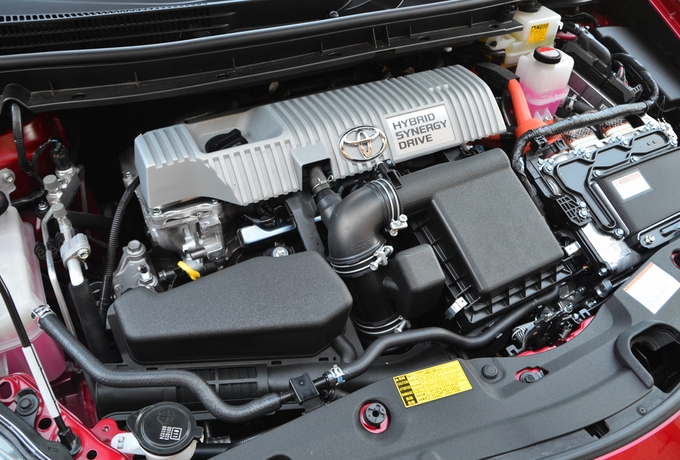
Occupying the engine bay under the short hood is an Atkinson cycle 1.8L 98 hp engine at a low 5,200 rpm plus peak twist occurring at 4,000 rpm. Atkinson cycle means a 13:1 compression ratio and a late closing intake valve. This creates a more efficient engine by enlarging the ratio between the expansion cycle and the compression cycle and still allows for the use of regular gas.

In addition there is the electric power system which uses an 80 hp electric motor that produces 153 pounds of twist. But don’t get too excited as the Prius is not a 178 hp car. Because battery output is limited to 36 hp, it limits the electric motor’s addition of power to the gas engine and the combined output is 134 hp. Still nothing to sneeze at.

Performance is more than adequate. Zero to 60 mph arrives in an average of 9.48 seconds, mid-pack for most compact cars and making it quicker than the conventional mileage champ, the Mitsubishi Mirage.  It is also identical to my first test of the Gen III Prius tested six years ago that ran a 0-60 mph time of 9.48 seconds. Passing performance is also mid-pack with 50-70 mph on a level road and up a six percent grade of 6.00 and 11.01 seconds.

Dividends are paid (or actually not paid) at the pump. While the EPA rates the Prius at 51/48/50 mpg city/highway/combined, it might be a little optimistic as when driven in a moderately aggressive manner while minimizing braking, which is perhaps the most efficient way to drive (look for a Road Beat column soon on maximizing fuel economy) in 200 miles city, country and some highway driving, evenly split, the Prius averaged 43.5 mpg which is about was other Road Beat tests have shown. However, on the highway (level) at 70 mph the Prius averaged 50.7 mpg, better than the EPA’s figure of 48 mpg. Those numbers exceed your best conventional compact, the Mazda 3,  which averaged about 35 mpg overall and 43 mpg on the highway.

Suspension is compact standard, MacPherson struts up front and a torsion or twist beam in the rear. Steering is an electric power rack with a turning circle of 36 feet with the optional 17 X 7 inch alloy wheels shod with relatively wide (and low profile) 215/45 X 17 all season rubber. Prius also has a wide 60 inch track. Believe it or not the Prius is quite nimble. It handles well. When pushed hard in the twisties, it goes where it’s pointed with no vices or mid-corner corrections required, however there is significant body roll. Prius handles just fine, but remember it wasn’t designed for Mario Andretti.

Prius, even with its low rolling resistance tires is quiet on all but the coarsest roads. On the highway at 70 plus mph it is very quiet with no wind, engine or road noise. There is no tach as the unique CVT tranny makes it unnecessary. In pure electric mode it is whisper quiet and the engine is so silent sometimes the only way you know it is running is the rumble in the go pedal when it comes on line. Prius handles bumps providing comfort without float or jarring over the worst roads.

While the Prius has only four wheel 10 inch discs with all the acronyms (ABS, etc.) its stopping distances are quite short, just an excellent 41 feet from 40 mph. Seven airbags plus traction control, vehicle stability control, smart stop technology braking and more are all standard equipment. Prius is safe.

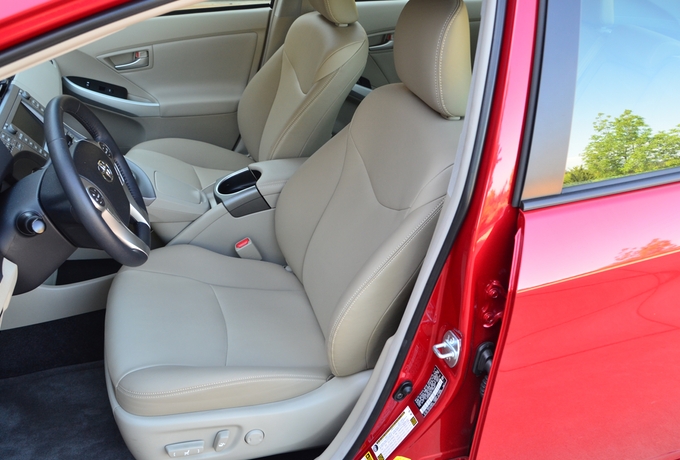
The interior of the Prius is nothing special.

The interior of the Prius is nothing special.

Inside is a lot of plastic. While of good quality, it is a blah interior. Seats are done in Toyota’s Softex, their brand of synthetic leather. While comfortable, it reminds one of a good washing machine or refrigerator, not too exciting. Interior room front and back is quite copious, room for five in comfort.

But there are some complaints, starting with the instrument panel which is located in the center of the upper dash, too far from the driver (it is at least two or more feet removed and located much too far to the right) with some of the ancillary info like the trip computer being presented in a size that is much too difficult to read. This needs to be fixed. The center stack is also hard to use with its touch screen, but it’s at least legible.

Is the Prius likable, sure it is and it drives well. I like it, but there another huge rub and that is price. The Prius Five model tested by the Road Beat stickers for a whopping $30,005 which even included a Nav system (why the extra $5, I just don’t know) plus $825 for the boat from Japan. This tester had the $4,320 Advanced Technology Package which had  an upgraded Nav and JBL sound system, stolen vehicle locator, radar cruise control, lane keep assist, heads up display (a nice feature considering the standard speedo is off to the right) and a bit more. With this package plus a couple of other small options brought the total sticker shock to $35,824. You are never going to save that much gas.

But the problem is that other very economical cars are much less expensive. A loaded Mitsubishi Mirage is less than half the price or a loaded Mazda 3 with more equipment, a much nicer interior, far superior performance and handling in a similarly sized package is $8K less money with an average fuel economy that is about 8 mpg less than the Prius. If you drive 15,000 miles a year you will save about 85 gallons of fuel or about $250 annually. The cost of the capitalization is higher, never mind eating into the purchase price difference.  Why do people buy the Prius as 4 million have since its introduction, it makes them feel good about themselves adding a bit of virtuosity to their lives.

Larry Weitzman has been into cars since he was 5 years old. At 8 he could recite from memory the hp of every car made in the U.S. He has put in thousands of laps on racetracks all over the Western United States.


Former IT director sues El Dorado County

By Kathryn Reed

An El Dorado County employee has filed a lawsuit against the county, interim chief administrative officer/human resources director, district attorney and auditor-controller.

Kelly Webb, one-time director of Information Technology for the county, in the suit alleges her First Amendment rights were violated, that she was discriminated against because of her age and gender, and that she was harassed.

Webb started working for the county full time in May 1985. She was appointed acting IT director by then CAO Terri Daly on March 15, 2011. This appointment came with a substantial pay raise. On July 23, 2013, she became permanent IT director at the direction of the Board of Supervisors.

Two days later, Auditor-Controller Joe Harn sent an email to Daly that said, “I believe that section 210.a(3) of the County Charter requires a formal recruitment for the IT director position.” The appointment also violated the Brown Act because it was not on an agenda.

According to the lawsuit, Webb doesn’t know why the IT directorship was revoked.

Lake Tahoe News asked Human Resources Director Pamela Knorr, District Attorney Vern Pierson and Harn to respond to the allegations in the lawsuit. Neither Knorr nor Pierson responded. Pierson also has the role of chief technology officer.

“I have read Ms. Webb’s complaint and I can’t figure out exactly what I have allegedly done. When she was acting IT director she worked directly for the Board of Supervisors, not me, not the DA. IT director is an at-will position. If the Board of Supervisors wanted Ms. Webb to be IT director, they would make her IT director. It’s the board’s call,” Harn told Lake Tahoe News. “When the Board of Supervisors appointed Ms. Webb IT director in July of 2013, I did write the CAO and inform the CAO that the appointment violated the County Charter (the law). That’s just me doing my job. Ms. Webb has been an analyst for a long time in the CAO’s office. She should have known the County Charter and realized her July 2013 appointment was invalid.”

County Counsel Robyn Drivon told Lake Tahoe News, “The county of El Dorado has just recently received this suit and is in the process of assigning it to counsel for review and response.

“The facts are:

·      Ms. Webb has worked for the county of El Dorado for many years.

·      She served for three years as the Interim Information & Technology Director.

·      Ms. Webb did not meet the minimum educational qualifications for the permanent IT director and therefore, was returned to her prior employment position as a CAO analyst.

·      There are no facts to support Ms. Webb’s allegation that her disqualification was based upon gender or age.”

Even in the lawsuit Webb admits she does not have the education requirements for the IT job: “Plaintiff realized that she did not even meet county’s minimum qualifications for the principal administrative analyst position, even though she had on or about Feb. 12, 2014, plaintiff finally met with (Human Resources Director Pamela) Knorr regarding the ageist comments (District Attorney Vern) Pierson had repeatedly made, and  the ominous tone he took about plaintiff’s future employment as county IT Director. Much to plaintiff’s dismay and disappointment, Knorr brushed aside Pierson’s actions, and chalked up plaintiff’s concern over these issues as plaintiff ‘over-reacting’ and being ‘overly sensitive.’ Rather than doing the HR director’s job and investigating obvious, unlawful ageism, Knorr made plaintiff feel like a mere complainer without a valid complaint,” the suit says.

During the time period Webb said she was being harassed and discriminated against there were also negative things coming out about her. The state Controller’s Office issued a negative audit report in August 2013 about IT’s cost accounting and the knowledge level of IT’s management.

A 2014 survey of county employees found that 41 percent of the IT employees were dissatisfied with their employment.

In the suit, Webb is asking for:

  • economic damages in an amount according to proof;
  • for punitive damages against the individual, non-entity defendants only;
  • for general damages in an amount according to proof;
  • for costs of suit, including but not limited to reasonable attorneys’ fees;
  • for prejudgment interest in an amount according to proof;
  • for such other and further relief as the court may deem proper.
  • a trial by jury.


Opinion: Why kids need to dig in the dirt

By Manuel H. Rodriguez

Kids today have it all it seems, except time to be themselves. Their lives are so intensely choreographed from one activity to the next, and their scarce downtime so consumed by all their different-sized screens. It’s no wonder they no longer get a chance to master one art kids used to excel at: using their imagination to turn free time into an adventure.

America was still mired in the Depression when my family moved into the south Los Angeles neighborhood of 61st Street, just east of Main Street, which was characterized by peaceful stillness, interrupted in the afternoons and on weekends by the shouts of children at play. My brother, Raul, and I were 5 and 7 when we moved into that house, oblivious to the difficulties facing the nation.

On the contrary, we felt blessed by the abundant opportunities to explore nature in our new home, even as it stood in the middle of the big city. A bedraggled yucca plant stood in the middle of our front yard besieged by crabgrass. Even there we found things to study up close and wonder at—the grasshoppers that hopped in during the summer months and the bright yellow dandelions that grew there in profusion. When the dents-des-lions went to seed they became translucent globes that we held up and blew at to watch their tiny filaments fly off into the air and disappear.

Our summers provided endless opportunities for exploration, as well as a challenge for us to entertain ourselves on days that languidly stretched themselves ever longer. In the backyard, we observed an enormous web that connected bush with bush. When an insect flew into the web, we watched wide-eyed as a big spider raced to deliver the coup de grace to a struggling but doomed captive. And then wrap it, weaving the silk with its legs into a gray shroud that would hang on the web to await future consumption. We discovered the daddy long-legs with its long, spindly extremities. In dark, out-of-the- way places like garages, we sought out the ominous black widow and strained to see the red hourglass that marked its underside. That activity we knew was fraught with danger. Mother had warned us about black widows.

In the heat of summer nights as we sat in the front room, we heard loud pinging at the front door—hard-shelled June bugs that, attracted by the house lights, came crashing against the screen. When it was very hot, we caught sight of the swift, darting creatures we called horny toads that were neither toads nor horny. More conventional lizards stopped and froze and then scurried away as well. We learned to coddle ladybugs and recite to them the verse that urged them to fly away home because their house was on fire.

Once in a great while we saw turtles—or maybe they were tortoises—that we suspected were brought in from the desert and had wandered away from their keepers’ homes. We fed them lettuce leaves and looked on as they munched on them. The rule that we should not watch as people ate did not apply to turtles. On the hottest nights of the summer, crickets loudly proclaimed their presence. Many were the times, especially when intense summer heat made staying indoors intolerable, when we played outside until well into the night, our child sounds competing with the chirping of the crickets.

Nights in Los Angeles were very dark then and the stars shone brightly. The sight of shooting stars was not uncommon in the era before we became a megalopolis. Occasionally, the darkness was pierced by enormous shafts of light that moved dramatically across the sky, from searchlights placed in front of a market or a carpet store announcing a grand opening. Or a movie premiere.

When the war came, I was in fifth grade. The nights became even darker, as blackouts were ordered to hide us from marauding Japanese planes. Several times we heard the nighttime wailing of sirens that announced a practice air raid drill and alerted residents to prepare their windows with blackout curtains. Helmeted air raid wardens in armbands patrolled the streets. When they spotted any light in a house, a warden would knock heavily on the front door and bellow out an order that it should be covered.

But for the most part, the real world didn’t intrude much in this realm where we were free to be children, even older siblings like me who were genetically programmed towards seriousness. Raul and I did a lot of digging and playing with dirt in our backyard. We spent many days on our knees inspecting the legions of red ants that entered and exited holes they had dug in the ground. I’m not proud to confess that, like boys before and after us, we inexplicably indulged in macabre experiments on the poor ants, involving a magnifying glass and concentrated sunrays. Enough said on that.

Digging in dirt was great fun. We flooded an area with water from the garden hose and ran it through little ditches we dug, damming the water up at intervals with pieces of wood we half buried in the muck. We made little paper boats and sailed them down our boy-made rivers.

But the best way we used our dirt paradise was as a spot for playing a game at which we spent countless hours—marbles. Ernie, my friend from across the street, often joined us. Playing in dirt got us very dirty. We tried to avoid kneeling in the dirt by squatting, which didn’t work at all. We wore overalls like the ones worn by farmers and garage mechanics, and canvas tennis shoes.

With a stick, we traced a large circle in the dirt and in its center placed several marbles that formed the pot we would play for. That is, assuming we were playing “for keeps.”

The boy whose marble stopped closest to a line drawn in the dirt played first. The shooter selected a spot on the circle and, forming a fist with his shooting hand, he knuckled down to play. With his thumb, he propelled a marble toward the pot with the aim of knocking one or more of the marbles out of the ring. He pocketed the ones he knocked out and earned another shot. If the shooter was very good, he could continue until all the marbles were knocked out.

We’d play for countless hours, so many that the fingernails of our right, shooting thumbs developed holes from the pressure of the hundreds of marbles they propelled.

Marbles and other games taught us the importance of playing by the rules. Arguments occurred when a player insisted on not conforming to them. Ernie’s father, an otherwise extremely mild-mannered man, came over to our house one evening demanding of our parents, for Pete’s sake, the return of his son’s marbles. Losing one’s marbles was not a good thing, then or now.

In summertime we’d also play a lot of tag, with other neighborhood kids, as well as hide-and-seek. The cry of olly olly oxen free rang out, signaling the all clear when hiders could emerge from their hiding places. After “Frankenstein” became a cinematic sensation, the child who was it became the monster. The mere thought that a monster was on the hunt for us was chilling, even though we knew that it was only a boy, or a girl.

On hot summer days, the iceman from Kirker Ice Company made his customary rounds. While he was out of sight, lugging a block of ice into our house for the ice box, children clustered around the back of his truck, packed floor-to-ceiling with ice, and engaged in a harmless but refreshing bit of thievery, helping ourselves to shards of ice that remained on the damp truck bed. We wiped slivers of wood off our pieces of ice and sucked off the ice-cold water, rubbing our faces and necks with them. On many summer days, Mother prepared frosty pitchers of lemonade that included pieces of the block of ice that now sat in our icebox.

We had roller skates that we fitted over our shoes and tightened against the leather sole. A neat little metal key did the tightening. We skated only on the sidewalk. I never got the hang of braking so I just headed onto the grass until I stopped moving.

Police radio dramas and cowboy movies were popular at the time and boys liked to wear badges. We made our own. The metal caps of soft drink bottles were lined with cork that we pried out. Then we held the metal cap on the outside of our shirts and pushed the cork into the cap from the inside. The cap stayed put. We became walking advertisements for soft drinks including that new drink, Dr Pepper. We wore holster sets that handled two pistols, the large, silver colored ones being the most popular. Some boys had BB guns that actually shot steel or lead pellets. We didn’t. Mother considered them dangerous and beyond the pale.

Flying kites was fun, too. Raul was much better than I at maneuvering a kite, running to get it airborne and flying like a good kite should. Mine had a maddening tendency to fly in frustrating circles. And then crash.

On especially hot days, we made use of the garden hose and sprinkler that we set in the middle of the lawn. Other neighborhood children would join in as we frolicked around in our bathing suits through the fountain of cool water the sprinkler created for us. Loose grass and weeds and little twigs stuck to the bottom of our feet.

When you’re 10, your summer is one big block of freedom to be a kid. When it’s 4:18pm in the middle of July and you’re scraping those twigs off your feet, laughing with your friends, the life ahead of you appears as one of infinite possibility. Mostly all things, starting with your own imagination, just seem wondrously infinite. I worry that kids today aren’t allowed such space.

As we grew older, the summers got shorter, and our playtime scarcer, until it all became a sepia-tinted memory in a life full of purpose, work, and seriousness.

But that’s another story.

Manuel H. Rodriguez taught in local schools for 41 years, 35 of them at Los Angeles Valley College.

A private equity gamble involving Caesars gone wrong

By William D. Cohan, Fortune

There have been so many truly extraordinary twists and turns in the saga of Caesars Entertainment over the past eight years that it’s hard to pinpoint exactly when the whole thing went off the rails. After all, an $18.4 billion bankruptcy filing at one of the biggest gambling empires in Las Vegas tends to result in a lot of finger-pointing. But for symbolism alone, nothing can beat the evening of Nov. 17, 2012.

That was the night that David Bonderman, the billionaire founder of private equity firm TPG Capital, threw himself a 70th birthday party. It made sense for Bonderman to have it in Vegas. He and his wife had planned a lavish celebration with 1,000 of their closest friends. Actor and comedian Robin Williams would serve as the emcee, with music legends Paul McCartney and John Fogerty rocking out. Bonderman had also agreed to make a $1,000 donation in the name of each guest to the charity of his or her choice, and every attendee would receive an iPod filled with the private equity mogul’s favorite tunes. It was the kind of event for which top-tier casinos are made.

And Bonderman just happened to be part owner of one. In 2008, TPG had joined with Apollo Global Management, the buyout firm led by former Drexel Burnham Lambert banker Leon Black, to take Caesars private. Four years later, Caesars was straining under its heavy debt load, and the two private equity shops stood to lose the bulk of their $6 billion equity investment. By having his gala at Caesars Palace, the company’s crown jewel, Bonderman could have made a high-profile show of support.

Instead, Bonderman took his celebration to the Wynn Resort, Caesars’ biggest Vegas rival.

Read the whole story