South Shore ready for annual fireworks

Lights on the Lake, the largest Fourth of July fireworks display in the west, will fill South Shore’s night sky for 25 minutes.

Now in its 34th year, the holiday tradition is synchronized to a soundtrack of familiar songs by pop legends and from music acts that will be at Harveys this summer. It is simulcast on KRLT-FM 93.9 and KOWL-AM 1490.

The show starts at 9:45pm.


Calif. auditing school mental health services

By Jocelyn Wiener, CHCF Center for Health Reporting

California’s state auditor has launched an investigation of school districts and other local educational agencies to determine whether they are delivering enough treatment to children with serious mental illnesses.

In 2011, a change in law shifted responsibility for decisions about the mental health care of students with disabilities from counties to the schools.

Since then, families, advocates and child psychiatrists have charged that some of the state’s sickest children are struggling to get help. A story in The Sacramento Bee last year focused on these complaints, and on data showing significant drops in placements in residential treatment facilities since the law changed.

State Sen. Jim Beall, D-San Jose, chairman of the Senate’s mental health committee, requested the audit. He said nearly 80,000 children with disabilities had been receiving mental health services through the counties before the change in law. Now, due to a lack of data, it is no longer clear how many are being served, he said.

“Right now, we literally don’t have any results or information,” he said. “My job is to make sure these services are available to all the kids who need them.”

He said he expects to see results in December and may pursue legislation after that.

The state auditor will examine how well school districts and Special Education Local Plan Areas are fulfilling their responsibilities to treat children with mental illnesses, how they are spending the money designated for these services, and whether the state Department of Education is fulfilling its oversight role.

Critics of the change in law say there have been significant disparities in how well schools have followed through on their new obligations.

“If you really look under the hood, what you see is enormous variance,” said Ken Berrick, CEO of the Seneca Family of Agencies, which serves children with emotional disturbances in a dozen counties.

Randall Hagar, director of government relations for the California Psychiatric Association, said the audit is a first step toward creating a more accountable, transparent system.

“We’ve needed information to clarify how the state is doing and whether it’s doing right by its kids,” he said. “Once we get that data, we’ll be able to figure out what the next steps are and how to improve care where it needs to be improved.”

Wiener writes for the California HealthCare Foundation Center for Health Reporting at USC’s Annenberg School for Communication and Journalism.


Drought increases need for forest thinning

By Susie Kocher

Lake Tahoe’s forests are beloved by many for their beauty. Yet they are vulnerable. Tahoe forests, like those throughout the Sierra Nevada, have lost much of their resilience due to overcrowding caused by a century of fire suppression.

The number of large trees in the Sierra Nevada has decreased by half while small trees have doubled since the 1930s. There are nine times as many dead standing trees and three times as many logs on the ground than in 1929. And, the dead wood in the forest today is smaller and more flammable. As a result, the percentage of forests burning at high severity — where most mature trees are killed — has increased dramatically, from roughly 5 to 10 percent a century ago, to more tha 40 percent in the 2013 Rim Fire and the 2014 King Fire.

Conditions are exceptional this year as we enter our fourth year of drought. The wildfire forecast is bleak. And we are currently experiencing a die off of trees in the Sierra. In April, the U.S. Forest Service conducted aerial surveys of over 4 million acres of forest in the southern Sierra (from Sonora south) and found that 20 percent was covered with trees killed by insects, totaling over 10 million dead trees.

Mortality was especially severe in pines at lower elevations in the foothills. Surveyors found 5 million dead trees on the Sierra and Sequoia national forests. Conifer mortality was much less at higher elevations though surveyors said it was too early in the season to be certain.

The insects killing trees in the Sierra are all native insects that are multiplying because of drought conditions. Native insects are a necessary part of the forest ecosystem that speed decay of wood, prey on other insects, and provide food for wildlife. They are normally present at low levels and cause tree mortality only in localized areas.

However, drought weakens trees and reduces their ability to withstand insect attacks. Normally trees use pitch to repel beetles trying to burrow through the bark. Weakened trees cannot produce the pitch needed to repel beetles, which allows beetles to tunnel in and lay eggs that turn into larvae that feed on the inner bark. Attacking beetles release chemicals called pheromones that attract other beetles until a mass attack kills the tree.

In the Tahoe basin, there are three predominant trees, white and red fir, which are vulnerable to the Scolytus beetle and Jeffrey pine which is vulnerable to the Jeffrey pine beetle. These beetles typically take a year to reproduce but two generations may be produced in warm years without much of a winter. Once a tree is killed, emerging beetles tend to attack the next closest green trees, causing group kills that enlarge every year until the epidemic collapses. This is what happened in the Tahoe basin during the multi-year drought of the early 1990s when many Jeffrey pine were killed.

Since spring arrives later in Tahoe and the drought is generally not as severe here, we don’t yet know whether local forests will experience the bark beetle outbreaks occurring south of here and at lower elevation. However, an upswing in beetle activity has been noted by area foresters, particularly in larger trees growing in higher densities.

The best way to protect forests from wildfire and insects is to thin them out. Widely spaced trees are healthier and less susceptible to bark beetles since they face less competition for moisture, light, and nutrients compared to densely growing and overcrowded trees. Thinning forests and reducing surface fuels is also the best way to reduce the impacts of wildfires and increase the chances the fire can be suppressed before getting out of control.

Government agencies and fire protection districts within the Lake Tahoe region have been working together to reduce fire hazards and improve forest health in the basin for many years. Thinning to remove overcrowded trees and surface fuels has been done on 36,890 acres of public forests since 2008.

Fire and forest management agencies goals this year include thinning of 3,765 acres, about half by hand with tools and the other half with heavy equipment. Prescribed burning is planned on about 4,900 acres — about 85 percent of that is burning piles of dead wood from previous thinning activities. Chipping to reduce fire risk is planned on 1,175 parcels. Almost 6,000 defensible space inspections of private property are planned.

In addition, the U.S. Forest Service is responding to current insect outbreaks at Tahoe. They removed several very large Jeffrey pines in the Kiva beach area this spring that were successfully attacked and killed by Jeffrey pine beetles last year. Foresters plan to conduct a survey of all developed recreation sites this fall to identify trees killed this summer for removal over the winter.

Lake Tahoe is celebrating Wildfire Awareness Month in June.  Keeping Tahoe forests healthy by thinning and removing beetle infested trees is one key way to prepare for wildfire and improve the odds that Tahoe communities will survive the next wildfire.

Susie Kocher works for the University of California Cooperative Extension.


Natural gas leaks exacerbate climate change

By Jonathan Thompson, High Country News

There have been 12.8 billion cubic feet natural gas released since 2010 in nearly 700 “incidents” reported to the federal Pipeline and Hazardous Materials Safety Administration. This occurred in the nation’s natural gas gathering and transmission systems.

Natural gas leaks are not  rare. Photo/Tod Baker

Natural gas leaks are not rare. Photo/Tod Baker

Another 36 million cubic feet of natural gas escaped during incidents from the distribution systems that deliver gas to homes and businesses during that time. Added up, it’s enough gas to heat more than 170,000 homes for a year.

Oil pipeline busts, like the one that wrecked the shoreline near Santa Barbara, recently, tend to get most of the attention these days — oil is sticky, nasty stuff. But natural gas infrastructure failures are equally alarming. Punctured natural gas pipelines can be dangerous. The reported incidents killed 70 people and injured more than 300. They can be expensive. Total costs in lost gas and property damage was nearly $700 million.

Read the whole story


Then and now: Access to Angora Ridge improves

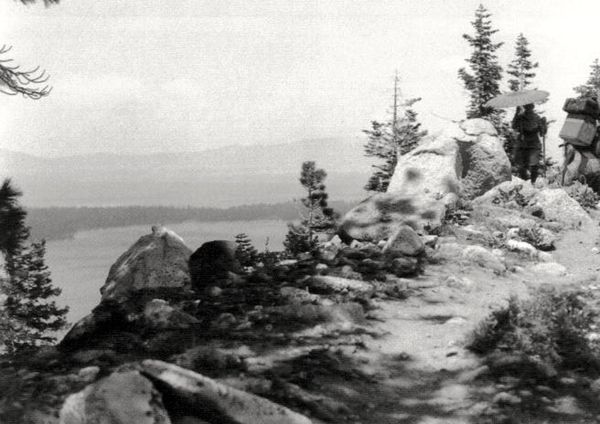
Getting to Angora Lakes wasn't always as easy as it is today. Photo/Jim Hildinger

Getting to Angora Lakes wasn’t always as easy as it is today. Photo/Jim Hildinger

If you recognize Fallen Leaf Lake and distant Lake Tahoe in the above photo, then you recognize Angora Ridge before road construction started in 1924.

Longtime local Jim Hildinger writes in his booklet “Angora Lakes Resort (1917 to 2014)” that his
father’s “construction of the road began in 1924 and was finally completed in 1929. It was all done by hand — a pick and shovel and crowbar, a very small amount of dynamite and a very great amount of sweat.”

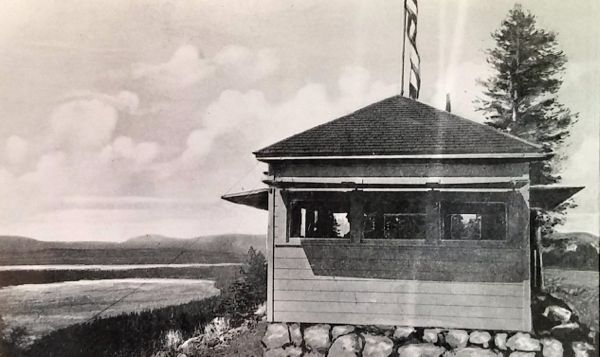
The fire lookout was constructed in the 1920s. Photo/Lake Tahoe Historical Society

The fire lookout was constructed on the ridge in the 1920s by the U.S. Forest Service.. Photo/Lake Tahoe Historical Society

The structure remains today, although it was retired as a lookout in the 1970s with the advent of modern technology. Considerable growth of the trees has obstructed views.

The look sits idle today. Photo/Bill Kingman

The look sits idle today. Photo/Bill Kingman

The road was only rocks and dirt and very rough, steep driving. Jim Hildinger writes in his booklet, “… In 1963 the ridge was paved — then in 2005 the whole road was paved in order to satisfy water quality standards established by the TRPA.”

Quite a contrast to the ridge of 90 years ago.

Pavement makes it much easier to reach the lakes and resort of Angora today. Photo/Bill Kingman

Pavement makes it much easier to reach the lakes and resort of Angora today. Photo/Bill Kingman

— Bill Kingman


Nev. fails to create rules to deal with drought

By Anne Knowles

CARSON CITY — Nevada could pay a price for not making any substantive changes to its water laws during the 2015 legislative session.

The possibility of a special session for the Legislature was discussed at the first meeting of the Nevada Drought Forum, a panel created in April by executive order of Gov. Brian Sandoval and consisting of several state agency heads and other water authorities.

Lynn Hettrick, deputy director of the Nevada Department of Agriculture and a former Nevada assemblyman, said a special session should not be ruled out if the forum determines new statutes are needed immediately to address the ongoing drought.

“We don’t know if we need to do something on an emergency basis,” Hettrick told Lake Tahoe News. “It’s a long time to wait for the next session and we have to at least be open to that possibility.”

The Carson River on The Nature Conservancy's River Fork Ranch near Genoa. Photos/Anne Knowles

The Carson River supplies water to farms and ranches in Nevada. Photos/Anne Knowles

The forum participants are conducting several meetings, including a three-day summit in September, and are tasked with delivering a report to the governor by Nov. 1 outlining actions the state should consider in order to deal with what is now a four-year drought.

“The bar would have to be really high for a special session, but never say never,” Leo Drozdoff, director of Nevada Department of Conservation and Natural Resources, who chairs the forum, told Lake Tahoe News.

The 2015 legislative session ended June 1 with neither bill requested by the Nevada Department of Water Resources becoming law. Even a separate bill sponsored by state Sen. Pete Goicoechea, R-Eureka, chair of the Senate Government Affairs Committee and the Legislature’s respected water expert, failed to pass.

Jason King, state engineer, told Lake Tahoe News he was “blindsided” by the opposition to the bills.

King said the water department spent the two years between sessions meeting with all the stakeholders who would be most affected by any changes to existing law, trying to craft acceptable legislation.

That included domestic well owners in Pahrump, a town about 65 miles west of Las Vegas, and farmers in Eureka County’s Diamond Valley, where basins are drying up due to overappropriation and overpumping. Both were the targets of Senate Bill 81, a bill making changes to critical management areas.

Critical management areas are a designation created by law in 2011 in which either by order of the state engineer or petition of the majority of the water rights holders a water management plan is mandated for a distressed basin.

SB81 proposed to give the state engineer the authority to limit the quantity of water that may be withdrawn from domestic wells in a designated basin. Currently, domestic well owners do not need water rights or a permit but they are limited to pumping 2 acre-feet of water annually. During one of several workshops on the bill, it was suggested that under the new law the state engineer might temporarily reduce that to half an acre-foot because that is what the average household consumes.

That drew immediate opposition from the domestic well owners as well as water rights holders, who also could by restricted by SB81.

“Since SB81 was made public, water users, particularly in one basin we have been working in, have accused our office of using this bill as a ‘power grab’,” said King, during his testimony to the Senate Government Affairs Committee. “I strongly disagree. This bill is directly in response to their concerns.”

The office’s goal, King said, is to have a more flexible way to limit water users where water is being overpumped. Right now, the state engineer can issue curtailment orders, but the orders are all or nothing.
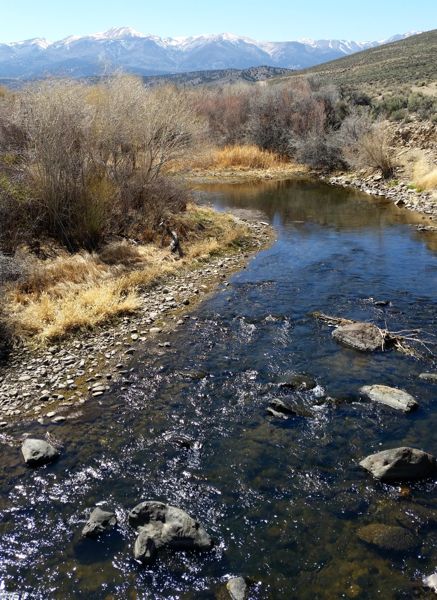
The Walker River that farmers in Mason and Smith valleys rely on. Photo/Anne Knowles

The Walker River that farmers in Mason and Smith valleys rely on. Photo/Anne Knowles

In February, in its first-ever curtailment of groundwater, the state engineer ordered farmers in Smith and Mason valleys to cut groundwater pumping by half. (Their groundwater rights are a supplemental right used in conjunction with surface water rights on the Walker River.) The farmers formed Farmers Against Curtailment Order LLC and sued the state engineer. District Court Judge Leon Aberasturi granted a temporary injunction.

“The judge might have been OK if we had cut off by priority,” said King, rather than try to reduce usage by a percentage.

By priority means that water is allocated by seniority. Those with the oldest or most senior rights receive their full amount of water, those with newer or junior rights are cut off.

All or nothing.

That could be the next step in Pahrump or Diamond Valley. Indeed, on April 28, Sadler Ranch in Diamond Valley sued the state engineer, saying the office’s failure for decades to curtail groundwater pumping by junior water rights holders in the valley has impinged on his senior water rights. The 3,000-acre ranch has rights dating from 1870.

The petition for curtailment, filed in the 7th Judicial District Court in Nevada, says pumping by junior appropriators has reduced the ranch’s water by 90 percent.

The suit, citing the state engineer’s data, says Diamond Valley has a perennial yield of 30,000 acre feet, which is the maximum amount of groundwater that can be pumped annually over the long term without depleting the aquifer.

But more than 130,000 acre feet of groundwater rights have been issued and in 2011, more than 96,000 acre feet of water was pumped, says the suit.

King said his office is examining what existing tools it has to use in Pahrump and Diamond Valley, which could including making the first designation of a critical management area.

“The biggest hammer we have that we never want to use is to manage by priority,” said King. “The biggest trigger is if senior rights holders can’t get their water.”

Domestic wells, too, can be regulated by priority. Even though the wells don’t need water rights, they do need permits to be drilled so each has a date that sets priority.

SB81 was the more disputed of the two bills. Senate Bill 65, a lengthy bill that primarily updated antiquated language in the state’s century-old water law, went through workshops too and was eventually stripped of its most controversial sections, including a definition of perennial yield and restrictions on where domestic wells can be drilled. Even then the bill failed.

“There was a fear factor,” said former Assemblyman Hettrick. “People looked at the bills and said what door is this going to open? Once you do this, what’s next?”

Next for the Nevada Drought Forum are two meetings to get the perspective of water users. A meeting with tourism, mining and other business interests is set for July 14 in Las Vegas and a meeting with the state’s two biggest water users, agriculture and municipalities, is scheduled for Aug. 19 in Carson City or Sparks.

The forum summit, likely somewhere in the state capital, is now planned for Sept. 21-23.



Opinion: Sneaky behavior by EDC officials exposed

By Larry Weitzman

On June 2 the El Dorado County Board of Supervisors did the right thing and saved the county from a mini debacle that would have cost hundreds of thousands of dollars annually starting in about two weeks. Since the Board of Supervisors’ agenda is prepared by the CAO’s office at the direction of the chief administrative officer, the blame for this initially resides there. But more specifically, this particular agenda item originated in Human Resources, headed by current CAO Pamela Knorr.

Larry Weitzman

Larry Weitzman

It was agenda item No. 13 and presented to the BOS as an innocuous clean-up of language in a resolution that would amend the salary and benefits resolution for unrepresented employees and replace a prior resolution from 2001, which was the first mistake. The resolution from 2003 should have been used as it amended the 2001 resolution. This June 2 resolution allegedly included basic changes to on-call duty compensation for HHSA extra-help employees to be consistent with on-call duty compensation recommended in a letter of agreement with county employees’ association, Local 1. While innocuous, it was important for HHSA, especially when a call for client service or mental problems occurs at 1am.

When on the consent calendar on May 19, the resolution contained enough errors that the assessor and auditor asked that the matter be put over for two weeks. Also part of the county’s process is that resolutions of salaries and benefits be posted to Legistar 21 days in advance of the calendar allowing sufficient time for scrutiny. The matter was re-calendared for June 2, but the matter didn’t hit Legistar until May 29. Because it was late in the day on Friday, no one gave it a look until June 1, which turned out to be a busy day as it was the first day of budget hearings.

It was late Monday when someone saw what appeared to be an intentional attempt to seek massive raises for some department heads. Remember, the resolution’s purpose was ostensibly to correct on-call extra help duty compensation, but the 44 pages of legalese and government-speak set for the June 2 calendar had a new four-line provision that was nowhere to be found in the May 19 resolution and those four lines provided that elected and appointed department heads would now receive longevity pay, not just for total service to El Dorado County, but for service to other city and county jurisdictions. How much? “Ten years gets 5 percent, 15 years gets 10 percent; 20 years gets 13 percent 25 years gets 15 percent and 30 years gets 16 percent.”

The history of this provision needs review. On Dec. 11, 2001, a salary and benefits resolution was passed by the board that gave elected and appointed department heads longevity pay for service to other counties and cities. On July 15, 2003, Resolution 204-2003 eliminated that longevity pay provision.

In Knorr’s apparent rush to finalize the 5.5 and 5 percent raises for most county employees, reduce the electeds’ pay by eliminating longevity pay entirely (not just longevity pay for in-county or out-of-county service) and eliminate other differentials to elected department heads, the problem commenced. This measure was proposed by former District 4 Supervisor Ron Briggs and passed 3-1 in late 2013 with supervisors Brian Veerkamp, Norma Santiago and Briggs voting yes, Supervisor Ray Nutting abstaining and Supervisor Ron Mikulaco voting no.

Then the Human Resources director, Knorr included modified language from the 2001 resolution instead of the more-current 2003 resolution and inadvertently (or intentionally?) included longevity pay for management for service to other cities and counties, striking the language that electeds can participate.

A recent Grand Jury report (Case 14-07) filed a few months ago criticized HR department’s operations, noting 16 significant negative findings. Its operation is a failure. Guess who runs the HR Department? Knorr is still HR director and has been so for this entire fiasco starting before November 2013.

No one on the board expressed a need for longevity pay for service outside the county, especially now with county deficits in the tens of million dollars, but technically it’s been part of the salary and benefits resolution since Nov. 18, 2013. And it’s still causing a potential problem. While it wasn’t included in this year’s May 19 resolution, the mistake reappeared in the June 2 resolution.

Who would benefit? Knorr would benefit, according to her statements regarding working for other government agencies, by an immediate $28,000 annual salary increase (15 percent) on top of her $186,000 salary, not counting benefits. County Counsel Robyn Drivon, who has a base salary of about $197,000, would receive almost $30,000. Since this longevity provision dates from November 2013, it could benefit people like Terri Daly and Kim Kerr. There are others who would benefit, but I doubt they even knew about it. Since this provision emanated from Human Resources and the CAO, with a county counsel review, how did it get through? Is this more evidence that the Grand Jury is even more correct? HR is incompetent and who else?

This matter just wasn’t on the board agenda; it was on the consent calendar where items are passed perfunctory without discussion. Information on the agenda described the funding source as: “Funding: Changes to on-call duty compensation affect the Health & Human Services Agency only and would be funded primarily from state and federal funds.” Nothing could be further from the truth. It would have amounted to hundreds of thousands of dollars of General Fund spending and this was just one day after the CAO’s budget wanted to cut more than $500,000 of vital senior programs. The board didn’t go along with that either.

On June 5, I received an unsolicited call from County Counsel Drivon, who tried to explain this “mistake.” It was so confusing to the point that I asked her three simple questions: How did that happen? Who did it? How and why did it get by the county counsel’s office? Drivon’s response was a simple “good day” and a hang up. Maybe it wasn’t such a good day.

Larry Weitzman is a resident of Rescue.


Tips to stay cool in the heat

With temperatures now more like mid-summer, El Dorado County health officials are offering tips on how to stay cool, hydrated and healthy.

Heat waves can be dangerous and cause serious medical problems, particularly for older people, the very young and those with chronic medical conditions.

The following are tips to stay cool and healthy during hot weather:

  • Drink plenty of fluids, such as water and low-calorie sports drinks, even if you are not thirsty.
  • Stay indoors in an air conditioned building. If you do not have air conditioning, visit a friend, relative or other location in the community, such as a library, community center, grocery store or shopping center where the air conditioning is working.
  • Pace yourself and avoid heavy exertion in the heat.
  • Never leave a child, elderly person or animal in a parked vehicle, even for a few minutes. Temperatures can rise to dangerous levels in a matter of minutes.
  • Check on neighbors, relatives and friends, particularly those who may be isolated.


#DroughtShaming is on the rise

By Associated Press

Pssst. Ready to water that beautiful lush lawn of yours? The one that’s the envy of the entire neighborhood.

You’d better wait until after midnight. Preferably on a cloudy, new-moon night during a power outage when it’s so dark even night-vision goggles won’t give away your position. Otherwise, you could wind up the star of the latest drought-shaming video posted on YouTube or Twitter.

“Yeah, I put your address out there. The world is watching a lot more,” says Tony Corcoran, one of several people who spend their spare time these days canvassing the tony communities of Beverly Hills, West Hollywood and elsewhere, looking for people wasting water during the worst California drought in recent memory.

Corcoran alone estimates he’s put up on YouTube more than 100 videos of water-wasters, complete with their addresses.

Others tweet out addresses and photos of water scofflaws, using hashtags such as #DroughtShaming. Still others are snapping smartphone photos of them and sending them directly to authorities.

Not everyone is happy about it.

One woman, quickly tiring of Corcoran’s lecture on conservation while she watered her plants, turned her hose on him.

In Beverly Hills, where he was showing a reporter and photographer water running down the street in front of a mansion, the angry resident called police. Two patrol cars quickly responded, but the officers took no action.

In Hollywood, Sam Bakman, who manages a condominium complex, said his building was recently shamed wrongly by somebody on Twitter over a broken sprinkler head that was quickly repaired. He showed a reporter the city-issued restrictions on watering and pointed out his sprinkler timers fall well within the guidelines.

“If they thought we were doing something wrong, why not come knock on my door?” he asked.

Corcoran, a restaurant group administrator who kept his New York attitude when he came to laid-back Los Angeles awhile ago, is unrepentant.

“The whole point is to get people to change, not to shame,” he said.

With California in the fourth year of a drought with no end in sight, the governor has ordered everyone to use 25 percent less water, and drought shamers say the easiest way to accomplish that is to quit watering your yard. Or at least be careful about it and not let water spill into the street.

“I was a passenger in a car driving by, and first I noticed water down the street. And when we drove up, I saw the broken sprinkler head,” said Patricia Perez of Eagle Rock who quickly tweeted out a picture of the mess. She also emailed it to the local water agency.

“When you’re trying to do your best personally, and you’re trying to conserve water, it’s very irritating,” she said of one of the reasons behind drought shaming.

Dan Estes, a Los Angeles real estate broker, has gone so far as to build his own free app, DroughtShame, that records the time and place where people see waste.

Unlike some other drought shamers, he doesn’t believe in getting in people’s faces or outing them to the world. Instead, people who use his app send the information and a photograph to him, and he forwards it to the appropriate water agency.

“I drought shamed the preschool next to my apartment,” Estes said. “Timer was off on their sprinklers. Those things were on for five hours, and the sidewalk was a river. I was non-confrontational, but at the same time, public.”

Twenty minutes after he reported it, Estes said, the sprinklers were shut off.


Same product, different price for women

By Shelby Slade, Deseret News

Does packaging an item in pink turn it into a luxury item? Some think so.

As if women weren’t already making less money, 78 cents for every dollar a man earns because of the wage gap, the “pink tax” may be overcharging women at the store too.

Studies show that women are paying more for everyday items and services, like deodorant, razors, shaving cream and dry cleaning, than for comparable items marketed to men.

Some manufacturers of shampoo and deodorant said the reason their products for women cost more was because they cost more to produce than the men’s versions, the Huffington Post reported.

Read the whole story