Science helps golf courses reduce water use

By Katharine Gammon, Inside Science

In California’s current historic drought, there’s one particularly easy target when it comes to pointing fingers: green golf courses.

Courses around the U.S. suck up around approximately 2.08 billion gallons of water per day for irrigation. That’s about 130,000 gallons per day per course, according to the golf industry.

In California, Gov. Jerry Brown has announced a statewide mandate to reduce water consumption by 25 percent – but that number actually varies depending on the water district, signifying a reduction of anywhere between 4 and 36 percent.

Since there are about 1,140 golf courses in California, reducing water use by one quarter would reduce consumption by 37 million gallons of water per day – about a million bathtubs full.

The golf industry uses a substantial amount of water and is therefore working on ways to make courses more sustainable, with new irrigation technologies, new types of grass, and new layouts that are easier on the environment.

Read the whole story


Multiple advantages to running

By Alan Barichievich

Running has advantages. It burns more calories per minute than walking. It’s a powerful stress reducer. Running also reduces the risk for heart disease, diabetes, osteoporosis, and depression.

If you’re active and want to try this vigorous exercise, here’s where to start.

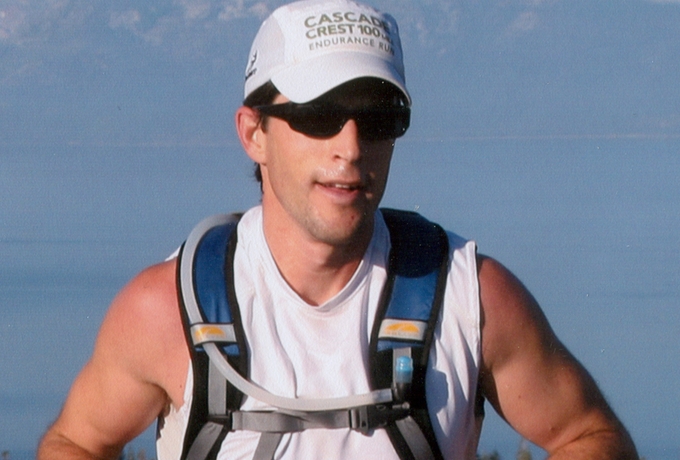
Alan Barichievich

Alan Barichievich

Sweet spot

Proper running technique is more important than shoes. Try running barefoot. Where your foot lands, usually between your heel and fore-foot, is your “sweet spot.” Land on your sweet spot, roll forward, and push off.  Now, try with shoes.

The right shoe

Type of running shoe depends on your foot type and surface you run on. Road shoes can work on trails, however, the sole may lack traction and rock protection.

General rules for arches:

·         High arch: chose a neutral shoe.

·         Medium arch: neutral or stability shoe.

·         Low arch: stability shoe.

Try on different shoes to determine which brand gives the best all-around fit. If a particular running shoe works for you, change the pair every 300 to 400 miles, but not the shoe.

Running form

Running itself does not cause injuries. It’s how you run.

Your body will thank you in the long run for proper form. Hold your head up in a natural and comfortable position.  Look ahead at the view and terrain. This helps build and maintain a strong posture, while creating a more efficient run. Keep your entire upper body relaxed and your shoulders low and loose. Relax your hands and try and keep elbows at a 90-degree angle. Run tall with a slight forward lean and straighten your torso up to its natural position. Efficient distance running requires a slight knee lift, a quick leg rotation, and a short stride with your foot landing under your body.

Terrain variation

Research shows no significant injury difference from running on various surfaces. Run on all kinds of surfaces. This challenges the body with slight changes in muscle activity which, in turn, helps reduce risk of injury.

When running hills, shorten the stride and maintain a flat running surface cadence, the foot strikes per a minute. Lean into the hill without bending at the waist and use your arms to boost locomotion up the hill.  If you feel winded and out of breath, gear down and adjust your cadence to a slow and steady pace.  On long hills, I look for a goal object – a rock, tree, or sign – up ahead and break the hill down into “little victories.” It motivates me and takes my mind off the hill.

Gear and hydration

Training outdoors, especially in the mountains, can be challenging and in extreme conditions even dangerous. Wear temperature-appropriate gear. Find clothing made of wick performance materials and wear a hat to shade your face and head. Lastly, stay hydrated before, during, and after your run with water and an electrolyte drink.

Barton Rehabilitation and Sports Medicine offers a comprehensive running program and a customized orthotics assessment. For details, go online.

Alan Barichievich is the director of Barton Health’s Rehabilitation and Sports Medicine. Alan and Caroline Barichievich will share more tips at a free presentation on July 8 at Lake Tahoe Community College. 


Truckee Donner PUD working to curb irrigation waste

The Truckee Donner Public Utility District is offering irrigation efficiency programs to make watering more efficient while maintaining beautiful gardens.

Available to qualifying customers, these programs will also help district customers comply with state prohibitions against wasting water, which include rules against overspray irrigation and watering for 48 hours after measurable precipitation.

More than 60 percent of the district’s summertime water use is attributed to irrigation. Experts estimate that as much as 50 percent of that water is wasted due to overwatering caused by inefficiencies in irrigation methods and systems.

The following are outdoor water saving programs offered by the district:

Wired Rain Sensor — Eligible customers receive a free rain sensor which will turn off  irrigation controller during precipitation and delay re-start depending on how much rain has fallen.

Rain Sensor Rebate — Eligible customers receive up to a $20 rebate to install a wireless sensor or specific manufacturer’s rain/weather sensor to improve watering efficiency.

Installation + Tune-up Rebate — Eligible customers receive an additional rebate up to $50 when they have a rain sensor installed by an irrigation/landscape professional with an irrigation system tune-up.

Go online for full program details.


Calif. renewable energy debate heating up

By Jeremy B. White, Sacramento Bee

A political fight over California’s renewable energy industry is playing out in the corridors of power, but it deals with something closer to home: your rooftop.

Capitol policymakers are advancing an ambitious proposal to have renewable sources generate half of the state’s electricity by 2030, up from the 33 percent benchmark already in law.

The full force of California’s political establishment backs the goal: Gov. Jerry Brown pitched the idea, Senate President Pro Tem Kevin de León, D-Los Angeles, has promoted it aggressively, and bills enshrining the new standard passed both the Senate and the Assembly with strong Democratic support.

The question now seems less whether the new goal will be enacted than how utilities will get there. With the clean energy industry anticipating an opportunity for more business, California’s rooftop solar firms are fighting to be included – and meeting resistance from other industry players.

Read the whole story


ZC club introduces youngsters to tennis

ennis Pro Rob Wheatley helps Bryant Pakes learn the volley while Kayden Pakes watches. Photo/Carolyn E. Wright/Copyright

Tennis pro Rob Wheatley helps Bryant Pakes learn the volley while Kayden Pakes watches. Photo Copyright 2015 Carolyn E. Wright

Youngsters took over the courts at Zephyr Cove Tennis Club for two days.

Rob Wheatley, the teaching pro at the club, led the annual Kids Clinic on June 20-21 with the help of a dozen volunteers from the club.

The free event was co-sponsored by Douglas County Parks and Recreation Department and the nonprofit Zephyr Cove Tennis Club Foundation.


Snippets about Lake Tahoe

barton·       Barton Pediatrics is relocating from Stateline to 2201 South Ave. in South Lake Tahoe on July 1.

·       Calidanza Mexican Folk and Contemporary Dance will perform June 27 at 2pm and 7pm at the Boathouse Theatre on the South Shore. The company fuses contemporary technique with traditional folk dance to tell stories of the cultural traditions of Mexico. For more info, go online.

·       The 12th Corvettes at Lake Tahoe car show is June 25-28 at MontBleu in Stateline. Public viewing is fro 9am-5pm, with awards given on Saturday.

·       CrossFit Lake Tahoe in Zephyr Cove will celebrate 10 years in business this weekend.

·       More than 50 artists will be featured at a show at South Tahoe Middle School from June 25-28 and then July 2-5.


Dispensing homeopathic remedies instead of drugs

By Steven Litvak

My grandparents, Norman and Mary Litvak, founded the Santa Monica Homeopathic Pharmacy back in 1944, originally planning on selling the usual items found in drug stores at the time — medicine, alcohol, soda, cigarettes. Little did they know that within just a few years, they would be pioneering the first fully integrative retail pharmacy in the United States.

Norman had been trained as a pharmacist at the University of Buffalo and understood the side effects of medication and the nutritional deficiencies caused by them. When the pharmacy’s customers weren’t doing as well as he and Mary had hoped, they decided they should provide customers with education and other alternative methods of healing, even though it was far more profitable to sell just prescription drugs. When a homeopathic sales rep entered their store shortly after purchasing, they were intrigued and decided to see what would happen if they offered these remedies to their customers.

When customers came in with allergies or aches and pains, Norman started giving them a homeopathic remedy instead of a drug. After those customers ran out of remedies, they came back for more. Complaints about side effects went down. Customers had fewer symptoms or were symptom-free. As word spread, many local doctors and individuals came to inquire about alternative ways of treating their ailments.

Norman and Mary’s passion for homeopathy was contagious. My grandfather formed relationships with doctors in the community, and even took some doctors under his wing, teaching them the homeopathic trade. A form of treatment that used to be considered snake oil or a placebo remedy proved to be an effective, non-invasive approach to a wide range of health issues.

Homeopathy is a system of medicine founded in the early 19th century by German physician Samuel Christian Hahnemann, who claimed that the medicine he had been taught to practice sometimes did patients more harm than good. The word “homeopathy” comes from the Greek words homeo (“similar”) and pathos (“suffering”). It is based on the principle that a disease can be cured by smaller doses of a medicine that, at full strength, creates similar symptoms to what the patient is experiencing.

Modern medicine often addresses a single symptom and not the totality of symptoms, whereas homeopathic physicians take into account all symptoms, including how the patient is reacting to the symptoms. Modern medicine is based on killing, suppressing, or blocking symptoms. Homeopathy works by allowing the body to handle the symptoms and then restoring balance.

For example, to treat allergies, a conventional pharmacist likely will dispense an antihistamine like Claritin or Zyrtec in which the active ingredient is designed to calm down your body’s immune reaction to allergens like pollen or animal dander. A homeopath, however, might prescribe Histaminum 15C, a remedy that is made from purified chemicals called histidines, which come from living substances, such as plants. Rather than blocking the action of histamine, one of the body’s natural chemicals, as a conventional allergy medicine would, this homeopathic remedy works by gently helping our immune system reduce the histamine load on the body without any drowsiness. Most patients notice a difference in their symptoms within the first 10 to 15 minutes after taking the remedy.

All homeopathic remedies are derived from plants, minerals, and animal sources and are prepared in minute dosages. They can be used during pregnancy and breastfeeding; they don’t react with other medications and substances like alcohol. Homeopathic remedies can be dissolved in water for animals and babies, and most have a pleasant taste, so children accept them with ease.

There are limits, of course, to what homeopathic medicine can do. Homeopathy alone is not for life-threatening emergency situations. It can be used for the side effects of chemotherapy or radiation, but not alone for cancer. Serious health disorders need to use multiple approaches to get the best results. But we have found that homeopathy and other alternative medicine work well for chronic diseases and certain diseases where there are no modern treatments available.

There are many misconceptions about homeopathic medicine, including that it’s merely a placebo therapy. But infants, children and animals – living beings who can’t “overthink” themselves well — get results from using our remedies. And, scientific double-blind randomized clinical trials, many of which have been recorded and repeated, also prove homeopathic medicine’s effectiveness. A few years ago, the Swiss government affirmed that homeopathic medicine works and is safe to consume.

One misconception about our pharmacy, especially from first-time customers, is to assume that everything in our store is homeopathic. However, we are a completely integrated pharmacy and also offer a few safe prescription medications. It’s just that we have more than one option for treating illness.

“Alternative medicine” is an umbrella term used to describe many of the health sciences that are not classified as modern mainstream medicine. Homeopathy is only one of the sciences that falls under alternative medicine. We also offer flower essences (commonly used for emotional problems), Western and Chinese herbs, professional nutritional supplements, essential oils, and natural skin care and household products.

Throughout the years, the alternative medicines industry has been challenged. As recently as April, the FDA announced it was considering enforcing more regulations for homeopathic medicine. (The labs that manufacture homeopathy are already regulated by the FDA.)

Such controversy belies the consistency with which we have run our pharmacy for almost a century. At any given time during business hours, Monday through Saturday, people enter our doors knowing that they can have a free consultation with any of our staff members, all of whom have been trained and certified in a field such as homeopathy, herbology, acupuncture, pharmacology, and nutrition. We also have pharmacists on staff who have received conventional training.

Over the years, our store has definitely changed. The name evolved (from Santa Monica Drug Company to Santa Monica Homeopathic Pharmacy). Cash registers were replaced by computers. Candy and soda was replaced by healthy snacks and beverages that do not cause sugar spikes in the blood and other negative effects on the body. Cigarettes and alcoholic beverages are long gone. The clients have come to ask more about alternative medicines. And we now have hundreds of medical doctors and hospitals that send their patients into the pharmacy to get help. Alternative medicine for many has become their medicine of choice.

When Mary and Norm opened the pharmacy in 1944, their sons were 4 and 7 years old. Santa Monica was a center of aerospace manufacturing. Bub and Pop could never have imagined that their small, family-owned pharmacy would still be in existence so far into the future, or that the city where it was based would become an upscale tourist destination. But they would recognize that, just as they did, two more generations are continuing to find the best ways to cure what ails their customers, no matter what tradition the treatments might come from.

Steven Litvak wrote this article with the help of family members Kimberly Litvak, Robert Litvak and Donald Litvak, who also work at the pharmacy. He wrote this for Thinking L.A., a partnership of UCLA and Zócalo Public Square.


Road beat: Hyundai impressively revamps Azera

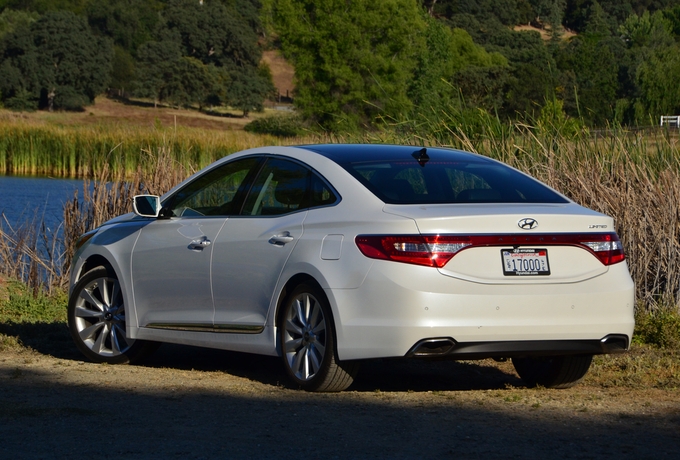
The latest Azera model from Hyundai is dramatically improved. Photos/Larry Weitzman

The latest Azera model from Hyundai is dramatically improved. Photos/Larry Weitzman

By Larry Weitzman

Never being a fan of the Azera, mainly because it was not attractive, has changed by about 180 degrees, with a new, fifth generation model. The prior generation, which was a follow on to the third generation known as the XG 300-350 (a car of real value), must have been designed by a competitor because it wasn’t exactly the belle of the ball.

But the fifth generation Azera changed everything. Sales have been slow to recover as auto experts think the intro in 2008 of the not much more expensive rear-wheel drive luxury Genesis made Hyundai Azera buyers quickly step up the few bucks to the superior Genesis.

Specifications Price (with destination) $34,895 to about $39,220 Engine 3.3L DOHC, 24 valve V-6 293 hp A 6,400 rpm  255 ft.-lbs. of torque @ 5,200 rpm Transmission Six speed torque converter automatic with paddle shifters Configuration Transversely mounted front engine/front wheel drive Dimensions Wheelbase 112.0 inches Length 193.7 inches Width 73.2 inches Height 57.9 inches Track (f/r) 63.1/63.1 inches Weight (18”/19” wheels) 3,684/3871 pounds Ground clearance 5.4 inches Fuel Capacity 18.5 gallons Cabin interior volume 107.0 cubic feet Trunk volume 16.3 cubic feet Turning circle 36.5 feet Steering lock to lock 2.9 turns Wheels (std/opt) 18X7.5/19X8.5 inch alloys Tires (std/opt) 245/45X18/245/40X19 inch radials Performance 0-60 mph 6.24 seconds 50-70 mph 3.35 seco9nds 50-70 mph uphill 4.97 seconds Top speed Way beyond sanity Fuel economy EPA rated at 19/28/22 mpg city/highway/combined. Expect 35 mpg in highway driving at legal speeds and 24 mpg overall in suburban/rural driving.

Specifications
Price (with destination) $34,895 to about $39,220
Engine
3.3L DOHC, 24 valve V-6 293 hp A 6,400 rpm
255 ft.-lbs. of torque @ 5,200 rpm
Transmission
Six speed torque converter automatic with paddle shifters
Configuration
Transversely mounted front engine/front wheel drive
Dimensions
Wheelbase 112.0 inches
Length 193.7 inches
Width 73.2 inches
Height 57.9 inches
Track (f/r) 63.1/63.1 inches
Weight (18”/19” wheels) 3,684/3871 pounds
Ground clearance 5.4 inches
Fuel Capacity 18.5 gallons
Cabin interior volume 107.0 cubic feet
Trunk volume 16.3 cubic feet
Turning circle 36.5 feet
Steering lock to lock 2.9 turns
Wheels (std/opt) 18X7.5/19X8.5 inch alloys
Tires (std/opt) 245/45X18/245/40X19 inch radials
Performance
0-60 mph 6.24 seconds
50-70 mph 3.35 seco9nds
50-70 mph uphill 4.97 seconds
Top speed Way beyond sanity
Fuel economy EPA rated at 19/28/22 mpg city/highway/combined. Expect 35 mpg in highway driving at legal speeds and 24 mpg overall in suburban/rural driving.

But this relatively new generation changes everything. What a great car. Sure it is front-wheel drive, but it is a non-issue. It is so well controlled that 99.9 percent of the time you will never know except for snowy conditions and then you will thank yourself for the front-wheel drive. Torque steer is deminimus, never thought about during the entire test with plenty of aggressive driving.

To improve the overall design, Hyundai designers went to the Fluidic Sculpture studio and came out with a pretty package with lines similar to the Sonata, but in some ways better. The front end is signature Hyundai, but the sides of the body are smooth with two stylish character lines especially above the rear quarter panel with perhaps its signature arrow. Nice touch. But with its long window line and proportions, you would have to call the Azera downright pretty. Many people seeing the car asked what it was saying it was sure stylish and pretty. Many didn’t know it was a Hyundai.

Having a long 112-inch wheelbase, a length of 194 inches and a width of 73 inches put the Azera into a large midsize class. But its voluminous interior dimensions place it squarely in the EPA large car class with a total interior volume of 123-cubic-feet, including a massive 16-cubic-foot trunk. This is a roomy, very comfortable sedan; so much so it could double for limo duty. But it doesn’t drive like a limo nor a Buick (which also don’t drive like Buicks anymore, either).

Powering the Azera is a choice of one silky, trick 3.3L, DOHC, 24 valve, direct injected V-6. Knocking down 293 thoroughbreds at 6,400 rpm plus a peak 255 pounds of twist at 5,200 rpm (meaning this engine is already making 252 hp at peak torque rpm), this engine pulls strong from off idle right to redline of about 6,600 rpm.  Power flows to the front wheels via a six speed auto cog swapper which you can by sliding the shifter over control manually for you boy racers out there. I did use the manual feature going down a long grade.

Azera is almost the mechanical twin of the Kia Cadenza and its performance is similar, matching the Cadenza times within a tenth of a second plus or minus, but its fuel economy was a bit better by an mpg. Zero to 60 mph averaged an excellent near world-class 6.24 seconds. Passing numbers also confirm the Azera’s rapid acceleration with a 50-70 mph passing run lasting just 3.35 seconds and the same test up a six percent grade only slowing the Azera to 4.97 seconds.

As to passing gas stations, the Azera is also exemplary. EPA rates the Azera at 19/28/22 mpg city/highway/combined. But the Azera exceeds those numbers by at least 10 percent in real world driving. Overall the Azera averaged 24.4 mpg and on the highway at 70 mph in a two-way run 35.6 mpg was the norm with the engine spinning 1,850 rpm at 70 mph. This may explain the 2 mpg better 70 mph fuel economy of the Azera over the Kia. While the transmission ratios are essentially the same the final drive ratio is lower in the Azera dropping 70 mph rpm by 150 and that would improve fuel economy. That would also explain why the passing numbers for the Kia are about a tenth of a second quicker over the Azera. Two mpg is significant; a tenth of a second is not.

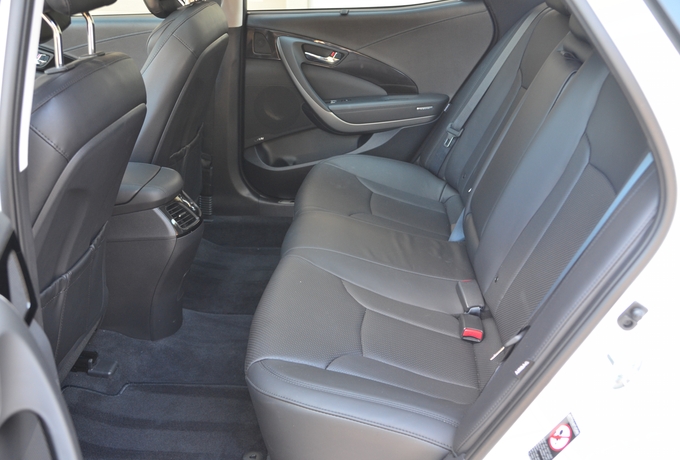
The roominess of the Azera is like sitting in a limo.

The roominess of the Azera is like sitting in a limo.

Handling is enhanced by state of the art fully independent suspension in all corners with Sachs ASD shocks and stab bars at ends. And those creds are improved by the Limited’s upgraded 19 inch alloys shod with super low profile and wide 245/40/19 rubber. Add in a 63 inch track front and rear and you should have a machine that can change directions with ease and the Azera does. Body roll is reasonably well controlled and the quick 2.9 turns lock to lock steering while slightly numb makes it easy to be aggressive and confident when the road bends, no matter how tight and frequent. Azera can straighten the road and keep your line with a minimum of fuss. Turning circle is a tight 36 feet.

Ride quality is superb. It eats road imperfections of any kind for breakfast, lunch, dinner and dessert plus any snacks you want to throw in. And it doesn’t gain weight. It is also extremely quiet, even with those low profile tires. The engine spins at 70 mph only 1,850 rpm and nothing can be heard unless you have back seat drivers which is easy to solve. Stop the car, unlock their doors and ask them to leave. They won’t find a better ride. They will willingly be quiet.

Braking performance was good stopping in 42 feet from 40 mph (large four-wheel discs with ABS). Having nine airbags including rear side impact bags, plus an alphabet soup of safety acronyms, HID headlights that turn night into day, Hyundai leaves nothing out, down to the rear view camera.

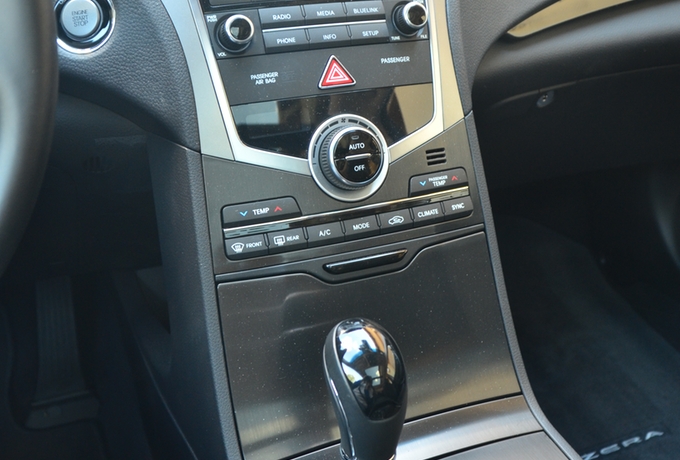
If you don’t like soft, buttery leather, don’t buy this car. It’s the only way it comes. Even the standard Azera is so equipped along with things like heated front and rear seats with the fronts having additional ventilation. The IP is superb with everything you need like a trick tach and a trip computer and more. There is only one easy to use Infinity sound  system, no upgrades required by the audiophile. Trust me this one is good, really good.

If there is an issue, I found the gorgeous front seats not to fit me well. Lower back support was lacking even with the adjustable bolster at maximum. It wasn’t low enough. Of course I should mention that during my week with the Azera, I was recovering from a severe lower back spasm. Blame it on me. Rear seating is a limousine and those rear quarter windows make the space feel even larger and the vehicle design better looking.

Now here is the deal. A base Azera stickers for $34,000 plus $895 for the boat from Asan, Korea, and the car is fantastically equipped. My tester was the moderately upgraded Limited stickered for $38,200 and the only option was floor mats for $125. With the limited you get a panoramic moonroof. My dermatologist says no to that so I might have to keep it closed, but the extra filtered light is nice.  With the Limited you get the 19-inch wheels and tires, but the standard Azera is no slouch there, as it gets great looking 18-inch alloys plus 245/45 series rubber that is also very capable.  Limiteds also get the HID lights, lane departures warning and forward collision warning and some other small items, but otherwise they are the same. At $38 large it is a phenomenal deal. At $34 large for the base Azera which is $2,000 LESS than a lesser equipped Camry V-6 tested a couple of months ago, it maybe the value sedan of the decade. Maybe Azera should be spelled v-a-l-u-e. And they still throw in for free a 100,000 mile power train warranty.

Larry Weitzman has been into cars since he was 5 years old. At 8 he could recite from memory the hp of every car made in the U.S. He has put in thousands of laps on racetracks all over the Western United States.


Guns in the U.S.: For every criminal killed in self-defense, 34 innocent people die

By Christopher Ingraham, Washington Post

“The only way to stop a bad guy with a gun is with a good guy with a gun.”says Wayne LaPierre, the vice president of the National Rifle Association.

That’s become the kernel of the NRA’s response to recent mass shooting tragedies — if only more people carried guns for protection, the thinking goes, then they would be less likely to be victimized by gun-wielding criminals.

“The only way to stop a bad guy with a gun is with a good guy with a gun,” LaPierre said

The challenge to that argument is that, data show, guns are rarely used in self-defense — especially relative to the rate at which they’re used in criminal homicides or suicides.

Read the whole story


Opinion: Commencement speech wisdom

By Riley Griffin and Alexandra Svokos, Huffington Post

As the school year came to a close, the class of 2015 methodically donned their caps and gowns. Four years long and four years gone, these students must brace themselves for the unexpected realities of what is known as “the real world.” Although each summer brings waves of trepidation to the prevailing graduating class, there is relief to be found at the finish line of commencement.

If only for a moment, the most prominent and experienced politicians, innovators, entertainers and entrepreneurs pause their pursuits to advise and inspire our future generation.

HuffPost noticed a trend in this year’s graduation speeches: Truth be told, our leaders love numbered lists. From George W. Bush to Denzel Washington to the Founder of Papa John’s, here are the most valuable lists of wisdom from this year’s commencement speakers.

Read the whole story