Drought an issue for governors in West
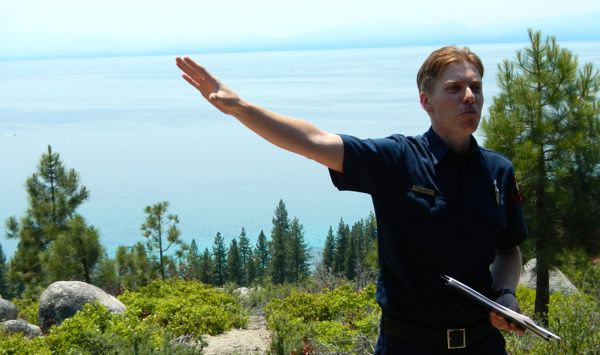
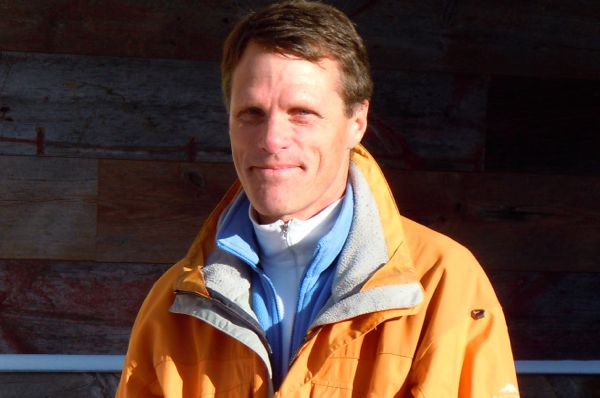
Forest Schafer with North Lake Tahoe fire on June 25 fire talks about how the drought is increasing the risk of a forest fire. Photos/Kathryn Reed

Forest Schafer with North Lake Tahoe fire on June 25 talks about how the drought is increasing the risk of a forest fire. Photos/Kathryn Reed

By Kathryn Reed

INCLINE VILLAGE – While people were in awe of the setting of the Western Governors’ Association gathering on Thursday, the reality is that in a non-drought year it would never have been able to be there.

The group assembled June 25 at the boat ramp at Sand Harbor. The ramp never opened this season because the water level at Lake Tahoe is too low for motorized vessels to launch.

Officials at the meeting said the level is at 6,220 feet. The natural rim is 6,223 feet. The dam in Tahoe City allows for another 6.1 feet of water above the rim to be stored in Lake Tahoe. Without much of a spring runoff because of the dismal winter snowpack, the lake has been dropping since the May rains ceased. Plus, about 0.1 inches is lost every day to evaporation. According to the Tahoe Fund, that evaporated water could serve the daily needs of 3.3 million people in the United States.

Cave Rock is the only launch ramp open in Nevada; even so, only one of the two lanes is accessible.

Much of the Western United States is suffering from drought – it’s not just California and Nevada.

Gov. Brian Sandoval is chairman of the Western Governors’ Association, having chosen drought to be his focus.

“We have to work together in this time of catastrophic drought,” the Nevada governor said.

Several people attending the multiday conference at the Hyatt in Incline Village went on a tour Thursday of the area, which highlighted the effects of drought in Tahoe. Besides the governors and their staffs, people from federal agencies and private companies that work with them were in attendance.

Motor boats cannot access Sand Harbor's boat launch area because the water is so low.

Motor boats cannot access Sand Harbor’s boat launch area because the water is so low.

Bob Mergell, deputy administrator for Nevada Division of State Parks, said parks are losing visitors because boaters are going elsewhere. To compensate his department is ramping up its efforts to attract non-motorized watercraft.

And while the low lake level means there is more beach area, not all of it is pristine.

“It’s a hard battle with noxious weeds,” Mergell said.

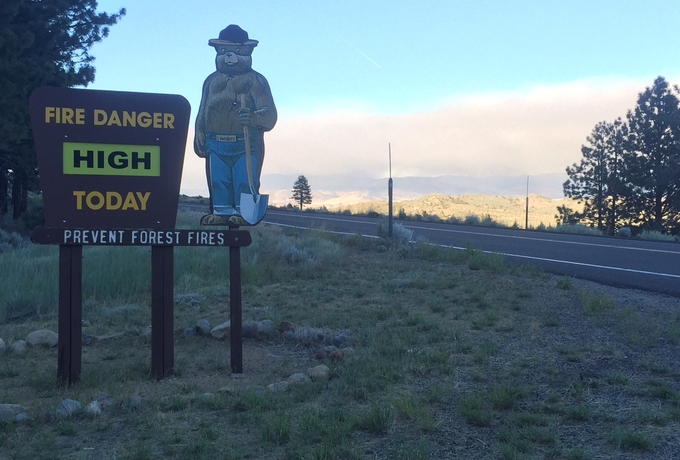
Fire is another threat all landowners are having to contend with as the drought stresses trees, making them more susceptible to beetle infestation. Plus, they are thirsty, which dries them out and makes them more prone to being wiped out if flames were to reach them.

Under increasingly smoky skies from the Washington Fire burning near Markleeville, a trio of fire officials spoke to the group from along Tunnel Creek Road – the same dirt path Flume Trail mountain bike riders descend.

“It looks like one forest, but politically it is very complex,” explained Forest Schafer with North Lake Tahoe Fire Protection District.

Collaboration to treat areas has been critical so there is a uniform approach to managing the forest, he said.

Roland Shaw with the Nevada Division of Forestry said the biggest thing the May rains did was to accelerate the growth of cheat grass that will dry out and add fuel to the forest.

He said evidence of bark beetle infestations are starting to show, something he expects to become worse as it spreads to various species of trees.

“Fire historically has been the great equalizer,” Shaw said. “Today, fire is getting the reputation as the great eraser, not the great equalizer. It’s making the restoration of sites more difficult.”

He said how Tunnel Creek usually has water in it into June if not July. It’s been dry for a couple years. No water means vegetation is less – especially berries that bears like to dine on. There is less protein in plants.

All of this means wildlife is looking for food and water in other places. It could mean in Incline having to cross Highway 28 to get to Lake Tahoe as a drinking source. It means human garbage becomes even more attractive.
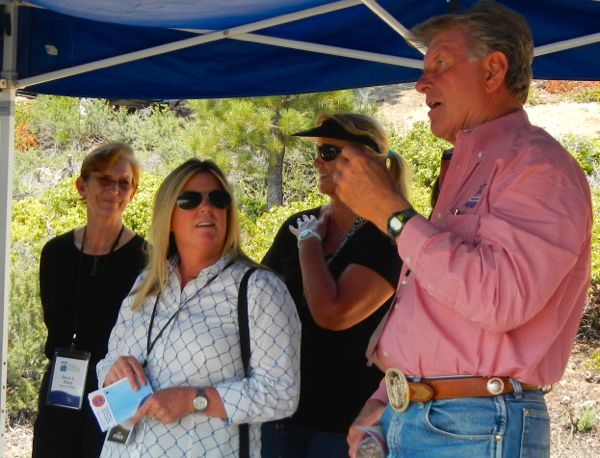
Idaho Gov. Butch Otter, right, talks about what his state is doing to fight fires.

Idaho Gov. Butch Otter, right, talks about what his state is doing to fight fires.

While agencies are working to thin the forest to make it healthier and less susceptible to fire, Brian Garrett with the U.S. Forest Service lamented that the policy stating trees larger than 30 inches in diameter cannot be cut down is hindering the agency from meeting its goals.

Leaving more of the larger trees per acre than the feds would like is putting stress on them, which in turn makes them ripe to be infested by beetles. Plus, the larger the tree, the more water it needs to stay alive.

Fire is inevitable the officials said. Suppression will be difficult in places where stands are denser. The Washington Fire in Alpine County is a prime example of this.

Idaho Gov. Butch Otter said his state has been using rural fire protection (RFP) districts for the past six years. This program allows ranchers to fight fires.

“Those guys are the ones who know the land,” Otter said.

He said each of the RFPs cost about $150,000 to start. They are helping to protect more than 3 million acres.

The RFPs are growing in popularity because of the stress on traditional firefighting agencies in terms of money and manpower. With the fire season starting earlier, lasting longer and being more prolific – especially in drought-prone locales, non-traditional measures and personnel are being deployed to douse the flames.
Washington Fire containment may take weeks

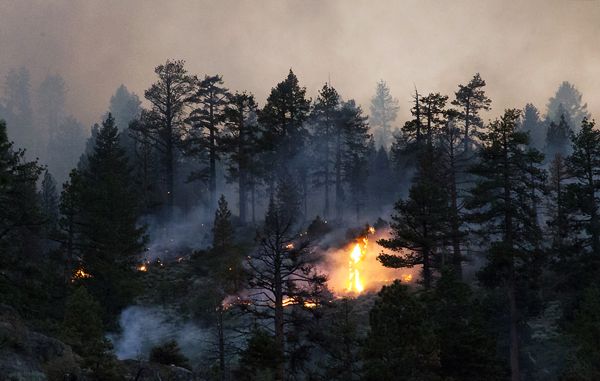
The Washington Fire burns on a ride with no visible sign of fire personnel. Photo/Carolyn E. Wright/Copyright

The Washington Fire burns on a ridge June 25 with no visible sign of fire personnel. Photo/Carolyn E. Wright/Copyright

Updated 9:50pm

The fire has burned 17,622 acres and is 29 percent contained.

“The availability of water to support firefighting efforts is a concern in large portions of the West this year. Thanks to a generous donation by Park Ranch and support from the California Department of Fish and Wildlife the use of Heenan Lake water is contributing to the suppression of the Washington Fire,” officials said.

Nearly 1,200 people are fighting the fire.

—–

By Susan Wood

MARKLEEVILLE – As the day turned to night, the crackling of fire against dry fuel on a treacherous, steep ridge above layers of heavy smoke overshadowed the beauty of a bucolic meadow where crickets chirped and displaced deer tried to find refuge.

This Washington Fire has had Markleeville on edge since it erupted nearly a week ago. It started about eight miles south of town off Highway 4 along Wolf Creek Road in the Carson Iceberg Wilderness where historic cabins dot a pristine landscape. It is now within three miles of the town.

The fire was caused by a lightning strike from a storm about 10 days before it was detected, according to officials. The exact date is still being determined.

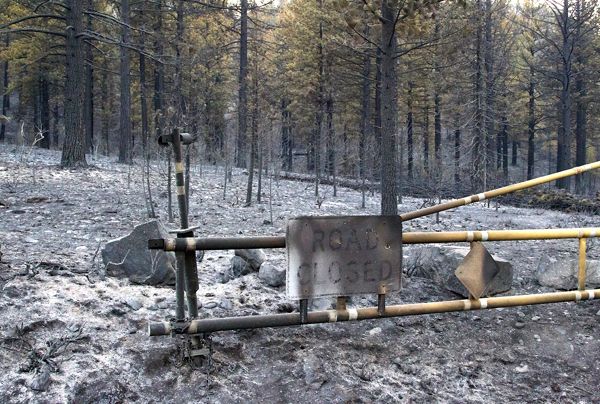
White ash fills the nearly 17,000-acre landscape burned by the Washington Fire. Photo/Carolyn E. Wright/Copyright

White ash fills the nearly 17,000-acre landscape burned by the Washington Fire. Photo/Carolyn E. Wright/Copyright

As of Thursday night, the time line in which fire agencies responded to the fire had not been released to Lake Tahoe News despite repeated requests.

Larry Lucas, U.S. Forest Service spokesman, said signs of smoke were first reported by the duty officer to the fire management officer of the Forest Service office in Markleeville at 6:10pm on June 19. USFS firehouses are not staffed around the clock. Alpine County has a volunteer fire department.

Tactical team Division Chief Kevin Kutterer, who works for the Bureau of Land Management, said he wanted more personnel and equipment to work with when he arrived.

“Our most challenging thing was the lack of resources like hand crews,” Kutterer told Lake Tahoe News on June 25 while leading a crew up the long, arduous drive along Wolf Creek.

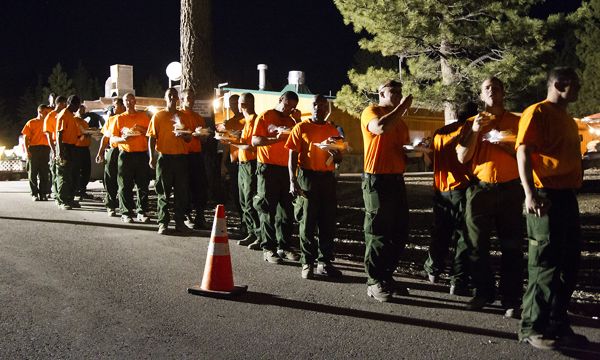
Inmates, temporarily calling Turtle Rock Park home, get dinner June 25 after working the fire line. Photo/Carolyn E. Wright/Copyright

Inmates, based at Turtle Rock Park, get dinner June 25 after working the fire line. Photo/Carolyn E. Wright/Copyright

The feds have diverted many resources to Alaska, which is being blanketed with fires. He also cited the steep, rocky terrain as a hindrance.

Kutterer expects full containment could take a few weeks as firefighters battle the elements and conditions to get a grip on the stubborn blaze. His sense of optimism seemed dwarfed by the fire’s back-and-forth nature and the immensity of the work ahead of his crews.

“The winds could kick up anytime,” he said.

The terrain’s densely forested areas will require much monitoring, he pointed out.

The wildland fire as of Thursday night had consumed nearly 17,000 acres.

Early on nearby campgrounds were evacuated. Markleeville has been turned into a ghost town even though mandatory evacuations are not in place. Turtle Rock Campground on Highway 89 has been turned into a small village of firefighters. Shift changes have some spending the night there, others resting in little coves along Highway 4 and the core backpacking or flown deep into the fire line.

Firefighters have been battling the original fire and spot blazes in an attempt to keep the flames from the town and away from the 15 historic buildings and cabins tucked in the trees. A fire truck on the night of June 25 was parked next to one of the nicer cabins along Wolf Creek Road.

Structures are threatened, but so firefighters have kept the flames at bay. Photo/Carolyn E. Wright/Copyright

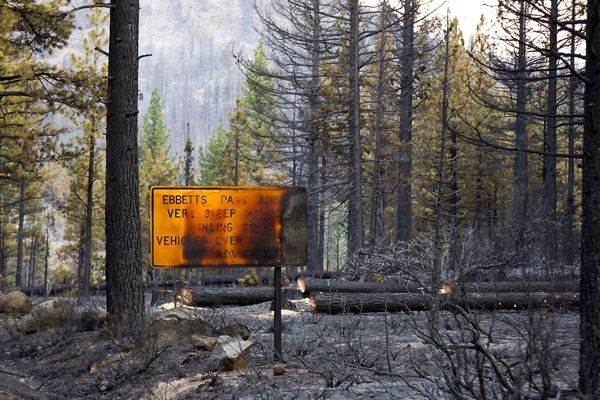
Ebbetts Pass is closed, as are other roads in the burn area. Photo/Carolyn E. Wright/Copyright

More than 900 people have been assigned to fight the Alpine County fire, with 50 engines, 12 water tenders, eight air tankers and 11 helicopters supporting the effort.

The hard-earned suppression push paid off Thursday with low winds. The break was well needed because containment has represented a seesaw between 10 percent to zero and back up to 15 percent containment by the evening.

Forecasts for Friday call for a chance of dry thunderstorms with winds picking up to 15 mph.

Highways 4 and 89 remain closed for public safety reasons.

The Carson Valley has been enshrouded in smoke for most of the week as winds burn the fire and smoke northeast. Smoke inundated Incline Village on Thursday and reached Truckee, too.

Fire restrictions go into effect for western Nevada and eastern California Friday, the Forest Service reported Thursday.


Opinion: Drone use needs to be regulated

By Ted Gaines

Technology’s miraculous leaps forward bring unimaginable benefits to us all. Life-saving medical procedures, limitless entertainment options, wealth building productivity tools and more change our lives for the better. But as with all tools, their benefit – or harm – depends on the intent of the user. That is why this legislative session I’m paying special attention to the drone revolution and pushing bills to enhance public safety.

The federal government is acting as well, creating “no drone zones” and tasking the Federal Aviation Administration with creating regulations on drone use, but the possibilities for abuse are unlimited and we need to take state-level action now. Would you want someone to hover a drone around your children’s locker room or bathroom and take pictures of them to post on the internet? What about an ex-spouse or potential abductor drone-monitoring the patterns of your children for some harmful purpose? What about a using a drone to gather information for some deadly, Columbine-style school attack?

Ted Gaines

Ted Gaines

It’s not paranoia to imagine these terrible scenarios, it’s just an understanding that technology can serve as an enabler for the best and worst purposes.

Schools should be sanctuaries for our children, and to protect students on campus, my Senate Bill 271 makes it a crime to use a drone to capture images of schools, and the students who use them, during school hours or during extracurricular activities.

Nowadays, drones also offer a new avenue for smuggling dangerous materials into prisons that threaten guards, prisoners, and citizens outside the jailhouse walls.

Last spring, the New York Times reported a small drone getting tangled up in the power lines outside of a prison in South Carolina. When they investigated, they found the drone had carried marijuana, a cell phone, and other contraband intended for prisoners inside the walls.

Cell phones let criminals project their power out on the streets in secret, facilitating the operation of gangs and other criminal enterprises. Weapons are an obvious problem for officer and inmate safety, and their proliferation is guaranteed if drone smuggling becomes commonplace. With drone delivery, prisoners would graduate from already dangerous sharpened bits of metal or plastic to far deadlier weapons that would put more people at risk.

Some companies are working to embed “no fly zones” into their drones, and there may be other mechanisms for controlling them, but even then, enterprising criminals may overcome those defenses in the perpetual cat-and-mouse game played between crooks and public safety. My Senate Bill 170 will make it illegal to fly a drone over a prison or jail. If we can’t stop drone smuggling, we can at least tack on extra punishment for those who would put so many lives at risk.

For next year, I’m already looking at “drone-stalking” bills and tackling the issue of drones and restraining orders, and I want to hear from my constituents, public safety, victims groups and civil libertarians to understand their ideas for how to deal with this changing landscape.

Computers once used vacuum tubes and filled up rooms the size of gymnasiums. Now we pack chips with circuits measured in nanometers and carry mini-PCs around in our pockets. Drones and other technologies will follow the same path, and as they become cheaper, better and ever more ubiquitous, it’s important that we regulate them in a way that preserves our safety and privacy while preserving our freedom. It’s not always an easy balance. But my two drone bills protect children and public safety and are an excellent start.

Ted Gaines represents the 1st Senate District, which includes all or parts of Alpine, El Dorado, Lassen, Modoc, Nevada, Placer, Plumas, Sacramento, Shasta, Sierra and Siskiyou counties.


Being poor affects brain as early as kindergarten

By Natalie Kitroeff, BloombergBusiness

Differences in wealth could affect the lives of American kids from the very first moment they enter a classroom, a study has found.

People with prestigious, lucrative jobs produce children who do better on math, reading, and memory tests, according to an analysis released today by the liberal Economic Policy Institute, which looked at parent and teacher assessments of 18,000 children who started kindergarten in 2010.Being Poor Affects Your Brain as Early as Kindergarten

On most skills, from ease with calculations and sentences to attention levels, children did better with every step up the wealth ladder. Students in the middle of the socioeconomic status spectrum did worse than the ones at the top, but better than those slightly below them.

Read the whole story


Beach cleanup volunteers being sought

Hundreds of volunteers will hit Lake Tahoe’s beaches on July 5 from 8:30am to noon to remove trash left from July 4 festivities.

Staff from the League to Save Lake Tahoe and its partners will be stationed at a beach with free raffle prizes, refreshments, and cleaning supplies. Bring a refillable water bottle.

During last year’s July 5 cleanup, League volunteers and staff collected and sorted nearly 2,300 pounds of debris. RSVP online.

Cleanups are planned at the following Tahoe beaches:
Commons Beach in Tahoe City
Kings Beach
Kiva Beach/Tallac Historic Site
Nevada Beach
Regan Beach.


Washington Fire 15 percent contained

Keeping flames from reaching Markleeville is the top priority. Photo/Susan Wood

Keeping flames from reaching Markleeville is the top priority. Photo/Susan Wood

Update 7:35pm:

The Washington Fire, which is three miles from the town of Markleeville, is 15 percent contained.

Markleeville residents are under an evacuation advisory issued by Alpine County Sheriff’s Office. No mandatory evacuations are in effect at this time.

“Significant progress has been made toward containing the western flank of the fire south of Markleeville,” according to officials.

The fire has burned 16,490 acres. The reduction in the reported fire size is due to more accurate mapping.

Smoke was bad in the Incline Village area on Thursday, with minimal impacts on the South Shore.

—–

The Washington Fire burning near Markleeville remains at 10 percent containment on Thursday.

It has burned 17,205 acres since Friday.

“The primary tactical priority is to prevent the fire from reaching Markleeville. The next priorities are to contain the fire in the Wolf Creek and Monitor Pass area. Tomorrow’s weather forecast calls for sunny, hazy, and increasing temperatures with northerly light winds in the afternoon. Forecasted dry thunderstorms with strong outflow winds remain a concern Friday,” officials said.

Highways 4 and 89 in the Monitor and Ebbetts pass areas remain closed. Several campgrounds along Highway 4 south of Markleeville as well as the Turtle Rock and Indian Creek campgrounds north of Markleeville remain closed. The Pacific Crest Trail is open.

Among the 900 people the blaze are 12 helicopters and three air tankers.

The fire was ignited by lightning, that occurred in previous storms in the weeks before, yet remained undetected until June 19.

— Lake Tahoe News staff report


Letter: Middle school students help Bread & Broth

To the community,

Club Live is a program sponsored by Larry and Paula Lambdin that promotes a healthy lifestyle by providing safe, high energy alternatives for middle school children.

On June 15, Club Live hosted Bread & Broth’s Adopt A Day of Nourishment. Prior to the end of the school year, Club Live members collected shampoo and lotion sample bottles to give to the sponsorship evening’s dinner guests.

“I liked how I got to see the people we collected the personal necessity items for and how happy they were to receive them”, said Lauren Constantine, a Club Live student leader. Constantine was joined at the dinner by Club Live Advisor Larry Lambdin, Co-Advisor Beth Aiton and Paula Lambdin. It was the first time Club Live sponsored a B&B dinner and Larry “enjoyed helping B&B provide an important community need and hope we can do it again.”

B&B would like to extend kudos to the Club Live organization for all it does to help our community youth and provide community service experiences. At the dinner, all of these wonderful volunteers worked really hard to help serve the dinner and even stayed past 6pm helping with the dinner’s cleanup.

“Always good to spend some time with amazing people,” Paula Lambdin said. She added, “Everyone in the building tonight was amazing.”

B&B commends Club Live for the amazing program they provide for our middle school students.

To help B&B as a donor or sponsor, contact me at 530.542.2876 or carolsgerard@aol.com.


Carol Gerard, Bread & Broth


Calif. water system stretched to limit, officials say

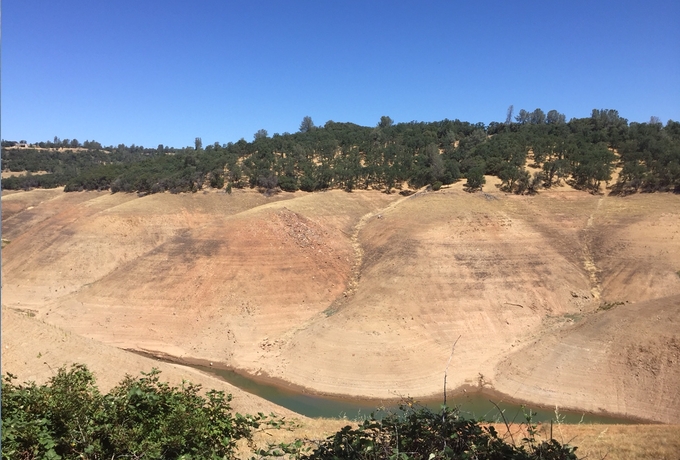
An arm of Lake Orville on June 22 is nearly depleted. Photo/Kathryn Reed

An arm of Lake Oroville on June 22 is nearly depleted. Photo/Kathryn Reed

By Dale Kasler, Sacramento Bee

A plan to save endangered fish has pushed California’s fragile water system almost to the breaking point, putting additional strain on farmers while drawing down reservoirs at Folsom and Oroville to historically low levels.

At an informal hearing Wednesday of the State Water Resources Control Board, federal and state regulators acknowledged they’re struggling to hold California’s water infrastructure together amid dwindling supplies and increasing anger from farmers, legislators and others.

With the drought in its fourth year, officials said the next few weeks could prove crucial – not only for endangered fish, but also for farmers throughout California who have planted crops based on earlier expectations of more generous water supplies.

“In my business, we get no do-overs,” said John Azevedo, a San Joaquin Valley farmer who is president of the Patterson Irrigation District. “I can’t unplant my crops.”

He and others, joined by state legislators, urged the water board to make more water available for agriculture this year, saying billions of dollars worth of crops in the ground are in danger. Environmentalists countered by saying several endangered fish species could go extinct if more water isn’t earmarked for them.

Read the whole story


Sex offender arrested on indecent exposure charges

A Placerville man was arrested on indecent exposure charges 25 minutes after registering as a sex offender.

Esteban Rocha, 51, registered about 11:50am June 23 with Placerville police. The process took about 40 minutes.

Just after 1pm a 911 call was placed regarding a man who had exposed himself to a woman in the 1300 block of Broadway Avenue. The woman ID’d Rocha.

He was arrested on charges of parole violation and committing indecent exposure with prior convictions.

— Lake Tahoe News staff report


TOCCATA celebrating 10th anniversary

Building on its June Go for Baroque kickoff series, TOCCATA will continue its 21-concert Summer MusicFest with a series that celebrates the 10th anniversary of Tahoe’s own Symphony Orchestra and Chorus.

The first concert is July 14, 7pm at Shepherd of the Sierra Lutheran Church in Carson City (3680 Highway 395 South) and opens with Mozart’s “Variations on Twinkle Twinkle Little Star” for flute and soprano performed by principal flute from the Puerto Rico Symphony, Josue Casillas, and soprano Joy Strotz. The concert continues with two hits for the 55 voice TOCCATA MusicFest Chorus an concludes with Beethoven’s “Choral Fantasy Op. 80”, dedicated to peace and world harmony with nature, with Donna Axton on piano.

Other concerts in the series will be presented on July 17, 7:30pm at St. Theresa Catholic Church in South Lake Tahoe (1041 Lyons Ave.), July 19, 4pm at Cornerstone Church in Incline Village (300 Country Club Drive), and July 21, 7:30pm at Bartley Ranch Amphitheater in Reno (6000 Bartley Ranch Road). Maestro James Rawie will conduct all performances.

Tickets are available at the door or online. General admission is $30 adults and $25 for seniors. Youth/students under age 24 with valid ID are $5 for seating 10 minutes prior to concert time, and under 18 enter free. Preferred seating is $40 and $15 for youth/students. Bartley Ranch lawn seating is $10.

For more information, call 775.313.9697 or email at ToccataTahoe@gmail.com.