Snippets about Lake Tahoe

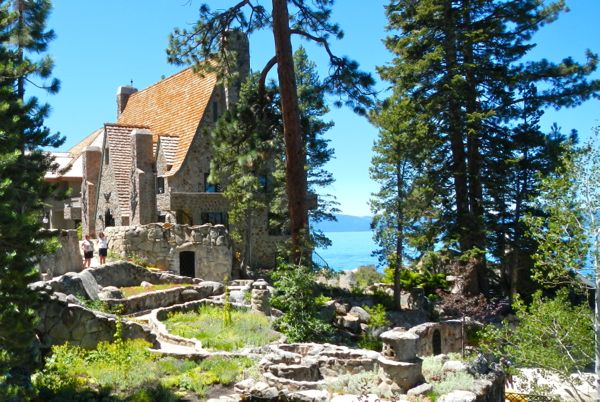
thunderbird lodge·       The Thunderbird Lodge has a series of fundraising dinners and wine events this summer. For more info, go online.

·      Barton Health now has a Pulmonology and Sleep Medicine program. Patients age 12 and older with sleep disordered breathing or sleep apnea can seek these services. For more info, call 530.543.5815.

·      Chevy’s is going to be in South Lake Tahoe for a while. The Mexican restaurant just signed a 20-year lease.

·       Learn about Emotional Freedom Technique, a protocol that uses tapping on acupressure points and gentle conversation to help eliminate negative behaviors and emotions. The class is July 10 from 6-9pm, with registration starting at 5:30pm. Cost is $25 (checks or cash). It is at the Gaia Wellness Center, 1475 Old Springs Road, No. 1
Carson City. For more info, email tahoehealthtouch@gmail.com.

·       The Truckee Town Council and Planning Commission are having a joint meeting July 7 to discuss climate change. The meeting is at 6pm, 10183 Truckee Airport Road.


Drought conditions make bad air worse


Smoke from the Washington Fire filled the Lake Tahoe Basin last week. Photo/Kathryn Reed

Smoke from the Washington Fire filled the Lake Tahoe Basin last week. Photo/Kathryn Reed

By Sammy Caiola, Sacramento Bee

A longtime asthma sufferer, Shirley Bittante tries to stay inside when the air district rates conditions outside her Fair Oaks house as “unhealthy.” She may have to spend more time indoors this summer as heat and drought degrade air quality across the state.

Bittante, 60, said she’s noticed more dust and fumes in the air in recent years. More fallow farmland, more forest fires, stagnant air and other factors aggravated by the state’s record four-year drought have spiked annual particle concentrations in Sacramento and other cities, creating an especially difficult environment for people with respiratory illnesses.

“I don’t have to physically see the smog. I just know it’s bad,” she said. “When you live with it every day, you get so used to it – the congestion and the coughing … I don’t see any end in sight.”

Particle pollution has increased in 25 California counties, where the number of unhealthy particle days has nearly tripled since 2014, according to the American Lung Association’s 2015 State of the Air report released in April. Statewide, 28 million people live in counties that received a failing grade for air quality, making up 73 percent of the state’s population.

Read the whole story


Reminder: Fireworks illegal in El Dorado County

Fireworks of any kind are illegal in El Dorado County. Any person caught possessing, transporting, purchasing, selling, or even storing fireworks could be cited or arrested and booked into the El Dorado County Jail for violating the misdemeanor county ordinance.

Illegal fireworks in El Dorado County include sparklers or those sold in neighboring counties as “safe and sane”. All fireworks will be confiscated.

According to the National Fire Protection Association, thousands of people, most often children and teens, are injured while using consumer fireworks every Fourth of July

Sanctioned pyrotechnic displays may be seen this weekend at the El Dorado County Fairgrounds, South Lake Tahoe, and Town Center in El Dorado Hills.


More areas opening near Washington Fire

Updated 8:55pm:

All state highways through the Washington Fire area are open to through traffic. This includes Highway 4 over Ebbetts Pass and Highway 89 east over Monitor Pass to Highway 395.

The fire near Markleeville is 66 percent contained, with 17,790 acres burned.

—–

While the Washington Fire continues to burn near the town of Markleeville, favorable weather conditions are helping firefighters to make progress.

The fire remains at 56 percent containment, with 17,787 acres burned.

“Fire is burning in hazardous and inaccessible terrain, and has burned into the Carson Iceberg Wilderness,” officials said.

However, in the flatter terrain crews are in mop-up mode and rehabilitation of the fire line has begun. The structure and night groups will be demobilized tonight.

Temperatures are expected to be cooler today with afternoon thunderstorms possible bringing rain.

The BLM area closure and the Indian Creek Campground closure were lifted at 8am Tuesday.

— Lake Tahoe News staff report


SLTPD to set up DUI checkpoint on July 1

South Lake Tahoe Police Department will be out in full force this week targeting those who drink and drive. DUI saturation patrols/DUI checkpoints will be deployed during the long holiday weekend.

The deterrent effect of DUI checkpoints is a proven resource in reducing the number of people killed and injured in alcohol or drug involved crashes, according to officers. Research shows that crashes involving an impaired driver can be reduced by up to 20 percent when well-publicized DUI checkpoints and proactive DUI patrols are conducted routinely.

The South Lake Tahoe Police Department will be conducting a DUI checkpoint along Lake Tahoe Boulevard From 8pm July 1 to 1am July 2.


NHTSA data also reveals that 35 percent of young drivers (18 to 34) were driving drunk (BAC of 0.08 or higher) in fatal crashes over the July 4 period in 2013. Motorcycle operators are also overrepresented as the highest percentage of alcohol-impaired drivers in fatal crashes. In 2013, more than one-quarter (27 percent) of motorcycle operators in fatal crashes had BACs of 0.08 or higher.

Drunken drivers are more common at night, too. Over the July 4 holiday in 2013, more than two fifths (42 percent) of the drivers in nighttime fatal crashes (6pm-6am) were alcohol-impaired, as compared to 13 percent of drivers in fatal crashes during the day.


Genoa hosting July 4 celebration

Mormon Station State Historic Park in Genoa and is hosting the Genoa Americana Celebration on July 4.

This event includes a children’s parade, games, live music, food vendors and jam sessions. Bring water and low backed chairs or blankets for listening to music on the grass, under the shade of the big trees.

Museum entrance is free for children 12 and under and is $1 for those older than 12.

The free event is from 10am-6pm.


Women play significant role in SLT’s 50 years

Publisher’s note: This is one in a series of stories Lake Tahoe News will be running leading up to the 50th anniversary of South Lake Tahoe on Nov. 30.

slt 50th logoThey buried Norma Thayer on a Saturday afternoon in May. She died in November 2014. She was interred with 17 friends and relatives remembering her and her 64 years at South Shore.

They gathered to lay her in the ground next to her daughter, no fuss, sharing memories of the extraordinary woman she was, but they left out one groundbreaking mention. Thayer was the first woman to run for the South Lake Tahoe City Council.

Norma Thayer

Norma Thayer

In the initial election in 1965 19 men ran for office, the top five each serving six-month terms as mayor. In 1967 the election was conducted for the first full four-year terms. Fifteen men and Thayer were on the ballot. Thayer didn’t succeed in her effort, but she didn’t come in last.

Nine years passed without a woman candidate. In 1974 Pat Lowe was elected. Lowe displayed a very practical turn of mind. It was her idea to set out left turn lanes in the neighborhoods and to place dry wells throughout the city to drain the annual floods. She went on to election as supervisor of El Dorado County, unfortunately succumbing to cancer before she could complete her second term.

As her colleague Laurie Ames recalls, “Pat spoke truth to power.” Today a portion of the bike trail is dedicated to her memory.

Del Laine as mayor of South Lake Tahoe. Photo/City of South Lake Tahoe

Del Laine as mayor of South Lake Tahoe. Photo/City of South Lake Tahoe

Del Laine was elected in 1976, serving two terms. Other women serving two terms were Neva Roberts (1982-1990), Margo Osti (1990-1998), Judy Brown (1996-2004), and Kathay Lovell (2002-2010).

Brooke Laine was elected to one term in 1998 and appointed to fulfill the two years remaining (2013-2015) on Claire Fortier’s term (2010-2012).

Lovell served three terms as mayor. Del Laine, Roberts and Brown all served two terms as mayor. Osti, Brooke Laine and Fortier served one-year terms as mayor.

Angela Swanson was elected to a term, retiring in 2015. JoAnn Conner (2012-2016) and Wendy David (2014-2018) currently serve.

Several other women stepped up to run, including Joan Currie, Gail Sanders, Linda Mendizabal, Joy Curry, Adrian Gooch, Elizabeth Hallen and Alice Jones. And Norma Thayer.

If you add those candidates up, 19 women have been willing to serve, of which 11 were elected, while 103 men ran the race, of which 33 were elected.

But it isn’t just numbers that matter, it’s what contributions were brought about. Neva Roberts initiated the competition that gave us the city flag, but what she more reveres are the people who came to her when they felt unheard by others. Her strong advocacy gave a handicapped woman a variance from CTRPA strictures and put a stop sign in Al Tahoe to provide a sense of safety for a neighborhood.

Margo Osti is proud of getting the Clean Tahoe program established, as well as working on affordable housing issues.

Standing fast for the gondola redevelopment plan and the vacation rental ordinance are tops on Judy Brown’s list of “yes!” Now after her council terms she continues to offer strong guidance as a member of the city’s Planning Commission.

Brooke Laine is proud the ice rink is an asset for the city, something she fought for, and she values her commitment to the public ownership of the city parking garage, which will be a financial asset for the city within a decade.

K

Kathay Lovell, then mayor of South Lake Tahoe, speaks during an Angora Fire meeting while state and federal officials look on. Photo/Kevin Chandler

Kathay Lovell, the only woman to serve three terms as mayor, worked hard to bring about Lakeview Commons, standing tall every hour to push for its completion. She was also the voice of calm during the tragic Angora Fire in 2007.

Claire Fortier delayed retirement until she could cast a strong vote for the revised Regional Plan update – a plan long in negotiation and diligently guided to fruition with her support as chair of the Tahoe Regional Planning Agency Governing Board.

JoAnn Conner takes pride on helping to revise city regulations to be friendlier in maintaining and attracting businesses, and to helping improve recreational facilities regionwide.

Wasting no time carving out an area of strong interest is Wendy David who has stressed mental health and community well being as her focus.

— Compiled by Del Laine


Opinion: LTUSD condones trashing tennis courts

By Kathryn Reed

Football is king. That’s nothing new. It’s just sad all the lies that go into making it a reality.

The latest lie is how Lake Tahoe Unified School District officials profess to care so much about the tennis courts at South Tahoe High School. Ever since those courts were rebuilt a few years ago it has been a nightmare to be able to play on them.

Superintendent Jim Tarwater claims he wants to keep the courts pristine. He doesn’t want riffraff coming in and ruining the courts. That’s why they are always locked, he has repeatedly said.

It cost about $350,000 to build what at the time were essentially six new courts. While the project wasn’t originally part of the Measure G facilities bond, a line in the contractors’ contract made it logical to repave the courts. The contract said if the workers could not park at STHS, they would be paid an additional 15 minutes at the start and end of their day to compensate for the time to get to the work site. This was going to add about $400,000 to the nearly $25 million project going on at that time.

The district decided it would be more prudent in terms of time and money to have the workers use the tennis courts as a staging area, lose access to them for a season and then have them rebuilt.

The use of these courts has been contentious and controversial since they were resurfaced.

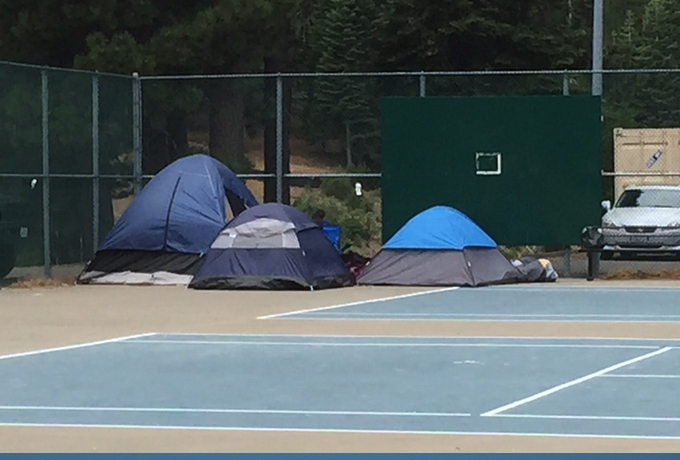
South Tahoe High School's tennis courts are now being used for housing for a multi-day  football camp. Photo/Kathryn Reed

South Tahoe High’s tennis courts are being used for housing for a multi-day football camp. Photo/Kathryn Reed

Tennis players are the first ones to want the courts to remain in good condition. But maybe it doesn’t matter since we aren’t allowed to play on them for more than 16 hours this summer.

What is galling is the duplicity of school district officials. Or maybe it shouldn’t be surprising if one looks at the sports the children of these decision-makers play.

Tarwater did not return a phone call, nor did STHS Athletic Director Tony Sunzeri nor school board President Barbara Bannar.

The courts were covered with tents last weekend. Boys attending a football camp were sleeping there. They were sleeping in the school. They were all over campus.

Several tents remained as a group of tennis players got to the courts Monday. The boys walked on the courts in their cleats. There are signs that say “Tennis Shoes Only”. It is these types of shoes that can ruin the surface of tennis courts. Apparently rules don’t apply to football players.

Chicks with Sticks, of which I’m a member, is a group of friends paying Lake Tahoe Unified School District $300 to use the courts for one day a week for eight weeks. Members of this group are the only ones allowed to use the tennis courts at South Tahoe High School this summer, according to LTUSD.

Why the public can’t use the courts for their intended purpose and football players can muck them up is beyond me.

It took the organizers of Chicks with Sticks more than 16 hours to secure a deal with LTUSD. Sixteen hours is about all the courts will be used – at least for tennis.

The fact that the school district clearly has no policy for how the courts get used, allowed a now retired secretary to make decisions above her pay grade, and gave the organizers the run around is a horrendous way to do business. Tennis could be big business in this town, and on the entire South Shore. One only has to look at what the nonprofit Zephyr Cove Tennis Club Foundation, which is in its second year, has done, to see what a well-run public facility looks like. (ZCTCF operates the six courts owned by Douglas County.)

It is inexcusable that the district says no to tennis at STHS except for eight days this summer, but yes to football players.

The courts are a mess. There is garbage flying around. Trash cans are outside the court, none inside. There is debris – like wood chips – that makes turning an ankle highly likely. Sand in the back of a court is dangerous. (Now I know why each player had to sign a liability form.) A bench is broken and lying in disrepair. A rolling ladder had to be moved so players wouldn’t run into it.

It’s incredibly sad to see my tax dollars being so misused. It’s sad to see tennis courts be locked so people can’t play on them. It’s sad to see football players be allowed to use them to sleep on, and even more horrendous to hear the click-clack of their cleats on these fairly young courts.

The fact that these boys wouldn’t listen to anyone explain how walking onto the court while we were playing was bad etiquette shouldn’t have surprised us. They had already trashed the courts and were continuing to do so in their cleats. And apparently all of this is OK with LTUSD officials, because, well, football is king.


Prudent way to fight childhood obesity

By Jane E. Brody, New York Times

Pardon the cliché, but it happens to be particularly apt in this case: In trying to tame the nation’s obesity epidemic, an ounce of prevention is decidedly worth a pound of cure — considerably more than a pound, in fact, according to the findings of a five-year collaborative research project.

Not only can several popular strategies help children achieve and maintain a normal weight and, in the future, reduce adult obesity, they can also save the country many health care dollars and, in a few cases, generate revenue to support further weight control efforts.

The project, initial results of which were published recently by the American Journal of Preventive Medicine, is called the Childhood Obesity Cost-Effectiveness Study, or Choices. It examined in exhaustive detail the costs and benefits of four possible approaches to curbing childhood obesity: placing an excise tax on sugar-sweetened beverages; ending the tax write-off for advertising on children’s television; increasing moderate to vigorous physical activity in schools; and fostering healthier habits (more physical activity, better nutrition and less screen time) in preschool settings.


Indian tribe recognition process overhauled

By Kevin Freking, AP 

WASHINGTON — The Obama administration is making it easier for some Indian tribes to obtain federal recognition, addressing a longstanding grievance of many Native Americans.

The new regulation updates a 37-year-old process that has been roundly criticized as broken because of the many years and mounds of paperwork that typically went into each application.

But the effort to address those criticisms generated a backlash of its own, with some lawmakers and existing tribes with casino operations complaining that the administration’s original proposals set the bar too low.

The Obama administration made changes in the final rule that answers many of those concerns, but not all. Kevin Washburn, an assistant secretary at the Department of Interior, announced the regulation Monday during a National Congress of American Indians conference in Minnesota.

Federal acknowledgment means a tribe is treated as a nation within a nation, able to set up its own government, legal system, and taxes and fees. Recognition also brings critical federal investments in medical care, housing and education. It also can lead to tribes opening casinos in future years through a separate approval process.

Washburn told the Associated Press that the regulatory changes will greatly enhance transparency by letting the public see most of the documents submitted by the petitioning groups via the Internet.

The changes will also give tribal groups facing rejection the chance to take their case to an administrative judge before a final determination is made.

Interior Secretary Sally Jewell said the new regulations for tribal recognition “makes good on a promise to our First Americans to clarify, expedite and honor a meaningful process for federal acknowledgment.”

The most scrutinized changes will be the new criteria that must be met for recognition to occur.

Indian groups seeking recognition will no longer have to show that outside parties identified them as an Indian entity dating back to 1900. Washburn said the requirement clashed with the reality of the times. Many Indians were attempting to hide their identity from outside sources out of fear they would be discriminated against, or worse. “They would have been crazy not to have,” said Washburn, a member of the Chickasaw Nation in Oklahoma.

Some federally recognized tribes had urged that the requirement be kept.

“We cannot understand why a legitimate petitioner could not produce external documentation of its existence,” Robert Martin, chairman of the Morongo Band of Mission Indians, testified during a recent congressional hearing.

Petitioners also had to show that their tribe has existed as a community and exercised political control over its members since first contact with European settlers, or as early as 1789. The proposed regulation had changed the threshold to 1934. After much pushback, the final rule sets the date at 1900 — more than a century of documentation that includes “a time when it was dangerous to be Indian,” Washburn said.

Under the current system, which began in 1978, the government has recognized 17 tribes and rejected the petitions of 34 other groups.

The Obama administration had originally envisioned giving groups who were denied federal recognition another opportunity to re-petition the government. That provision wasn’t included in the final rule.

“It would be unfair to allow people to come in and re-petition when there are people in line who haven’t had their first chance to make their case,” Washburn said.

Lawmakers in Connecticut had been particularly critical of allowing previously denied groups the chance to re-petition, and the change deals a blow to four Indian groups whose petitions were rejected in 2005.

Congress also has the authority to recognize tribes.

The Obama administration is moving ahead with the regulation even as lawmakers had expressly warned them to pull it back. A spending bill in the House contains language banning the Interior Department from using federal money to implement or enforce the regulatory change.

In all, there are 566 federal recognized tribes and hundreds more want to join their ranks.

Arlinda Locklear, an attorney in Washington who has worked on behalf of about a dozen tribes seeking federal acknowledgment, calls the current tribal recognition process heartbreaking because it’s so demanding and takes so long, often more than a decade.

“You have a whole generation of people who just die while they’re waiting for it to happen,” Locklear said.