Future of Lake Tahoe Airport in council’s hands

By Kathryn Reed

Before summer is over, a preferred alternative for the Lake Tahoe Airport Master Plan should be selected.

The South Lake Tahoe City Council is expected to discuss the matter July 21 or Aug. 4.

It was in 1992 that a settlement agreement regarding the master plan was reached. This involved the city, state Attorney General’s Office, League to Save Lake Tahoe and Tahoe Regional Planning Agency. That document expired in 2012 so the city has been operating the airport without a valid master plan.

The June 30 meeting attended by about a dozen people was the final public workshop before the council takes over. The public will have two more opportunities at council meetings to offer input.

Michael Hotaling, the consultant preparing the master plan, said it’s likely the preferred alternative will be a combination of the various proposals that have been whittled down based on public comments, research and staff input. The alternatives separately address the airfield, and land area with buildings and open space.

Under consideration is whether to keep the airport as it is or do something else.

The FAA will have the ultimate say over the Aviation Demand Forecast and the Airport Layout Plan. The feds are paying 90 percent of the cost to create the master plan.

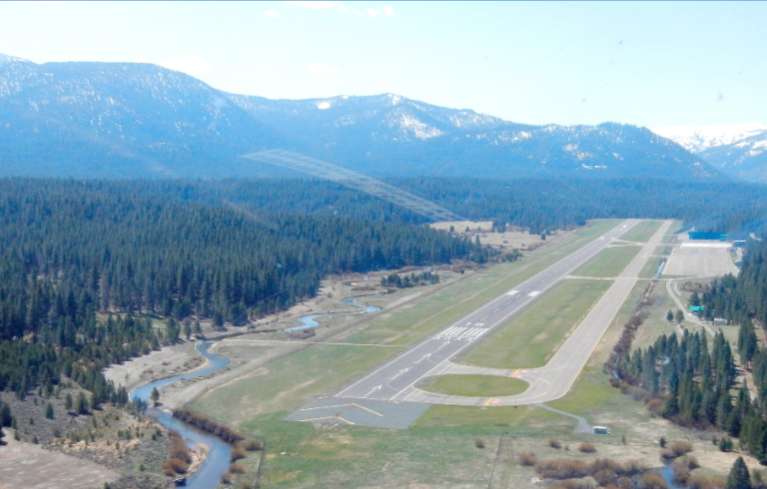
Lake Tahoe Airport's airfield could be altered. Photo/LTN file

Lake Tahoe Airport’s airfield could be altered depending on what the master plan calls for. Photo/LTN file

Closing the airport, while considered early on, is no longer an option. This is because the FAA deems the airport an important element in its greater transportation plan. Plus, it is a resource in emergencies and could provide the only way out of the basin in a catastrophe.

To accommodate a large number of planes like what will be arriving for this month’s celebrity golf tournament a temporary tower will be in place. Personnel from Reno will operate it. This is the second year for the portable tower. The permanent one cannot be used because it does not have equipment and the line of sight is blocked by trees.

Bringing back commercial air service is also off the table. The 139 certificate, which would allow commercial service, no longer is in effect. The council in the last year voted to give up that FAA designation.

Based on input from a meeting earlier this year the public is divided over what should be done at the airport. Some want to alter the airfield to allow a larger class of plane that is forecast to be the aircraft of choice going forward, others want to leave things as they are.

The consultants predict air traffic at Lake Tahoe Airport to increase 1.7 percent in the next 20 years. This means going from 2.7 flights per hour to 3.1.

When it comes to the land segment, some want to get keep the aviation designations for the property in case things change, others want to allow different uses. The city is looking at creating an outdoor events area east of the tower.

In the 2013-14 budget, $351,972 of the general fund was used to keep the airport afloat. That is a decrease of 43 percent from 2010-11. Hotaling said projections are for that number to continue to decline.


Road beat: Mazda sets the bar high with CX-5

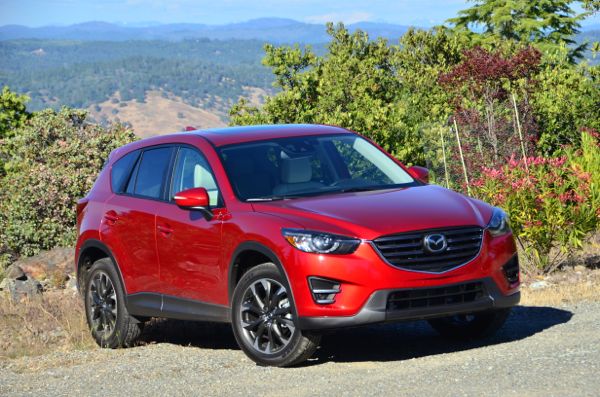
The 2015 Mazda CX-5 excels in looks and performance. Photos/Larry Weitzman

The 2015 Mazda CX-5 excels in looks and performance. Photos/Larry Weitzman

By Larry Weitzman

If there were a stealth car company in the world, look to Mazda. While their product line for the last 10 years has been at or near the top of their respective classes, until the last couple of years, you could say they have been flying under the radar. But they have been found out and sales are growing like bad weed in a rainstorm. And there is a reason; Mazda has proven itself as the best cars in the small sports car, compact and mid-size sedan class. Now they can claim best of class honors from the Road Beat in the small CUV/SUV class, which has been dominated in the past by the Subie Forester, especially since it went to a CVT.

For 2016, Takeri design philosophy has made the CX-5 by far the best looking small SUV, which has been so successful in the Mazda 3 and 6. It has a new aggressive look from its gorgeous front end to its clean rear end finish. It looks smaller than it is and its smooth lines are minimal yet purposeful. In the looks department alone, the CX-5 is the clear winner in this class.

Size wise, the CX-5 is true compact size with a length of 179 inches on a 106-inch wheelbase. Its beamy 72-inch width allows its wide track of 62.5 inches. While its sleek design disguises its height, it is 66-inches tall without the roof rack or shark fin antenna. It will swallow a mammoth 65-cubic-feet of cargo behind the front chairs. Its interior is definitely not compromised by its high style. Co-efficient of drag is 0.33.
Specifications Price $22,675 to about $34,000 Engine 2.0L inline four 16 valve, DOHC 155 hp @ 6,000 rpm 150 ft-lb of torque @ 4,000 rpm 2.5L inline four 16 valve, DOHC 184 hp @ 5,700 rpm 				185ft-lb of torque @ 3,250 rpm Transmission Six speed manual Six speed torque converter automatic Configuration Transverse front engine/ FWD/AWD  Dimensions Wheelbase 106.3 inches Length 178.7 inches Width 72.4 inches Height 65.7 inches Track (f/r) 62.4/62.5 inches Ground clearance 8.5 inches Weight 3,433 pounds GVWR 4,409 pounds Steering lock to lock 2.7 turns Turning circle (wall to wall) 38.4 feet Wheels 19X7 inch alloys Tires 225/55X19 Cargo capacity (second row up/down) 34.1/65.4 cubic feet Fuel capacity 14.8 gallons	 Co-efficient of drag 0.33 Performance 0-60 mph 7.17 seconds 50-70 mph 4.17 seconds 50-70 mph uphill 6.56 seconds Top speed (mfg) 127 mph Fuel economy EPA rated 26/33/29 mpg city/highway/combined. Expect 28-29 mpg in rural country driving. 32 mpg on a level highway at legal speeds.

Specifications
Price $22,675 to about $34,000
Engine
2.0L inline four 16 valve, DOHC 155 hp @ 6,000 rpm
150 ft-lb of torque @ 4,000 rpm
2.5L inline four 16 valve, DOHC 184 hp @ 5,700 rpm
185ft-lb of torque @ 3,250 rpm
Transmission
Six speed manual
Six speed torque converter automatic
Configuration
Transverse front engine/ FWD/AWD
Dimensions
Wheelbase 106.3 inches
Length 178.7 inches
Width 72.4 inches
Height 65.7 inches
Track (f/r) 62.4/62.5 inches
Ground clearance 8.5 inches
Weight 3,433 pounds
GVWR 4,409 pounds
Steering lock to lock 2.7 turns
Turning circle (wall to wall) 38.4 feet
Wheels 19X7 inch alloys
Tires 225/55X19
Cargo capacity (second row up/down) 34.1/65.4 cubic feet
Fuel capacity 14.8 gallons
Co-efficient of drag 0.33
Performance
0-60 mph 7.17 seconds
50-70 mph 4.17 seconds
50-70 mph uphill 6.56 seconds
Top speed (mfg) 127 mph
Fuel economy EPA rated 26/33/29 mpg city/highway/combined. Expect 28-29 mpg in rural country driving. 32 mpg on a level highway at legal speeds.

Two engine choices are available, a spunky 2.0L Skyactiv inline direct injected super high compression (13:1) DOHC, 16 valve four knocking down 155 hp at 6,000 rpm and 150 pounds of twist at 4,000 rpm which engine is found in the Sport edition. Stepping up to the 2.5L inline four with the all the same Skyactiv bells and whistles improves its output to 185 hp at a low 5,700 rpm and 185 pounds of torque at a remarkably low 3,250 rpm which resides under the hood of the Touring and Grand Touring edition. These are the exact same powertrains used in the Mazda 3 and 6 right down the six-speed manual (Sport only) and six-speed auto cog-swapper (Sport, Touring and Grand Touring). As the numbers will reveal, both are among the most powerful and efficient powertrains in this market segment today.

Two drive systems are available with FWD (all models) and AWD Touring and Grand Touring only.

Getting to where the rubber meets the road, my FWD, 2.5L tester is a veritable rocket ship in this class. Zero-60 mph times splits the difference between a Mazda 3 and a Mazda 6 with times averaging 7.17 seconds (the 3 ran 7.1 and the 6 ran 7.3). Nothing else in this class ever broke into the sevens, let alone the low sevens. When I performed the two way runs, I didn’t believe the chrondex when it stopped at 6.97 seconds on the first run. The traction control was switched off requiring careful launches to prevent wheel spin at full tilt boogie launches. Phenomenal.

Passing rimes are also top of the class with 50-70 mph runs lasting just 4.17 seconds on level ground and 6.56 seconds up a 6 percent grade. Nothing else in this class comes close unless you opt for a Subie Forester Turbo which is an absolute flyer.

Fuel economy is also excellent as with the Mazda 3 and 6. EPA rates the 2.5L FWD at 26/33/29 mpg city highway combined. The 2.0L will net you 2 more mpg on the highway with the manual, but the combined mpg prediction is the same at 29 mpg as with the 2.0L auto. There is no mpg benefit according to the EPA. AWD is predicted to cost you a couple of mpg.  But what about real life? My 2.5L AT FWD averaged about 28.8 mpg mostly in hilly country driving with max speeds of about 60 mph. In a two way level highway run fuel economy 70 mph run settled in at 31.8 mpg. But it’s the overall mpg number that is so good, a real 28.8 mpg.

But it is not just performance and fuel economy that shines. CX-5 is a bright star in all aspects.  Besides the CX-5’s wide track, everything else is state of the art. Suspension is fully independent with coils in all four corners and stab bars at both ends. Steering is an electric rack that is very quick at 2.7 turns lock to lock. Wheels in the GT model are 19X7 inch trick alloys and they are shod with 225/55 lower profile tires. Consequently this extraordinarily tuned design has predictable super quick turn-in and minimal body roll when pushed hard with moderate understeer. It is extremely well balanced allowing for very sporty, aggressive driving. Mazda’s new ad campaign “Driving Matters” is so appropriate to this brand as it is obviously evident in the five models tested recently by the Road Beat. These are driver’s automobiles.

Ride quality doesn’t suffer as a result. It is quiet, very smooth with a firm, but supple and compliant ride that handle big bumps well with no head tossing. Yeah, sure it’s a small crossover SUV, but it acts like a sport sedan. The engine spins at 2,200 rpm at 70 mph with no noise except for some tire noise on coarse roads, but remember this thing is shod with some semi-performance tires (225/55). That shorter top gear (2,200 rpm at 70 mph instead of 2,000 rpm at 70 mph) may answer the question of why the CX-5 is so quick and its highway mileage is not a Mazda sedan like 40 mpg. But then again, no conventional compact SUV comes close to 40-mpg highway. Even though its CD is a low 0.33, it still is taller and that adds to drag overall.

Those wide tires plus good size four-wheel discs with the fronts being ventilated do an excellent job at arresting forward progress from 40 mph in 41 feet. As with most other (if not all other passenger vehicles in production), it has every electronic safety system in autodom like stability control, ABS and BA plus enough airbags to float the Titanic. It also has the aforementioned superb handling which equates to good accident avoidance.
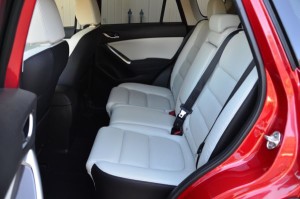
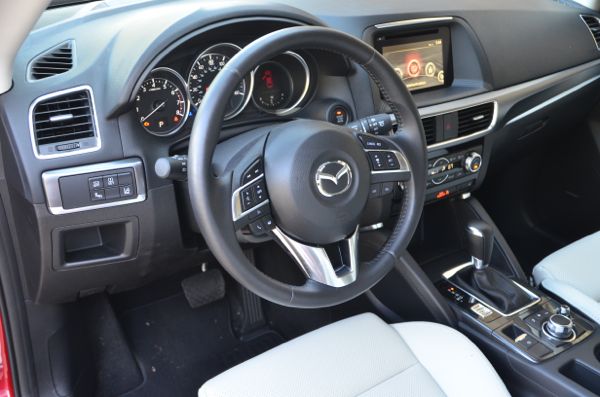
The interior looks like it belongs in a higher-end model.

The interior looks like it belongs in a higher-end model.

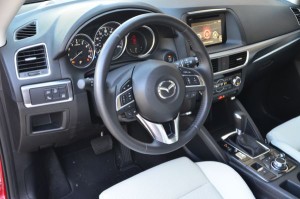
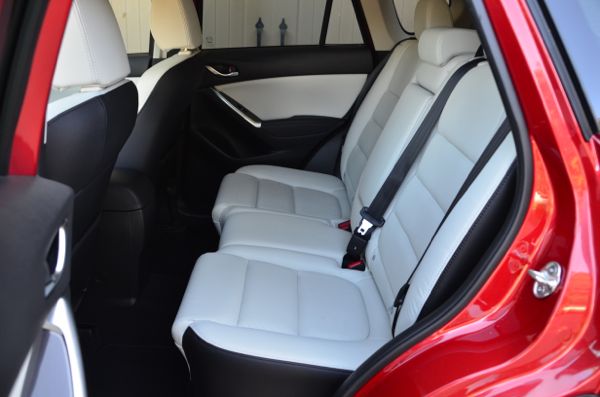
In another surprise, the CX-5 comes with an interior that looks like it came right out of the top of the line Mazda 6.  Done in a contrasting sporty off white and black leather trim, the design is almost identical (if not identical) to the Mazda 3 and 6. It is beautiful to look at and even better on the backside.  Well done. The IP (instrument panel) is a simple three-hole binnacle with the appropriate tach, speedo, ancillary gauges plus complete trip computer. If there is a downfall with the CX-5, it is the radio, too confusing and difficult to use. It could be done better, but maybe after some time one could become adept. Maybe I am old fashioned as I bang this story out on my IBM Selectric that just replaced a Smith Corona manual.

Rear seating is excellent for three reasonable sized adults, while cargo room is good at 34-cubic-feet behind the second row (about twice the volume of a Lincoln Town Car trunk) and 65-cubic-feet of volume with the second row folded flat. If you want a third row, you will need a trailer.

Pricing starts for a FWD Sport with a manual cog swapper at $21,795. The six-speed auto unit adds $1,400. An AWD Sport auto stickers for $24,445. My FWD Grand Touring was $28,220. AWD only adds $1,250, a bargain and probably fully recoverable on resale. My tester had a few options bringing to total to $32,010 plus $880 for the cruise ship from Hiroshima, Japan.

Two of the packages were the GT-I-Activesense pack that includes radar cruise, smart braking, lane departure warning and a high beam control for the excellent headlights, $1,500. The Grand Touring Tech pack at $1,505 offers Nav, LED headlights that are adaptive, plus LED running lights, fogs and more. And then there were the fabulous seats. Mazda is looming large.

Larry Weitzman has been into cars since he was 5 years old. At 8 he could recite from memory the hp of every car made in the U.S. He has put in thousands of laps on racetracks all over the Western United States.
NY firm takes over South Shore fireworks; app allows music synchronization without radio

By Kathryn Reed

Three barges loaded with an array of canisters will make their way this morning from Tahoe Keys Marina to a secure holding area near Stateline. Then a small vessel will deliver a slew of pyrotechnics to the barges in anticipation of Saturday’s fireworks display on the South Shore.

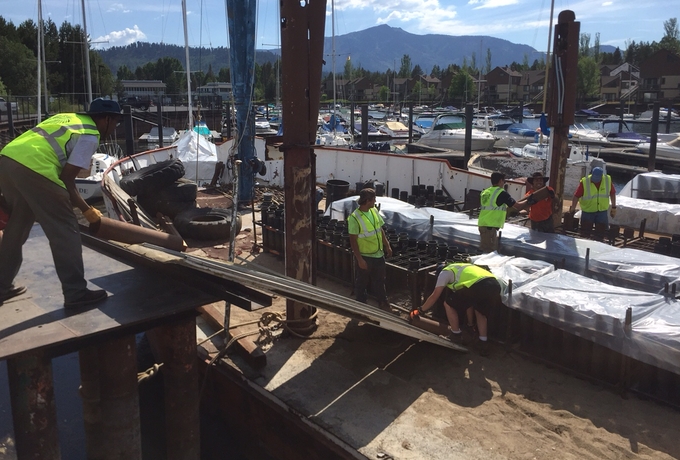
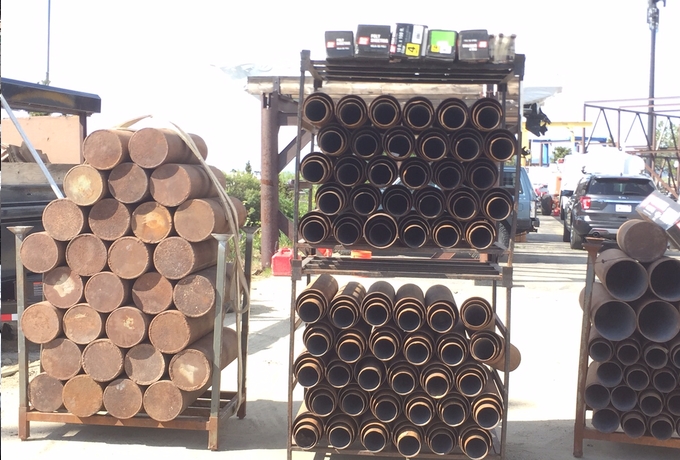
An 18-wheeler carrying empty canisters of varying sizes was being unloaded June 30, with the materials transferred to the barges.

“With three barges, what we look for is the ability to have movement, some animation to the show,” Joseph Mercante, project manager for Fireworks by Grucci, told Lake Tahoe News. “Instead of lifting three of the same or red, white and blue we can move from one side to the other or all at once with a lift so the audience sees the relationship of the three barges.”

Employees of Grucci load the barges June 30 at Tahoe Keys Marina with canisters that will be filled with pyrotechnics. Photos/Kathryn Reed

Employees of Grucci load the barges June 30 at Tahoe Keys Marina with canisters that will be filled with pyrotechnics. Photos/Kathryn Reed

His company is well versed in creating displays with a water setting. This allows for more creativity. Red strobing dahlias are a flower shape, with the deep red reflecting off the water like a strobe. Mercante said at some angles the reflection on the water has a triple effect.

The kamuro shell from Japan is one Mercante only uses on water.

“This willow shell is just like the tree. It will break out wide and will dip almost to the ground,” Mercante explained. “It’s something we would not want to do in a land-based area where that might touch the ground.”

Grucci was one of the first companies to sync its display with music. They did in 1976 for the country’s bicentennial. Arthur Fiedler was conducting the Boston Pops. Since that time technology has evolved so it’s not just music playing during a fireworks show.

Grucci created the score for Saturday’s show, with the blessing of the Tahoe Douglas Visitors Authority – the entity paying for the event. Mercante said it is patriotic in nature, with other music selections.

What will be new for Tahoe is the ability to hear the music without radio access. Grucci has an app for 99 cents that allows people to access the music on their iPhone or Android.

Grucci manufacturers its fireworks, so there is more control over the material used. This means less superfluous material – which is a boon for when it comes time to clean up the mess that night and in subsequent days.

This is Grucci’s first time to work in Tahoe. And it’s the first time in decades that there is a new operator of the annual show. Fireworks by Grucci – which is based out of New York – was awarded a contract to put on the July 4 and Labor Day weekend shows by the Tahoe Douglas Visitors Authority. The more than $100,000 July 4 show is costing about what it was with the other vendor.

The company has been around since 1850.

Various sized canisters are needed to accommodate the multitude of fireworks.

Various sized canisters are needed to accommodate the multitude of fireworks.

“At the end of the process the TDVA board decided that Fireworks by Grucci was a better overall value, and as one of America’s oldest and largest companies the experience of shooting top tier shows globally was an important factor,” Mike Frye, who handles events for Lake Tahoe Visitors Authority, told Lake Tahoe News.

Grucci has two Guinness World Records – one for the largest fireworks display. The company has worked seven consecutive presidential inaugurations; and the Olympic Games in Beijing, Salt Lake City, Los Angeles and Lake Placid.

“This is a world renowned company that has set world records. They have a good safety record and are environmentally responsible. We anticipate a safe clean firework show that will please the audience,” Eric Guevin, Tahoe Douglas fire marshal, told Lake Tahoe News.

In addition to being permitted by the Tahoe Douglas Fire Protection District, the company has permits from the U.S. Coast Guard and Nevada Division of Wildlife.

—-

Other info:

There are other sanctioned fireworks shows in the basin. However, all personal fireworks are illegal – even the ones that are labeled “safe and sane.”

As of today fire restrictions are in affect. The U.S. Forest Service is only allowing propane or gas-type grills on beaches. Fires are only allowed in established campgrounds with permanent fire pits

July 4 display details:

·       Number of days to install – five

·       Number of hours to choreograph – 25

·       Number of pyrotechnicians – 12

·       Number of man hours to set up – 720

·       Largest firing aerial shell – 10 inches

·       Show starts at 9:45pm and lasts 25 minutes.

·       The barges are in Stateline, near the California border.


Opinion: Tips for summer driving

By Jaime Coffee

Californians may be experienced with warm weather driving, but the California Highway Patrol and the California Office of Traffic Safety warns that summer presents a new set of challenges on the roads.

“Carefree summer travel requires extra care by motorists to make sure the trip is not ruined by problems,” CHP Commissioner Joe Farrow said.  “Drive at a safe speed, maintain your vehicle, and be aware of the challenges of summer driving.”

Some of the hazards of summer driving:

·         Leaving children or animals in a vehicle – dangerous at any time of year – becomes extremely dangerous. Be sure that all children are properly restrained in a safety seat or booster seat when driving.

·         More new drivers, generally young and inexperienced, will be on the road when school is not in session.

·         Visitors not only generate more traffic on the roadways, but those who are unfamiliar with an area may be distracted looking for landmarks and exits.

·         High temperatures may create problems for tires and engines. Hot weather can lead to blowouts in tires that have not been well maintained.

·         More bicycles, motorcycles and pedestrians are on the roads. Pedestrians can be unpredictable and hard to see, especially in bad weather or after dark.

·         Forest and grass fires generate smoke, reducing visibility and sometimes causing road closures. More emergency vehicles may be on the road in a fire area. Check for road reports before you leave home.

“When school is out and temperatures climb, family travel can be a happy occasion,” said OTS Director Rhonda Craft.  “We can make sure it stays that way with a little trip planning and attention to safe driving.”

OTS also reminds drivers to make safety a priority:

·         Buckle up. Every trip. Every time.

·         If you have a vehicle issue, drive out of traffic lanes and off the highway if possible – freeway shoulders are not a safe place for repair work.

·         Research road conditions and closures before getting in the car.  Visit www.quickmap.dot.ca.gov for real time highway conditions.

A few more tips for safe summer driving from the CHP:

·         Vehicle care is critical: oil changes, cooling system, tires, belts and hoses, and windshield wipers and wiper fluid should all be well maintained.

·         Carry a roadside emergency kit with fresh water, cell phone, first aid kit, flashlight, flares and a white flag, jumper cables, jack (and ground mat) for changing a tire, work gloves, basic repair tools and duct tape,  a jug of water and paper towels for cleaning up, nonperishable food, extra windshield washer fluid, and maps.

Jaime Coffee works for the California Highway Patrol.


Numbers reveal burn out of U.S. workers

By Matt Saccaro, Salon

The American worker is overworked, underpaid, and suffering from severe burnout.

This sentiment isn’t populist rhetoric, there are numbers to back it up. A study from WorkPlaceTrends — an HR-focused research firm — and  Staples Advantage polled over 2,500 workers and reached troubling results. According to the data, 53 percent of American workers report feeling burned out at work.

With current working conditions, it’s easy to see why. A 2012 study concluded smartphones and tablets enable employers to further colonize a worker’s time to the tune of two extra hours a day since they can be reached at all hours. In 2014, Gallupestimated the typical American workweek was 47 hours, not 40; the American worker was toiling for almost a full extra day. Of the workers this recent study polled, more than half worked a day longer than eight hours.

“This isn’t the workplace of 10 years ago,” Dan Schawbel, founder of WorkPlaceTrends, co-author of the study, and author of the New York Times bestselling book “Promote Yourself”, told Salon. “There’s a lot of pressure. And it’s competitive in the sense that anyone in the world could take your job for less money, so you have to work harder.”

Read the whole story


Supreme Court won’t hear Nev. patient dumping case

By Associated Press

WASHINGTON — The Supreme Court won’t hear an appeal from Nevada over a lawsuit that claims the state wrongfully bused indigent psychiatric patients to San Francisco without paying the costs of their medical care.

The justices on Tuesday let stand a lower court decision that said California state courts have authority to hear the case challenging Nevada’s discharge policies.

San Francisco is seeking $500,000 in reimbursement costs for treating 29 patients who were given vouchers for one-way bus tickets to California. It also wants an order barring Nevada from sending over any more patients.

A California Superior Court judge ruled that Nevada could be sued in California because it knew San Francisco would have to spend money on the patients.

Nevada claims the lawsuit interferes with its sovereign powers.


Letter: Fanny Bridge transparency questioned

To the community,

After spending the last three and a half years reviewing the documentation provided by the Tahoe Transportation District (TTD) to the public on the proposed Highway 89 Fanny Bridge Revitalization I am amazed at the continued use of falsified information to justify the project. Initially the TTD may not have done adequate research on the information they used to file the California Access Program Project Application for the federal funding for the proposed project; however, the continued use of misleading information is unethical.

The current Caltrans Bridge Inspection Report dated June 9, 2014, states that the girders, columns, abutments, footing and pier caps are structurally sound. With accurate information provided to both the TTD and the TRPA, both agencies have continued to falsify the actual condition of the bridge.

On May 19, 2015, the TTD published: “Because it serves as the sole vehicular and emergency access and evacuation route over the Truckee River for West Shore residents, Fanny Bridge’s deficiency also proposes a safety risk to local residents and visitors.”

The TRPA staff also presented the same information to the TRPA Governing Board on Feb. 18, 2015. Confirmation from Caltrans was provided to both agencies on Nov. 4, 2014 when Caltrans confirmed that the repairs to Fanny Bridge are minor in nature. Much of the information provided in the funding application fell into the same category.

Actions taken by the TRPA during the vote on this project did not follow its past direction in protecting the Tahoe environment. The executive director for the TRPA held a public meeting a few years ago and displayed a Tupperware box with road sand in it. Stating that road sand is the No. 1 cause in the decline of lake clarity. TRPA further stated: “TRPA years ago established an urban boundary to stop sprawl, capped the roadway capacity of the basin to reduce reliance on the private automobile .…” and “Limiting the amount of land coverage at Lake Tahoe will continue to be a cornerstone of TRPA’s plan to protect Lake Tahoe’s water quality.”

The proposed project approved by the TRPA governing and advisory boards adds road sand to an expanded highway system resulting in approximately 4.4 acres of land coverage some of which is through a stream environmental area.

On April 14, 2015, I met with the staff of Sen. Dianne Feinstein to request the senator’s involvement in the SR89 Fanny Bridge Project. Sen. Dianne Feinstein, who co-authored the Lake Tahoe Restoration Act and prides the achievements of the act by eliminating roadways through forested land, protecting the irreplaceable environment and protecting the SEZs; after over a month from meeting with her staff, Feinstein has remained silent on whether the impacts to the environment, community and businesses out way the proposed cost of $33 million.

The outcome of the SR89 Fanny Bridge Community Revitalization Project was decided on over a year ago, which was confirmed by a representative of Placer County. Based on factual information there is no justification for the project.

I would like to thank all of the members of the North Shore community, League to Save Lake Tahoe and Friends of the West Shore who supported me on my passion to try and provide the best project possible for our irreplaceable environment, community and businesses.

Jim Sajdak, Tahoe City


Nev. working on skill-based slot games

By J.D. Morris, Las Vegas Sun

Nevada’s effort to make casino floors feel more like arcades advanced last week as gaming regulators started crafting the rules that will govern the introduction of skill into the state’s slot machines.

The Gaming Control Board had its first workshop to receive input on regulations that will implement Senate Bill 9, which Gov. Brian Sandoval signed in May. The bill directs regulators to encourage “innovative, alternative and advanced technology” in casino games — now the board is making rules to figure out exactly how that will work.

Once in place, the regulations should let slots play more like arcade and video games by allowing for an element of skill, hopefully making the games more appealing to customers who aren’t attracted to the traditional, chance-controlled slots.

Board Chairman A.G. Burnett said he expects the skill-based regulations will bring a “sea change” to the casino industry.

Read the whole story


Mono Lake ecosystem in state of crisis

The drought is taking a toll on Mono Lake. Photo/ Chris Steeter

The drought is taking a toll on Mono Lake. Photo/ Chris Steeter

By Louis Sahagun, Los Angeles Times

As this drought-stricken body of salt water recedes, the repercussions mount: Its exposed alkaline flats are giving rise to dust storms. A haven for endangered migrating birds has become more vulnerable to predators. And Los Angeles’ ability to divert snowmelt from the region — which it has done for seven decades — could be cut off.

In recent months, the Department of Water and Power has reduced its take from Mono’s tributaries by more than two-thirds. Still, the 1-million-year-old lake is within two feet of the level that state officials say threatens the alpine ecosystem at the base of the Eastern Sierra Nevada.

Unless the region gets a significant amount of rain by the next official water level reading in April 2016, Mono may fall to 6,377 feet in elevation, triggering a halt to any diversions. The California State Water Resources Control Board established the limit in 1994 to resolve a dispute between environmentalists and the city 350 miles south.

Of particular concern is further exposure of a land bridge that coyotes could cross to access the second-largest California gull colony in the state. That passageway to Negit Island and nearby islets is surfacing, leaving the eggs and chicks vulnerable.

Read the whole story


WCSO looking to train citizens for emergencies

The Washoe County Sheriff’s Office Citizen Corps is offering an emergency preparedness and response training academy beginning July 9. The training is free and trainees are not required to become a Citizen Corps volunteer to participate.

The Community Emergency Response Team (CERT) Academy provides residents with the information they need to help save lives and reduce trauma in the event of an emergency. CERT Academy training includes disaster preparedness, emergency medical techniques, fire safety, light search and rescue, disaster psychology, and terrorism awareness education.

The CERT Academy is 25 hours of training during six sessions over two consecutive weekends.

Academy dates are:

July 9, 6-9pm

July 10, 6-9pm

July 11, 9am-3pm

July 16, 6-9pm

July 17, 6-9pm

July 18, 9am-3pm.

Training takes place at the Regional Public Safety Training Center located at 5190 Spectrum Blvd., Reno.

No special skills are required. Children 12-15 may participate with parent’s supervision, teens 16-17 with parent’s permission. To sign up for training, contact Shirlee Rhodes at 775.325.6928 or srhodes@washoecounty.us.