Opinion: Californians have no idea how important public universities are

By Joe Mathews

Californians, I regret to inform you that your diplomas have been held, and you won’t be graduating.

You flunked higher education.

Another state budget, accompanied by an 8-month-long controversy over UC demonstrated once again that we Californians don’t have a clue about what our public universities mean to the state.
Joe Mathews

Joe Mathews

Because if we did, we wouldn’t make them beg us for money to educate more of our children.

Most Californians think that we’re all here because of Junípero Serra or the Gold Rush or oil or sunshine or Hollywood. Nope. The biggest force luring people to California over our history has been our abundance of free — or very cheap — high-quality public education. California pioneered such educational access very early — by 1912, Berkeley was already the largest public university in the world. Offering university degrees on the cheap was a great money saver; we stole away some of the smartest people from other states and countries and had to pay for just four years of their education (a much better deal than paying for K-12 for Californians).

The result of this policy: for most of the 20th century, Californians weren’t just better looking than other Americans — we were smarter too, with the highest rate of college graduates.

But, then in the second half of the 20th century, we began to forget what we had. The state locked in lower tax rates and higher spending by ballot initiative, at the expense of public investment in our world-class university system. The universities made it up by adding tuition fees. Today, we Californians still look great — but we’re not as smart. We’ve fallen out of the top 10 of U.S. states by percentage of adults with college degrees.

The public universities have held onto their reputations and found ways to serve more students despite relentless cutting. The UC 10-campus system, a focus of debate this budget season, saw a 30 percent decrease in state funding — and a 20 percent reduction in its cost per student — over the past decade.

But try telling that to voters, legislators or the media, all of who see the universities as greedy and inefficient — even as they’ve educated more people with less state support. UC and CSU have fought cuts by appealing to reason and making funding deals with politicians. But reason and politicians are not to be trusted in California, especially when recessions shrink state revenues.

Instead, UC has come to rely on charging out-of-state students huge tuition fees. ($38,000 compared to $14,000 for in-state students). The justification is that such fees subsidize about 9,000 California students whose enrollment is not funded by the state. In one disgraceful legislative hearing this spring, lawmakers actually complained that out-of-state students eligible for financial aid were in fact receiving that aid. Yes, you read that right. The Legislature doesn’t want poor kids coming to UC from out of state.

Since the state has a demonstrated need for more educated workers (we’ll be short by 1 million by 2025, according to a much-cited report), we should be building on our historic lead and rapidly expanding our universities. But today’s California is so small-minded and budget-obsessed that no one seems inclined to make long-term investments in our well being anymore. Even the usually reliable and nonpartisan Legislative Analyst’s Office has itself fallen prey to the myopic short-sightedness, declaring that UC doesn’t need to increase its enrollment, even as it receives record numbers of applications.

In response to Sacramento’s cuts and meddling, the UC finally got tough and hired former Arizona Gov. Janet Napolitano, the former secretary for Homeland Security, as UC president. Last November, she confronted newly re-elected Gov. Jerry Brown and the Legislature with a choice: give UC more money or watch it raise tuition again. Sacramento leaders and their media cheerleaders howled but Napolitano’s strategy worked. She ended up with more money — including crucial one-time money to cover pension costs — than anticipated.

But Napolitano still had to beg the Legislature to cover an increase in enrollment of 10,000 students over four years (and got less than half of what she asked for).

With immigration flat and the birth rate under replacement levels, California will need to attract more people from out of state too study and work here to maintain the state’s vitality. It won’t be easy, as other countries and states are more competitive now, especially when it comes to cost-of-living considerations, including the cost of education. So we’ll have to make higher education better and cheaper.

It’s an argument that Californians haven’t much heard — and clearly don’t understand. Maybe we all could enroll in a summer course on the importance of higher education in California, and the massive returns we receive from our investment in it.

But who would pay for it?

Joe Mathews is California and innovation editor for Zócalo Public Square, for which he writes the Connecting California column.


Black bears rebounding throughout the U.S.

By Jennifer S. Holland, National Geographic

If you live in the eastern United States, you might want to keep an eye on your backyard for some surprising summer visitors.

Bears.

The American black bear (Ursus americanus), which was heavily diminished by overhunting, habitat loss, and fragmentation in the past century, is making an impressive comeback in parts of North America — particularly the East. An estimated 800,000 black bears roam the continent, slowly returning to many of their old haunts.

Three success stories highlight the resurgence of the up-to-600 pound omnivores. The Department of the Interior announced in May that Louisiana’s black bears may be pulled from the Endangered Species List, where they’ve sat since 1992. Years of legal protection, better habitat, and a reintroduction program have helped boost the population from as few as 200 animals to some 750 or more.

In Florida, an extensive new survey shows bear numbers have doubled, to some 1,200 animals, in one area and increased by almost a third in another since 2002.

Read the whole story


Caltrans clocking local drive times via mobile devices

Caltrans has set up travel time billboards around South Lake Tahoe.

Using Bluetooth technology, readers along the highway collect data from mobile devices and transfer that data to a server to determine how long it takes vehicles to travel from one reader to another. This information can then be used to display travel times on the highway electronic message boards from South Lake Tahoe to Placerville. Personal information will not be collected, according to Caltrans.

Caltrans said the project was initiated from a request by the city to provide travel times to Echo Summit, and other destinations, so visitors may make better-informed decisions on their travel.


Calif. water rights lawsuits a century in the making

Houseboats at Lake Oroville sit well below the high water mark. Photo/Kathryn Reed

Houseboats at Lake Oroville sit well below the high water mark. Photo/Kathryn Reed

By Bettina Boxall, Los Angeles Times

The lawsuits hit the courts within days of the state mailing notices to some Central Valley irrigation districts: They were to stop diverting from rivers and streams because there wasn’t enough water to go around.

Unsurprising as the move may be in this fourth year of drought, to the districts, the notices amounted to an assault on water rights they have held for more than a century.

“This is an attempted water grab,” said Steve Knell, general manager of the Oakdale Irrigation District, one of several San Joaquin Valley agencies suing the state to block the curtailments. “It is a power move and we will fight tooth and nail to make sure that this doesn’t happen.”

The drought has highlighted the arcane workings of California’s water rights system, one that rewards those who got here first and underpins agriculture’s position as the state’s dominant water user.

Read the whole story


USFS implements basinwide fire restrictions

Fire restrictions on National Forest System lands in the Lake Tahoe Basin began today and will remain in effect until the official end of fire season.

Campfires will be restricted to certain exempted recreation sites and other fire-related activities will be prohibited.

On National Forest System lands, fire restrictions mean:

·         No open fires, campfires or charcoal fires will be allowed outside of exempted recreation sites even with a valid campfire permit. Campfires must be built within agency installed and approved fire rings or grills. Lanterns and portable stoves using gas, jellied petroleum or pressurized liquid fuel are allowed as long as the forest visitor has a valid California campfire permit.

·         No smoking, except within an enclosed vehicle, building or exempted recreation site.

·         Internal combustion engines are restricted to National Forest System roads, routes, trails, and areas as identified on the Lake Tahoe Basin Management Unit Motor Vehicle Use Map.

·         No possessing, discharging or using any kind of firework or other pyrotechnic device, using an explosive or operating a welding or other torch with an open flame. Fireworks, including sparklers, are always illegal in the Lake Tahoe Basin.

·         No welding, or operating acetylene or any other torch with an open flame.

For more information on fire restrictions, call 530.543.2694.


Sheriff’s department seeks senior volunteers

The El Dorado County Sheriff’s Office’s next S.T.A.R. Academy is Aug. 3-14.

The training is Monday–Friday from 9am-noon, with an afternoon driver proficiency training and law enforcement support visits.

The training will be at the Senior Center, 3050 Lake Tahoe Blvd., South Lake Tahoe. Academy training is diversified with instruction and interactive participation provided by experienced senior S.T.A.R.s and deputies. The academy will conclude with a formal uniformed graduation on Aug. 14.

S.T.A.R.s are the “eyes and ears” of the El Dorado County Sheriff’s Office. They patrol the highways and byways of El Dorado County in specially marked vehicles.

Duties involve patrolling the county roads looking for bear break-ins, checking trailheads for cars that may have been broken into, vehicle abatement, manning roadblocks for downed power lines and trees, assisting in search and rescue operations, participating in school lockdown drills, and traffic control; during forest fires, at accident scenes, for emergency helicopter landings, and checking on homes while the owners are on vacation.

S.T.A.R.s assist at community events with parking or traffic control, participate in local parades, the Drug Store Project, Sober Grad Night, Day of the Young Child, Treat Street, and the annual Air Fest.

Applicants must be 50 years or older, have a good driving record, no criminal history, a physical clearance from a doctor, and pass an oral interview and background investigation. Mandatory participation requirements are: volunteer a minimum of 16 hours per month, attend a monthly station meeting, and purchase a uniform.

For more info or an application, call 530.573.3005.


Festivities to impact Incline Village traffic

Roads in Incline Village will be closed during the festivities on July 3-4.

The following traffic and parking controls are planned for Friday and Saturday:

July 3, 9:30-11:30am road closures:

Highway 28 between Southwood Boulevard West and Southwood Boulevard East, including cross street of Village Boulevard.

Southwood Boulevard between Highway 28 and Incline Way.

Incline Way between Country Club Drive and Southwood Boulevard.

No parking:

Village Boulevard between Southwood Boulevard and Lakeshore Drive.

July 4, 6am-11pm:

One-way traffic:

Lakeshore Boulevard from Village Boulevard to Country Club Drive (west to east). One lane will be open to through traffic; one lane will be used for loading and unloading only.

Incline Way from Country Club Drive to Southwood Boulevard (east to west).

No parking:

Village Boulevard between Southwood Boulevard and Lakeshore Drive.


Snippets about Lake Tahoe

opinion-stop-congress-from-taking-bike-money·      Lake Tahoe Bicycle Coalition will be providing a free bike valet at the celebrity golf tournament at Edgewood Tahoe in Stateline on July 14-19 from 8am-4pm.

·       The Northstar Mountain Run is Aug. 9 starting at the Village at Northstar and finishing at the top of the Tahoe Zephyr Express. It is a 10.6K run. For more info, go online.

·       The Truckee Municipal Code prohibits possession and use of all fireworks without a valid use permit issued by the Truckee Fire Protection District.

·       According to AAA, more than 4.8 million Californians will travel at least 50 miles this weekend. That’s about one-half percent higher than last year.

·       As of today, KRLT and KOWL radio stations on the South Shore are locally owned. Steve Harness, who remains the general manager, is now the owner.


Brown signs historic vaccine bill

By Tracy Seipel and Jessica Calefati, Contra Costa Times

SACRAMENTO — In a historic decision that could reverberate nationwide, Gov. Jerry Brown on Tuesday signed a bill mandating that almost all California schoolchildren be fully vaccinated, regardless of their parents’ personal or religious beliefs.

By signing Senate Bill 277 into law, Brown pushed the Golden State — long a bastion of liberal vaccine exemptions — into an odd political alliance with two conservative states, Mississippi and West Virginia. Until Tuesday, they were the only states that permitted medical exemptions as the sole legitimate reasons to sidestep vaccinations.

“The science is clear that vaccines dramatically protect children against a number of infectious and dangerous diseases,” Brown wrote in his signing message. “While it’s true that no medical intervention is without risk, the evidence shows that immunization powerfully benefits and protects the community.”

But the governor also noted that the Legislature had specifically amended SB277 to exempt children from immunizations whenever their physicians conclude that there are “circumstances, including but not limited to, family medical history, for which the physician does not recommend immunization.”

Read the whole story


Collaboration touted as key to Tahoe’s success

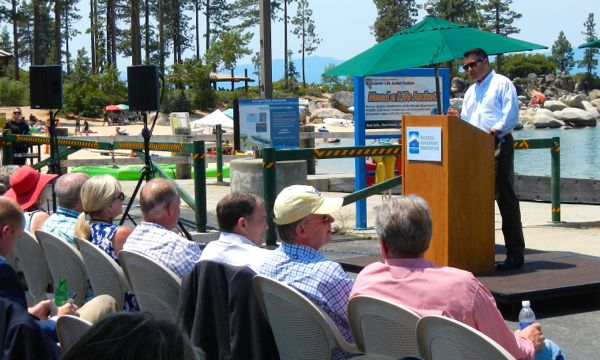
Gov. Brian Sandoval talks June 25 about collaboration as other Western governors listen. Photo/Kathryn Reed

Gov. Brian Sandoval talks June 25 about collaboration as other Western governors listen. Photo/Kathryn Reed

By Kathryn Reed

INCLINE VILLAGE – Collaboration. That is what has allowed public and private entities in the Lake Tahoe Basin to get things done.

Various speakers pointed this out last week at the annual Western Governors’ Association confab.

Nevada Gov. Brian Sandoval, the outgoing chair of the group, said how collaboration is necessary for the economic and environmental survival of Lake Tahoe. With Lake Tahoe the backdrop, the governors had a front row seat at Sand Harbor. Gov. Jerry Brown was not in attendance.

“We have to work together in a time of catastrophic drought,” Sandoval said. This ties into the need to work on water and fire issues as a region and not in isolated jurisdictions.

John Laird, California secretary of Natural Resources, spoke of the time when both states were hashing out details regarding the Tahoe Regional Planning Agency’s Regional Plan update and legislation that threatened the states participation. He said it wasn’t easy, but the end result was worth the angst.

Joanne Marchetta, TRPA executive director, said keeping aquatic invasive species out of Lake Tahoe has brought together a number of agencies. With the lack of funding nearly wiping out the inspection program, she credits both states with coming forward to rescue the program from a “fiscal cliff.”

“Nothing we do here follows neat political boundaries,” Marchetta said. “Collaboration is the way to protect the lake and getting things done.”

For Pete Sonntag, chief operating officer at Heavenly Mountain Resort, he said a new mindset has developed in the last five years since he has been at the helm.

“It’s less of what can we get. It’s evolved into what is possible if we partner together early on,” Sonntag said. “We wouldn’t be able to operate our business without collaboration.”