Search and rescues often come with a bill

By Jimmy Tobias, Outside

In 2012, 59-year-old Ed Bacon attempted a solo hike through New Hampshire’s White Mountains. While in the backcountry, on a windy, rain-drenched day, he tried to jump onto a rocky ledge, dislocated his artificial hip and found himself incapacitated in the wilderness. He was stuck, so he did what you’re supposed to do: he called for help.

The New Hampshire Fish and Game Department, which runs search and rescue in the state, mobilized fast. It sent 50 people, mostly volunteers, to his aid. After a nighttime operation in rough weather, they delivered him to safety. He was unharmed, save for an injured hip and a bad scare.

That’s where you might expect the story to end, but not in Bacon’s case. Shortly after his ordeal, he received a bill for more than $9,300. The state said he owed big money for the mission that saved him.

New Hampshire is not the only state where hikers, climbers, and other outdoor enthusiasts can be hit with hefty bills for search and rescue (SAR) services that save their lives. At least six other states have controversial laws that enable officials to recover SAR costs. Some of those laws are broad, and just about anybody can be forced to pay. Others are narrow, and you’ve got to do something reckless to get a bill. In any case, many SAR providers across the U.S. believe the prospect of forcing individuals to pay out of pocket for help in times of crisis further threatens the lives of the people in danger.

Other states can charge for search and rescue under limited conditions. Colorado and Vermont can bill people who travel out of bounds at ski areas, and Idaho can charge hikers who venture into areas closed to the public. Sheriffs in California, meanwhile, can charge an individual’s county of residence for a mission that costs more than $100.

Read the whole story


Kings Beach runner sets TRT record

A Kings Beach man now holds the record for the fastest time to complete the Tahoe Rim Trail without support.

Mike Tebbutt, 44, started from the Brockway trailhead on June 25. He returned there 54 hours and 17 minutes later.

The previous record of 58 hours, 43 minutes was set in 2013 by J.B. Benna.

Records for fastest assisted run around on the 165-mile trail are also kept.

The Tahoe Rim Trail Association does not have an official record book for these accomplishments, but they are tallied on a website.

— Lake Tahoe News staff report


Report: Airbnb not hurting hotel revenues

By Alison Griswold, Slate
 
In mid-June, Amanda Hite, president and chief operating officer of Smith Travel Research, delivered some exciting news at an annual hospitality conference in New York: U.S. hotels were killing it. For the 12 months ending in April, hoteliers had hit all-time highs in occupancy, average daily room rates, and the money made off each room. Over the next two years, more growth was expected. This marked a stunning return from the recession, which left the lodging industry battered as businesses and households alike slashed travel budgets.

“We continue to experience some of the best fundamentals that we’ve had,” Hite said.

Hotels aren’t the only players in hospitality enjoying a banner year. Late last month Airbnb, the popular alternative lodging site and poster child for the “sharing economy,” closed a $1.5 billion funding round at a towering $25.5 billion valuation. One of the biggest privates rounds ever, the new money vaulted Airbnb into the upper echelons of the ultra-elite club ofbillion-dollar startups. Only two other venture-backed private companies — Uber and Chinese electronics-maker Xiaomi — have valuations that are greater.

Airbnb, which helps people rent out their homes and spare rooms for short stays, is expected to top $900 million in revenue this year. By 2020, that figure is projected to increase more than tenfold to $10 billion. Airbnb’s listings and annual guests have soared as well, roughly tripling from 2013 to 2014.

That astounding growth is just the latest sign that Airbnb is making good on its promise to “challenge the status quo,” as co-founder and CEO Brian Chesky once put it. Here and now, Airbnb isn’t profitable, forecasting an operating loss of about $150 million for 2015. But at $25.2 billion, Airbnb’s valuation has already surpassed the market cap of major hotel chains like Marriott ($20.6 billion), Starwood ($14.1 billion), and Wyndham ($10 billion), and it’s close to eclipsing that of Hilton ($27.4 billion) as well. While Chesky has at times balked at the term disruption, numbers like those can’t be denied. Airbnb is disrupting hotels. Which is why it’s so surprising that midway through 2015, somehow, both Airbnb and hotels are thriving.

Read the whole story


Letter: Breakfast club helps at Bread & Broth

To the community,

About 15 years ago, several ladies from Zephyr Heights began a social gathering once a month to share friendships over breakfast. Every third Monday of the month, 10-12 ladies ranging in age from their 30s to 92 share family happenings, celebrate successes and support each other when needed. One of the approximately 15 Zephyr Heights Breakfast Club members, Peggy Ellena, began volunteering at Bread & Broth and coordinated the club’s Adopt A Day of Nourishment on June 29.

Representing the Zephyr Heights Breakfast Club at the dinner were Julie Nelson, Peggy Ellena, Maryon Tilley and Sandie Mancinelli.  They were a very busy group. They helped assemble over 75give-away” bags filled with fruits, vegetables, canned goods and breads, served 125 meals and helped with the dinner’s cleanup.

Describing their three hours of volunteering, Ellena and Mancinelli together wrote, “The experience helping B&B was gratifying and blessing to all of us. The regular volunteer staff was patient with us and were good teachers – obviously dedicated to their mission. Thank you for allowing us the opportunity to help!”

B&B would like to thank all of the members of the Zephyr Heights Breakfast Club for their donation of $250 and sending a wonderful group of volunteers to the dinner served at St. Theresa Church’s Grace Hall.  Thanks to the club for taking the opportunity to help people in need.

For more B&B information, go online or find us on Facebook.

Carol Gerard, Bread & Broth


Don’t leave personal data in a rental car

By Kim Komando, USA Today

There are plenty of reasons to rent a car, from leaving an unreliable car behind on a vacation to getting around on a business trip. But there’s a real hidden danger when doing so that you may not even realize — one that potentially puts you and your family at substantial risk.

Rental companies continually upgrade their fleets with newer-model cars, which means many now have the latest infotainment systems, which let you connect, or “pair,” your smartphone via Bluetooth with the car. This lets you take calls over the car’s audio system, dial from the center console, get directions or stream your music. Others include a USB connection so you can do all that and charge your phone.

When you connect your gadget to a car with Bluetooth, the car stores your phone number to make it easier to connect later. It also stores your call logs, including any contacts you dialed. Just one problem: All that information is saved inside the system and just sitting around for the next renter to find.

Read the whole story


Rowell book captures night sky

By Tom Stienstra, San Francisco Chronicle

It was close to midnight at remote Richardson Lake near Tahoe when Tony Rowell looked up from his campsite to see a meteor streak across the night sky, then explode into three pieces.

“As a kid out camping, seeing shooting stars was always one of my favorite parts of the trip,” Rowell said. “Camping that night, I looked up and said to myself, ‘I wonder if I could capture a shooting star on film.’”

That was 22 years ago. On Tuesday, the story comes full circle with the publication of the book “Sierra Starlight,” a collection of 60 of Rowell’s photographs that showcase the night sky and meteors above High Sierra landmarks. The images will take you back to your first campsites, starry nights and shooting stars.

Read the whole story


Tahoe Tails — Adoptable Pets in South Lake Tahoe

Bridget

Bridget

Bridget is a 3-year-old Dachshund-beagle mix. She is house trained and has good manners, and she walks nicely on the leash. Plus, she does well with other dogs.

Bridget was left in a shopping cart at a store with a note saying she is good with kids and needs a new home.

Bridget is spayed, microchipped, tested for heart worm, and vaccinated. She is at the El Dorado County Animal Services shelter in Meyers, along with many other dogs and cats who are waiting for their new homes. Go to the Tahoe animal shelter’s Facebook page to see photos and descriptions of all pets at the shelter.

Call 530.573.7925 for directions, hours, and other information on adopting a pet.

For spay-neuter assistance for South Tahoe residents, go online.

— Karen Kuentz


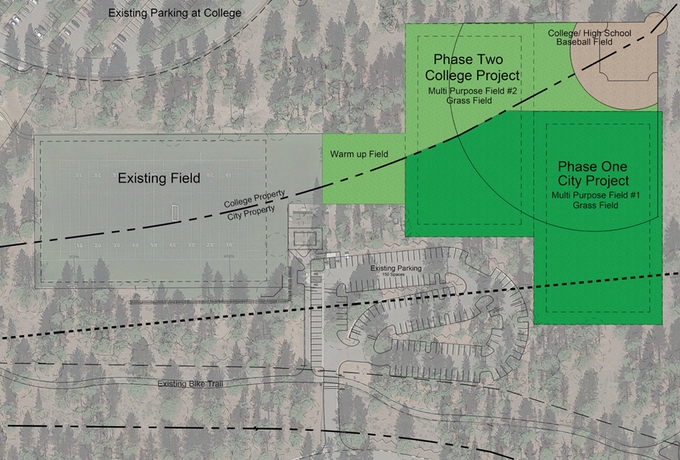
SLT, LTCC, LTUSD working to build ball fields

The proposed fields are in green and brown. The existing community field is to the left in grey. Rendering/Design Workshop

The proposed fields are in green and brown. The existing community field is to the left in grey. Rendering/Design Workshop

By Kathryn Reed

By the end of 2016, there could be two new ball fields in South Lake Tahoe – and not a dime of additional taxpayer money is needed to build them.

Designs are such that the fields could be used for football, soccer or baseball – just not all at the same time.

When Measure S was passed in 2000 it said four community ball fields would be built. Only one ever was. In large part this had to do with the recreation measure not generating enough money and the ice rink costing more than originally planned. When it was revised to be Measure R, it said three ball fields.

The Measure S field is next to Lake Tahoe Community College, with the property being  owned by the college and city. The new fields would go to the right of that field if looking at the area from the community ball field parking lot.

The project is a joint endeavor between the city, college and Lake Tahoe Unified School District. To do so the three are creating a recreation joint powers authority. This proposal is on the July 7 City Council agenda. The college board should vote on it in August. The school district time line and funding source are unknown because Superintendent Jim Tarwater did not return a phone call.

Once the respective boards approve the JPA, permits will be sought with the goal of construction starting in May. The exact work plan will be devised to have the least impact on the current field users.

The city on Tuesday could allocate $1.2 million to the fields project. This money is from excess budgeted hotel taxes. Through April, the transient occupancy tax is up 19 percent. For the fiscal year, an excess of $2 million is expected to be collected.

“All of our community surveys say collect taxes from tourists and spend it on things that are valuable to residents. We are delivering on that without asking for new taxes,” City Manager Nancy Kerry told Lake Tahoe News.

The partnership will in effect deliver what Measure S/R intended to do. It will also help resolve scheduling problems.

The new fields are expected to be grass. One reason for grass is to not have to contend with Tahoe Regional Planning Agency coverage stipulations.

Kerry also said artificial turf is expensive, there are potential negative health side effects, and that it’s hard to keep clean.

“The college believes this is a way to bring multiple agencies and funding to facilitate the recreational fields that were promised years ago under Measures R and S. The college realizes that our soccer program has strained the use on the community field, and by collaborating, the community, LTUSD, and the college are all getting more recreational space,” LTCC President Kindred Murillo told Lake Tahoe News. “Our next steps will be to bring easement documents to the board for dedication of the 5.62 acres to the new joint powers authority, draft an agreement for a new joint powers authority that includes appropriate language so the college can invest bond funding in the community field as we promised in Measure F. This is anticipated to start in early August.”

Measure F, which was approved by voters last fall, includes funds for recreation facilities. A caveat is that money cannot be spent on facilities the college does not own. The college has $1.1 million for the fields, some of which will be spent on new artificial turf at the current field. There is $300,000 in Measure S/R money that is also dedicated for turf replacement.

Besides the turf, bleachers are also expected to be built. Murillo said artificial turf is less expensive to maintain and that it is safer for soccer conference play.

Other field improvements are also in the works.

“We are still looking at investing bond funds on the field at South Tahoe Middle School. Under the stipulations of bond funding we must have irrevocable rights to use the field for the length of the bond funded improvements,” Murillo said. “The rationale is that it will expand use of the field for the community, LTUSD, and our soccer program. We are working on a shared facilities agreement between LTUSD and LTCC which will leverage the taxpayers dollars by not duplicating facilities.”

After Tuesday’s meeting, the city and unified district will then work on a plan that is likely to come before the council in August. This has to do with amending the agreement between the entities so the school district is paying for the lights and water for its fields. Currently, the city is doing so.

“The end result will be more efficient management and operation of these fields,” Kerry said.

A side note, this will be last year SnowGlobe, the three-day outdoor concert, will be at the current field even though this is only the second year of the three-year contract. It’s possible the festival could be on the new grass fields. That type of hardscape is more conducive to such activities. The city is also considering 30 acres near the airport for outdoor events.


Opinion: Robinson’s life no home run for racial progress

By Jason Sokol

Jackie Robinson’s story brings together two American obsessions: sports and freedom. This is why we never tire of his tale. Yet in the way that the story has been handed down, it masks as much about our national identity as it illuminates.

The story of Robinson’s breakthrough often comes in the language and rhythms of baseball – the stuff of hits and runs, stolen bases and brushback pitches. He wrought havoc on the base paths, demolished a racial barrier, and opened up our society.

The popular tale emphasizes Robinson’s moral courage, and rightly so. It has shaped him into a folk hero who belongs to the ages. But Robinson’s story becomes most instructive when we bring it down from the realm of the timeless epic, and connect it to the time and place in which it occurred.

The larger history – of racial struggle in Brooklyn and America after World War II – is often ugly and painful. When Robinson’s saga is placed in this context, it does not represent just a feel-good triumph for racial equality. It also reveals how the quest for freedom and democracy has coexisted with our country’s commitment to segregation and racism.

To be American is to know that we strive for freedom and at the same time we practice its opposite. We are capable of great leaps forward in terms of racial progress, including the election and re-election of the nation’s first black president. Yet our streets are not yet safe enough for unarmed black men to walk in peace. This remains our unresolved conflict: high-achieving African Americans have been welcomed into specific realms of American life, yet such individual accomplishments have done nothing to alter the deeper patterns of black poverty, police brutality, and spatial segregation. The conflict between racial progress and racial inequality was as clear in Jackie Robinson’s day as in our own.

For many Brooklynites, an afternoon at Ebbets Field was the definition of bliss.

The aroma hit them first. The smell of bread rising from the Taystee factory, and cakes baking at the Ebingers plant, greeted the fans when they stepped out of the train station. As the throng pressed closer to the stadium, that scent mixed with roasted peanuts and hot dogs, sweat, and grass. Then came the sounds: the excited yells of children, the vendors hawking scorecards or newspapers. Many Brooklyn natives, like Joel Berger, recalled Ebbets Field as “a total sensory experience.” Nighttime made the stadium a palace, transfixing the eyes. Joe Flaherty remembered the decadent feel “of walking through Prospect Park to see a rare night game.” On a balmy evening in mid-summer, “all of a sudden the sky would be lit up,” transforming Flatbush into “the Emerald City, and as you got closer, you’d pick up your pace, and you’d give your tickets and go charging inside.” A Dodger game was the quintessential Brooklyn experience. In the age of Jackie Robinson, it became more than that. Ebbets Field was not only the borough’s cultural heart but the very seat of American democracy.

Robinson broke baseball’s color barrier in 1947, almost nine years before anyone had heard of Martin Luther King Jr., or Rosa Parks. His achievement armed postwar Brooklynites with a distinctive claim to progress. Dodger fans had long detected something special in their baseball team and their borough; Robinson deepened that sense. He “added another dimension to being a Dodger fan,” reflected journalist and Brooklyn native Pete Hamill. “It was about right and wrong…we became the most American place in the country.” A moral element at once mingled with the magnificent smells and sounds and sights.

If white fans looked further down the street, they would have come to entirely different conclusions about the extent of racial progress. On the same Bedford Avenue that housed Ebbets Field, they would have witnessed the grim reality of housing segregation. Discriminatory federal policies had combined with block-busting realtors and fearful white homeowners to create racially homogeneous neighborhoods. Brooklyn’s African Americans were corralled into a few select areas. Poor blacks had little choice but to pay high rents for dilapidated apartments. In neighborhoods like Crown Heights, Brownsville, and particularly Bedford-Stuyvesant, residents found basic services sorely lacking. Their garbage was collected only sporadically in Bedford-Stuyvesant, and in such areas, the city built few recreation centers, parks, or pools. In the very same years when Robinson played for the Dodgers – 1947 to 1957 – black ghettoes solidified.

This is what the rhetoric about Robinson and interracial democracy so brazenly missed. Even if Robinson’s heroics in the stadium pushed baseball fans to rethink their racial attitudes, even if Ebbets Field became a crucible of integration, very little of that feeling spilled over into the city – or country – at large.

Robinson’s own family experienced the inequities first-hand. Jackie Robinson learned that it was one thing to integrate the national pastime, and quite another to desegregate white towns and neighborhoods. The Robinsons ended up enjoying polyglot Brooklyn. But white homeowners had tried to prevent African Americans from buying property in Flatbush. The Robinsons’ black landlord had endured such discrimination. Moreover, after the Dodgers integrated, some white fans had renounced their allegiance to the team. The borough was no interracial oasis, and even for the Robinsons it was not always welcoming.

In 1953, Jackie and Rachel Robinson began to search for a house in the suburbs of Fairfield County, Conn., and Westchester County, N.Y. It was a humiliating experience.

The Robinsons attempted to buy land in New Canaan but were rebuffed. Rachel called about one house in Greenwich and, after giving her name, the owners refused to show it. The couple settled for a property just across the state line in New York. Jackie recalled that in autumn 1953, “we finally found a piece of land in New York’s Westchester County that was just what we wanted.” The Robinsons offered the asking price, waited for weeks, and were told that the price would be raised by $5,000. This was standard practice in housing discrimination, a sure-fire way for whites in exclusive towns to claim that they had nothing against African Americans – it was just that blacks could not meet the asking price. This was purely the market at work, they would say, not racism. So the Robinsons promptly kicked in the extra $5,000. “There was another period of confused silence,” Jackie recalled. “At last, we were told that the land had been sold to somebody else. It was this way everywhere we went.” Suburban whites did not want an African American for a neighbor, even if it was Jackie Robinson.

After the Bridgeport Herald printed an article about the Robinsons’ experience, the citizens of North Stamford, Conn., were moved to action. Ministers circulated non-discrimination petitions. The Robinsons finally bought a home on Cascade Road. Rachel Robinson recalled that moment: “I don’t know that I ever have felt closer to being a real American, closer to having lifted from my shoulders the nagging doubts and insecurities that are the heritage of the American Negro.” For her, the ability to buy a home was the true test of American freedom.

Their story serves as a sobering reminder about the meaning of racial progress in America. That progress isn’t really about whether we embrace famous black athletes or cultural icons, or even whether we elect an African-American as president. The true test of our progress is whether we can enact policies that combat racial inequality – to stop the rising tide of mass incarceration and police brutality – and whether we can eradicate racial inequality from our private realms, much closer to home, as well. Only then can we begin to build a country in which African-Americans are truly welcome in every neighborhood, every school, and on every street.

Jason Sokol is an assistant professor of history at the University of New Hampshire. His latest book is “All Eyes Are Upon Us: Race and Politics from Boston to Brooklyn”.



Study: Americans’ support of First Amendment grows

By Roger Yu, USA Today

Americans’ support for the First Amendment rebounded strongly over the past year, a new study says.

Three-quarters of Americans say it “does not go too far” in ensuring Americans’ freedom. That’s a jump from 57% last year after the Boston Marathon bombing in 2013 stirred public debate about the role of social media during a crisis and the media’s use of shocking images, according to State of the First Amendment 2015, a report by the Newseum Institute’s First Amendment Center in partnership with USA Today.

A year ago, 38 percent said the First Amendment goes too far, but the current survey shows only 19% agrees with the sentiment. The study saw a similar dive in public opinion and a subsequent recovery after the 2001 terrorist attacks, the authors noted.

Read the whole story