Garden tour to focus on drought-resistant flora
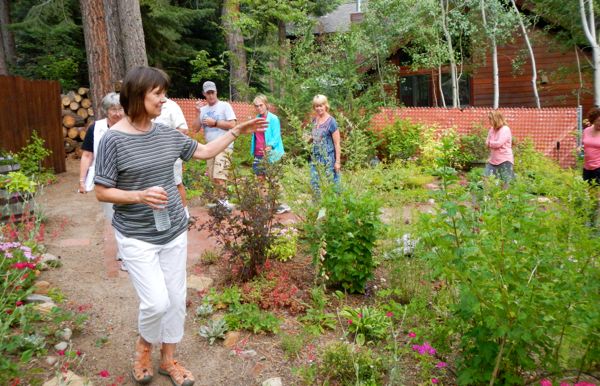
Darya Vogt points out various features in her garden. Photos/Kathryn Reed

Darya Vogt points out various features in her garden. Photos/Kathryn Reed

By Kathryn Reed

STATELINE – “Gardening is such a surprise.”

So said one of several people on Monday’s preview of the annual Tahoe in Bloom Garden Tour.

Much of the time they are good surprises. For the six houses that will be featured on the July 25 tour the recent hail storms were an unwanted surprise. Most homeowners lamented how prior to the storms their gardens were in much better shape, leaves didn’t have holes in them and plants didn’t look so downtrodden.

Call them perfectionists because the beauty that spills forth from this neighborhood off Kingsbury Grade is a sight to behold. Despite most of the yards having grass – and some with quite a bit, the focal point is what can be done without sod.
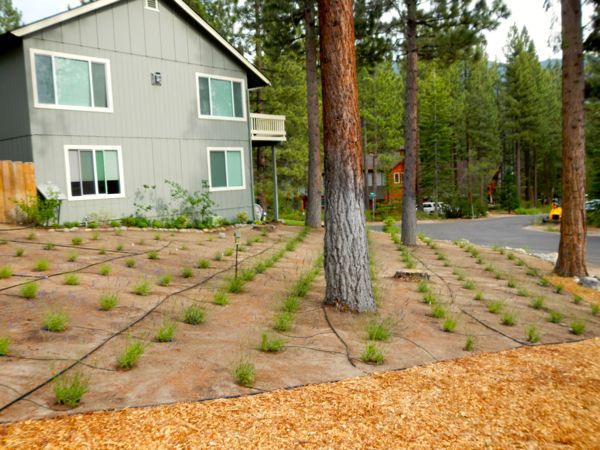
This field of lavender was planted in October and one day will be filled in.

This field of lavender was planted in October and one day will be filled in.

Robin and David Winter created the most drastic change after removing sod from the side of their house. It’s now a lavender field.

“The main thing I wanted to do was save money on water and save water,” Robin Winter said. And save they did. In summer 2012 they used 44,000 gallons of water per month. Now usage is 18,000 gallons per month.

Six varieties of lavender are planned. Eventually, the perimeter will have the tallest which will create a fence of sorts around the property. Another variety will be used to make oils for Winter’s massage therapy practice.
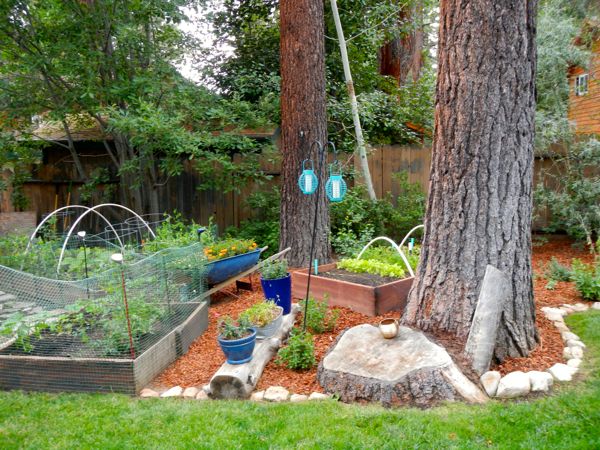
Karen and Billy Hayes grow a variety of veggies in their back yard.

Karen and Billy Hayes grow a variety of veggies in their back yard.

Billy Hayes has multiple rows of raspberries out front covered with mesh to keep the birds out. These edibles were brought from Cottonwood, where he lived years ago. They are thriving at Tahoe.

More things to eat are being grown in the back yard in raised beds.

Burying bowling balls halfway into the ground created a unique element to borders. Golf clubs and sawed off skis are accent features.

Some areas of various yards are more manicured than others. While most have sections that look wild and a bit unkempt, it’s that natural setting with native or adapted native plants that oozes Tahoe. No need to go on a hike – these yards have plenty of wildflowers.

Drought-tolerant plants are everywhere. Some are ground cover, while others are waist high and make for a kaleidoscope of color.

Paths meander through the colorful flora. Yard art is popular in most places – whether it’s birdhouses, an old two-seater chairlift swing from Stagecoach and ski boots planted with flowers, or a fire hydrant with recirculating water.

Big blue

Big blue

Sitting areas abound to be able to enjoy these natural works of art.

All houses are within walking distance to each other. The tour, sponsored by the UCCE Master Gardeners of Lake Tahoe, will have a master gardener at each house who will be able to answer questions in addition to the homeowner.

At three of the houses will be specific presentation stations. They are:

·       Fill your yard with perennials that reseed – how to make it happen in Tahoe.

·       Toss that lawn and plant water-wise Tahoe friendly perennials.

·       Square foot vegetable gardening and attracting Mason bees.

Rose campion

Rose campion

—–

Notes:

·       Tahoe in Bloom Garden Tour is July 25 from 9am-2pm.

·       Tickets are $20. They are available at Nel’s Garden Center, Aspen Hollow Garden Center, Tahoe Outdoor Living, and Sun Basin Nursery.



Opinion: Big corporations are good for social progress

By Andrés Martinez

Ever since the Supreme Court’s Citizens United decision in 2010, it’s been fashionable to deplore (with full-on How dare they? indignation) the power of big business in our political process. But judging from recent events, maybe we would all benefit if corporations wielded more political power, not less.

Seriously. Think about the recent exhilarating triumphs for once-marginalized minorities: the U.S. Supreme Court legalizing gay marriage across the land; South Carolina hastening to lower the Confederate flag of sedition and racism; a Republican presidential candidate being ostracized for bashing Latino immigrants. One thread connecting these stories is the presence of corporate America taking a stand against the bullying and discrimination of minorities.

In the landmark marriage case, a Who’s Who list of blue-chip companies from Procter & Gamble to Goldman Sachs signed onto legal briefs urging the justices to strike down all bans on gay marriage. They argued that such bans conflict with their own anti-discrimination and diversity policies, and that you can’t have a country (and cohesive marketplace) where fundamental rights vary from state to state.

Even more impressively, big business mobilized in a number of states over the past two years to defeat or roll back proposed “religious freedom” laws seen as disingenuous efforts to legitimize the discrimination of gays. No single company has been more identified with challenging such laws than Wal-Mart, which singlehandedly defeated a proposed measure in its home state of Arkansas.

Business interests also helped turned the tide against the Confederacy. The New York Times story on South Carolina Gov. Nikki Haley’s call for the removal of the Confederate flag credited “intensifying pressure from South Carolina business leaders to remove a controversial vestige of the state’s past” as one factor leading to the governor’s reversal of her previous position.

At the national level, the U.S. Chamber of Commerce and other business groups have led the charge for sensible immigration reform – though this effort can’t yet be checked off as a victory. If only the business lobby had as much power as we often assume it does. In the meantime, it was gratifying for Latino activists aligned with business on immigration to watch Donald Trump be fired by corporate partners like Macy’s, Comcast, Univision, and Disney over his hateful comments about Mexicans. Vicious speech denigrating immigrants may be acceptable in certain political circles, but not in the corporate realm.

Some politicians eager to cater to local prejudices, and capitalize on them, are chafing at the activism of corporations. This spring, while pushing for his own religious freedom law, Louisiana Gov. Bobby Jindal whined in a New York Times op-ed: “As the fight for religious liberty moves to Louisiana, I have a clear message for any corporation that contemplates bullying our state: Save your breath.” Jindal’s choice of the verb “bullying” is deliciously hypocritical, because it was business rising up to oppose the bullying of people by small-minded politicians.

This is why I differ from my friends and colleagues in journalism and academia who hold to a reflexively anti-corporate worldview. They see large, distant corporations as the source of much bullying. I see the worst forms of bullying arising closer to home: at the hands of local or state governments, or dominant business interests rooted in one place.

No, there isn’t anything inherently virtuous about business leaders. As cynics are quick to note, the political fights I’ve described here are all about business wanting what’s best for business. Companies need to avoid offending customers and they need to be seen as inclusive and diverse employers to potential hires. But big business tends to be more enlightened than smaller businesses rooted in only one place, because the broader your perspective, the bigger your market, the less tolerant you can afford to be of idiosyncratic regional prejudices. It’s no accident that commerce across state lines has always been one of the great motors of progress in this country, and not just economic progress.

That is also why trade agreements that seek to harmonize norms across borders are as beneficial to individuals as they are to big multinationals. The prospect of joining the European Union (and attracting investment by large foreign companies) forced governments across Eastern Europe to protect the rights of long-oppressed minorities. As much as Elizabeth Warren and her protectionist allies have attacked President Obama’s proposed trade deal with Asia as a sop to big business, the agreement will help strengthen civil society and individual rights in these countries for precisely the reasons these critics attack it – by standardizing norms of behavior across jurisdictions.

Bigotry, and the disregard of people’s rights and dignity that comes with it, doesn’t travel well. And it’s bad for business.

Andrés Martinez writes the Trade Winds column for Zócalo Public Square, where he is editorial director. He is also professor at the Walter Cronkite School of Journalism at Arizona State University.


Pet-wildlife attacks increase in summer

By Sue Manning, AP

A 1-pound squirrel and 90-pound dog didn’t let their size disparity stop them from dueling.

The rodent died in the recent run-in with Kimberlee Jaynes’ pet Skip, but the Shar Pei and golden Labrador mix got a long scar on his face and was lucky not to lose an eye.

“Skip has a vendetta now,” said Jaynes of Portland. “When he sees them, his ears go up — he’s looking for them.”

Temperatures are rising, and so are wildlife attacks against pets. Dogs and cats encounter wildlife more often in the summer as people and pets spend more time outdoors and drought and forest fires push wild animals outside their usual territory, veterinarians say. Warmer weather brings out hikers and campers when wildlife is likely to be active and aggressive — often protecting their young broods from perceived threats.

In regions suffering from drought, including the Northwest and California, animals from sea lions to bears must search farther for food, sometimes into populated areas. The dry spell also worsens wildfire season, which can leave habitat scarred and meals even harder to find.

With these challenges, authorities warn against getting too close to wildlife. As visitors flood national parks and other wilderness areas this summer, attacks against people also have ramped up: Several tourists at Yellowstone National Park have been gored or tossed into the air by bison when they crowded the large animals.

After Skip’s squirrel encounter, veterinarians at the DoveLewis Emergency Animal Hospital in Portland stitched him up and gave him antibiotics. They also have treated dogs, cats and backyard chickens for attacks by raccoons, coyotes, wild rats and even dive-bombing crows, Erica Loftin said.

Threats can stem from animals that people think are gentle, such as deer, said Gretchen Schoeffler, an emergency and critical care vet at Cornell University Hospital for Animals in Ithaca, N.Y. Almost any wild animal is capable of striking, from beavers and groundhogs to owls and swans, she said.

“Most wildlife, if they feel threatened in any way, they are going to react defensively,” Schoeffler said. “And chances are the domestic animal is going to come up on the short end of a stick there, especially if it’s a wild animal of any size.”

Rabies, usually from bats and foxes, is the biggest risk, though most cities and counties require vaccinations for dogs and cats, veterinarians said. A series of shots can prevent the infection from taking hold in people, but not in pets, Loftin said. If they are exposed, all doctors can do is give a vaccine booster and quarantine them, she said.

Wild animals carry other potentially deadly diseases, including the plague. It’s rare but its risk increases in summer as travelers and their pets come into contact with squirrels, mice, prairie dogs or the fleas that feed on infected animals in places such as northern Arizona, Idaho and Colorado, where a teen died of the illness last month.

“Wildlife is wildlife. Appreciate them at a distance,” Schoeffler said. “We only do harm when we try to interact with them. If we alleviate their fear of people, that probably won’t serve them well in their future.”

A few warnings for pet owners:

  • Always see a vet if a pet is attacked. There might be crushed tissue, damage to organs or an infection.
  • Watch for signs of infection and go to the vet if swelling, discoloration, discharge from the wound, lethargy or lack of appetite are present.
  • Don’t wrap a limb. To avoid cutting off blood supply, try a clean cloth compress over the wound.
  • A couple of stings from bees, wasps, yellow jackets or hornets probably don’t warrant a vet visit unless a dog is allergic or very small. But if the dog has been swarmed, get there as quickly as possible.
  • Keep dogs on leashes and in your control.


Reincarnated Rainbow Lodge worth a stop

By Allen Pierleoni, Sacramento Bee

Next time you’re headed for Truckee or Lake Tahoe via Interstate 80, take a detour at Exit 168, Rainbow Road/Big Bend. Turn right at the stop sign to find the Rainbow Lodge & Tavern. It’s well worth a look, especially if you want to grab a bite; lunch and dinner are served from 11:30am to 8pm Fridays and Saturdays, with Sunday brunch 10am to 2pm.

The 33-room B&B was built from local granite and massive timbers in the 1800s, when it was a stagecoach stop. By the 1920s it had become an inn and mini-resort. It’s a familiar landmark to generations of Sacramentans who have stayed and played there over the decades, cross-country skiing in the winter and hiking in the summer.

After a series of dead-end trails (including years in receivership) and ownership changes dating to the 1990s, the lodge was purchased in 2013 by a Rocklin-based family, who refreshed it and installed a whole new kitchen.

Read the whole story


Meyers set to host 2-day mountain bike festival

The 3rd annual Meyers Mountain Bike Festival is designed to be bigger, with two days of riding and fun on Aug. 8-9.

On that Saturday there will be demos, shuttles and riding with Ibis, Norco, Specialized, Knolly and Intense. Sunday will be the famed Triple Crown Ride, expo and bands at Divided Sky.

Pre-registration is available online for $35 per day or $65 for both days. All proceeds go back to the trails.


Snippets about Lake Tahoe

library·       Friends of the Library is having a book sale July 25 starting at 10am at the South Lake Tahoe branch at 1000 Rufus Allen Blvd.

·       “Duck Dynasty” star Willie Robertson landed 12 feet 1 inch away from the pin in the Korbel hole-in-one contest at the ACC. Lake Tahoe Wildlife Care was the nonprofit recipient of $5,000 from the Korbel Toast Life Foundation.

·       The third annual Hemophilia Walk & 5K is Sept. 12 at Virginia Lake Park in Reno. To register, go online.

·       Séan Cummings, the Tahoe Bagpiper, will play on the lawn of the South Lake Tahoe Library on July 22 at 6pm – for free. Bring a picnic. The library is at 1000 Rufus Allen Blvd.

·       Here is the El Dorado-Tahoe roadwork schedule for the week.


Letter: Yacht club volunteers are B&B

To the community,

Taking a break from competitive racing and cruising club activities, the members of the  Lake Tahoe Windjammers Yacht Club took the opportunity to serve the community by sponsoring a Bread & Broth Adopt a Day of Nourishment on July 13. The Windjammers donated $250 to B&B to provide the evening meal to any community member that came to St. Theresa Church Grace Hall for a full course, nutritional dinner.

Representing the Windjammers at the dinner were Kurt Rasmussen, the club’s rear commodore, and fellow club members Laura Rasmussen and Liz Beelik. Trading their sailing gear for B&B aprons, this sponsor volunteer crew was eager to help, and in addition to bagging 65 food giveaway bags and cleaning up after the dinner, they cheerfully served up pulled pork sandwiches, cole slaw and sweet corn on the cob to the 114 hungry and grateful dinner guests.

“From the friendly, dedicated cooks preparing the fresh food, everyone setting up for the evenings’ guests, to the cheerful dishwasher, Bread & Broth is an impressive organization,” wrote Laura Rasmussen. “It has been a privilege to assist the team today. The folks who enjoyed this dinner were polite, grateful and a pleasure to serve.  The Windjammers Yacht Club thanks B&B for this opportunity and looks forward to sponsoring another Adopt A Day.”

Bread & Broth is grateful to the Windjammers Yacht Club for their support and looks forward to partnering with the club in helping people in need in the future.

For more B&B information, go online or find us on Facebook.

Carol Gerard, Bread & Broth


Bike paths expanding in Tahoe basin

Several bike baths are being built in the Lake Tahoe Basin this summer, with most expected to be completed by fall.

They include:

  • Sawmill 2 – Closing the gap on Sawmill Boulevard Bike Trail in El Dorado County
  • Nevada Stateline to Stateline Bikeway – Laura Drive connection on the South Shore
  • South Tahoe Greenway – Herbert to Glenwood Shared Use Trail in South Lake Tahoe
  • Al Tahoe Boulevard – upgraded sidewalk in South Lake Tahoe
  • Highway 89 – bike lanes and wide shoulders from the Y to  Taylor Creek Visitor Center on the South Shore and then Tahoma to Ward Creek on the West Shore
  • Zephyr Cove Campground to Warrior Way – this shared-use trail is now under construction and will be completed next summer.


Borg to read from latest Owen McKenna book

Author Todd Borg returns to the South Lake Tahoe Library on July 29 with “Tahoe Blue Fire”, the 13th book in the Owen McKenna Tahoe mystery series.

“​​Tahoe Blue Fire” is about former pro football player Adam Simms who is suffering traumatic brain injury from his days on the gridiron. When Simms becomes the prime suspect in a series of brutal murders in Tahoe, Detective Owen McKenna can’t tell if Simms is being framed or if he is a diabolical killer who is faking brain injury.

Borg will shares his writing techniques and story​ ​lines with the audience.

There will be a book sale and signing to follow the free 6:30pm reading.

The library is at 1000 Rufus Allen Blvd.


Calif. climate change bill could set global example

By Chris Megerian, Los Angeles Times

When Gov. Jerry Brown visits the Vatican this week for an international conference, he’ll be carrying a resolution from state lawmakers supporting Pope Francis’ recent encyclical on climate change.

He’s hoping the Legislature will send an even stronger message later this year by passing new environmental rules aimed at helping California slash greenhouse-gas emissions over the next few decades.

Approval of the legislation, intended to enact goals outlined by the governor this year, would bolster Brown’s calls for global action on climate change with a display of regulatory muscle in his own state.

Oil companies have ramped up opposition, and utilities are angling for changes in the bill that would make it easier for them to fulfill requirements to produce renewable energy. But so far, no one has been able to stop the legislation, which has passed the state Senate and is advancing in the Assembly.

Read the whole story