
What Clinton’s renewable-energy proposal means for Nev.

By Conor Shine, Las Vegas Sun

The debate over renewable energy in Nevada has raged in the Legislature and at the Public Utilities Commission for over a year. Now, the issue could be taking center stage in the 2016 presidential campaign, following a recent proposal from Democratic front-runner Hillary Clinton to install more than half a billion solar panels across the nation by 2021.

But as Nevada has seen, solar panels generate more than just electricity — they also produce political controversy.

Clinton’s plan, which also calls for generation of enough renewable energy to power every home in America by 2027, would require a 700 percent increase in solar energy production, in addition to significant increases in wind and geothermal energy.

Read the whole story


State infrastructure funding fair in Truckee

The California Water Resources Control Board, along with five partner agencies, will host a free California Financing Coordinating Committee Funding Fair on Aug. 5 in Truckee.

The event is an opportunity for public works and local government representatives to obtain information on funding currently available for California infrastructure projects. Project categories include, but are not limited to: drinking water; wastewater; solid waste; water quality; water supply; water conservation; energy efficiency; flood management; community facilities; streets and highways; and emergency response vehicles.

The fair will be from 8am-3pm at the Truckee Town Hall’s council chambers, 10183 Truckee Airport Road.

The CFCC was formed in 1998 and is made up of six funding members: State Water Board; California Department of Water Resources; California Department of Housing and Community Development; U.S. Department of Agriculture Rural Development; U.S. Department of the Interior Bureau of Reclamation; and the California Infrastructure and Economic Development Bank.

These funding fairs provide one-stop shopping for those looking for infrastructure funding in California.

The Truckee funding fair is one of six to happen this year. The schedule and registration are available online.


High rollers: Dealers describe special treatment, abuse

By Michael Melia, AP

UNCASVILLE, Conn. — One high roller requests a refrigerator full of bananas that he squeezes and throws as he gambles. Another urinates against a wall. Other high-stakes players described by a pit manager at Mohegan Sun, one of the world’s largest casinos, throw chairs, scream at dealers and expect rules to be bent at the tables.

In the increasing competition for the biggest spenders, casinos are known to pull out all the stops with comped hotel rooms, meals and rebates for a percentage of their losses. But some dealers say efforts to satisfy and retain the players — known as “whales” — go much further, with casinos tolerating abuse and extending courtesies that test the integrity of the games.

“All men are created equal except in the casino,” Glen Costales, the pit manager, said at a hearing before a tribal gaming commission in May. Transcripts of the hearing were obtained by the Associated Press. “If it’s a premium player, he gets away with a lot more than the five-dollar player would get away with.”

Costales was testifying in support of a pit boss, Maria DeGiacomo, who was fired this year after the casino accused her of colluding with a high roller by allowing late bets at a blackjack table. DeGiacomo and other employees say dealers frequently grant similar requests from top players.

The player, Matthew Menchetti, was a regular who lost as much as $50,000 on visits to Mohegan Sun, and a lifetime total of more than $1 million. Casino security flagged his play as suspicious in February and asked state police to arrest him and two dealers, but the detective concluded DeGiacomo and another dealer apparently took it upon themselves to keep Menchetti happy and playing, according to a police report, and no charges were filed.

His attorney, John Strafaci, said Menchetti is seeking to have his name cleared by the gaming commission since state police cleared him of wrongdoing. He said what his client was doing was normal for players of his caliber.

Mohegan Sun’s president, Raymond Pineault, said its termination of the dealers involved and its ejection of the player demonstrate it does not tolerate any bending of the rules.

Shane Kaufmann, a vice president for a branch of the Transport Workers Union in Las Vegas, which represents several thousand casino dealers, said rules are frequently ignored at high-stakes tables.

“The casinos pretend they have rules that are set in stone, like going into a bank or dealing with a police station. Are they supposed to allow late bets? Absolutely not. Do they do it all the time? All the time,” said Kaufmann, a dealer who sees plenty of crude behavior himself. “The abuse, the screaming, the cheating, the sexual harassment. Throwing things around. It’s worse all the time.”

Gaming commissions enforce the rules at casinos across the country, but the level of scrutiny can vary by jurisdiction. Dealers say state inspectors in Atlantic City, N.J., for one, have a reputation for toughness. In Connecticut, the state does not have any oversight of table games at Mohegan Sun and Foxwoods, where the tribes that own the casinos also control their own gaming commissions.

Costales, who described the banana squeezer and public urinator without revealing their names in his testimony, said such outrageous behavior is tolerated more these days because of growing competition than when he joined the business three decades ago.

Menchetti, who also was testifying in support of DeGiacomo, told the gaming commission that when he said he’d forgotten to post a bet, DeGiacomo and others generally made accommodations. He said the intention was never to steal — at most, it prolonged his stay at the table — but he expected special treatment, given his level of play, according to the transcript of the hearing.

“It’s no different in my mind than me calling my host and asking him for an extra 2,500 points on my account so I can go purchase something at a Lux, Bond & Green,” he said, referring to a jewelry store.

DeGiacomo said Menchetti did not do anything close to cheating and the two of them became victims of selective enforcement because certain bosses did not like either of them.

DeGiacomo, who is still fighting her dismissal, said rules shifted depending on the player and pit bosses were encouraged to keep high rollers happy. She testified during her hearing: “I have to make sure that we get our money, which we did, every time he played. There’s maybe two times he won.”

As part of the state police investigation, the detective interviewed several dealers who said Menchetti would hit the table, curse and yell at them. They told the detective that in cases where he or other high rollers asked to post a late bet or for other considerations, they would defer to a superior.


LTWC to show off array of animals at open house

 The second is a baby chipmunk (one of three) which we received last week and is receiving its nutrition in one of its ELEVEN (11) feedings EVERY DAY!!!

Lake Tahoe Wildlife Care must feed the three baby chipmunks 11 times a day. Photo/Provided

Lake Tahoe Wildlife Care, which has been serving the South Shore community for 38 summers, will once again open its doors to the public with its annual open house.

The Aug. 2 event (10am-4pm) will have a different twist. Each cage will have a monitor outside so people will be able to see the wildlife better. It will be like a virtual tour.

This is the one time of the year people other than volunteers are permitted on the grounds where the wild birds and animals are rehabilitated.

There are two bear cubs, two red-tailed hawks, 15 raccoons, seven great-horned owls, a gray fox, river otter and more.

Volunteers will guide people through the grounds and describe the reasons the various wildlife are at LTWC, and the prognosis for their eventual release back to the wild. Plus, information about the new facility that will break ground in August will be available.

Retail items may be purchased, including Lake Tahoe Wildlife Care T-shirts and hats, posters, LTWC license plate holders and magnets.

LTWC is at 1485 Cherry Hills Circle off of Elks Club Drive in the unincorporated area of El Dorado County.


Double header of music on the South Shore

Valhalla is putting on a double header of music on Aug. 5.

Susie Glaze & the Hilonesome Band, and Houston Jones play starting at 7:30pm in the Boathouse Theatre.

Susie Glaze & The Hilonesome Band has been likened to the classic British bands Pentangle and Fairport Convention, blending classic folk music with rough-edged stories of tragedy and fate, all with orchestral arrangements sounding like chamber music gone folk. This is a lush newgrass Americana folk fusion quintet presenting gorgeous eclectic blends of mountain folk and exciting new grassy and Celtic-inspired originals, all with the remarkable voice of Susie Glaze.

Houston Jones’ musical virtuosity and storytelling ranges from the myths of ancient Greece to the red dirt back roads of Waskom, Texas. Houston Jones is a high octane Americana quintet.

For tickets and more info, go online.


McClintock to host veterans meeting

Rep. Tom McClintock, R-Granite Bay, on Aug. 5 will join officials from the Department of Veterans Affairs to provide information on the department’s benefits and its service delivery procedures.

All veterans are welcome and encouraged to bring questions and observations on how the department is serving those who served our nation.

The meeting will be at 10am at the Placerville Town Hall, 549 Main St., Placerville.

Joining the congressman at the forum will be Juilianna Boor, director of the VA Oakland Regional Office and David Stockwell, director of the VA Northern California Health System.


Redevelopment keeps redefining S. Lake Tahoe

Having the gondola Heavenly go from the village to the mountain transformed the skiing experience on the South Shore. Photo/Heavenly Mountain Resort

Having the gondola at Heavenly go from the village to the mountain transformed the skiing and tourist experience on the South Shore. Photo/Heavenly Mountain Resort

Publisher’s note: This is one in a series of stories Lake Tahoe News will be running leading up to the 50th anniversary of South Lake Tahoe on Nov. 30.

slt 50th logoBy Susan Wood

Resilience, humility, irony. This describes the state of redevelopment in South Lake Tahoe from the early days of Virginia Slims commercials to the mid-1980’s burst of tourism to today’s absence of California government in sanctioning the way to finance change.

As the city this year celebrates its 50 years in business, the look and feel of this mountain town next to the largest alpine lake in North America reflects a state of flux in the last half century.

A hint of early, unofficial redevelopment came about in the 1960s upon Squaw Valley bringing the Winter Olympics to Lake Tahoe. The South Shore city accommodated the perceived influx of visitors by building rows of motels along the major thoroughfare, Highway 50. Right or wrong, the infrastructure in many respects stayed planted for decades.

Before ceasing to exist three years ago as a result of the 2011 Budget Act, state redevelopment agencies had been around since 1943 as a mechanism for growth for cities. But most at that time relied on federal funding. It wasn’t until 1952 that cities got into the swing of using the state’s money to fund such ventures – eight years before the Games arrived in the Tahoe area. Talks were even under way in July 1966 of building a convention center on Happy Homestead property, a proposal that never materialized, albeit how easy it seemed to build back then.

In the early ’60s, building required an 8½ x 11 site plan and power permit. Now, reams of paper and a bankroll are necessary for construction on most projects.

Then in the mid-1980s, a group of moving and shaking city officials realized that to compete, ironically with places like Vail for tourism dollars, South Lake Tahoe would need to reinvent itself. When the city’s planning department saw “what was coming” as community matriarch and former city Councilwoman Del Laine pointed out, efforts were under way by officials to get on the improvement track.

“We realized we could improve on what we had,” Laine told Lake Tahoe News.

There were meetings and more meetings in 1987, some as far away as the League to Save Lake Tahoe’s home base in San Francisco. Along with the lake’s regulatory watchdog Tahoe Regional Planning Agency, the League’s environmental advocacy leaders were at least curious about what redevelopment could do for the city on both sides of the town from north to south.

Today, current projects are still in the works from the Y’s just approved Tahoe Valley Area Plan to the Stateline area’s constantly evolving condominium hotel-retail project where a convention center was once planned on 11 acres bordering Cedar, Stateline and Friday avenues, and Highway 50.

At this time, the notion of the environment and economy working in harmony was what kept the redevelopment wheel in motion.

“South Tahoe would have been in the same shape as other failed tourism communities,” former City Attorney Dennis Crabb said, while also listing Seaside near Monterey and Jackson in the Gold Country as other examples.

A pretty lake wouldn’t have been enough to maintain a pristine environment and an economy full of potential. With McDonald’s on Lake Tahoe Boulevard flooding every year because of a lack of storm drainage infrastructure and motel owners seeking more business to sustain them, citizens appeared eager for something to change.

“Motel owners were going to get bailed out, and that was salvation,” Crabb said, while also building a case for nearby retailers tacking onto the gravy train.
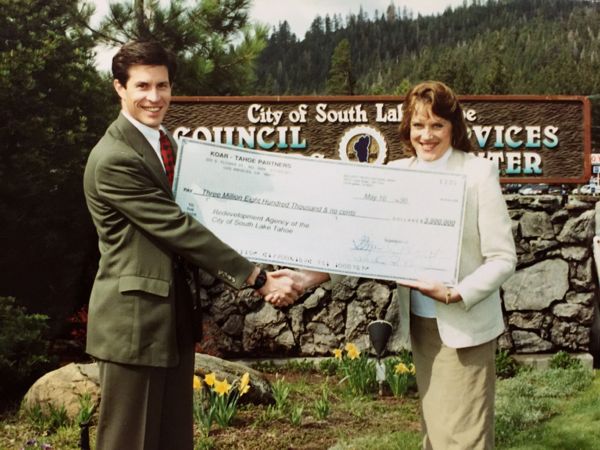
SLT 50th project: Steve Kenninger with KOAR, developers of Embassy Suites, and Mayor Nera Roberts in 1990.

Steve Kenninger with KOAR, developers of Embassy Suites and what is now called Lake Tahoe Resort Hotel, and then South Lake Tahoe Mayor Neva Roberts in 1990. Photo/South Lake Tahoe

Nothing worth doing comes easy

After the city incorporated in 1965 and the lake was legally divvied up by jurisdiction in 1970, the town was in desperate need of reinvention.

Kerry Miller, the city manager who arrived in June 1987, remembers redevelopment’s humble beginnings like they were yesterday.

“The Tahoe basin came off a three-year building moratorium, with the League’s legal challenge of TRPA, and we realized that as a result, the economy suffered and tourism suffered,” Miller said from his home in Folsom.

In days long before its flagship ski resort owned anything here, Vail continued to develop during the lake’s moratorium. The Colorado town’s achievements cut into ski area tourism, and Tahoe faced a visitation drought down the road that would make the recession from a few years ago look like happy days.

“It became likely Tahoe as a tourist destination would not be able to compete,” Miller told Lake Tahoe News.

City staff prepped some plans. An agreement was struck with the state Attorney General’s Office. Measure C, which passed in November 1988, put transient occupancy tax in city coffers – 10 percent across the town, 12 percent in project areas. And what a project area South Lake had, resembling an oversized barbell from one side of town to another. The South Tahoe Redevelopment Agency zone spans 173 acres from Herbert Avenue to Stateline Avenue. Later on, the zone leapfrogged to Harrison Avenue at midtown near El Dorado Beach and at the Y.

In the late-1980s, all approvals were reached, movement was made to secure bond financing and the land assembly came together starting with Lake Tahoe Vacation Resort at Ski Run Boulevard.

“The citizens were involved during the entire planning process,” Miller said.

Sure, there were naysayers but “surprisingly not a lot,” the former city official added in a tone that seemed to almost surprise him.

“People had objections. There were people bemoaning the idea of change. But it was overwhelmingly positive. The town looked dated. Tahoe’s beauty ‘no matter what’ had a dated quality to attracting visitors,” he said.

Eminent domain – the government-sanctioned taking of property for improvements to alleviate blight, in its truest sense – represents the all-encompassing main objection to redevelopment. But bringing fair market value and a relocation plan to the table for the displaced seemed to ease the pain somewhat, and citizens were ready for a change, Miller recounted.

Improvements were being made, but then “a funny thing happened” as the city endorsed the KOAR company’s plans for what was Embassy Suites bordering Stateline. The Gulf War in 1990 literally dried up the financial markets. The post-war recession “fatally affected” redevelopment for three years, Miller went on to say.

After the economy started to recover and Embassy Vacation Resort opened at Ski Run in 1995, the movement paved the way for a concentrated effort to go into the Park Avenue Project on the other side of the street bordering Stateline.
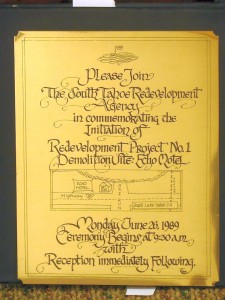
Redevelopment in South Lake Tahoe began in earnest in the last 1980s.

Redevelopment in South Lake Tahoe began in earnest in the late 1980s.

The birth of Heavenly Village

The major redevelopment undertaking resulted in Heavenly Village with its two Marriott timeshare condominium properties, 120,000 square feet of retail run by Gary Casteel who at the time owned the Factory Stores at the Y, a city transit station and parking garage, and a $25 million gondola built by Heavenly Mountain Resort in 2002.

Project 1 didn’t come without hitches and glitches. It demonstrated a sign of ultimate, stubborn resilience from the private and public sectors – almost to a fault.

First, the city Redevelopment Agency siphoned off $7 million from the general fund to finish the 110,000-square-foot project – a watershed moment announced at a meeting in May 2003 when the council got a wakeup call on monitoring its accounting department. The tab was financed and refinanced, thus raising the debt service in 2006 to $112 million to be paid over three decades. The city even paid out $12 million in legal fees associated with the $250 million project flanked by the Grand Summit and Timber Lodge.

Redevelopment was a lot like gambling – one, which paid off ultimately when considering, delayed tax-revenue benefits. The property once assessed at $15 million when the plan was adopted in 1988 had increased more than 20 times on the El Dorado County tax rolls according to statistics from a decade ago. Its value mushroomed then at $346 million, up $100 million from when the complex was completed.

Moreover, Heavenly’s parent company at the time – American Skiing Co. experienced a dive in its value on the stock market to the point shares sold for less than $1. The plummet resulted in a delisting from the New York Stock Exchange. It was the beginning of the end. At one point, it was doubtful the gondola would even get built.

To the rescue, Vail Resorts ended up buying the town ski resort a few years later – and has since poured millions of dollars into capital improvement projects.

Yet another hurdle to overcome, parking turned out to be an albatross of an issue. The money-losing $6 million garage turned into $9 million for the city. Parking at the gondola turned into a debate and debacle for years. Visitors either clogged the side streets until the city implemented a two-hour limit in the surrounding area to urge motorists to park in the garage or parked at Harrah’s back lot or at what was the Crescent V shopping center next door. The latter resulted in aggressive parking monitors ticketing visitors or in some cases grabbing their arms.

Something needed to give. City officials got creative, offering deals for parking in the garage, validation agreements with retailers and a turning of the cheek from the major casino in what was happening in its back lot.
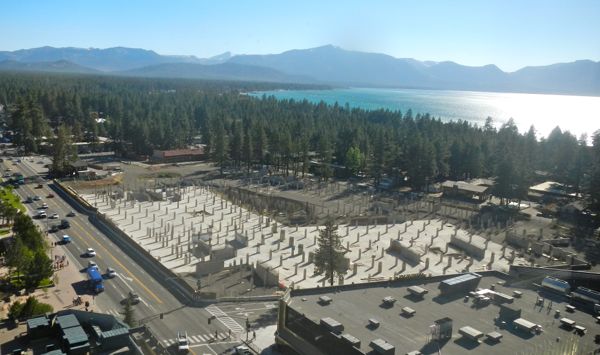
Concrete rebar constituted "the hole" for years until Owens Financial consolidated the properties and has incrementally begun to develop the site. Photo/LTN file

Concrete and rebar constituted “the hole” for years until Owens Financial consolidated the properties and began incrementally developing the site. Photo/LTN file

The other side of the coin

Parking could still be an issue as one looks at the current Project 3 across the highway. Talk about evolution. The changing of management hands alone resembles a cross between a card game and a chess tournament. Harveys casino, then Marriott, then Lake Tahoe Development Co. – the latter run by a small, local development duo – was once in line to build the city’s largest proposed project once estimated at $410 million.

Upon breaking ground in 2007, the triangular-shaped project area on the lake side now called the Chateau Project where McP’s Tap Room serves as an anchor was supposed to house a major hotel and 200,000-square-foot convention center. The city was due to own the monstrous facility according to the ever-changing Owner Participation Agreement between the city and Tahoe Regional Planning Agency.

One challenge after another ensued.

Displaced and bought-out business operators kept the city in and out of court through the years. Legal fees mounted, with some business owners having better results than others.

At least Jim Hickey, owner of the former Union 76 gas station, came out ahead of the game.

“I thought everything was fair in the long run. I wished it would’ve happened a little faster, but I know the project was big. It took several months to close the deal,” Hickey, now an Internet marketer, told Lake Tahoe News.

All in all, there was the harsh reality that convention centers went out of style, a warning Charlie McDermid from Holiday Inn Express warned the city about when he waved a hotel-trend magazine at a heated City Council meeting years ago. Financing for the evolving hotel-condominium idea dried up.

With no performance bond in place for the city, L.T. Development Co. led by Randy Lane and John Sherpa consequently filed for bankruptcy. Rebar and concrete marked what was affectionately referred to in town by locals as “the hole in the ground” — much to the embarrassing dismay of the city.
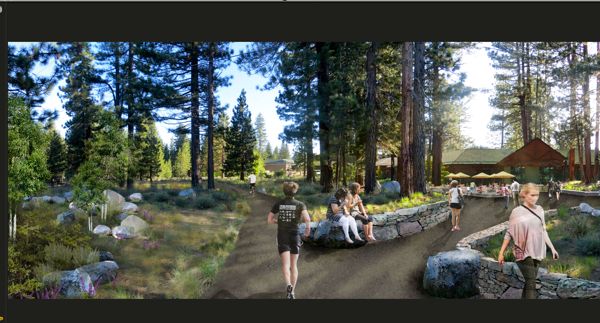
The Tahoe Valley Area Plan has passed the regulatory hurdles and now awaits investors to transform the area along with the city creating a green belt.

The Tahoe Valley Area Plan has passed the regulatory hurdles and now awaits investors to transform the area along with the city which intends to create a green belt.

It’s a new game in town

But current City Manager Nancy Kerry, an idea activator, was not going to let this blemish lie unattended on her watch.

Even as the state pulled its support for redevelopment a few years ago, staff and L.T. Development Co. negotiated with Tahoe Stateline Ventures, a subsidiary of Owens Financial, for it to buy the parcels in the project area and with tweaked plans go forth with a scaled down version of what was to happen across from Harveys.

The 32-unit condominium project, absent a traditional hotel now, is now proposed with a pool, 19,477-square-feet of retail space (a third of its original size), streetscape improvements and public fire pits.

A little modesty never hurt anyone.

Owens Financial chief Bill Owens describes his undaunted dedication in three words: “Location, location, location.”

What keeps him interested sounds almost in line with what the founding fathers and mothers of redevelopment had in mind.

“I believe South Lake Tahoe has been maligned in public perception because of the older properties not being redeveloped. A lot of (business operators) don’t want to bother. We need this. You can walk to gaming, walk to the lake, walk to a ski resort. There are very few places on Earth you could do that,” he told Lake Tahoe News, adding working with the city has been “a pleasure.”

One could say he’s a visionary like Kerry.

He doesn’t wince at challenges. And between planning staff’s early caution led by Jim Marino about parking and sometimes dangerous pedestrian movement across the highway, there could be more issues. A Heavenly employee was hit by a motorist crossing the street in that area about a decade ago, severely injuring her.

There are the other considerations.

Owens would prefer not to have to deal with the slopes of the roofs as dictated by TRPA guidelines issued in 2007 for the project now estimated to cost almost half as much.

“(The roof slope) makes it more expensive to build, but it’s not something I can’t live with,” he told Lake Tahoe News.

But that’s all in a day’s work to people on his side like Joe Stewart of SMC Contracting. The contractor is a tour de force for building in the redevelopment area, namely the Park Avenue project, so he knows the drill.

It’s a good thing. Between a changing proposal, shrinking competitive market, nagging recession and no redevelopment agencies in 400 communities up and down the state, this isn’t easy.

“Heavenly Village was built with redevelopment funds. This one has zero public funds. In some cases, it makes the project go slower. I think the redevelopment agency was a huge benefit across the street. We should be lucky it’s built,” Stewart told Lake Tahoe News. “I feel like Bill Owens certainly stepped up and did something no one else would do.”

In August, Stewart expects the groundbreaking of the second phase.

All this is music to the ears when it comes to the last of the “redevelopment” oriented projects for civic-minded Paul Bruso, who has owned and operated Ernie’s Coffee Shop for decades.

Bruso was one of the early pioneering citizens to spearhead a plan for a remodeling of the Y where his restaurant he’s retiring from sits.

The Tahoe Valley Area Plan has undergone its own jerks and grinds as it makes its way into the future. It’s come to the forefront with issues over building height, project area and former Councilman Ted Long’s apparent push to spearhead taking over the plan from the citizen’s group years ago, elevating the debate.

But when all was said and done minus Long’s sarcastic “thank-you-very-much, we’ll-take-it-from-here” attitude, Bruso said he’s pleased with how the plan is materializing.

One thing he would like to see is better lighting.

“People who visit want to get out of their cars and walk. We want them to feel safe,” he said.

Overall, it’s “a good plan,” according to the restaurateur.

“It’s like (the city has) been thorough in what people want. They took all the necessary steps,” he said. “The whole idea is this town is going through a beautification process. Unfortunately, the Y is the tail of the dog.”



Opinion: Break down barriers for better health

By Zocalo

Americans have more ways to be healthy than ever before. Organic vegetables line grocery store shelves. Yoga studios crowd city streets. Fitbits remind us to skip the elevator and Rocky Balboa it up the stairs.

But just because all these waist-thinning options exist doesn’t mean everyone has access to them. Fresh produce, fancy gyms, and habit-tracking technology are expensive, and cost is one of many prohibitive factors that keeps millions of people from taking good care of themselves.

The obesity rates in America are staggering; more than a third of adults deal with the disorder, with demographics that reflect a complicated web of cultural and socio-economic influences. So how do we even the playing field? In advance of the Zócalo/The California Wellness Foundation event “Is Healthy Living Only for the Rich?” we asked medical experts and others invested the public’s well-being: Given the structure and demands of everyday life in America, what can be done to make healthy living more accessible across classes?

Leonard Jack Jr.

The burden of chronic disease in the United States is substantial. Chronic diseases — such as heart disease, stroke, diabetes, obesity, and cancer — are among the most common, costly, and preventable of all health problems. More than half of all adults in the U.S. have at least one of them.

Improving the overall health of Americans will involve reducing risk factors such as physical inactivity, poor nutrition, and limited or no access to quality healthcare. In addition to these factors, environment (for example, communities, schools, workplaces, restaurants, parks, etc.) plays a large role in helping Americans achieve optimal health. The importance of creating safe places to exercise, increasing access to healthier foods and beverages, and reducing exposure to secondhand smoke in public places cannot be overlooked or minimized.

Bettering people’s environments requires strong partnerships and a commitment to making healthy choices easier. The best successes are where schools, local parks, businesses, faith-based organizations, clinical settings, and restaurants work together through a combination of approaches. These approaches include establishing policies in schools that make available salad bars and healthy-foods vending machines; adopting joint-use agreements with facilities such as schools, churches, and businesses to increase access to safe places to exercise; working closely with corner grocery stores in communities to increase access to fruits and vegetables; and changing prices of healthier foods and beverages relative to the cost of less-healthy foods.

Leonard Jack Jr. is the director of the division of community health within the National Center for Chronic Disease Prevention and Health Promotion at the Centers for Disease Control and Prevention.

Paul Simon

First, address a community’s fundamental needs.

There is unfortunately no single, easy answer. We certainly need to encourage healthy eating and regular physical activity, and discourage tobacco use and unhealthful patterns of drug and alcohol use. However, these efforts are unlikely to make a dent in the glaring health inequities we see across socioeconomic and racial and ethnic groups unless we also create environments that promote healthy living.

Sadly, in most communities, and particularly in low-income communities, the deck is stacked against healthy choices. We need to shift the balance in favor of healthy options where landscapes are largely dominated by junk food, unhealthy food and beverage marketing, tobacco shops, and liquor stores, and few if any options for recreation. Even these measures, though, are unlikely to achieve the desired results unless we address even more fundamental needs, including safe and affordable housing, high-quality education, and meaningful employment opportunities that offer a living wage.

Though these issues may seem far removed from healthy living, they are in fact among the most important factors that influence health across the lifespan. In addition, chronic stress associated with living in communities that are rife with violence, disinvestment, and degradation exact an enormous toll on one’s health. We need to work with and support communities to build resilience, strengthen social networks, and create opportunity. Anything less is like putting a Band-Aid on a festering wound.

Paul Simon is the director of the division of chronic disease and injury prevention at Los Angeles County of Public Health. He is also a pediatrician, and teaches at the UCLA Fielding School of Public Health.

Cherise Charleswell

Healthy living is truly a privilege in the United States, because many families are focused on survival. I will forever remember the words of a mother who spoke up at a grassroots community-organizing event I attended: She said even though she knows it’s not nutritional, she still gives her sons honey buns in the morning, because it’s quick, cheap, and at least they will have something to eat.

Simply stating that this woman — and others like her who don’t have access to healthy living — need more health education classes is not enough. There is arrogance in that notion. Surely, this marginalized population knows that they should be eating better, getting more exercise, and having more routine physicals. However, there are barriers in the way that seem to be growing — barriers that are among the key reasons why protestors took to the streets during the Occupy campaigns. When we speak of classes, the United States is simply becoming the “have” and the “have-nots,” and public health is suffering because of this, as healthy living options become unattainable.

The problem involves macroeconomics, and should be approached from this macro-level with urgently needed social policies and legislation that will make healthy living accessible. Speaking about the poor is taboo in American politics; politicians prefer to talk about the “shrinking middle class,” without providing any context as to where they are shrinking away to. For that reason, we need to begin to speak about privilege and inequity, and consider diverse public health interventions, such as creating and maintaining community gardens, imposing higher taxes on sugar-laden foods, and extending physical education requirements in schools.

Cherise Charleswell holds a dual position as diversity officer and clinical researcher at Huntington Medical Research Institutes in Pasadena. She is the president of the Southern California Public Health Association. 

Jonathan M. Samet

This is a critical question with an easy answer: Much can be done, and the imperative to do a lot is strong.

In the United States, there are tremendous gradients in health and longevity by indicators of socioeconomic status. Underlying these gradients are patterns of harmful substance use (tobacco, excessive alcohol, and illegal drugs), availability and affordability of healthy food, psychosocial stress, and access to high-quality preventive and medical care.

What can be done on the short-term?

  • Continue to drive down rates of tobacco use, while taking on the new challenge of various electronic nicotine delivery systems. In California, for instance, cigarettes are too cheap, so there’s an opportunity to reduce smoking through a tax increase.
  • Invest in research to find better interventions for alcoholism, as the problem of excess alcohol consumption remains deeply rooted.
  • Assess, address, and monitor the availability and consumption of healthy foods. We have the tools to do so, and already know the solutions: local growing and selling, and pushing for healthier options from the food industry.
  • Promote physical activity by identifying and addressing barriers to it (for instance, lack of walkable routes, lack of education on the risks of a sedentary lifestyle)
  • Teach communities to advance their own health. Strategies could include engaging community leaders, providing model initiatives, and offering funding to foster innovation.

For some of the most critical factors, solutions are for the long-term and outside the domain of local communities—healthcare access and quality, and a strong base of jobs—but they should not be forgotten.

Jonathan M. Samet is the chair of the department of preventive medicine at University of Southern California’s Keck School of Medicine. He is also the director of USC’s Institute for Global Health. 

Siddhartha Angadi

Socioeconomic status is adversely associated with obesity and lifestyle diseases. However, it’s often incorrectly assumed that access to recreational facilities is critical to maintaining a good workout routine.

Exercise is potent and virtually “free” medicine that delivers health benefits independent of education level, financial status, or body size. Cardiovascular disease is the leading cause of death in the U.S., and exercise is extremely efficacious cardiovascular medicine. Current American Heart Association guidelines recommend that adults engage in 150 minutes of moderate-intensity aerobic activity or 75 minutes of vigorous-intensity activity per week.

While these goals may sound unattainable to a time-crunched person or busy family, it is important to note that accumulating 30 minutes of exercise in short bouts is just as effective at lowering cardiovascular risk. Short exercise sessions — as little as 10 minutes at a time — have been shown to be just as effective at reducing blood pressure as a single, longer session. A short walk or bike ride to work, the park, or a store can enhance heart health without the cost of a gym membership.

The salutary effects of exercise occur independently of body weight or body fat. In a series of studies carried out at the Cooper Clinic in Texas, researchers examined the effects of fitness on the risk of death from all causes and cardiovascular mortality. The key finding was that obese and fit individuals had the same risk of adverse outcomes as normal-weight and fit individuals, and half the risk as normal-weight or obese, unfit individuals.

In short, good heart health is possible at any size with a cheap pill called exercise.

Siddhartha Angadi is an assistant professor at Arizona State University. His research focuses on the effects of exercise and diet on cardiac and arterial function in patients with serious cardiovascular conditions. His doctoral student Jennifer Herbold assisted him in writing this response.

This article is supported by a grant from the The California Wellness Foundation.


Nev. largely controlled by federal agencies

By Conor Shine, Las Vegas Sun

If you were to amass all of the federally owned land in Nevada, the 10 smallest states in America, plus Guam, would fit inside.

Many conservative Nevadans view the federal government’s presence — it owns about 85 percent of the state — as an overreach, an argument that motivated the Sagebrush Rebellion in the 1970s and ’80s and the Cliven Bundy standoff in 2014. Liberal opponents, however, point out the federal government provides many services, such as wildfire protection, that the state couldn’t afford if it managed the land.

The debate was rekindled this month when President Obama designated 700,000 acres in southeastern Nevada as the Basin and Range National Monument, fulfilling a longtime goal of ally Sen. Harry Reid.

Read the whole story


Pro soccer may be headed to Reno

By Anjeanette Damon, Reno Gazette-Journal

Professional soccer could be coming to Reno if negotiations between the United Soccer League and Aces Baseball owner Herb Simon continue to go well, the president of the Reno Aces confirmed Monday night.

Aces President Eric Edelstein said a franchise deal with the United Soccer League has not been finalized, despite what unnamed sources told a national pro soccer blogger.

“We don’t have a franchise at this moment,” Edelstein said. “We have been in talks for some time and we are actively pursuing a franchise that, if awarded, would play at Aces Ballpark and would be owned by Herb Simon.”

Read the whole story