Bankruptcy court denies Caesars Entertainment’s quick appeal

By Associated Press

A bankruptcy court that ruled lawsuits against Caesars Entertainment Corp. would not be halted as the company’s debt-heavy subsidiary attempts to emerge from Chapter 11 has also denied the casino company’s effort to fast-track an appeal of the decision to a higher court.

The order was denied Wednesday in Judge Benjamin Goldgar’s federal courtroom in Chicago according to court records.

A Caesars Entertainment attorney has argued the fate of its bankrupt operations subsidiary and its own financial well-being are at risk if creditor lawsuits seeking billions of dollars in claims proceeds.

The creditors suing Caesars allege the company robbed its subsidiary of valuable assets and left them without a guarantee on their investments.

Caesars Entertainment Corp. has argued the litigation puts Caesars Entertainment Corp. at risk of filing bankruptcy itself.

Caesars is the parent company of Harrah’s Lake Tahoe and Harveys.


Letter: Food bank looking for shelter for client

To the community,

The Food Bank of El Dorado County is committed to helping with the homeless issue in El Dorado County one person at a time. We have adopted a young single mother that is homeless and have provided a job at the Food Bank.

We need help with a temporary place for her to live. We have located a donor that is willing to provide the property if we can find a trailer with a holding tank for temporary use until we can get this mother placed in her own apartment.

The Food Bank is looking for a 25-foot by-40-foot camp trailer or modular. A donation would be optimum, but we are willing to take one on loan or purchase one for a very reasonable price. Do you have a trailer just sitting around that could be put to good use and are willing to help this young mother in need?

Contact us at the Food Bank of El Dorado County today — 530.621.9950.

Together we can make a difference in her life and her children’s lives.

Rachel Galvin, Food Bank of El Dorado County


Regan Beach options narrowed to 3

By Terra Breeden

Expand the beach, build a jetty, put in adult swing sets; these were a few of the options presented to the public by the Regan Beach Committee on Tuesday night during a meeting at the South Lake Tahoe’s recreation center.

After months of considering possibilities and listening to public opinion, conceptual plans that included many drastic changes to the popular beach were shown to the nearly 50 who gathered July 28.

“What we don’t want to do is recreate Lakeview Commons,” Parks and Recreation Commissioner Steve Noll said. “This is a restoration project.”

Three options were presented, each containing many of the changes discussed at previous meetings. All three options included a new concession stand and restroom facility, improved play area for children, and focused on shoreline stabilization and rebuilding the decrepit retaining wall.

Although all of the plans presented at the meeting included these changes, each had a different focus on what the future of Regan Beach should be.

Attendees were directed to choose their three favorite features from each option. The park features that are favored the most by the community will be included in a completed plan of Regan Beach due to be presented at a meeting later this summer.

Homeowners from the Al Tahoe neighborhood and other South Lake Tahoe residents who frequent the beach examined the plans, trying to visualize what this “new” park would actually look like. Contrasting opinions circulated wildly as each option was presented to the audience.

Option 1 was called “The Hub” and was geared toward creating a more park-like setting at the beach. Changes to the beach that “The Hub” include creating a larger lakefront plaza and picnic space, building separated parking lots with two-way traffic, and placing a gazebo with terraced seating on the event lawn. “The Hub” plan was also drawn to include a non-motorized boat launch for water sport enthusiasts and separated the dog beach area from the main park.

Option 2 was called “Play” and as the title suggests, this option concentrated on providing more outdoor activities at Regan Beach. Option 2 extended the beach area and implemented a large adventure play area with terraces that extended from the lawn to the beach. This conceptual plan also contained a direct walkway connection to the dog beach from Lakeview Avenue and a handicap-friendly ramp that extended from the parking lot to the beach.

Option 3 was named “Restoration” and this plan focused on renovating the park to be in tune with the Lake Tahoe environment. This option aggressively tackled shoreline restoration and concentrated on wildlife habitat creation. With this plan, a jetty would be built to the east of the park. This structure would be a physical barrier between the park and dog area and would also create an aquatic habitat for fish. The “Restoration” plan also included a large promenade walkway with a picnic area and moved the restrooms and concession stand closer to the beach with views directed toward the west for watching sunsets.

“These are not finalized plans,” Noll stressed. “We want to know what the community thinks about these ideas.”

The beach and recreation area are in need of a serious makeover after decades of neglect. The concession stand is not up to health code standards, the retaining wall around the park is collapsing, and the steep stairs that descend to the beach are not handicap or kayak and paddleboard friendly. The latter is a feature that has become increasingly problematic as the watersports grow in popularity.

Separating the dog beach area from the main park is a big concern as well.

“These days the whole beach is a dog park,” one man said at the meeting.

The preferred alternative will be decided based on input gathered at the community meetings and survey. It will be presented to the public in late August. The survey is online. The three options are also online.


Collaboration keeps beaver habitat intact

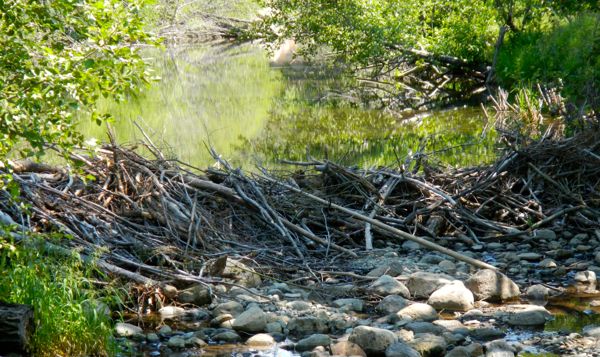
Beaver dams at Taylor Creek are no longer being destroyed by the U.S. Forest Service. Photos/Kathryn Reed

Beaver dams at Taylor Creek are no longer being destroyed by the U.S. Forest Service. Photos/Kathryn Reed

By Kathryn Reed

CAMP RICHARDSON – It depends on who one talks to whether beavers are destructive or one of nature’s best engineers.

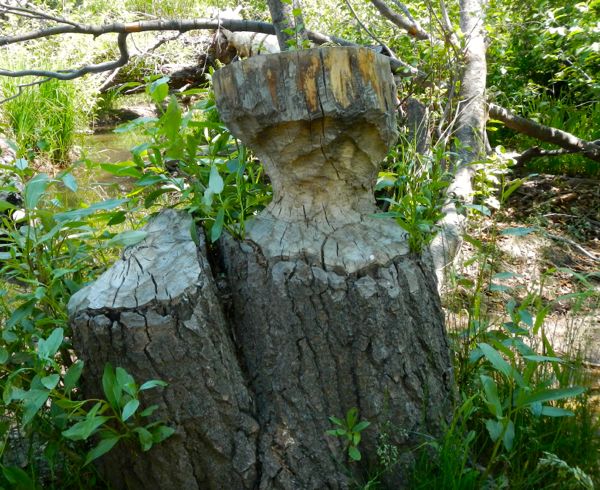
At 40 to 50 pounds, these mammals are no slouches in the animal kingdom. Being nocturnal, they are not often seen. However, their “work” is very evident. Usually it’s in the form of dams or felling of trees.

This “work” that is done near civilization is what has the Sierra Wildlife Coalition and U.S. Forest Service partnering to maintain the animal’s habitat and protect manmade structures.

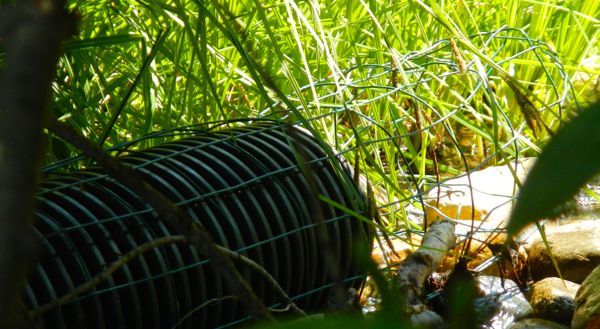
Pipes carry water through the dam and wire mesh keeps them from plugging up.

Pipes carry water through the beaver dam and wire keeps them from plugging up.

Beaver dams were causing the $1 million stream profile center at Taylor Creek on the South Shore to flood. Removing the dams was futile. Killing this native species wasn’t an ideal option.

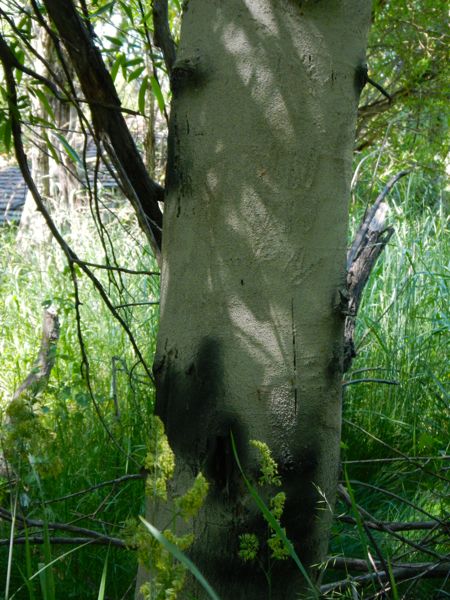
Sierra Wildlife Coalition proposed painting some of the aspen trees in the area with a sand-latex mixture that would prevent the beavers from gnawing at them. It’s worked. And unless one looks closely it is difficult to know the tree has been treated with anything.

The painting goes 5 feet up from the ground because beavers will cross the snow in the winter. It is winter when most trees are chewed.

Beavers leave behind evidence of their work.

Beavers leave behind evidence of their work.

Levelers have been placed in the dams to allow water to keep flowing down stream while keeping the beaver structure in place. It almost looks like a rudimentary science project with the plastic pipes and wire-mesh cages.

Advocates are working to prevent the kokanee salmon from getting caught up in the diversion devices. However, with the fish not being native to the Tahoe, their survival is less of a concern to the federal agency.

While the devices are not working perfectly, it is a better scenario than repeatedly removing the dams – which is a costly and time consuming endeavor. It would cost about $40,000 to raise the trail, so the leveler method is the economically cheaper route.

Trees are painted to deter beavers from chewing them.

Trees are painted to deter beavers from chewing them.

Beavers are good for the environment. The problem is people are living or recreating so close to their habitat so the good aspects get overshadowed.

According to the Sierra Wildlife Coalition, beaver ponds create wetlands, reduce erosion, decrease flood damage downstream, control soil erosion and help filter out sediment before it reaches Lake Tahoe.

The nonprofit, which is based in Tahoe City, has about seven volunteers who help with the installations and tree protection. Another 200 people are on the group’s email list and keep the core group informed about beaver activity in the basin and Truckee area.

Beavers are in almost every creek in the region. This is why the Sierra Wildlife Coalition is working with agencies, homeowners and others wherever possible to have beavers and people coexist.

—–

Notes:

·      Sherry Guzzi with the Sierra Wildlife Coalition will give a presentation about beavers July 31 at 8:30pm at Taylor Creek, Lake of the Sky Amphitheater on the South Shore. Cost is $5.


Opinion: How much is Calif. really spending?

By Dan Walters, Sacramento Bee

It’s time again for some more fun with numbers – big numbers.

Dan Walters

Dan Walters

They’re the numbers associated with the 2015-16 state budget, which the Legislature and Gov. Jerry Brown enacted last month.

There may be some public confusion over its dimensions. Some news media reported the total as $115.4 billion, others as $167.6 billion.

Both are correct as far as they go.

Read the whole story


Youngster injured in Zephyr Cove crash

A South Lake Tahoe man was arrested July 28 following an accident in Zephyr Cove that injured a 9-year-old girl.

Jody Campos, 46, is accused of driving under the influence.

The head-on crash occurred Tuesday about 11:40am on Highway 50 near the Presbyterian center driveway.

Calstar airlifted the youngster to Renown Medical Center in Reno.

Further details about the accident were not immediately available.

— Lake Tahoe News staff report


Drone launched to find man missing in Eldorado forest

By Julia Horowitz, AP

The California National Guard is using a drone to search Eldorado National Forest for a missing San Francisco teacher, marking the first time the Guard has used an unmanned aircraft for a search-and-rescue mission.

The drone will collect images in real time, allowing searchers on the ground to make faster, more informed decisions about where to concentrate their efforts, said Capt. Will Martin, a spokesman for the California Guard.

The Guard previously used the drone to support firefighting efforts in 2013 at Yosemite National Park.

“For the purpose of collecting imagery, it’s unrivaled,” Martin said of drone technology.

The search for Edward Kavanaugh, 45, has intensified in the 12 days since he went missing. Kavanaugh was last seen July 17 driving a motorcycle on a trail through El Dorado County, about three hours east of the San Francisco Bay Area. He was with another driver before cruising off on his own.

Kavanaugh is a popular veteran teacher who works for San Francisco Unified School District. Several staff members and students have gone to Eldorado National Forest to join the search efforts, SFUSD spokeswoman Gentle Blythe said.

Martin said the drone has yet to provide any new leads in Kavanaugh’s disappearance.

Officials have gathered more than 50 volunteers to help sweep El Dorado and neighboring counties by foot, car and helicopter.


Alleged car thief apprehended in Truckee

A routine traffic stop on Wednesday in Truckee ended with one person arrested on charges of possession of a stolen vehicle.

Seven people from two vehicles that were associated with each other were stopped in the area of the Bank of America on Donner Pass Road.

Erik Limon-Herrera, 26, was arrested July 29, while the passengers and occupants of the other vehicle, who were all relatives, were cleared and released at the scene.

Truckee officers are working with the California Highway Patrol in what has been a string of stolen vehicles in the area. Detectives believe there are other suspects involved in an earlier who have returned to the Bay Area.  The other vehicles were stolen out of Reno and abandoned in the Truckee area.

Officers said several of the vehicles that were stolen had the keys in them.

— Lake Tahoe News staff report


Snippets about Lake Tahoe

washoe meadow·       There is going to be a clean up day in Washoe Meadows State Park on Aug. 8 from 9am-noon. Meet at the Lake Tahoe Boulevard entrance near Tahoe Mountain Road. To RSVP and for more info, email Sarah Markowitz at sarah.r.markowitz@gmail.com.

·       Squaw Valley’s Brews, Jazz and Funk Fest is Aug. 8-9 from 2-8pm each day. The daily entry fee is $5 per person, with proceeds going to the Humane Society of Truckee-Tahoe.

·       Richie Lawrence and the Yolos will be playing outside the Valhalla Grand Hall on the South Shore for free on Aug. 2 from noon-2pm.

·       El Dorado County wants people to take an online survey about public health.


How water scarcity shaped the U.S.

By Stephen Grace

Water, when scarce, has split the nation into warring factions. But it has also united fractured regions. Water can both release the demons of war and stir the better angels of our nature.

We hear so much about California and the drought. But consider the whole West — and the Continental Divide, also known as the Great Divide. This spine of the continent splits North America — and the state of Colorado, where I live — into hydrological halves.

The snowy West Slope of the Great Divide boasts abundant rivers that flow to the Pacific Ocean. The East Slope, which drains to the Atlantic, is decidedly drier but is home to a thirsty agricultural sector and Front Range cities (including Denver and Colorado Springs) that support the vast majority of the state’s population. To address this imbalance, Colorado diverts water from the West Slope of the Great Divide to the East Slope by means of a Rube Goldberg assemblage of dikes, dams, and pipes, including a tunnel that runs beneath the Rocky Mountains the exact length of a half marathon, 13.1 miles. The economic and ecological consequences of this water transfer from one side of the Divide to the other have provoked disputes throughout the state’s history.

Droughts and disconnects between water sources and water needs are by no means exclusive to the western United States. Even in the water-rich Southeast, imbalances between population centers and water supplies have led to conflicts. In the 1980s, severe drought triggered a water dispute between Georgia, Alabama, and Florida when drought-depleted rivers couldn’t satisfy competing needs for agricultural production, municipal use, hydroelectric generation, and environmental health. This tri-state dispute clogged courtrooms and triggered the involvement of the federal government.

Florida also faces water wars within its borders. According to a study by the Natural Resources Defense Council, Florida is one of 14 states at high risk of water shortages by midcentury. The Sunshine State is blessed with an abundance of freshwater in its rural north, but cities desperate for more supply crowd the south. This disparity has exposed chasms between competing economic and environmental interests. Transferring water over long distances in Florida could allow golf courses to remain green in the south while upsetting the balance of ecosystems in the north.

Along with diverting rivers, pumping water from beneath the ground has supported the growth of cities in many parts of the country. It has also revolutionized agriculture, perhaps most notably on the High Plains. This rain-scarce region was transformed into one of the world’s most bountiful breadbaskets by pumping from the Ogallala Aquifer, which stretches from Texas to South Dakota. The Ogallala, which accumulated over millennia as melting Ice Age glaciers soaked into the ground, is now being spent far faster than rain can replenish it. This liquid inheritance is in danger of running dry — and creating skirmishes both within states and across state borders.

Conflict, of course, commands attention. Some of the West’s most iconic stories—from the novel “The Virginian” to the movie “Shane” to the Broadway musical “Oklahoma!” — center on conflicts over scarce water. In my first water book, “Dam Nation”, I spun tense tales of water wars to keep readers, and myself, awake while unpacking complex issues. For instance, one of the West’s most memorable water battles broke out in 1934 when Arizona’s governor, vowing to stop California from completing a dam that was being built to divert water to Los Angeles, dispatched National Guard troops with machine guns to the Colorado River.

To say that water is a perennial cause of conflict is to state the obvious, but as I learned while researching “The Great Divide,” a forthcoming film and book about Colorado’s water issues, that’s not the whole story. What is less apparent, but arguably more significant, is that water scarcity has spurred far-reaching compromises throughout history. When fierce debate over the use of the Colorado River headwaters threatened to fracture the state of Colorado in 1937, a pact was forged to maintain peace across the Great Divide. While negotiating this historic agreement, neither the West Slope nor the East Slope got all the water it wanted. Each side achieved a modest victory, and compromise prevented conflict from escalating into chaos.

Prior to that momentous accord within Colorado, the 1922 Colorado River Compact united seven western states in a far-reaching agreement that negated the need for courtroom brawls. Some argue that the Colorado River Compact should be discarded and replaced with a new interstate agreement that reflects the economic, demographic, and environmental realities of the 21st-century American West. Regardless, over nine decades later, that compact continues to balance water use between states. This is not as exciting a story as the narrative of “Chinatown”, the film noir classic that shows ruthless power brokers in Los Angeles robbing a river from a rural valley. But as California’s epic drought exposes stark divides between north and south, between cities and agriculture, and between economic development and environmental sustainability, the proven ability of water agreements to bond fractured regions must not be forgotten.

In 2013, after six years of persistent effort to find common ground among competing parties in the state of Colorado, the Colorado River Cooperative Agreement was finalized. This pact created a framework for resolving disputes over the use of West Slope rivers by Denver Water, which supplies 1.3 million people in the city of Denver and its surrounding suburbs. Furthering this cooperative process, Trout Unlimited, a nonprofit conservation organization, and the West Slope’s Grand County joined with Denver Water to craft a plan to heal the ecologically damaged Colorado River headwaters. Former adversaries will work together to improve the health of the watershed while allowing Denver Water to increase the amount of its diversions across the Great Divide during periods of high flow.

Water compromises are not the stuff of scintillating drama. But as we face a future of cities surging with growth in some of the continent’s driest regions, a food supply strained by drought, and ecosystems degraded by depleted aquifers and drained rivers, we must remember that cooperation, not conflict, is the best way to bridge our nation’s many water divides.

Stephen Grace is the author of “The Great Divide”, a companion book to “The Great Divide” film by Havey Productions, which will be published in August. He wrote this for Thinking L.A., a partnership of UCLA and Zócalo Public Square.