How every dollar is accounted for in casinos

By Megan Messerly, Las Vegas Sun

Despite the proliferation of credit cards, Apple Pay and Square readers, Nevada’s gaming business has remained largely cash-based.

Though the days of players carting around buckets of quarters are, for the most part, long gone, “the gaming business will remain a cash-heavy business,” said Douglas Florence Sr., vice president of strategic operations at eConnect, a security software company, and former head of surveillance at the Mirage.

So what happens to the money gamblers lay down on tables or feed into slot machines?

The Nevada Gaming Control Board sets standards for casinos about how money must be watched and secured. Some casinos set their own stricter standards as well.

Read the whole story


SLT vacation rental ordinance to change Oct. 1

By Kathryn Reed

Those wanting a vacation home rental permit in South Lake Tahoe under the current rules have an extra month to get one.

The City Council today approved the controversial ordinance that will take effect Oct. 1. This ordinance only affects VHRs in residential neighborhoods, of which there are about 1,200 parcels.

Ten people spoke at the Aug. 4 meeting about the rentals. This was the second reading of the ordinance, which is usually a formality on the consent agenda without changes. It was pulled for discussion, which took more than 90 minutes.

“The City Council is making up this ordinance as they go. The council doesn’t understand the real estate industry and how escrow works,” Natalie Yanish, South Tahoe Association of Realtors board member, told Lake Tahoe News. “It’s unfortunate that they feel these bureaucratic processes and top down government tactics will work in the real world.”

Mayor Hal Cole said the purpose of the ordinance is to deal with the abuse of the industry, reel in houses being built purely as a vacation rental, and not to put anyone out of business.

The new ordinance requires notification within a 300-foot radius of a home seeking a vacation rental permit. Anyone, though, can voice an objection. However, the hearing administrator will have discretion as to whose comments carry more weight. Staff and electeds repeatedly said not liking a VHR is not a reason to have a permit denied.

If an issue is identified, it’s possible an applicant could mitigate the problem and then the permit would be granted.

To deal with the mandated inspections – which are required for new permits starting Sept. 1 and existing ones’ permit holders when their permit comes up for renewal – the city will be hiring staff. It’s expected three to five inspections will be done a day. The city will have two inspectors dedicated to VHRs.

The fee schedule related to VHRs was also changed. The VHR inspection fee will be $133. It was $160.

Appealing a denied permit will cost $1,500 for most people. Those living within 300 feet of the property will be charged $250 to appeal. According to the staff report, that expense includes “15 hours of staff time including preparation of reports by zoning administrator for appeal to Planning Commission or City Council, compilation of facts regarding the decisions, review by mid-level and senior management official, public notification and public reporting requirements and conducting the public hearings.”


Clean energy advocates in Nev. welcome EPA rule

By Daniel Rothberg, Las Vegas Sun

President Obama sought to mark his legacy on Monday with an ambitious rule that would roll back greenhouse-gas emissions with regulations that curb emissions from power plants, the largest source of carbon pollution.

And while the rule is expected to face considerable opposition, with attorneys general preparing legal challenges and Republican Senate Majority Leader Mitch McConnell sending preemptive letters urging all 50 governors to not comply with the Environmental Protection Agency’s plan, many elected officials and environmental advocates cheered the news.

Standing in front of the solar arrays that line Las Vegas City Hall, city officials and leaders in clean energy held a rally in support of the rule.

Not everyone cheered the announcement. Nevada Rep. Joe Heck released a statement saying that although he sees potential for renewable growth in the state, he believes that fossil fuels remain an important industry for energy and jobs.

Read the whole story


Talk to focus on Tahoe’s transportation history

Gene Abshier on Aug. 12 will share the history of late 1950s proposed highway improvements that included plans to build a bridge across Emerald Bay.

This is the final segment of fireside chats put on the Lake Tahoe Historical Society and South Lake Tahoe as part of the city’s 50th anniversary celebration.

The 7pm event is free to society members, $3 for others. It will be at the council chambers at Lake Tahoe Airport.


Snippets about Lake Tahoe

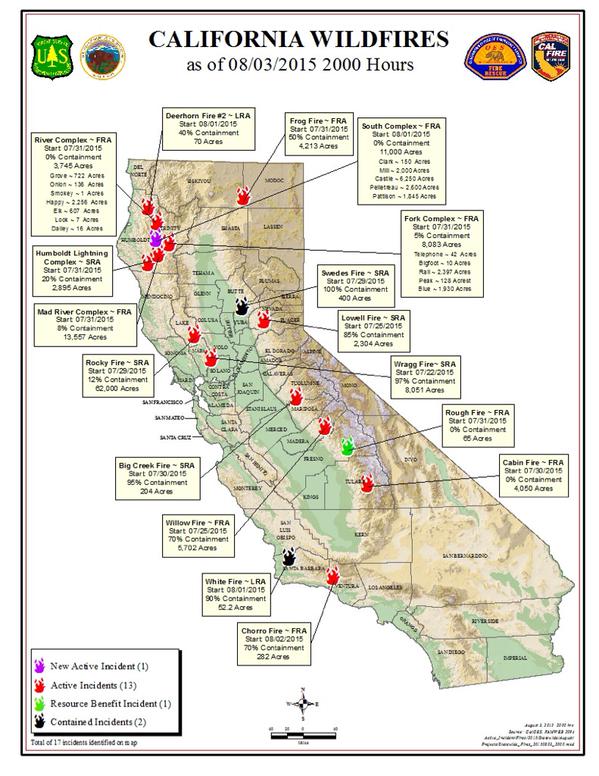
Fire activity in California.

Fire activity in California.

·       The South Lake Tahoe Fire Department has installed automated external defibrillators in all city staffed buildings.

·       The Tahoe Kids Triathlon hosted by Athlete’s United and Epic Tahoe Adventures will be at the South Lake Tahoe rec center on Aug. 16 at 1pm.

·       Here are the El Dorado-Tahoe and Sierra roadwork schedules from Caltrans for the week.

·       There will be a tea party at the Children’s House located on the grounds of the Hellman-Ehrman Estate at Sugar Pine Point State Park on Aug. 5. A special tour of the “Big House” is included in this event that supports the Sierra State Parks Foundation. Tickets and more information are available online.


Wine industry takes root in Nevada

By Margo Bartlett Pesek, Las Vegas Review-Journal

Nevada’s emerging wine industry is expanding into new areas, offering winery visitors different experiences and opportunities for agritourism.

The Silver State joins a national trend toward proliferating vineyards and wineries. In the drought-prone Southwest, vineyards are rapidly replacing traditional crops that use much more water.

Just 60 miles from Las Vegas, Pahrump Valley Winery is Nevada’s first and largest winemaker. Follow state Route 160 over Mountain Springs Pass into Pahrump Valley. As you enter the town of Pahrump, turn right at the first stoplight onto Winery Road. The entrance to the winery is about a half mile from the highway. Developing since the 1990s, the Pahrump facility offers year-round wine tours, a tasting room, a gift shop and Symphony, a “white-linen” restaurant open for lunch and dinner.

Read the whole story


Barton takes steps to improve area’s health

By Lake Tahoe News staff

Mental health, substance abuse and access to healthcare services are the main concerns of people on the South Shore, according to Barton Health’s 2015 Community Health Needs Assessment.

Other issues to be addressed include: Alzheimer’s disease, cancer, heart disease and stroke, infant health, injury and violence, nutrition and weight, oral health, and tobacco use.

The Affordable Care Act mandates these studies be done every three years, with this being the second one for Barton. The information was collected from community members, health professionals, and national Census data.

Assessment highlights:

·      Substance abuse ranked as the No. 1 major problem.

·      The ratio of primary care doctors to patients in the region is less than the California or U.S. proportion. In the past year, 20 percent of patients had difficulty finding a physician and 25 percent struggled to schedule a physician visit. More than 25 percent of survey responders reported not having a specific source for ongoing care.

·      Responders indicated mental health as a major problem. Nearly 30 percent of responders showed signs of chronic depression for more than two years and only half have been diagnosed with depression.

·      Suicide rates are above the state and national average.

·      Seventeen percent reported experiencing emotional abuse in the past or present.

·      Deaths from liver disease and drug use increased from the 2012 assessment and remain above California and national levels. One third of responders reported being excessive drinkers and 7 percent admitted to drinking and driving within the past month. Five percent had sought help for an alcohol or drug problem.

·      The majority of survey responders met physical activity guidelines, and 41 percent of adults and 72 percent of children identified as a healthy weight. Fewer adults and children were overweight or obese compared to California, Nevada, or national levels.

·      Violent crime and homicide rates were both low.

·      Teen pregnancy rates were half the national average.

Lake Tahoe News asked Leanne Wagoner, Barton community relations manager, a few questions about the assessment:

LTN: What steps did Barton take three years ago to deal with top needs in the assessment?

Wagoner: Barton Health staff has worked with numerous community partners, including the Community Health Advisory Committee and Lake Tahoe Collaborative, to create and implement more than 20 action items to address the top health concerns in the community.

Between 2012 and 2014, Barton Health awarded $25,000 each year in community health grants to organizations with projects that addressed the top three health priorities: mental health, substance abuse and access to healthcare. In 2015, Barton Health doubled the amount and will award $50,000.

Barton Health has provided volunteers and financial support for community-based initiatives, including the Drug Store Project, Every 15 Minutes, Sober Grad Nights, and educational classes such as Mental Health First Aid. To assist community members with finding the appropriate community resources, Barton Health now annually creates a “Health and Wellness Directory,” a free community resource guide comprised of local health and wellness resources. In addition, the top health issues are woven into free wellness lectures conducted by Barton physicians and clinicians, articles in submissions to local media and every Health & Life magazine, and a poster and advertisement series.

Barton Health continues to expand services for mental health. Staff has contracted with a second psychiatrist at Barton Psychiatry and hired a full time clinical social worker at Barton Community Health Center. The demand for counseling services and social service guidance is high and Barton is currently in the process of hiring an additional social worker. Because services are often restricted to a county or state, Barton Health collaborated with mental health agencies to create a process for Legal 2000, the ability to transfer mental health patients across state lines, which increases Barton’s ability to place patients in need of in-patient psychiatric care from five to nine facilities, improving access and expediting appropriate care. Barton Health hosted two well-attended mental health forums with partners and agencies in the fall of 2013 and spring of 2015, and formed a Mental Health Cooperative to address mental health issues. From the 2015 forum, a six-month action plan was developed identifying the following priorities: development of transitional housing, expand the health resource guide, implement coping skills programs for fifth-graders, attain local representation for NAMI, and launch a Mental Health Awareness campaign in May. All have been completed or are on target for completion this year.

Barton Health has implemented programs and protocols to address substance abuse. Physicians have received training in chronic pain management and an integrated pain management task force continues to help the program evolve. A Barton Health staff member chaired the Drug Free Coalition for a year and now leads the Reducing Access workgroup. In the fall, Barton Hospital’s Emergency Department will start implementing an Alcohol Brief Intervention Program to assess trauma patients for alcohol abuse and provide counseling services.

To improve access to health care, Barton expanded the Community Health Center by 3,000 square feet.  Barton added new specialties and telemedicine services for underserved community members, including those uninsured, underinsured, and Medi-Cal patients. With implementation of the Affordable Care Act, more than a dozen certified employees helped community members enroll in a health plan.  They hosted eight enrollment events, created a website link and telephone line to answer questions, and provided private appointments.

New services were also added. Additional service lines include Urology, Sleep Medicine, and Robotic Surgery. Barton expanded telemedicine services and created new partnerships with Tahoe Forest Cancer Center as well as a free Cancer Wellness Program. Transitions in Care was started to help patients being discharged from the hospital with chronic conditions, such as congestive heart failure, manage their conditions successfully at home to reduce the risk of readmission. Launched in spring 2015, Barton now offers a price estimator tool for certain procedures allowing patients to understand and plan for medical expenses, including a cost reduction program for MRI services.

LTN: With the data similar to what it was three years ago, it would seem like whatever was implemented didn’t really work. Can you speak to that?

Wagoner: Significant progress has been made. In 2012, access to care referred to the number of uninsured in our community. In less than three years, the uninsured population has reduced from 26.2 percent to 14.7 percent.  Barton Health’s certified enrollment counselors helped nearly 600 South Lake Tahoe residents navigate the insurance market and get the coverage they need. The 2015 Assessment shows new access to care hurdles that reflect demands from newly insured residents, which will be addressed in the 2015-2018 Action Plan.

With other results, we are seeing progress, but know it takes time and resources to see change. Mental health issues can be life long and difficult to diagnose and treat. Within the mental health category, Barton Health has expanded the telemedicine psychiatry services and has hired an additional psychiatrist and licensed social worker at the Community Health Center. This spring, Barton developed a Mental Health Cooperative with other agencies to implement a mental health action plan and has received a rural health grant to implement preventative and action measures to address mental health issues. The South Lake Tahoe community has also seen an investment from the school district with the allocation of increased counseling resources at the middle and high school.

To help address substance abuse, Barton plays an active role in the South Tahoe Drug Free Coalition which has had a number of successes including the new Brief Intervention program at the high school. A permanent drug take-back bin is now located at the police department and this school year a Friday Night Live program will launch at the high school. Barton’s integrated pain management group will continue to work on protocols to responsibly address acute and chronic pain patients throughout our health system. The California Healthy Kids Survey is a survey administered by LTUSD illustrating perceptions and usage around substance abuse in addition to other behavioral health measures. Improvement occurred in certain categories such as: there was a decrease in frequency of alcohol use among three age categories for kids in the 2014-15 school year as compared to 2011-12; across all grade levels more teenagers now perceive marijuana use as harmful.

Mental health, substance abuse, and access to healthcare are almost always listed as “Areas of Opportunity” among other Community Health Assessments and fairly frequently end up as priorities for both rural and urban communities alike. Mental health and substance abuse cannot be solved by one entity and require time and collaboration between social service agencies and the individuals as well as community support.

LTN: Is Barton required by law to create a three-year action plan, or is this something you are doing on your own? How will the outcomes be measured?

Wagoner: Barton Health has gone above and beyond the Affordable Care Act requirement that nonprofit hospitals conduct a Community Health Needs Assessment and Action Plan. Barton Health has maintained Community Health as a strategic plan priority for the organization and has hired a community outreach liaison to oversee the Action Plan and strengthen community partnerships. Barton Health has donated funds for community projects that address community health needs and successfully acquired additional partnerships and funding sources to support the action plan.

Outcomes can be measured by community data such as the California Healthy Kids Survey, county public health data, results from the Community Health Needs Assessment, and law enforcement reports. Hospital data provides valuable insight into our patients and their care.  Barton has expanded services and hired new clinicians and primary care providers. The community resource guide is widely distributed and has expanded to include mental health services. Find Barton’s community investments highlighted in the Community Benefit Report.

—–

Notes:

·      The 2015 Community Health Needs Assessment results and summary are online.


Opinion: If you care about California, you should care about Salinas

By Joe Mathews

Do you worry about the future of California?

Then you should worry about Salinas. Because if this Monterey County town of 155,000 can’t build itself a brighter future, it’s hard to imagine other struggling places doing the same.

Joe Mathews

Joe Mathews

“Rich in land. Rich in Values. Ripe With Opportunity,” reads the slogan on a city website, and that’s no exaggeration. Salinas might be the richest poor city in California.

So many poor California cities sit well inland, but Salinas is just eight miles from the Pacific. It’s part of the prosperous Monterey Bay region, and close enough to Silicon Valley that rising apartment rents are a problem. The Salinas Valley is known as the Salad Bowl of the World, a center for producing leafy greens and berries at a time when healthy foods have never been more popular. It’s rich in culture — from the dynamic Alisal neighborhood to the old downtown — and the newest California State University campus is a 10-minute drive away. Its citizens are deeply engaged in their neighborhoods.

But, by the numbers, Salinas borders on the nightmarish. Its homicide rate remains stubbornly high — more than twice that of Los Angeles’; the year 2015 began with 10 shootings, including four deaths, in an 11-day period. It has some of the highest rates of child poverty in the state, and lags the rest of California in high school graduation rates, amount of park space per person, and measures of public health.

As a columnist traveling around California, this mismatch between its horrible statistics and its obvious strengths makes Salinas easily the most confounding city in the state. Why does Salinas add up to so much less than the sum of its parts?

Two of its handicaps are fundamental: it’s a midsized city and it’s in California. Salinas is one of 60 cities in this state of between 100,000 and 300,000 people, too many of which are dysfunctional; Salinas’ municipal sisters include bankrupt Stockton and San Bernardino. Many Salinas-sized cities started as smaller towns and grew to have all the problems of any urban place, while retaining the weak local governments and public resources of small towns. And California’s governing system famously limits the power of local officials to shape their communities’ own destinies.

Salinas, to its credit, has more than its share of people who have tried to transform the community anyway. Many of its leading citizens were part of the 1970s farmworker movement — or are the children of those who were — and there is almost no constituency for the status quo in Salinas. People know the city needs to change.

But, perversely, the ambitions of Salinas have served mainly to create more frustration.

People in Salinas are very good at starting things — but finding the public resources to maintain them has been harder. Driving around town, you can see how Salinas is littered with public institutions it couldn’t quite sustain so they had to be taken over by private entities — a golf course, a public swimming pool, a performing arts center. The struggling National Steinbeck Center is about to be rescued by CSU Monterey Bay.

Of course, Salinas has problems that are peculiar to it. While residents like to tout the wealth of the city’s agriculture industry, agriculture relies on low-wage workers and migrants, which is why agriculturally oriented cities are often poor and plantation-like in their social structure. And while Salinas boasts remarkable diversity, it’s also been marked by segregation and racism. Monterey County (Salinas is the county seat) was one of three California counties that, until recently, had to get federal approval for changes in its election rules because of its history of voting discrimination. The divide between East Salinas and the rest of the city dates back across decades of discrimination.

In this age of inequality, Salinas’s prosperous surroundings do it no favors. The economic successes of Monterey and the Bay Area can make the climb Salinas faces seem steeper than it really is.

It also makes people in Salinas feel isolated. Steinbeck called Salinas “a closed pot” cut off “from the sky and from all the rest of the world,” a line that still gets quoted by residents even though their city is a California crossroads. It’s right on Highway 101, linking north and south, the coast and the agricultural inland.

Salinas is an All-America City, too. That’s not opinion — it’s an official designation, issued just last month, by the National Civic League. And, suitably, it’s a double-edged award. It recognizes all the efforts in Salinas to address community problems—of which there is an all-American abundance.

Joe Mathews is California and innovation editor for Zócalo Public Square, for which he writes the Connecting California column. This column is part of Salinas: California’s Richest Poor City, a special project of Zócalo Public Square and the California Wellness Foundation. 


Tennis players duke it out at ZCTC

Melissa Jester returns a shot with partner Judy Spellman against Women's 7.0 division champions, Donna Rockwood and Patty Gilliland

Melissa Jester returns a shot with partner Judy Spellman against eventual women’s 7.0 division champions Donna Rockwood and Patty Gilliland. Photo/Carolyn E. Wright/Copyright

Past winners and newcomers have etched their names into the history book of the 32-year-old all doubles Tahoe Tennis Classic tournament at Zephyr Cove Tennis Club.

A record number of teams –121 — played in the July 30-Aug. 2 tournament. There were 170 people playing from as far away as the East Coast.

Hersch and Sheryl Herschman of Zephyr Cove, who started the tournament and ran it for the first 30 years, went home with winners’ shirts. He won the men’s 65 category with tournament director Bob Beutenmiller. They beat Richard Svedeman of Los Altos and Tad Yukawa of Palm Desert, 7-5, 6-3. Sheryl Herschman teamed with Carel James of Carson City to win 6-4, 6-4 in the consolation round of the women’s 7.0 over Ceci Chourre of Carson City and Susan Horst of Truckee, 6-4, 6-4.

Yukawa also made it to the finals of the men’s 50 with partner Ryan Johnston of South Lake Tahoe. They lost to Richard Johnson of Ballwin, Mo., and Terry Ward of Chesterfield, Mo., 7-5, 6-1.

The last players to walk off the courts were the four who battled it out in an epic three-setter in the 8.0 mixed finals. The No. 2 seeds and mother-son duo of Holly and Mitch Rittiman of Zephyr Cove triumphed over the No. 1 seeds Denise Hallerbach and Robert Skinner of Reno, 6-4, 5-7, 7-5.

8.0 Mens Division Champions and brothers, Dennis and Jim Thorne, defend an overhead from consolation round winners, Steve Reid and Randall Osterhues.jpg

Brothers Dennis and Jim Thorne, who won the men’s 8.0 division,defend an overhead from consolation round winners Steve Reid and Randall Osterhues. Photo/Carolyn E. Wright/Copyright

Skinner earlier in the day had lost the men’s 8.0 with partner Larry McFall of Reno. The brother duo of Jim Thorne of Sunnyvale and Dennis Thorne of Stateline prevailed 6-3, 6-2.

Hallerbach won the 8.0 women’s title with partner Laurie Sabol of Las Vegas by default. Carol Tretten of Reno and Joyce Youngs of South Lake Tahoe had to forfeit the final because Tretten injured her quadriceps while playing with her daughter, Holly, in the 9.0 category.

Winning the women’s 9.0 over the Trettens were Jeanette Berry and Laura Pierce of Reno, 6-4, 6-4.

Blake Beavers of Plano, Texas, and Holly Tretten of Reno, the No. 1 seeds in the 10.0 mixed, were easily defeated in the finals by Reno’s Dora Lane and Kevin Strawn, 6-3, 6-0.

In the men’s 10.0 division, the No. 1 seeds of Strawn and Tony Matkulak of Reno never dropped a set on their way to winning 7-6, 6-3 over Chris Evers and Dave Hagiwara of Folsom in the finals.

The No. 1 seeds in the women’s 7.0 were knocked off by the fourth seeds in three sets. Donna Rockwood of South Lake Tahoe and Patty Gilliland of Reno, who until this tournament had never played together, beat Carolyn Wright of Zephyr Cove and Becky LeBuhn of Glenbrook, 6-3, 3-6, 6-4.

Wright also reached the finals in the 7.0 mixed with partner R.J. Gardner of Stateline. As the No. 1 seeds, they were upset by No. 3 seeds Melissa Jester of Zephyr Cove and Heck Mata of Reno, 7-5, 3-6, 6-4.

Kurt Massing and Bruce Pate, who traveled from Texas, came up just short of returning to the Lone Star State as winners. Thor Spargo of Fair Oaks and Murray Yoffee of Gardnerville won the men’s 7.0 contest 2-6, 6-3, 6-4.

Only two teams competed in the women’s 10.0 division. Kim Iliffe of Mill Valley and Keri Mills of Davis topped Carol Akre of Martinez and Cynthia Reddick of Sacramento, 6-3, 6-1.


Living history of Vikingsholm

Helen Smith, who spent her first 14 summers at Vikingsholm, is the centerpiece of an effort to raise funds for the castle at Emerald Bay. The house is now part of a state park in Lake Tahoe.