Calif. meets drought-fueled fire season with extra crews
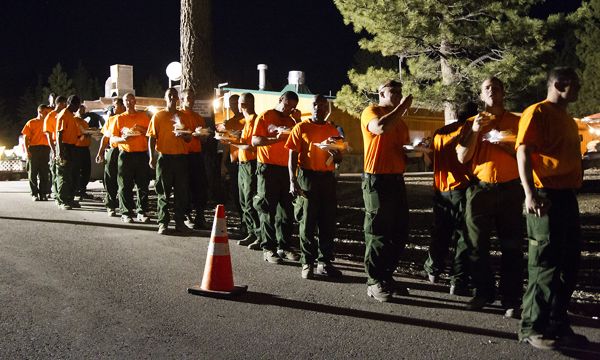
Inmates, temporarily calling Turtle Rock Park home, get dinner June 25 after working the fire line. Photo/Carolyn E. Wright/Copyright

Additional crews on many fire lines are inmates. Photo Copyright 2015 Carolyn E. Wright

By Janie Har, Associated Press

LAKEPORT —    f.

They bunk in tight sleepers and eat in a big mess hall. They depart in the mornings with enormous high-calorie sack lunches of sandwiches and cookies as others come back tired, footsore and hungry to their makeshift base at the Lake County fairgrounds.

The National Interagency Fire Center in Idaho has listed the fire 110 miles north of San Francisco as the nation’s highest priority for crews and equipment. It is the largest of 23 fires statewide and takes up nearly a third of the 10,000 firefighters dispatched in California, which has become tinder box amid years of drought.

The good news is state fire officials prepared for a drought-fueled fire season and staffed up early with several hundred more firefighters than previous years, CalFire spokesman Daniel Berlant said.

“We’re definitely at a medium to high level of activity but we’re not at extreme, where we are low on resources by any means,” he said. “That helps us out if there are new fires.”

Across the U.S., 118 fires are burning on 2,757 square miles, according to the Idaho fire center. About 17,200 people are fighting those fires, but resources are not tapped out yet, center spokeswoman Robyn Broyles said. If civilian crews run low, officials can call on national guard and military crews.

August is the height of fire season, and while the number of fires nationally is below average, the 9,361 square miles burned to date is about 50 percent above average. Most of that — 7,731 square miles — has been in Alaska.

On Wednesday, evacuation orders for a small Washington town were lifted after a fast-growing wildfire bypassed the community.

Fire spokesman Ron Fryer said people were being allowed back into their homes in Roosevelt, about 120 miles east of Portland, Oregon. He said the grass fire that began Tuesday has grown to 26 square miles.

In California, CalFire has responded to 4,200 fires this year — 1,500 more than average, Berlant said.

The biggest is in rugged terrain in Lake, Yolo and Colusa counties, and its cause is under investigation. More than 13,000 people have been required or urged to leave their homes, cabins and campsites, and at least 39 homes have been destroyed.

Some of the 3,400 firefighters on the blaze have been here since it started a week ago. The fire, which was 30 percent contained Wednesday night, isn’t expected to be fully corralled until at least Monday.

As much as crews love the work, fatigue inevitably sets in.

“This is our seventh day,” said Seaton King, a battalion chief with the Pasadena Fire Department. He returned from a shift protecting structures and cutting low tree limbs.

“You kind of get used to it, but it’s still taxing in terms of being up and available for those 24-hour work cycles.”

California fire officials say their biggest concern is that forecasts call for lightning that could spark more blazes.

Since July 1, when the new fiscal year started, CalFire estimates it has spent $63 million battling large wildfires. Last fiscal year, it spent an estimated $434 million.

Bills for firefighting are adding up across the country. On Wednesday, the U.S. Forest Service released a report showing rising firefighting costs are affecting national forest conservation, restoration, recreation and management programs.

Firefighting costs now consume more than 50 percent of the Forest Service’s budget, compared with just 16 percent in 1995. They are expected to comprise two-thirds of its budget in 10 years if left unaddressed.

At the fire camp here Wednesday, freshly returned firefighters in blue sat at long tables and dug into bowls of fruit, corned beef hash and fried eggs. They told jokes and drank coffee named after Justin Bieber, Johnny Cash and Metallica, to indicate strength.

Fire trucks parked outside hailed from Long Beach, Los Angeles and Riverside. Nearby were large white mobile sleepers that could fit 45 weary firefighters. Some preferred to pitch a tent.

“It’s tiring work, no doubt about it. But most of these guys are in really great shape, and they thrive in this environment,” said Hugo Patino, Modesto Fire Department battalion chief.

Mike Burt with the Glendale Fire Department in Los Angeles County said his crew received a call to help last Thursday morning and was in Lakeport that afternoon.

“I’d like to put my feet in an ice chest basically, but I won’t do that,” he said, laughing. “That would feel pretty good.”


Opinion: Teaching social skills makes a difference

By David Bornstein, New York Times

In the early 1990s, about 50 kindergarten teachers were asked to rate the social and communication skills of 753 children in their classrooms. It was part of the Fast Track Project, an intervention and study administered in Durham, N.C., Nashville, Seattle and central Pennsylvania. The goals were to understand how children develop healthy social skills, and help them do so.

Using an assessment tool called the “Social Competence Scale,” the teachers were asked to assign each child a score based on qualities that included “cooperates with peers without prompting”; “is helpful to others”; “is very good at understanding feelings”; and “resolves problems on own.”

This month, researchers from Pennsylvania State University and Duke published a study that looked at what had happened to those students in the 13 to 19 years since they left kindergarten. Their findings warrant major attention because the teachers’ rankings were extremely prescient.

Read the whole story


SLTFD training

South Lake Tahoe firefighters demonstrate what it takes to extricate someone after a vehicle accident.


Boutique fitness studios gain in popularity

By Rachel Bachman, Wall Street Journal

Alison Dougherty used to pay $30 a month for a health club membership. She’s much happier now that her fitness expenses average $500 a month.

The 27-year-old New York marketing professional exercises at Title Boxing Club NYC. She spends $139 monthly for unlimited classes and $100 for weekly personal-training sessions. She says even though the boxing studio presents fewer options, the workouts are more fun and effective than her treadmill-and-weights sessions were at the gym.

Specialized fitness studios used to be pricey enclaves for a few fanatics. But the ranks of their fans have surged, and now stand-alone cycling studios, boot camps and ballet barre rooms are transforming the fitness industry.

Read the whole story


Elite dancers offering classes through LTCC

The Lake Tahoe Dance Connection is bringing professional dancers and choreographers from Broadway, Los Angeles, and the Joffrey Ballet to South Lake Tahoe for a weekend of dance, professional instruction, and fun.

This is a unique opportunity for dancers in and around the Tahoe basin to learn from elite dancer.

The Aug. 12-16 classes are through Lake Tahoe Community College’s Connect Community Education. It’s possible to take classes all six days, one day or single classes.

Dance studios that bring 10 or more dancers will receive a 20 percent discount.

LTDC is open to a variety of age groups and will be offering classes in ballet, hip hop, contemporary, and musical theater, all at an intermediate level.

For more info, go online. To register, call 530.541.4660, ext. 717.


California could allow more felons to vote

By Paige St. John and Timothy M. Phelps, Los Angeles Times

California Secretary of State Alex Padilla on Tuesday reversed the course set by the state elections chief before him and dropped efforts to prevent some 45,000 state felons from voting.

The move brought cheers from those seeking greater rights for former prisoners and comes as California is rethinking some of its get-tough criminal justice policies.

A lawsuit challenged a rule created by former Secretary of State Debra Bowen after California in 2011 enacted legislation that required lower-level felons to serve their time in jails instead of prison, or when released from prison on community probation instead of state parole.

Read the whole story


3-day SUP races in Kings Beach

The Ta-Hoe Nalu Paddle Festival at the Kings Beach State Recreation Area will feature two new races during the Aug 14-16 event.

The event will start that Friday at 2pm with registration and yoga. The day includes a concert featuring Mojo Green from 6:30-8:30pm.

The festival will continue through the weekend with retail and food vendors, demos, contests, prizes and more. A portion of proceeds from Ta-Hoe Nalu will support local organizations.

For more info, go online.


Letter: Stop overdeveloping the Tahoe area

To the community,

Two spectacularly bad ideas:

Martis Valley West (MVW) and the Brockway Campground (BC) are Proposals with cumulative impacts:

1. Sierra Pacific Industries (SPI) and Mountainside Partners (aka East/West) is the developer on both.

2. Both adjacent projects are located on the ridge overlooking Tahoe and Truckee one mile west from Highway 267 on Mt. Watson Road.

3. Both projects propose massive development-MVW is 760 homes in a gated community plus 6.6 acres of commercial. Brockway Campground is huge-550 campsites/RV spaces/yurts on approx. 150 acres. (Yosemite is 1,169 square miles and has only 1,445 campsites.)

4. 4,000-plus people will occupy the iconic ridge between Tahoe and Truckee; 1,900-plus for the gated community MVW and up to 3000 for the campground (Yosemite Valley Family Campground’s 459 sites accommodate 2,754 people)

5. Both projects will alter the rules: MVW lands will require rezoning from forest/conservation and the campground will require a special use.

Why these two adjacent proposals are a terrible idea for the region:

1. Destruction of an important wildlife corridor and natural setting.

2. Degradation of an important recreational open space.

3. Traffic congestion and gridlock.

4. Diminished air quality.

5. Permanently ruins community character and vision.

6. Dangerous precedent to justify further development along Tahoe’s iconic ridgelines.

7. Loss of nighttime dark skies.

8. Ground water loss.

9. Scenic loss.

How much can the Tahoe basin absorb before you don’t recognize it anymore? Isn’t trading development from the Martis Valley onto the ridge above Tahoe just moving Truckee problems to Tahoe which has less capacity to handle them? Who is looking at the big picture? Where is TRPA?

Anne Nichols, North Tahoe Preservation Alliance


Mark Twain to come to life on South Shore

Chautauqua performer MacAvoy Layne will perform An Evening with Mark Twain at Taylor Creek Visitor Center on Aug. 7 at 7pm.

Samuel Clemens came to the shores of Lake Tahoe in 1861 to stake a timber claim and returned less than two years later as Mark Twain, reporter and columnist for Virginia City newspaper Territorial Enterprise. Twain’s early visits to Lake Tahoe are that of adventure, tragedy, and self-discovery.

For more than 25 years, Layne has been portraying the wit and wisdom of Twain.

The $5 donation goes the Tahoe Heritage Foundation. Tahoe Heritage Foundation, a non-profit that partners with the Forest Service to preserve the culture and natural history of Lake Tahoe, hosts this event at the Lake of the Sky Amphitheater. Taylor Creek Visitor Center is located approximately 3 miles north of South Lake Tahoe on the lakeside of Highway 89.


Newfangled slots aim to hook younger players

By Jeff Barker, Baltimore Sun

Many slot machines on casino floors bear images of faded but recognizable movies or TV shows such as “Sex and the City,” “Ghostbusters” or the still-running “Wheel of Fortune,” appealing to an older generation of players who reliably play the random games of chance.

But time and technology are catching up with traditional slot machines, which don’t hold anywhere near the same appeal for younger players as they do for their parents. Slots simply can’t compete with the variability and social nature of the window through which most young people view the world — their smartphones.

Slots play “has kind of been slowing down nationally. It’s not advancing as fast as table play,” said David G. Schwartz, director of the Center for Gaming Research at UNLV. “Today, anybody who has the disposable income to play a slot machine has something in their pocket that is way more entertaining than that slot machine.”

Anxious about millennials’ indifference to slot machines, manufacturers are testing more social and interactive games that would make the casino floor of the future look like a cross between a TV game show and a NASA flight control room.

Read the whole story