Report: Sage grouse numbers surged in ’14 and ’15

By Phil Taylor, E&E Publishing

Greater sage grouse numbers in the West have grown by nearly two-thirds since 2013, marking what could be a significant rebound to the bird’s previous several years of decline, according to scientists in Western states.

Western state biologists said they spotted 80,284 male sage grouse across the West in 2015, a 40 percent jump over the 57,399 that were spotted in 2014 and 63 percent over the 49,397 that were spotted in 2013, according to yet-to-be-published research compiled by the Western Association of Fish and Wildlife Agencies and shared with Greenwire.

Sage grouse experts caution against drawing conclusions from the two-year spike, noting that sage grouse populations appear to fluctuate on roughly decadelong cycles and are influenced in the short term by precipitation.

Read the whole story


UNR profs at center of geothermal study

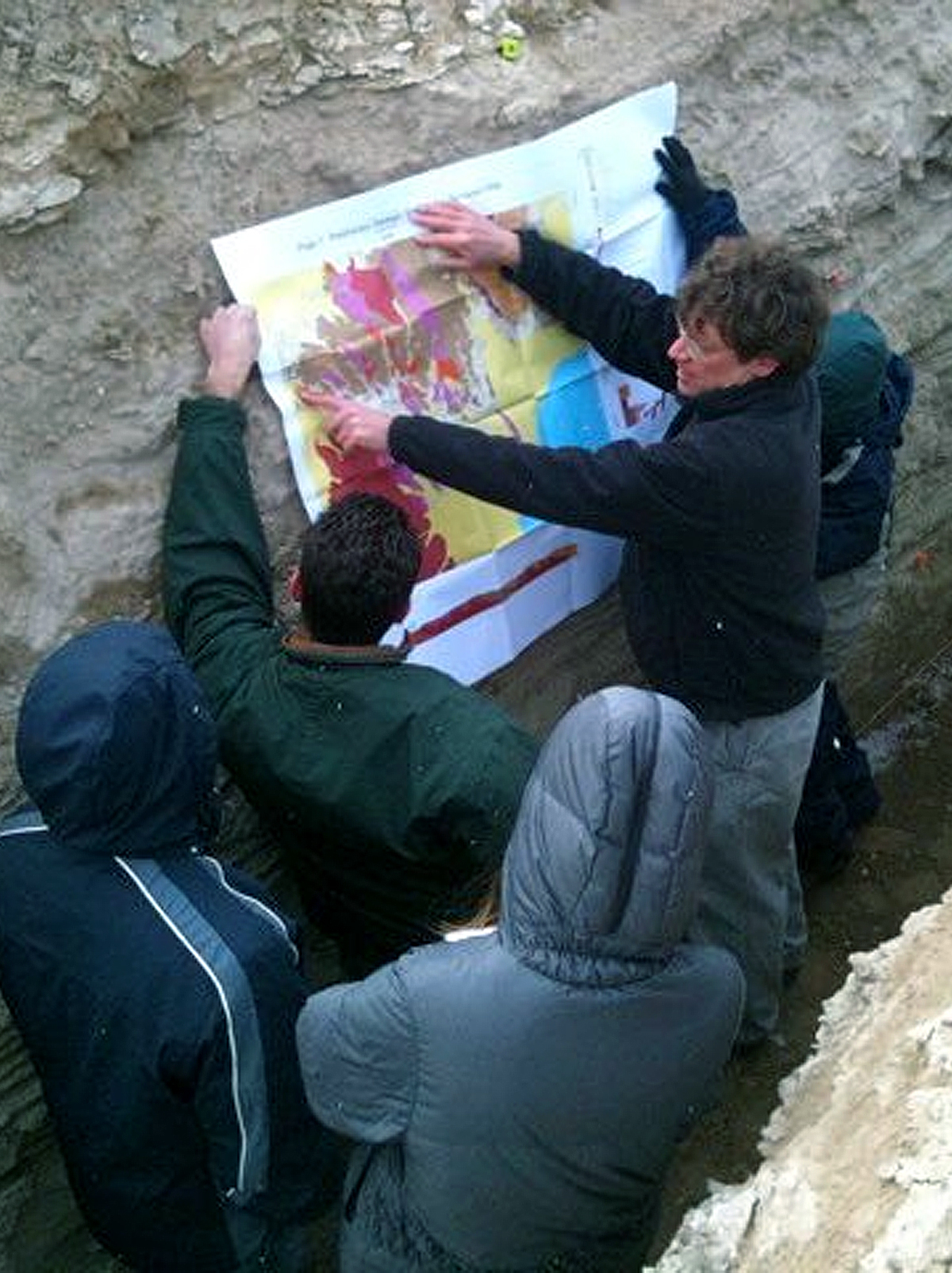
Director of the Nevada Bureau of Nevada Mines and Geology Jim Faulds talks about mapping geothermal resources with students. Faulds is leading the University of Nevada, Reno efforts in the recently funded Department of Energy FORGE project to identify a site to develop enhanced geothermal systems. Photo courtesy of University of Nevada, Reno.

Jim Faulds, director of the Nevada Bureau of Nevada Mines and Geology, talks about mapping geothermal resources with students.  Photo/UNR

Two researchers from the UNR are poised to play a key role in a project that has the potential to unlock massive resources of power generated from geothermal sources.

Professors Jim Faulds and Wendy Calvin, among the world’s leaders in the understanding of geothermal systems, are providing their expertise to the project funded by the U.S. Department of Energy.

The project dubbed FORGE – short for Frontier Observatory for Research in Geothermal Energy – seeks to dramatically widen the number of potential locations where power could be produced from geothermal resources.

The UNR researchers will provide geologic modeling of two potential FORGE sites – one near Fallon and a second near Coso in California. The establishment of FORGE at these two sites will provide the geothermal community a field laboratory where the science and engineering needed for widespread commercialization of enhanced geothermal systems can be developed and refined.

The FORGE project seeks to develop enhanced geothermal technology for use at locations where heat is available but water doesn’t naturally flow through the underground rock. Those locations are widespread through the Great Basin.

But the geological challenges are difficult, he said, because researchers need to find ways to open formations sufficiently so that water can move through the heated rock and become steam to drive generating units.

“We know that there are huge resources in the subsurface,” the geologist said. “Finding that fluid flow is the trickiest part.”

The researchers based in the University’s College of Science bring valuable experience to the FORGE team: experience that will make that job easier.

“We have a long history of working with the geothermal systems in the region and understanding the geologic setting of those systems,” Faulds said.

Participation in the FORGE project provides an opportunity for University researchers to widen their knowledge of geothermal operations and maintain the state’s position on the cutting edge of development of the geothermal industry.


Bobcat trapping to cease in California

The California Fish and Game Commission voted 3-2 this week to ban bobcat trapping statewide.

Commission President Jack Baylis and Commissioners Anthony Williams and Eric Sklar voted in favor of a statewide ban. Commission Vice President Jim Kellogg and Commissioner Jacqueline Hostler-Carmesin voted against it.

The decision completely bans bobcat trapping in California, with the exception of depredation trapping.

The ban will become effective after approval by the state Office of Administrative Law and submission to the Secretary of State. The regulations may be effective before the start of the 2015-16 bobcat trapping season.

— Lake Tahoe News staff report


Snippets about Lake Tahoe

montbleu·       The Lake Tahoe Craft Beer Festival is Aug. 8 at MontBleu in Stateline. More info is online.

·       Jimmy LaFave & the Night Tribe will be at the Boathouse Theatre on the South Shore on Aug. 12 at 7:30pm. For more info, go online.

·       Soroptimist International of South Lake Tahoe’s annual wine shindig is Oct. 16 from 6:30-9pm at MontBleu. For more info, go online.

·       Tahoe City is celebrating its 152 birthday all day Aug. 8. For more info, go online.

·      James Beard award winning author Hank Shaw of Honest-Food.net will be cooking a multi-course meal that celebrates the natural bounty of Northern California and his passion for Italian cuisine. The dinner is at Stella in Truckee on Aug. 26-27. For more info and to buy tickets, go online.


Brown highlights climate change risks at fire site

By Chris Megerian, Los Angeles Times

In his quest to force tougher action on climate change, Gov. Jerry Brown has traveled to China, Mexico, Canada, even the Vatican.

But he was much closer to home on Thursday, just a couple dozen miles from the ranch his family has owned for generations.

Standing in front of scorched hills, the smell of smoke lingering in the air, Brown said the wildfire that had ripped through the area was evidence that global warming already has created dangerous conditions in California.

“This is a real wake-up call,” the governor said. “It’s a new normal.”

Read the whole story


Author to give reading in Meyers

Author Mojie Crigler will read from “Get Me Through Tomorrow: A Sister’s Memoir of Brain Injury and Revival” at Bona Fide HQ in Meyers on Aug. 13.

bookIn intimate and unflinching prose, Crigler chronicles her brother’s medical saga while drawing on memories of their unusual childhood. “Get Me Through Tomorrow” is much more than the story of a medical victory amid a broken healthcare system. It is about a sister’s metamorphoses from fearful naïf to assertive caregiver. It is about families bridging heartache and divorce to find hope. It is about the deep, enduring relationship between siblings—and the love that transforms both.

Crigler’s fiction and nonfiction work have appeared in Glimmer Train, Los Angeles Review, Drunken Boat, Hunger Mountain, The Rumpus, The Believer, and in the collection “Tahoe Blues” published by Bona Fide Books.

The free talk is at 7pm. Bona Fide is at 1069 Magua St., No. 4, Meyers — behind the Getaway Cafe.


Evidence of wolf in California

The California Department of Fish and Wildlife has collected evidence that suggests at least one wolf has traveled into Siskiyou County.

Based on compelling information received earlier this year from Californians reporting they saw a large, dark-colored canid, CDFW deployed a number of remote trail cameras within southeastern Siskiyou County.

At one location, in early May, images were captured of a large, dark-colored, lone canid, which is possibly a dispersing gray wolf. Although scat was collected in the area for genetic analysis, they yielded poor-quality DNA and results were inconclusive. Since then, no other images of a large canid have been captured at this location.

In early June, CDFW biologists came across large canid tracks on a dirt road in a separate, remote location of Siskiyou County, while searching for fawns as part of an ongoing deer study. The tracks were fresh and were from a single animal. Some were within the tire tread marks made from a CDFW vehicle the day before. Assumptions based on the track’s size, linear nature and distance, compelled CDFW staff to place a trail camera to remotely capture images of subsequent animal activity along the roadway.

On July 24, CDFW downloaded a series of images from that camera taken the previous week, revealing a large, dark-colored canid. Although other wildlife species and a few passing vehicles were also photographed, there were no images of domestic dogs or other human activity.

Based on the photographic images and tracks, CDFW biologists believe that this lone animal is a gray wolf. The animal’s tracks are significantly larger than those of a coyote, and a comparison of the images with photos of an adult coyote captured at the same site indicate the animal is significantly larger than a coyote.

Additional remote cameras have been deployed and CDFW wildlife biologists will return to the location in an attempt to find scat for subsequent DNA analysis to conclusively confirm whether or not this animal is a gray wolf.

Prior to the arrival of the famous wolf OR7 in December 2011, the last confirmed wolf in California was in 1924. This animal is not OR7. OR7 has not been in California for more than a year and is currently the breeding male of the Rogue Pack in southern Oregon.

Gray wolves are listed as endangered under the Federal Endangered Species Act (ESA). In June 2014, the California Fish and Game Commission voted to list gray wolves as endangered under the California Endangered Species Act.


Domestic violence perp on the run in Truckee

Truckee police officers spent the better part of Thursday night looking for a man accused of domestic violence.

Corbin Nunnally

Corbin Nunnally

Corbin Nunnally, 30, left the Gateway shopping center on Donner Pass Road when police arrived about 5pm Aug. 6. Officers were told a woman was in distress.

Nunnally is wanted for his possible involvement in several felonies including domestic violence, kidnapping, child endangerment and robbery. Nunnally is not known to have any weapons, but is considered dangerous based on the nature of the crimes.

He is described as a white, having a shaved head, last seen wearing a long-sleeve white button up shirt and light colored Dickie style pants. He may have changed clothes to basketball shorts and a white sleeveless T-shirt.

— Lake Tahoe News staff report


Scientist: Fires in Sierra Nevada to worsen

By Kathryn Reed

No one thing can be blamed for the proliferation of catastrophic fires, but there are some things that could be done to help combat them.

“So much is driven by politics. As a scientist, I’m not sure I have much control, Hugh Safford said.

Safford, a regional ecologist with the U.S. Forest Service, gave a talk Aug. 4 at the South Lake Tahoe Library about what is going on in the Sierra Nevada when it comes to managing the forest as well how fire and climate change play a role.

Suppression and the lack of fire are equally devastating to the ecosystem, he said. He believes more fires should be managed instead of immediately extinguished. This will create a more natural forest that is healthier. He’s also an advocate of controlled burns.
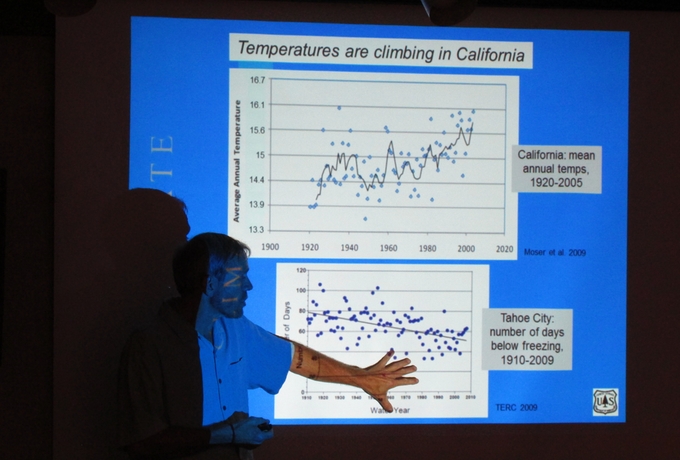
Hugh Safford, a USFS ecologist, talks about fire and the ecosystem of the Sierra Nevada on Aug. 4. Photo/Denise Haerr

Hugh Safford, a USFS ecologist, talks about fire and the ecosystem of the Sierra Nevada on Aug. 4. Photo/Denise Haerr

Fires are burning hotter than ever before because there is so much fuel as well as other changes like air temperature.

“Sixty-eight percent of the conifer stands have not burned since 1900,” Safford said.

Areas used to burn about every 10 years. They did so with less intensity and consumed small swaths.

The increase in overnight temperatures is having a huge affect with the growth of fires and the inability to quickly contain them. Humidity is not rising overnight with the higher temps, which means the fires are not dying down at night. This is when crews could get a handle on a fire. It is difficult for firefighters to work at night because of the lack of visibility.

“Precipitation is growing, but the snowpack is going down. That is driven by temperatures,” Safford said.

He said the indicators are that temps will increase 5 to 9 degrees by the end of the century. That would be like Davis having summer temps equivalent to Phoenix’s. For Lake Tahoe it will be like being in Nevada City.

“Poison oak will be here, oaks, algae in the lake. It is going to be a very different place,” Safford said.

The higher temps also mean less dew is forming. That little bit of moisture is what some animals rely on as their water source.

Fire is also impacting wildlife because animals’ homes are destroyed and won’t be “rebuilt”. The heat intensity is such that trees won’t grow because there are no seeds to naturally sow, and most often replanting has failed.

What ends up growing are shrubs. If shrubs are what burned, then it’s grass that sprouts. The landscape is changing because of catastrophic fires. That in turn impacts everything associated with what was once a forest of trees. This includes water quality and clarity.

Safford would like to be more experimental when it comes to dealing with managing the forests. He said his agency plans too much and doesn’t take enough risks. He also acknowledged those plans get challenged with lawsuits without ever being put to the test to see if they work.


Opinion: Learning from strangers

By Debra Carpenter, Huffington Post

“Come on, it’s time to go! I’m burning up out here!”

I sat at the neighborhood park, ablaze with the summer heat and more than a little irritated that my daughter was taking so long to finish her “last” go around on the jungle gym. She continued to play, blissfully unaware of my growing aggravation.

I called for her again, this time with a scary edge to my voice — “I SAID, IT’S TIME TO GO! WE HAVE THINGS TO DO!”

The woman sitting next to me turned to me, touched my arm, and smiled understandingly. If she had smiled any other way — sarcastically, condescendingly,or even gleefully — I might have yelled at her, too.

But no, she seemed understanding and kind and way better at the parenting thing than I was. Her two grandchildren were peacefully playing and had been since we got there. Without her saying a word, I could already tell — this woman was wise.

Read the whole story