SLT recreational pot ordinance takes shape

By Kathryn Reed

Recreational marijuana is going to be for sale in South Lake Tahoe. When still remains to be seen, but most likely by summer.

The City Council made substantive progress March 27 in regards to this controversial topic that has languished for months.

Some of the major decisions the council agreed to include in the proposed ordinance:

·      Up to three recreational marijuana shops.

·      Development agreements would be allowed.

·      The applicants will go through a merit based process, with preferential treatment to locals.

·      Special use permits would be required.

·      Background checks would be a necessity.

·      Staff will look at the public safety and application procedures.

·      No micro businesses will be allowed in the first year.

·      There will be no limits on the various license types with exception to retail.

·      Delivery services will be allowed.

What will come back is a draft ordinance, which should be at the April 17 regular City Council meeting. The public will still have time to sway the council at at least two public hearings on that document.

The council members can also add, delete or amend what the city attorney brings forward. Sergio Rudin with Burke, Williams and Sorensen law firm handled the city attorney duties for the night.

Application procedures and minimum requirements for development agreements will be created by staff. These will likely be handled by a separate resolution and may not be ready in April.

Onsite consumption is one of the sticking points. The city attorney will bring the council more information. Tahoe Wellness Cooperative, the medicinal pot shop in town, has allowed onsite consumption since Day 1, so there is a precedent for this activity.

The special meeting started with a presentation from the planning department and then one from law enforcement. Acting City Manager Jeff Meston then wanted to go over seven pages of questions.

At that time Councilwoman Brooke Laine said it was more important to be answering questions the community cannabis working group came up with and flushing out concerns the council had. Meston’s questions never got addressed, at least not how he intended.

Rudin confirmed the draft ordinance for adult use marijuana was 90 percent complete. This is because the council had previously agreed to adopt most of what the community working group had come up with.

Rudin then took over the meeting, getting the council to focus on the handful of issues he needed consensus on.


Opinion: Pointing out SLT’s flawed processes

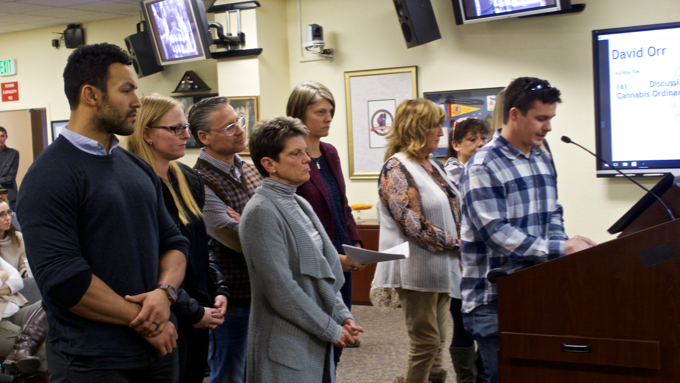
Members of the South Lake Tahoe recreational marijuana working group stand with David Orr as he addresses the City Council on March 27. Photo/Kathryn Reed

Publisher’s note: The following was read to the South Lake Tahoe City Council on March 27 by David Orr, a member of the city’s recreational marijuana working group.

After South Lake Tahoe voters overwhelmingly approved Proposition 64 in November 2016, the city of South Lake Tahoe began the process of considering local cannabis regulations in August of 2017. As part of that process, the City Council subcommittee opted to create our working group that has dedicated significant time and energy to helping determine the best cannabis regulations for our community. The working group met seven times over 12 weeks and spent a total of 24 hours discussing potential commercial cannabis policies for the city of South Lake Tahoe.

Members of the committee represented a full range of perspectives, from those who voted against Proposition 64 and were inclined to enact a local ban to those who wanted to see the proliferation of a robust cannabis industry in the city. The group recognized that state law permits recreational cannabis, and even those who would prefer a ban recognized the impact that state law would have on our community. With a ban, we would not be able to eradicate a black market and there would still be impacts on our youth, health system and medical services.

As such, the group consensus moved to developing smart policy that regulated local cannabis operations, while providing resources for enforcement, education, and prevention that would otherwise be unavailable to our community.

The group focused on developing a framework that allowed commercial activity in the city, that balances the desire to avoid a proliferation of businesses, but embraces a tightly regulated structure that allows smart local growth of the industry. This group is standing here together because we came to 100 percent consensus in our recommendations, and we stand by those recommendations.

Democracy is messy, which means that although we didn’t always agree completely, we did agree that coming together and compromising on recommendations was the best path forward to achieve good, and democratic policy in our city. We also understood and recognized our recommendations would provide a framework for City Council and community discussion and not necessarily translate into the final policy adopted by council, similar to what happened in the VHR process.

However, what started out as a positive, constructive process has instead devolved into a process excluding our group and left us dismayed by a dismissive staff process. We understand that we all have biases, but the way staff has dismissed consideration, conversation and engagement as a result of those biases isn’t just frustrating, it is damaging to the public’s trust in the City Council’s process.

We cannot emphasize enough the work that went into this process. Our recommendations were the culmination of significant, thoughtful analysis in consultation with lawyers, law enforcement, industry experts, healthcare providers, educators, parents and community leaders. Our preparation packets included robust data and credible studies on both sides of the issue from California and other states that have legalized adult use cannabis. We encourage you to review those packets, minutes and report, as they were prepared thoughtfully and with the goal of helping determine the best local policy for our community.

We twice presented the report that came from hours of deliberation to City Council, and neither time were we asked a single question about our detailed and comprehensive recommendations, even as part of the council workshop. A month and two additional council meetings later, council has yet to meaningfully discuss our recommendations or policy direction at all despite having tasked us – committed community members – with the important responsibility of crafting a framework for that discussion. Those recommendations have been covered in the press and there has been no public outcry by pro-cannabis activists or anti-cannabis activists, demonstrating our recommendations are not controversial.

Additionally, we have concerns about how staff has set up [Tuesday’s] meeting. For example, staff has provided numerous questions for council and included columns for council to essentially “vote” on each of these, presumably ahead of the meeting, which could be viewed as making decision outside of the public process, which would be illegal.

The current process set up by staff diverges from council direction and the process used in previous subcommittee structures. Without a consistent and transparent approach, fewer and fewer citizens will trust the City’s process or be willing to engage in future subcommittees knowing that their time and effort could be tossed aside, as ours has been to date.

We urge the council to be consistent with the process it used in the VHR debate, where they convened a subcommittee, reviewed and considered their recommendations in the form of an ordinance and made changes to that policy. Staff’s professional recommendations in VHR discussion were generally limited to their role in implementation, such as how to implement the VHR cap, etc.

An ordinance consistent with Proposition 64 has been drafted that follows our recommendations and would allow such a discussion. We appreciate your consideration and ask to be meaningfully included as you develop the next steps in your conversation on this important policy.

Peggy Eichorn, Jane Flavin, Julie Garrett Wright, Liz Hallen, Kelsey Magoon, Rosemary Manning, Kevin McHugh, David Orr, Francisco Rodriguez, David Turner, Christina Wilson, Jude Wood (* Devin Middlebrook is out of the country)


LA Times lawsuit alleges county violated opening records law

By Jack Dolan, Los Angeles Times

 The Los Angeles Times has sued L.A. County, accusing it of repeatedly and routinely flouting laws designed to ensure government transparency.

Over the last year alone, county officials have refused to release information about the status of homicide investigations, allegations of sexual misconduct against prosecutors and even mundane information such as email addresses for Sheriff’s Department employees, the lawsuit says.

County officials also ignored a request for copies of two instruction manuals coaching employees on how to respond to such requests, according to the lawsuit. One of the manuals is titled “California Public Records Act ‘Emergency Kit’ for County Counsel.”

Read the whole story


Nev. pot sales dip in January, still beat projections

By Colton Lochhead, Las Vegas Review-Journal

Nevada’s recreational marijuana market can’t seem to figure out which way to go.

Sales numbers for the Silver State’s new green market have fluctuated each month since it opened in July, going from an up month to a down month.

That trend continued in January, when roughly $32.8 million in marijuana was sold. That was down from December’s $35.8 million total, according to statistics published by the state this week.

Read the whole story


Ski resorts fight climate change with snow blowers and buses

By Eric Niiler, Wired

After a wimpy winter, spring break has arrived, and skiers and snowboarders from Maine to Mammoth Lakes are stoked. More than 18 feet of snow has dropped at Squaw Valley in March; Utah’s famed powder resorts have finally broken the 100-inch mark; and New England has been pummeled by four big storms pushing closing dates to late April.

At the same time, there are warning signs about the future of the sport. Climate change has already made winters warmer and shorter, while a March study by researchers at Oregon State University found North America’s snowpack has declined up to 30 percent in the past century. By 2050, climate change will cut ski resort winter seasons by 50 percent, with the hardest-hit in the Pacific Northwest, Southwest, and Upper Midwest, according to a 2016 study by the University of Colorado, the Environmental Protection Agency, and consulting firm Abt Associates.

Mountain snow isn’t just important for shredding; it also provides drinking water for urban dwellers and irrigates farmers’ fields.

Read the whole story


Website devoted to EDC road work projects

El Dorado County has launched a website dedicated to road work projects that have been completed, are currently being done, or are slated to begin this calendar year.

Of the 100 projects listed, 58 are maintenance projects, 28 are storm damage projects, and 14 are capital improvement projects. These projects collectively account for nearly $100 million.

The site contains an interactive overview map of the county with each project marked with different icons indicating whether the project is related to storm damage repair, maintenance or capital improvement and where it is along the continuum of construction.

When a user clicks on an icon, the page moves to screen that provides the project description, estimated cost, estimated construction date (or completion) and the funding source. Many of the projects also include images of construction. Additionally, when a user selects a project, a second map appears on the right side of the screen that displays a zoomed-in location of the larger map highlighting the precise location of the project. Finally, users can also search for projects by name.

Because of the complexity of the mapping features, the functionality of the site works best on Chrome rather than Internet Explorer. 


Time to audition for Valhalla musical theater production

“Broadway in Blue” is anticipated to be an energetic showcase of Golden Age and contemporary musical theater songs to be presented as a musical review at Valhalla July 6-8 and July 13-15.

Producer/director Gabriella Giocomo will be casting from out of town. Auditions packages are due April 10 to be considered. People will have the opportunity to audition with a full song.

This production will be partly custom-tailored to the cast. There will be group numbers and solos, and light staging. Three men and three women are needed.

For more info, go online.


North Shore teen wins national ski title

By Megan Harrod, U.S. Ski Team

The Toyota U.S. Alpine Championships wrapped up on Monday with women’s giant slalom with A.J. Hurt (Carnelian Bay) grabbing her second national title of the series.

Hurt, who skis for the National Training Group, won the alpine combined – her first career national title – last Wednesday. Hurt, who grew up skiing at Squaw Valley, made quite the impression this season with two NorAm victories and three FIS Ski World Cup starts.

“It’s always difficult [winning a national title],” reflected Hurt. “I knew I was capable if I skied my best, and that second run was definitely some of my best skiing all year, so that felt really good – not only for the result but just to finish the season off like that.”

Hurt was able to make up a significant amount of time from the mid-section to the finish line of both courses and won by a margin of 1.51 seconds over the University of Denver’s Andrea Komsic and Dartmouth College’s Foreste Peterson – who tied for second.

At a mere 17 years old, Hurt was also the fastest junior on the day, followed by an impressive showing from Ski & Snowboard Club Vail’s Allie Resnick, who finished fourth overall and second among juniors.

The Tom Garner Regions Cup was awarded to the Western Region, who amassed 2,171 points over the Eastern Region’s 1,789 points, followed by Rocky Central with 1,347 points.


Opinion: SLT police chief’s views on marijuana

Publisher’s note: The following is an email sent March 24 by South Lake Tahoe Police Chief Brian Uhler to David Orr of the subcommittee working on recreational cannabis after learning the group was convening without him or the two council members assigned to the working group. Lake Tahoe News was sent the letter by a community member. The City Council is having a special meeting at 4pm March 27 at Lake Tahoe Airport to discuss recreational marijuana and Tahoe Wellness Cooperative.

Hello David [Orr],

Thank you for letting me know. Hope you have a good meeting.

Please email any questions or concerns—if there are any particular concerns I could address in advance, I’d appreciate it.

Brian Uhler

I realize that the subcommittee’s position for the best path forward may be different than the city staff position (and my individual position).

I hope you and the rest of the subcommittee do not hold any ill feelings. I assure you, my concern on the issue of MJ is focused on the health and we’ll-being of the community as a whole. I make no extra money for caring, which I most definitely do (or conversely for not caring). To be completely open with you—it would probably be much better for me (professionally speaking) if I could have a little less heart in this. I am rather sure a more “milk toast,” safety-net oriented and politically concerned chief would be more universally liked—especially on this polarizing issue…but that’s not me. I am rather certain that their might be a City Council member (or members) who would prefer I not do the”police chief thing” on this issue—not doing so would probably help me with political “points” (but also, I am confident that some council members appreciate my honest, consistent and clear perspective).

I have made no secret from the subcommittee members (or co-chairs) regarding the potential “clash of opinions/ideas” path we have been upon for the last several months. However, during the process, I hope the subcommittee members have found me to be respectful and pleasant despite my “police centric” viewpoint. I hope you realize that I am just doing my job.

It is through my work life that I have closely witnessed the downside of MJ (especially when mixed with life emotional upheaval, mental health problems, other drug use, crime, etc). It’s at least a once a week thing for the officers in our town to see nice young lives in a downward MJ related spiral (sometimes causing lifelong harm … often accompanied/complicated by co-existing issues).

Further, I regularly attend meeting of the community health advisory council (CHAC) and mental health consortium. In these venues community drug use is routinely considered by most in these “helping profession” roles as being a significant problem for SLT (for years, assessments/surveys have demonstrated the recurring theme).

I recognize the police experience can be slanted. As an officer, we are trained to try and guard against being “jaded” or forming strong opinions about the broad human condition when, day in and day out, you see the ugly, bad, sad, and tragic. I ask you (and other subcommittee member if you choose to share this email) to try to guard against any bias you may have for me because I happen to wear a police uniform and my perspective has been shaped by more than 35 years of police service/experiences.

This said, I do realize and agree that many, successful and productive people who use marijuana exist and never come into the view of police. I hope that you likewise realize that just because I am a police officer and an employee of the city my role or experiences count less (or shouldn’t be included). It could be easily argued that I am specifically expected (and compensated) to bring the real life SLTPD experiences which relate to our community’s health into the view of the community and especially our elected officials so they have meaningful insights to make well-informed, tough decisions. Would you agree that if I stayed clear of this unfolding situation and an ugly picture emerged later, some elected officials would complain they were not properly informed?

The way I see this is pretty simple … the subcommittee, staff, public, those who want to make money in MJ business, those who represent community interests (school officials, mental health service providers, hospital representatives), those who don’t want MJ to harm their business interest (e.g. tourism), etc., all make their voices heard to our elected officials. The elected officials are entrusted with the duty to represent and protect the public, make well-reasoned decisions with community interests over personal or political advantage, and at the end of it all make the really tough choices (even if they are unpopular). When all this is done, we should be thankful that they took all of our input, weighed it, and were willing to be “out there” and have courage on issues like MJ.

In August, as the dialogue on MJ was just warming up, I spoke with our City Council and explained that I would ultimately respect their decision and carry out my duty accordingly (even though I believed anything beyond a complete ban was wrong).

When the dust settles, I suspect neither the subcommittee, I, or anyone else, will feel like we got what we wanted. That’s just the messy method of how things work in a complicated democracy.

While I appreciate the enthusiasm demonstrated by the subcommittee members (many of whom are also TRYP members), I wonder if the TRYP goal of ensuring economic opportunities has been overly emphasized in the subcommittee’s work. As I look back over the last few months, I cannot help but feeling like I was on an island when talking with the subcommittee about things like risk, unintended consequences, community harm, or slow/low risk progress. It really seems like the group members lost individual identity and instead viewed social acceptance as more important (group think). I hope that the group’s energy and enthusiasm doesn’t lead to bad feelings (if it turns out that the group doesn’t get total support). Also, your description of needing “ammo to defend the subcommittee’s decision” really makes it seem like this is being viewed as a win-lose situation.

I really hope to move past any such feelings (on my part too) when our City Council makes its direction known (maybe we can go cry in a beer together because chances are we’ll feel the same).

Sincerely and with respect,
Brian [Uhler]


Snippets about Lake Tahoe

·      Caltrans and NDOT are reminding political candidates that campaign signs are not allowed in the right-of-way on state highways.

·      Heavenly Mountain Resort has extended its season through April 22.

·      A question about the $40,000 annual line item on the El Dorado County budget for the Tahoe Regional Planning Agency prompted this response from TRPA: “The Compact calls for local jurisdictions to contribute $150,000 per year. Half is split evenly, and half by assessed property value.”

·      Harrah’s South Shore Room will be the venue for the May 4 acoustic evening with Sammy Hagar & The Hagar Family.

·      There is a planned outage by Liberty Utilities in South Lake Tahoe on March 29 from 8:30am-noon on Gardner Street, Wentworth Street, Panther Lane and Taylor Way to replace a power pole.