By Joann Eisenbrandt
PLACERVILLE – “Placerville, a Unique Historical Past Forging into a Golden Future.”
Placerville’s letterhead describes the historic Gold Rush city that way. But retaining a reverence for the city’s legendary past while accommodating the demands of an expressway future has proven to be an uncomfortable process, no more so than in the decades-long effort to upgrade Placerville’s courthouse facilities. A recently-filed lawsuit by the Placerville Historic Preservation League has complicated the process once again.
Court services are divided between the historic Main Street courthouse, built in 1912, and a portion of Building C at the El Dorado County Government Center on Fair Lane. Both facilities are undersized and fail to meet a number of physical and security standards. Construction of a new facility on the county’s 8 acres adjacent to the El Dorado County Jail just off Forni Road has been talked about ever since the jail was constructed in 1988. Without a funding source, the plans sat dormant.
In 2002, all California courts came under the management of the state, overseen by the Judicial Council. In 2008, Senate Bill 1407 authorized funding from increased court user fees for consolidation of court services, renovation of existing facilities and construction of new courthouses. A list of “immediate and critical need” projects was created. The new Placerville courthouse project is on that list.
The search for a Placerville project site began. The county offered its property off Forni Road next to the jail, and contacted former state Sen. John Briggs, proposing an option agreement to “swap” 5.2 acres of his adjacent property with part of the county parcel to accommodate the courthouse project. The Administrative Office of the Courts (AOC) reviewed alternative sites such as Ponderosa Road and Cameron Park before they chose this as the preferred location.
Some see plans for this new facility as a boon to the larger Placerville community and an opportunity to jumpstart additional development in the southwestern part of the city around Placerville Drive and Highway 50. Others are convinced it is simply another boondoggle of political cronyism tainted by blatant conflicts of interest on the part of government officials, many of whom own property in the project area.
Placerville Mayor Patti Borelli points to the increased revenue that development in that area will bring.
“We live and die by sales tax,” she told Lake Tahoe News.
Others are concerned that if court services leave the Main Street courthouse, all the corollary government agencies and private businesses that are a large part of the downtown economy, such as the DA’s office, CASA, attorneys and their staffs, will inevitably follow, many relocating around the new facility.
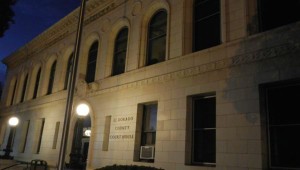
The old courthouse in Placerville needs replacing. Photo/LTN
Making progress
Once the site was chosen, preparation of an environmental impact report under the guidelines of the California Environmental Quality Act (CEQA) was required to identify the project’s potentially-significant environmental impacts, propose mitigation measures to reduce them to “less than significant,” and provide reasons why the project should still go forward even if some impacts could not be fully mitigated.
The EIR analyzed the proposed project with all court services consolidated in a three-story, six-courtroom, 88,000-square-foot facility next to the existing jail, and a reduced size alternative with a two-courtroom facility next to the jail, and some court services remaining in the Main Street courthouse. The larger facility would require acquisition by the county of the adjoining 5.2-acre parcel owned by Briggs. The smaller one would not. After some delays because of state funding issues, a draft EIR was prepared and circulated in October 2014, with the final EIR certified by the Judicial Council on June 10. It selected the larger facility as the “preferred alternative.”
A one-year option agreement between the county and Briggs for his 5.2 acres was first approved by the county in December 2012 and subsequently extended for another year. When it expired on Dec. 18, 2014, it was not renewed, but instead was executed by the county on Feb. 24, 2015, well before the environmental document has been certified. The city in August 2013 made the required determination that the transfer was consistent with their General Plan.
Briggs received a nonrefundable $5,000 for each of the one-year periods. County Counsel Robyn Drivon explained, “Rather than pay more money for an extension, it was felt that the courts were far enough along on the EIR process to provide the assurance that they were on solid footing with the EIR process to reduce the risk of the transfer not taking place. It was recommended to go forward with the exchange.”
The county would next transfer the combined parcels they own to the state for construction of the courthouse. An email from Judicial Council staff confirmed that transfer has not yet taken place.
“We are still in negotiations with the county. Once the details are settled, it still needs to go to the state Public Works Board for approval before we can complete the site acquisition,” the Judicial Council said.
Litigation, potential conflicts stall project
On July 10, the Placerville Historic Preservation League, an unincorporated association, filed a writ of mandate with the San Francisco Superior Court, asking that the EIR be vacated and a new one prepared. The case is being handled by attorney Donald B. Mooney of Davis. It names the Judicial Council as respondent, and El Dorado County, the El Dorado County Board of Supervisors and Briggs as parties in interest. Placerville is not named in the lawsuit.
“The Judicial Council as the named respondent in the lawsuit,” county counsel explains, “will be taking the lead role in this matter and the County will participate and monitor the status and progress of the case.”
A settlement conference is scheduled for Aug. 28 and the administrative record is due Sept. 14.
Briggs, as property owner of the transferred parcel, may also have to produce documents.
The writ claims the EIR didn’t do an adequate job under CEQA to fully analyze and provide mitigations for the project’s environmental impacts to biological resources such as wetlands, rare plants, and protected migratory birds, to traffic and circulation, as well as its, “economic impacts to the businesses in historic Placerville on Main Street that will lead to urban decay and blight.”
Unrelated to the lawsuit are conflict of interest claims. In 2013, an El Dorado County Taxpayers Group letter to the Judicial Council alleged, “John Briggs is developing the entire project known as Ray Lawyer Commercial Subdivision using a combination of local, state money and federal highway government money being funneled through the county government under the guise of the development of a new courthouse. . . The remaining six project parcels and other nearby abutting parcels are held in Ron Briggs (ex-county supervisor) and his son’s name (Brian Briggs, former chairman of the Placerville Planning Commission) will not be required to pay for their normal proportional and equitable share of reimbursement of the heavy master infrastructure improvement costs and off-site improvements totaling tens of millions of dollars.”
The Ray Lawyer Commercial Subdivision was approved by the city, and is within the Western Placerville Interchanges Project area which will widen and improve Forni Road, Placerville Drive, Fair Lane and Ray Lawyer Drive as well as ramps to Highway 50 from these surface streets.
The Judicial Council asked the county to respond to the El Dorado County Taxpayer Group’s allegations, since if unanswered, they could cause the site to be termed “controversial,” which would trigger another layer of approvals and even potential site reconsideration.
Then-County Counsel Ed Knapp responded, “The county is aware of no conflicts that should impair the ability of the county, city of Placerville, and the state to move forward with the construction of this much needed courthouse.”
He noted that then-Supervisor Ron Briggs had recused himself from all county agenda items relating to the courthouse project and Brian Briggs had recused himself from all Placerville Planning Commission meetings where the issue was discussed. John Briggs had assured the county that, “Supervisor Ron Briggs was not beneficially interested in the Briggs Family Trust (the owner of the ‘swapped’ parcel) nor in the parcel at issue.” Attached to the letter were declarations under penalty of perjury by John and Ron Briggs to this effect.
The AOC determined the site was not “controversial” and the project proceeded.
Lack of trust, transparency
Some have alleged that even though the outward appearance of propriety was maintained, there has been considerable pressure and politicking behind the scenes for years to push the courthouse project forward. Kirk Smith of the Placerville Historic Preservation League feels, “Political corruption in this town goes back to the very beginning . . . It’s rarely a situation where somebody’s hands get caught in the cookie jar. What appears to be the case is that politicians back other’s projects.”
Sue Taylor of Save Our County, a group focused on protecting the historic and rural environment of El Dorado County, contends, “I don’t like the whole way (the courthouse project) was processed. There’s a lot of cronyism involved . . . I’m not sure who it’s really benefitting, and I don’t think they’re giving us all the information on the courthouse.”
It’s not just who wins, but also who loses that is at issue. The Main Street courthouse is owned by the county and court services there are provided by the state, but the fact that the 100-plus-year-old-structure sits right in the middle of historic downtown Placerville brings the city inevitably into the mix.
At the March 10, City Council meeting, some speakers accused the city of not doing enough to lobby the Judicial Council to retain court services on Main Street or to keep residents informed as the process unfolded. Many, they said, were unaware of the Nov. 6, 2014, public meeting or that the EIR public comment period had ended Dec. 1, 2014. A petition signed by 60 downtown merchants had been sent to the Judicial Council requesting the EIR comment period be reopened.
City officials, some said, had already decided the relocation of court services was a “done deal” well before the process was concluded. City Manager Cleve Morris told meeting attendees, “On more than one occasion I’ve asked the question whether or not the courthouse could continue downtown. It was emphatic that the state would not use that building as a courthouse in the future. The state has jurisdiction over the court and it’s ultimately their decision over what happens to it.”
Heidi Mayerhofer, owner of the Painted Owl on Main Street, told the council, “Downtown businesses benefit significantly from the functioning of the courthouse . . . did the city make this case on our behalf? If not, it’s not too late.”
Celia Lux, co-owner of The Bookery on Main Street, agreed, “We’ve heard, ‘the sky is falling, the sky is falling’ for 25 years so we don’t take it seriously . . . I would have appreciated the opportunity to make a comment.”
Jackie Neau, a Placerville resident, disagreed. “I hope you wouldn’t reopen the public comment. We all have to pay attention. It is our responsibility to pay attention, read agendas and engage.”
Mayor Patti Borelli told Lake Tahoe News, “I made a trip with Councilwoman (Wendy) Thomas and (Presiding Superior Court) Judge (Suzanne) Kingsbury to San Francisco where (Judge Kingsbury) presented our case to the Judicial Council. We were lobbying to keep it in the city and in El Dorado County.”
Borelli was unsure whether Kingsbury lobbied specifically to retain services in the Main Street courthouse, but added, “We did due diligence.” Because of the current lawsuit, Kingsbury was unable to respond to questions. Councilwoman Thomas was asked to respond, but chose not to.
The Judicial Council is the entity responsible for posting notices regarding preparation of documents, comment periods and public meetings for the courthouse environmental review process. They met all their obligations in this regard.
The Placerville City Council agreed to put an item on the March 24 agenda to consider sending a letter to the Judicial Council from the city requesting an extension of the EIR’s comment period.
Heated conversations
On March 22, there was a meeting at the Cozmic Café on Main Street. Heidi Mayerhofer remembers it starting from a conversation she had with Councilwoman Thomas.
“We came up with the idea to have a meeting with merchants where concerns could be addressed and more information disseminated. She called me and said other City Council members wanted to attend. It became more formal than what I originally wanted,” Mayerhofer said.
The meeting was attended by all five city councilmembers, current El Dorado County Supervisor Brian Veerkamp, former Supervisor Jack Sweeney, City Manager Cleve Morris, City Clerk Susan Zito as well as downtown merchants. An agenda was posted by the city, but no minutes were taken.
At its March 24 meeting, the City Council chose not to request an extension of the EIR comment period, and instead sent a letter to the Judicial Council offering the city’s support of the site next to the county jail and asking for their help in securing funds to repurpose the Main Street courthouse. The letter referenced the merchants’ petition and the two subsequent meetings that it said had, “created good dialogue and the result was overwhelming support for the current proposal to relocate the court operations ….”
Not everyone remembers the March 22 meeting that way. Nancy Duncan, co-owner of The Bookery said, “I wouldn’t say it was overwhelming, no. That wasn’t what I got out of it.”
Kingsbury gave a presentation on March 24 outlining a long list of physical and security problems with the 100-plus-year-old Main Street courthouse. She pointed to the state’s longstanding concerns with use of the building, dating back to 2009 when it declined to have the building deeded over by the county, “finding that nothing could be done to overcome the deficiencies, and they were frankly concerned about the liability ….”
Lake Tahoe News asked the county and the Judicial Council about the liability issue and why, given such serious problems, court services continue in the Main Street courthouse, and well may for the five or more years until a new courthouse is built. Jackie Davenport, assistant court executive officer for the El Dorado County Superior Court, said the liability is “shared,” as the county owns the building and the state is occupying it. County Counsel Drivon agreed, adding, “It’s a courthouse built in 1912 to last a hundred years. There are very few other commercial properties with that lasting power. The alternative doesn’t exist at the moment.” Judicial Council staff noted in an email that, “determinations of liability are fact-specific.” There is an agreement in place between the county and the Judicial Council for the ongoing maintenance of the building.
Kingsbury touched on another issue of concern — the effect of further project delays on continued funding.
“If we don’t go forward on this project,” she told the council, “there are people standing in line. If we are not poised to move on this project, we will lose it.”
Similar concerns had been expressed by City Manager Cleve Morris at the March 10 City Council meeting.
“I’ve heard discussions about whether it even had to stay in El Dorado County. Rancho Cordova was mentioned,” he said.
In a document presented as part of the March 24 staff report, former Supervisor Sweeney said, “I was one of two county supervisors that did the negotiations with the courts for the site. Our first choice and strongest was to keep the courts within the city limits of Placerville. Another alternative was to combine some Sacramento County courts and site it in Rancho Cordova.”
Sue Taylor believes many merchants felt undue pressure that if they did anything to slow down the process, they would be responsible for a $90 million project being lost entirely. Of the Cozmic Café meeting, she says, “It was very intimidating with all the city people.” Mayerhofer recalls an earlier conversation she had with Councilwoman Wendy Thomas. “I was led to believe by Wendy that if the Judicial Council became frustrated with how long the process was taking they would find another alternative.”
In an email to Lake Tahoe News, Judicial Council staff noted with regard to plans to locate the courthouse in Rancho Cordova, “No, this rumored plan was never considered by the Judicial Council.”
As for funding, the Legislature authorizes site acquisition funding in three-year phases, with funding for the new Placerville courthouse project first allocated in 2009. It was reauthorized in 2012 and again in 2015, for a three-year term ending on June 30, 2018.
“Yes,” Judicial Council staff confirmed, “the funding is secure for the entire term of the re-appropriation period.” The project will also retain its status as an “immediate and critical need” priority group project.
Not everyone sees the loss of court services at the Main Street courthouse as entirely negative. Resident Cindy Savage told the City Council, “I also think it’s an opportunity of great magnitude. We have five years to figure out what to do to make it more vibrant, bring more life to downtown Placerville.” Mayor Borelli told Lake Tahoe News, “I see a lot going on (downtown) now, especially on weekends and at night and these are days that the courthouse is closed.”
City Clerk Zito said she was, “excited with the potential of what we could have on Main Street . . . it’s been underutilized by just being a courthouse.”
But repurposing the Main Street courthouse will be expensive. The formation of a joint city-county Blue Ribbon Committee to explore funding options was first proposed in September 2014. The committee will be comprised of three county residents, three city residents and four Placerville business owners, with at least one being from the downtown business district. Due to a poor initial response, the announcement requesting applications had to be posted again. Interviews were held and committee members have been chosen. After formal confirmation by the city and the county this month, the committee will begin meeting.
The Judicial Council put out a request for proposal to find and pay for a firm to assist with the courthouse repurposing process. In addition to acting as facilitator for the Blue Ribbon Committee, the firm will also perform a retail analysis to determine the best use for the courthouse, identify key barriers to re-use, recommend strategies to remove regulatory barriers and identify potential grant funding.
After years of planning, the fate of the new Placerville courthouse project depends on the course the lawsuit challenging the project’s EIR will take. A mandatory settlement conference for all parties to the lawsuit has been set for Aug. 20 at the Sacramento law offices of Remy Moose Manley LLC, the law firm representing the Judicial Council. The goal, the court document states, is to, “attempt in good faith to settle the litigation and the dispute that forms the basis of the litigation.” The outcome of that conference is still uncertain. What is certain is that the successful melding of past and future in this historic Gold Rush community remains a work in progress.
 · Trey Stone, Niall McGuinness and John Shipley are putting on a fund-raising concert for Tahoe Arts Project on Aug. 27 from 7-9pm at Lake Shore Lodge and Spa in South Lake Tahoe. Cost is $10.