Resort-like camping proposed on Tahoe ridge
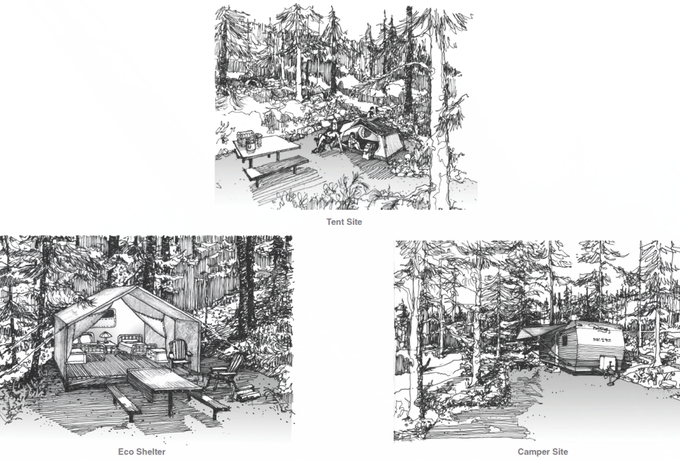
Three types of camping will be available — tent, RV and eco-shelters.
By Kathryn Reed
KINGS BEACH – Pristine isn’t a word developers of the Brockway Campground like to use when describing the 104-acre site. To the average camper pristine might be exactly the word for it.
Campers aren’t going to care how many times it has been logged by Sierra Pacific Industries – the land owner, or the fact that first generation trees don’t exist or that this mixed conifer forest has white fir, red fir, Jeffrey pine, sugar pine and incense cedar. They will be there to relax and play, and will probably never realize 18 percent of the trees that exist today will have been removed to make room for the campground.
What is proposed is a camping experience for a whole new generation.
“The generation coming up hasn’t tended to fire much. They are used to a flick of a switch,” Kurt Krieg with Mountainside Partners told Lake Tahoe News while on a tour of the property. His firm is the developers. “It’s the way camping is going. Propane-gas is better for the environment.”
In other words, instead of wood fire rings at each campsite, there will be shared gas ones. Wood will be allowed – but only used by staff for ranger talks and group activities.
Campers will hardly have to rough it in ways that go beyond not having to light a fire. While tent camping will dominate the 282 campsites, RVs will be allowed and there will be eco-shelters so people don’t have to sleep on the ground.
Plus, there will be dining facilities so cooking over a Coleman stove isn’t necessary. And the pool will be an option instead of the forest to play in.
Krieg said the camping market has changed and that people want these types of amenities. Plus, there will be shuttles provided so people could get to Lake Tahoe or one of the nearby towns without driving themselves.
This area is already a haven for hikers and cyclists, with the Tahoe Rim Trail crossing Fibreboard Freeway. Sixteen miles of trails exist on this side of Highway 267, with another 40 miles on the other side. It would also be possible to ride-hike into Northstar ski resort.
The campground will be seasonal; open about 130 days.
Slivers of Lake Tahoe can be seen from different vantage points. Mount Pluto (the peak at Northstar at 8,617 feet) is a landmark.
Krieg said the campground would not be visible from Kings Beach or Tahoe City.
Mountainside Partners at one time had planned 112 residences on the land. That idea has been scrapped at the urging of planning officials and others.
There is only one main road into the parcel – Fibreboard Freeway (which is a bit of a misnomer of a name) off Highway 267 between Kings Beach and Northstar, so access to emergency vehicles could be an issue. The U.S. Forest Service maintains the road, with the land to the right (1,192 acres) belonging to Sierra Pacific Industries and land to the left being USFS. This road that was built in the 1960s and last improved in the 1980s will be upgraded. The campground entrance will be just more than 1 mile in from 267. There will be one entrance, with a loop system created for the sites as is common at most campgrounds.
Developers have a tentative date of Sept. 23 to present the project to the Tahoe Regional Planning Agency Governing Board. Placer County Board of Supervisors will also have a say in the approval process. An environmental impact study and environmental impact report will be prepared.
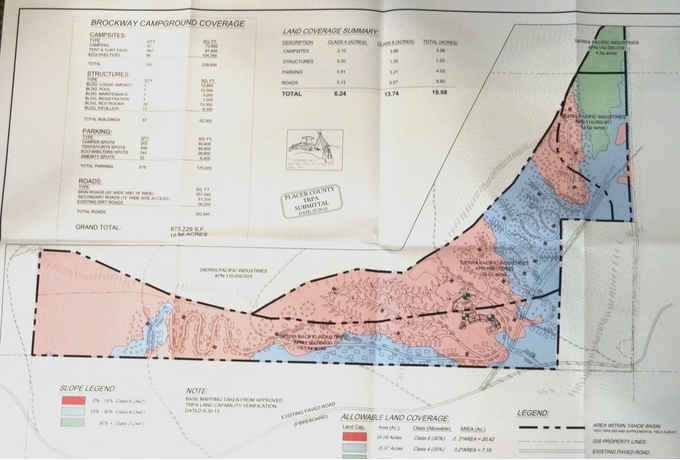
The layout of the proposed campground.
Here is what others shared with Lake Tahoe News about the project:
· Mary Bennington, executive director of the Tahoe Rim Trail Association: “We have mixed reactions to the proposed project. On the positive, it could provide a water source, showers, parking and bear boxes for TRT users and through hikers. Possible negative impacts include, potentially causing a significant increase to the number of users on the sections near Brockway which may then increase maintenance needs, cause user conflicts and change the user experience.”
· Tom Mooers, Sierra Watch: “Can’t really offer a position, because we haven’t seen an actual proposal. But I can offer a comment: Everyone loves camping. But we’ll have to put sentiment aside and take a clear-eyed look at the proposal. We’re talking about a relatively pristine and remote corner of the Tahoe basin, and we’ll have to carefully assess what the resort − with new roads, buildings, lights, sewage hookups, water demand, etc. − would mean to Tahoe, Martis Valley, and beyond.”
· Darcie Goodman-Collins, executive director League to Save Lake Tahoe: “This is not a traditional campground proposal. We are talking about locating accommodation for more than a thousand visitors on 120 acres of forested land in fairly pristine and natural condition, far from existing town centers. It remains to be seen if any development of this scale — regardless of whether it’s a campground, a major hotel or a some other type of larger scale resort complex — could be developed in a manner that is in line with our region’s goals to protect Lake Tahoe and the Tahoe basin’s natural resources.”
· Michael Schwartz, fire chief North Tahoe Fire Protection District, : “Since the fire district is a part of the review process for Brockway Campground, it would be inappropriate for us to comment at this time. While we have had some preliminary discussions with the applicants, Mountain Partners, we have not seen or reviewed plans for the proposed campground. It is important to note that the fire district is not a land use planning agency. However, should the project be approved, the district will be responsible for ensuring that the campground meets the stringent best practices for development in the wildland urban interface and complies with state law and fire code. The district currently serves six campgrounds, so we are familiar with public safety concerns and other issues related to providing emergency services within recreation campgrounds.”
· Alexis Ollar, executive director Mountain Area Preservation: “Mountain Area Preservation has not seen the actual proposal yet from the project applicant, Mountainside Partners. Our initial comments/concerns are focused on the scale of the proposal, 550 campsites located on the ridge of North Lake Tahoe in an undisturbed area adjacent to existing recreation on the Tahoe Rim Trail seems like too intense of a use for the landscape and topography. We are concerned the proposal will add further traffic congestion to Highway 267, creating more green house gas emissions and air pollution impacts for the Lake Tahoe and Martis Valley area. While we understand camping is an allowed use, we are unsure the use is appropriate for the landscape.”
· Kathy Carter, Liberty Utilities: “Utilities do not have a say in growth issues, but are mandated by the CPUC to provide service to any new customers.”
· Sandy Evans Hall, North Lake Tahoe Resort Association: Did not respond.
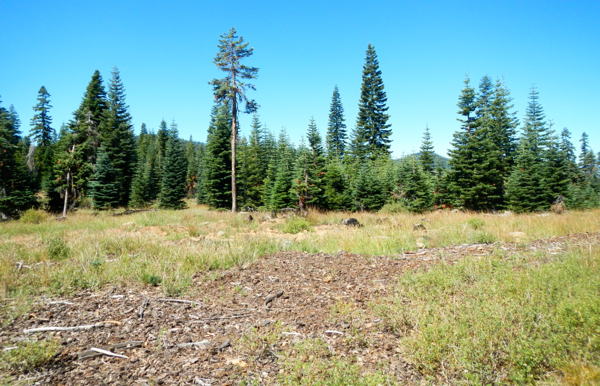
Most of the acreage is covered in conifers, with a few open spots. Photo/LTN
Lake Tahoe News posed the following questions to Blake Riva, managing partner at Mountainside Partners:
LTN: Why was the decision made not to build the 112 units and instead go with a campground?
Riva: We were asked by local agencies to consider a project on the basin lands that did not include traditional residential development. A campground is a permissible use under current zoning, it makes private land available for public use, plus it meets the goal of the Regional Plan update.
LTN: Economically, wouldn’t the permanent housing be more profitable?
Riva: We are excited about the prospect of the campground, as it will offer the public a new opportunity to experience and enjoy the incredible recreation available in North Lake Tahoe in a beautiful, natural setting. Our studies indicate that a campground is a viable business in Lake Tahoe.
LTN: Will the campground be leased to some entity to operate while Sierra Pacific Industries retains ownership of the land? Any idea who that might be?
Riva: We will determine how best to operate the campground once the entitlement process is complete. As the entitlement process is just getting under way, there is plenty of time to consider various alternatives.
LTN: With a swimming pool, coffee shop, general store, pocket parks and other amenities, this won’t be your typical campground. It sounds more like a resort. Can you describe what the area is going to be like? And what type of camper do you anticipate visiting Brockway Campground?
Riva: We anticipate campers who wish to enjoy a great outdoor experience will be interested in staying at the Brockway Campground. The proposal includes a mix of campsites, with the heavy focus on traditional tent camping sites. There would also be sites for campers and yurts or canvas tents that are on a platform, for those who don’t have their own tents or prefer that style of camping.
The inclusion of a general store, gathering areas, a small dining venue, swimming pool are actually the type of amenities that are commonly found in today’s campgrounds. The Tahoe basin and surrounding area have not had any new campgrounds in over two decades.
The idea is to provide those who are camping with the ability to stay at the campground once they arrive if they wish to and use it as their “home base.” They will have access to the basics, i.e. general store for items they may have forgotten at home, the ability to rent a bike to use on the nearby trails accessible from the campground, as well as the ability to take a shuttle to access the recreation, shopping and dining at the lake and in Truckee.
LTN: How many people could stay overnight?
Riva: Industry statistics reflect typical occupancy is 2.5 people per site, on average. Also, it is typical that loops and enclaves are opened and closed on demand. D.L. Bliss and Sugar Pine are two examples.
LTN: How many employees will be needed during peak and non-peak periods? Where do you anticipate they will live? What types of jobs will there be?
Riva: The campground will be seasonal, thus the majority of positions will be seasonal employment. The types of positions could include maintenance, check-in/registration and guest services.
LTN: What exactly are the eco-shelters and how many people would they sleep?
Riva: Eco-shelters can be accommodations such as yurts or canvas tents on a platform. Typically they can accommodate up to 4-6 people per.
LTN: The site allows for 832 campsites. Do you foresee developing the remaining 282 sites at any point?
Riva: No. While permissible use allows for up to 8 campsites per acre (totaling 832 possible sites), our land plan as designed reduces the density proposed to roughly 5 sites per acre. This represents a 34 percent reduction to what is allowable. The 550 sites that have been proposed for the Brockway Campground would be phased over time.
We have had numerous consultants study the land and its topography. While the design is far less than capacity, we feel it will provide a better camping experience.
LTN: According to the USFS and Outdoor Foundation, RV camping nationwide has decreased by 14 percent since 2006 and there has been a 20 percent decrease in non-RV, non-backcountry camping in that same period. With numbers like that, why do you believe this campground will be successful?
Riva: The 2015 North American Camping Report shows some different statistics with regard to camping. Please find the study here.
Existing Tahoe campgrounds are in great demand, and are often fully reserved a year in advance. As there aren’t that many lodging opportunities on the North Shore, and with existing campgrounds in the basin being so popular and often booked well in advance, as well as primarily located on the West and South Shores, the Brockway Campground would offer visitors more opportunities to enjoy a seasonal camping experience in a beautiful, natural setting in North Lake Tahoe.
LTN: Describe what the winter use would be like and how many sites would be open.
Riva: The application for the Brockway Campground as proposed is for summer seasonal use. We have not contemplated winter use, and in any case, the Fibreboard Freeway would remain closed during the winter months.
LTN: The campground site is very close to your company’s planned development of 760 residential units in the Martis Valley that are outside the Lake Tahoe Basin. How would these two projects complement each other or potentially be a conflict? Where is that project in the planning process?
Riva: As the proposed Brockway Campground and Martis Valley West parcel project are two separate, unrelated projects, they will neither complement nor conflict with each other. One is not dependent on the other.
The seasonal nature of the campground, significant buffer between the two, as well as tree retention will provide positive experiences for both campers and homeowners.
LTN: Many people believe this much development on the ridgeline is environmentally unsound. Any comment?
Riva: As with any proposed development project, the Brockway Campground will be subject to a thorough review process. It is important to note that a campground is a permissible use, and is consistent with TRPA’s Regional Plan update mission.
LTN: Both projects will bring added traffic to the area. How will this be mitigated?
Riva: Traffic studies will be completed as part of the environmental review process. Initial studies anticipate over 80 percent of Brockway Campground guests will arrive from Interstate 80, traveling from the north through the Martis Valley and turning off at Brockway Summit on the Fibreboard Freeway to access the campground. As the Brockway Campground is a seasonal use facility, it is also important to note that access to the campground will only be available in the summer. Currently, peak traffic on Highway 267 is experienced during the winter season.
To reduce vehicle trips once guests are on-site, campground guests will have access to shuttle services that will be provided from the campground to/from nearby recreational and shopping locations.
LTN: What are the planned ingresses and egresses to the campground site? Is there a map of this?
Riva: Access to the campground will be via the Fibreboard Freeway, a seasonal, paved road that also provides access to the Watson Lake campground and recreational trails. It will continue to be managed by the U.S. Forest Service.
LTN: What does access to hikers mean? Will new trails be developed? If so, how many miles? And will these be multi-use trails – hikers, cyclists, equestrians, motorized users?
Riva: The Brockway Campground is positioned near the Tahoe Rim Trail, close to Northstar, as well as 56 miles of existing hiking, biking and multi-use trails in the area. There are no plans to develop additional trails at this time. The campground would enhance public access to these trails that are already open for public use and recreation.
Specifically for through hikers on the TRT, the Brockway Campground would offer an opportunity to restock water, supplies, stay overnight and shower. Currently, there are no opportunities to refill water or restock supplies between Tahoe City and the Mt. Rose Wilderness, which accounts for nearly 30 percent of the TRT.
LTN: You have said the response has been “overwhelmingly positive”. Who has said what?
Riva: We have had conversations about the Brockway Campground with the Tahoe Rim Trail Association, Tahoe Area Mountain Biking Association, the Boys & Girls Club of North Lake Tahoe, the North Lake Tahoe Resort Association, North Tahoe Business Association, as well as other local residents, business owners and camping enthusiasts.
LTN: Who do you believe will be the detractors and what do you have to say to counter their arguments?
Riva: While there will always be some who don’t want to see anything change, we were specifically asked by regional environmental groups to consider proposing a permissible use on the basin land, and we’ve done just that. We would like to encourage people to familiarize themselves with the project proposal and ask questions throughout the public process to ensure they have the facts.
LTN: The campground is going to be “green” – is there a campground someplace else doing what you propose?
Riva: California and other Western states are leaders in “green” initiatives. As the first new campground in Lake Tahoe in over 20 years, Brockway Campground will be the most eco-friendly in the region.
LTN: You are proposing gas fire pits. Will there be any wood pits? Will wood be allowed to be burned at all anywhere in the campground? If not, why not? Will there be individual pits or will they all be shared?
Riva: There will be two iconic wood campfire sites located in guest gathering areas that will be managed by staff. Wood will not be allowed to be burned elsewhere in the campground.
As is becoming the industry standard with newly developed campgrounds, the Brockway Campground will provide gas fire pits in an effort to significantly reduce the risk of fire danger. Gas fire pits are substantially more environmentally friendly, and emit far less smoke and air particles than do wood burning fires.
LTN: How will the solar power be generated? What size will the panels be? What will they look like and how will they tie into the natural scenery?
Riva: Solar power will be the ancillary power sources that will be on remote buildings or signs to minimize ground disturbance.
LTN: If the environmental impacts prove to be too great for this project, would you consider going back to the 100-plus luxury units?
Riva: We have suspended the area plan, however we do not anticipate the environmental impacts being significant with mitigation.
LTN: Is additional development planned on other SPI lands in the proposed resort recreation zoning. If so, what?
Riva: At this time, there are no other pending proposals for development, and the area plan has been suspended.
It is important to note that the final resort recreation designation, an area plan and a Regional Plan amendment is not required on the land on which the campground has been proposed. A campground is a permissible use according to the current zoning, and would require only a minor use permit.
LTN: Your company is Mountainside Partners. It used to be East-West Partners, which filed for bankruptcy after building the Ritz-Carlton, Lake Tahoe and Northstar Village. What assurances can you provide that Mountainside Partners won’t suffer the same fate with the campground and Martis Valley projects? How much will the campground project cost? Have you secured financing?
Riva: Mountainside Partners has a strong financial partner committed to funding the Brockway Campground. It will be a phased project built out over time based on market demand.
LTN: When would you like the first campers to be able to book a site? How many phases do you expect and when will it be completed?
Riva: The entitlement process is likely to take anywhere between 12-18 months to complete. The earliest campers might be able to book a site would be the summer of 2018.
LTN: Would you try to build this as Liberty Utilities is doing its upgrades so as to minimize the disturbance to the lands?
Riva: We are always looking to minimize disturbance and share synergies, whether with Calpeco, USFS, CalFire or others.
LTN: With no utilities at the site now, what will it take to get sewer, water, electric and gas to the area and do all the entities have the necessary capacity to accommodate this project as well as the Martis Valley project?
Riva: Water will be secured on site from wells. Since the campground is seasonal it will have propane gas. Electric is an efficient over land run with minimal disturbance. We are anticipating septic for sewer as limited seasonal flows.
LTN: Anything else you would like to add?
Riva: The exciting elements of this project include the fact that camping is for everyone, and the Brockway Campground would provide incredible access for the public to experience the outdoors in North Lake Tahoe. Currently there are 18 campgrounds that represent a total of 2,066 campsites in the Tahoe basin, and only 46 of those campsites are located between Tahoe City and Zephyr Cove. If approved, the Brockway Campground would help bring the camping opportunities in the basin more into balance, and would offer an outdoor experience that is not currently available in North Lake Tahoe.