Milfoil in Truckee River being eliminated

The Tahoe Resource Conservation District is taking the proven approach of killing Eurasian watermilfoil in Emerald Bay to a pilot project on the Truckee River to control the aquatic invasive plant.

The week has been in Lake Tahoe since the late 1980s and likely entered the Truckee River following the overflow of the dam in 1997.

In 2010, approximately 6 acres of aquatic invasive plants covered the near shore near Vikingsholm. Bottom barriers killed the plants by eliminating light, along with the use of diver-assisted suction removal. After four years, Emerald Bay is free of aquatic invasive plants.

TRCD is going to use both methods on the Truckee River from the lakeside of the Tahoe City Dam downstream to Alpine Meadows Road.

In 2014, 10,000 square feet of benthic bottom barriers were laid lake-ward of the Tahoe City Dam. In 2015, less than 20 plants have been detected at this site and subsequently removed. Also in 2014, 427 cubic feet of invasive plants were removed downstream from the dam using diver-assisted suction removal.

This month TRCD is working with A.C.E. Diving to install bottom barriers in the river system below the dam.  While bottom barriers have been successful in open water lake environments, using them within a river system will be a new.


Tahoe RCD anticipates the need to continue efforts to control aquatic plants in the Truckee River for several years to come as the population is dense in some locations and environmental conditions such as water levels will continue to fluctuate.


Uber, Lyft could be on Nev. streets in a month

By Conor Shine, Las Vegas Sun

After nearly a year of waiting, Uber and Lyft are finally coming to Nevada.

The ride-hailing giants have both filed permit applications with the Nevada Transportation Authority and, if everything goes according to plan, they should be able to begin operating on Las Vegas streets by Sept. 14.

Uber submitted its application Friday; Lyft filed earlier last week.

Read the whole story


Much drone testing in Nevada shrouded in secrecy

By Daniel Rothberg, Las Vegas Sun

It’s been more than a year since the Federal Aviation Administration designated the state of Nevada as a drone test site. Since then, the state has largely been quiet about what the sites are being used for.

One reason for the relative quiet: confidentiality agreements.

Much of the research going on at the test sites at about 35 locations across the state is proprietary, said Tom Wilczek, who works closely with the test sites as the aerospace industry specialist in the Governor’s Office of Economic Development.

The state has signed non-disclosure agreements with various organizations that have made use of the sites. Those using the sites include private companies, universities and public agencies.

Read the whole story


Golf tourney benefits Squaw Valley Institute

Resort at Squaw Creek is the site of Squaw Valley Institute’s annual Celebrity Golf Tournament.

This annual fundraiser will begin at 10am Sept. 28 with a shotgun start.

Golf with local celebrities such as Nate Holland, Jonny Moseley, Tamara McKinney, JT Holmes and more. Celebrities will be joining each foursome.

It will be a scramble style format, meaning participants need not be incredible golfers to play.

Prizes will be awarded to the top three teams and mulligans will be available for purchase. There will be a contest for closest to the pin and the longest drive as well as the hole in one grand prize. A gourmet boxed lunch will be served at the event followed by an appetizer reception and awards ceremony.

Entry fee is $150 per individual or $500 per foursome.

Go online to register.


Snippets about Lake Tahoe

truckee·      Truckee is asking people to take this survey about Donner Pass Road improvements.

·       The High Fives nonprofit foundation’s 7th annual Bocce Tournament at Truckee River Winery is Sept. 13 starting at 10am. To register, call 530.587.4453. Cost is $125 per two-person team.

·       Patagonia has opened a store in the Village at Squaw Valley.

·       The vacation rental home market business is growing with InvitedHome servicing the south and north shores of Lake Tahoe.

·      Here are the Caltrans roadwork schedules for this week forEl Dorado-Tahoe and Sierra.


LTCC adds last-minute soccer conditioning class

Lake Tahoe Community College is adding a late summer course designed to improve soccer athletes’ physical conditioning to compete successfully at the intercollegiate level.

Emphasis in this class will be placed on the development of physical fitness levels in strength, endurance, speed, power, agility, and reaction time. Fundamental soccer techniques and game-related strategies will also be addressed.

The course, PEA102A: Sports Techniques & Conditioning Soccer, will meet Monday through Friday from 11am-12:50pm at the community play fields on Al Tahoe Boulevard starting Aug. 17 and ending Sept. 11.

Students may register online. For more information, call 530.541.4660, ext. 225.


Then and now: Evolution of the Y in SLT

This photo of the Y in South Lake Tahoe is dated 1949. Photo/Lake Tahoe Historical Society

This photo of the Y in South Lake Tahoe is dated 1949. Photo/Lake Tahoe Historical Society

A “Then and Now” in 2013 looked at how the Tahoe Valley Y”intersection evolved. Just recently, I came upon a detailed aerial photo, perhaps 1949, which includes labels on early landmarks around the Y. None of which exists today.

#2, U.S. Geological Survey, the Y 1969

Not much development existed at the Y in 1969. Photo/U.S. Geological Survey

Nevada Lumber and the schoolhouse were gone before 1960. They were near today’s sites of Tahoe Valley Pharmacy and TJ Maxx. Lampson’s Market and the gas stations remained when the Y”intersection became a four-way in the early 1960s.

The Y area evolved through the years. Photo/Google Earth

The Y area evolved through the years. Photo/Google Earth

Today, all aspects of the Y have changed since the aerial photo taken more than 60 years ago.

— Bill Kingman


Tahoe Mountain growth returns post-Angora

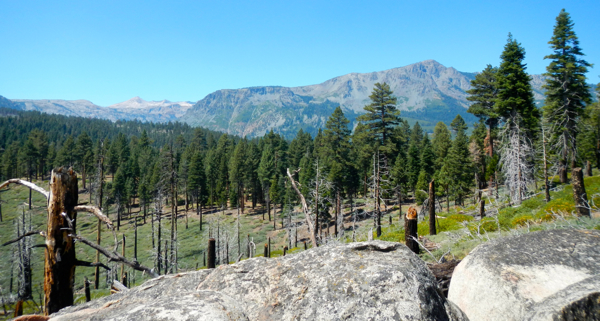
A stand of live trees defines the Angora Fire boundary. Photos/Kathryn Reed

A stand of live trees defines the Angora Fire boundary. Photos/Kathryn Reed

By Kathryn Reed

The dictionary definition of a forest is “a large area covered chiefly with trees and undergrowth.” It’s hard to know what to call a former forest that is covered with undergrowth and what looks like poles.

This is Tahoe Mountain eight years after the Angora Fire.

The trees – such as they are – create a salt and pepper affect. It burned so hot through here in June 2007 that what was once brown and green trees are no more. “Stumps” are taller than people. The life of these trees was taken too soon all because people were negligent when it came to putting out an illegal campfire at Seneca Pond.

When it comes to forest devastation, Angora’s 3,000-plus acres is a blip on the map – especially when compared to the fires burning throughout California right now. It was the loss of the 254 houses that was the most impactful.

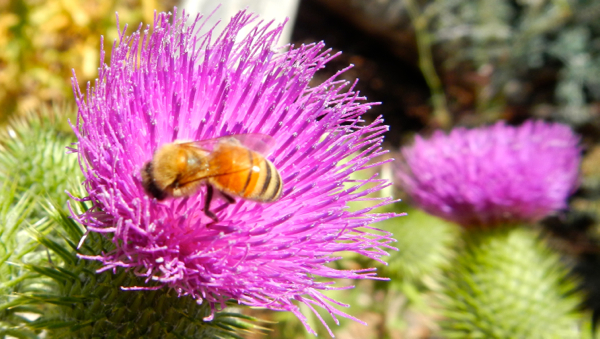
Bull thistle, while pretty and attractive to bees, is not a native species to the basin.

Bull thistle, while pretty and attractive to bees, is not a native species to the basin.

Among the standing dead trees is an understory of life. However, much of it is invasive and flammable like white thorn and bull thistle. Grass is a couple feet tall.

This is U.S. Forest Service land. They say it’s normal for this type of flora to grow after a fire because these species like disturbed soils. The agency is treating some areas to kill the invasives.

Late spring and early summer rains have helped the vegetation grow taller than would be normal for this time of year.

Tall grass is thriving on Tahoe Mountain.

Tall grass is thriving on Tahoe Mountain.

Dave Fournier, vegetation specialist with the Lake Tahoe Basin Management Unit, said this flashy fuel would burn quickly, but at a low intensity if a fire were to come through this area again. Even in windy conditions this type of fuel is easy to suppress, he said.

Some of this vegetation is along the trails off Tahoe Mountain Road and some is near houses. The Forest Service offers a homeowner stewardship program that allows residents who have property that abuts the federal land to treat it. For more info on the program, call 530.543.2600, then wait for the “urban lots” prompt.

South Lake Tahoe looking toward Stateline is visible from the ridge.

South Lake Tahoe looking toward Stateline is visible from the ridge.

A map at the third gate on the right on Tahoe Mountain Road shows a variety of trails that are mostly used by mountain bikers. They are also good for dog walks, and evidence showed equestrians use them as well.

The views are fabulous – the South Shore peaks (Tallac, Jobs, Freel), Lake Tahoe from the ridge, and even the developed area is interesting from this perspective.

—–

Notes:

From South Lake Tahoe continue on Lake Tahoe Boulevard at the Y. Turn right on Tahoe Mountain Road. Park at the third green gate.

Not all the trails are marked. We took the first two distinct left turns and then the first right. Then we guessed and just kept going up.


Opinion: Vaccines have always been controversial

By Charlotte DeCroes Jacobs

In 1952, Americans suffered the worst polio epidemic in our nation’s history. As in prior outbreaks, the disease spread during the summer, mainly attacking children who had been exposed to contaminated water at public pools or contaminated objects in other communal places. The poliovirus entered the body through the mouth and multiplied in the gastrointestinal tract. Symptoms started innocently enough — a sore throat, a runny nose. As the virus moved throughout its victims’ bloodstreams, the pains soon began — electric shocks darting through the neck to legs, muscle spasms. Within a day or two, paralysis set in. If the virus made it to the nervous system in the base of the brain, death came quickly. By the outbreak’s end, 58,000 people had been stricken. More than a third were paralyzed, many of who spent the rest of their lives in a wheelchair or bed.

Most Americans today have no concept of the terror generated by polio throughout the first half of the 20th century. During epidemics, newspapers and magazines displayed adorable children struggling to walk in braces or entombed in iron lungs, but the disease mostly fell off the national radar after it was eliminated from the country in 1979. In the past few years, however, polio has begun creeping back into headlines, for two opposite reasons. On the one hand, thanks to the Global Polio Eradication Initiative, the world is closer than ever to wiping out the virus completely; widespread vaccination efforts reduced the number of cases to 414 in 2014, mostly in Pakistan and Afghanistan. On the other hand, because of recent anti-vaccination trends, it’s not unreasonable to worry that a resurgence of polio might afflict Americans again.

The person responsible for easing our minds over the past half century was Jonas Salk, a physician-scientist who was born in a New York tenement and driven by a passion to aid mankind. During the 1952 outbreak, with funds from the March of Dimes, he rushed to develop the earliest vaccine for polio that used a killed, or “inactivated,” form of the virus. In that, he met resistance from more-senior scientists who believed that only a vaccine made from a live virus could provide lifelong protection.

The public was desperate for a vaccine, yet Salk was afraid these scientists would try to derail his efforts. Objections from one even prompted the famed newscaster Walter Winchell to warn his radio audience not to take the vaccine, because “it may be a killer.” So Salk initially made and tested his vaccine in secret. Thankfully, his promising preliminary results led to the March of Dimes launching the biggest clinical trial in the history of medicine. Beginning on April 26, 1954, with a 6-year-old named Randy Kerr from McLean, Va., the trial eventually involved 1.5 million children, and had remarkable results: Salk’s vaccine was 80 to 90 percent effective in preventing paralytic polio. It was mass-produced and distributed around the country, and by the end of the decade it had reduced the incidence of paralytic polio in the United States by 90 percent.

When the success of the vaccine trial was first announced, the public crowned Jonas Salk a national hero. He experienced a celebrity accorded few scientists in the history of medicine. Yet his rebuke by the scientific community had only just begun. As heads of states around the world rushed to honor him, scientists — the one group whose adulation he craved — remained ominously silent. Basil O’Connor, director of the National Foundation for Infantile Paralysis/March of Dimes, said they acted as if Salk had committed a felony. They accused Salk of failing to give proper credit to other researchers whose work had laid the foundation for his own. Salk in fact had tried to give them credit. But the media had made him the icon for polio, ignoring other scientists’ contributions. This set the stage for difficulties throughout Salk’s career wherein politics in and beyond the scientific community seemed to override good science.

In 1961, a public health decision was made to replace Salk’s vaccine with one developed by a virologist who constantly tried to discredit him, Albert Sabin. Sabin’s oral vaccine, made with a live virus, was cheaper and more convenient, but also much riskier; it actually caused polio in some cases. Salk worked throughout the rest of his life trying to reverse the decision—a sole warrior in a fight against what he considered entirely a politically driven change. (In 1999, four years after his death, the Sabin vaccine was replaced with a new version of Salk’s vaccine, which is still used today.)

Salk also campaigned vigorously for mandatory vaccination, putting the health of the public foremost. He went as far as calling the immunization of all the world’s children a “moral commitment.” Thanks to his efforts — along with those of other researchers — we’re able to enjoy our summers without the fear of a crippling disease.

America now has been polio free for more than 35 years, and children are supposed to be vaccinated when they are babies. We’ve reached the point, however, where it seems many people can’t believe an epidemic could really occur. Some parents refuse vaccination, arguing that a healthy lifestyle is enough to protect their children from potentially lethal infections. But studies have shown that the introduction of sanitation actually enhances the circulation of poliovirus, because babies are no longer exposed to the virus in the very small amounts that used to produce lifelong immunity. Poliovirus can spread relentlessly once it gets a foothold in an unvaccinated community.

Such was the case shortly after Salk’s vaccine was released in 1955. Massachusetts closed its vaccination program because a manufacturing error led to some contaminated shots. Even though the mishap was quickly corrected, the state did not reopen its program. That summer, Massachusetts suffered one of its largest epidemics. Four thousand people contracted polio, and 1,700 were paralyzed — mostly children.

Does the public want to repeat history? I think Jonas Salk would plead with them to learn lessons from our past. Californians did with the recent measles outbreak, which affected more than 130 people, the majority of who were unvaccinated. This helped spur the state to join Mississippi and West Virginia by mandating childhood vaccination, despite an outcry from several groups. Now if only 47 other states would follow suit.

Charlotte DeCroes Jacobs is a professor emerita at the Stanford University School of Medicine and the author of Jonas Salk: A Life. She wrote this for What It Means to Be American a national conversation hosted by the Smithsonian and Zocalo Public Square.


Fire closes Tioga Pass

The Walker Fire burning in Mono County has forced the closure of Tioga Pass.

The fire is near June Lake, burning north toward Tioga Pass and Yosemite National Park. Campgrounds in the Lee Vining canyon area have been evacuated, as well as about 20 structures near Walker Lake. Walker is west of June Lake, on the north end of the June Lake Loop.

About 1,200 acres have burned.

The fire started Aug. 14. The cause is unknown.

— Lake Tahoe News staff report