Health officials urge precaution with plague

Health officials in El Dorado County are reminding residents and visitors that chipmunks, squirrels and other wild rodents can carry plague, and that a few simple precautions can prevent the spread of the disease.

The California Department of Public Health routinely monitors rodent populations for plague activity in California and closely coordinates with county health officials. So far this year, no rodents in El Dorado County have tested positive for plague. However, last year one rodent tested positive for the disease and three tested positive in 2013 in El Dorado County. The four positive rodents were all located in the Tahoe area. There were no reports of illness to people.

A campground in Yosemite was temporarily closed this month when visitors were diagnosed with plague.

Plague is an infectious bacterial disease spread by squirrels, chipmunks and other wild rodents and their fleas. People can get infected through close contact with infected animals or the bite of an infected flea. Plague can be prevented by avoiding contact with rodents and areas where fleas are noted, and by keeping pets away from rodent burrows.

Symptoms of plague usually occur within two weeks of exposure to an infected animal or flea, and include fever, nausea, weakness and swollen lymph nodes. Plague can be effectively treated with antibiotics if detected early.

Tips to prevent plague include:

  • Do not feed squirrels, chipmunks or other wild rodents.
  • Never touch sick, injured or dead rodents.
  • Do not camp, sleep or rest near animal burrows or areas where dead rodents are observed.
  • Look for and heed posted warning signs.
  • Wear long pants tucked into boot tops and spray insect repellent containing DEET on socks and pant cuffs to reduce exposure to fleas.
  • Leave pets home if possible; otherwise keep pets on a leash. Do not allow pets to approach sick or dead rodents or explore rodent burrows. Protect pets with flea control products.
  • Cats can pose a higher risk of plague transmission to humans when they have contact with infected rodents. Keep cats away from rodents. Consult a veterinarian if your cat becomes sick after being in contact with rodents.


Triathlon to cause traffic delays on West Shore

Caltrans is advising motorists to expect delays this weekend on Highway 89 along the West Shore during the Lake Tahoe Triathlon.

There are four events scheduled – a sprint course Saturday; and Olympic, half and duathlon courses Sunday. All events start from Sugar Pine Point State Park and all will use Highway 89 for the cycling portion. Runners will also be crossing Highway 89 back and forth from the Ron Beaudry Trail, but will not be running along the highway.

Highway 89 will not be closed during the events, but CHP officers will be conducting traffic control at several locations along the courses.

Work on Caltrans’ construction projects in the area will be wrapped up today at 10am and won’t resume until Sunday night.

Cyclists should be off the highway by 9am Saturday during the sprint triathlon and by 1pm Sunday during the half, which features a 56-mile bike ride, the longest of the events and the only to use 89 north of the park. Sunday the course is between Ward Creek on the northern end and Baldwin Beach Road on the southern end.


Wolf pups caught on tape in NorCal

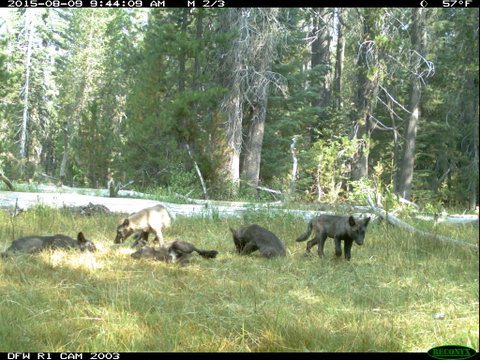
Wolf pups in Northern California. Photo/CDFWS

Wolf pups in Northern California. Photo/CDFW

The California Department of Fish and Wildlife has photographic evidence of five gray wolf pups and two adults in Northern California.

After trail cameras recorded a lone canid in May and July, CDFW deployed additional cameras, one of which took multiple photos showing five pups, which appear to be a few months old and others showing individual adults. Because of the proximity to the original camera locations, it is likely the adult previously photographed in May and July is associated with the group of pups.

CDFW has designated this group (comprised of two adults and five pups) the Shasta Pack.

Wild wolves historically inhabited California, but were extirpated. Aside from these wolves and the famous wolf OR7 who entered California in December 2011, the last confirmed wolf in the state was in 1924. OR7 has not been in California for more than a year and is currently the breeding male of the Rogue Pack in southern Oregon.

In June 2014, the California Fish and Game Commission voted to list gray wolves as endangered under the California Endangered Species Act. The gray wolf is also listed as endangered in California, under the Federal Endangered Species Act of 1973.


Lake Tahoe Hard Rock on shaky ground

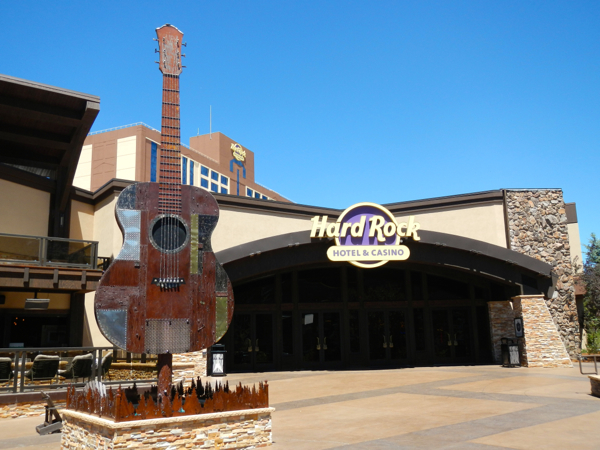
Lake Tahoe Hard Rock has had a rough beginning. Photo/Kathryn Reed

Lake Tahoe Hard Rock has had a rough beginning. Photo/Kathryn Reed

By Kathryn Reed

Current and former employees of Lake Tahoe Hard Rock believe the hotel-casino is destined for failure because of the management company running the place.

“It is very disappointing to see the history and potential of this property being squandered by bullies, liars and thieves with no long term commitment to or concern for our beautiful Lake Tahoe Basin. Employees who speak up or challenge the behaviors and tactics of this group are being picked off one by one and replaced with Las Vegas imports that will keep their mouths shut,” an ex-worker told Lake Tahoe News.

Brothers Jon and David Park, who own the Stateline property, hired Las Vegas based Warner Hospitality to run the hotel-casino. Warner does the same for the Hard Rock in Las Vegas, though the company didn’t open that property, and in Sioux City, Iowa, as well as other hotel-casino entities. The Las Vegas Hard Rock that Warner manages has been losing money for years. According to Mergers & Acquisitions, Bref HR, which owns that Hard Rock, has struggled the last three years with substantial losses – $103 million for the last fiscal year, $105.5 million in 2014 and about $116 million in 2013.

Jody Lake, Warner’s chief operating officer, is the person who employees said makes most of the decisions regarding the Stateline property. He is out of town and deferred comment to Chris Fiumara, vice president and general manager of the Lake Tahoe property. Fiumara is married to Brooke Fiumara, vice president of marketing for Warner. Some employees believe having a local GM married to an executive working for the management firm is compounding the problem.

Questions to Fiumara were limited and only done by email.

Lake Tahoe News spoke to about a dozen workers – some of whom are still working at the Hard Rock, some who quit and others who were fired. All spoke off the record for fear of not retaining their job or not being able to get a new one. Some were with the Hard Rock before it opened, others since nearly day one and others were hired more recently. (The property opened Jan. 28 after a $60 million makeover of what was the Horizon.) All had a similar story to tell of corners being cut, staff shortages, a tyrannical-like approach to dealing with employees, and guests being unhappy. (Hard Rock has a 2-star rating on Yelp and 2½ on TripAdvisor).

Morale is an issue for employees throughout the property. Photo/Kathryn Reed

Morale is an issue for employees throughout the property. Photo/Kathryn Reed

Staffing issues

There are about 500 people working for the Hard Rock. Employees say a property this size – 539 rooms, three restaurants and gaming – should have closer to 700 workers. (Housekeeping is contracted out.)

Turnover of the front desk staff is at 180 percent and about 150 percent with upper management. Overall turnover is closer to 45 percent. It had been forecasted to be 15 to 18 percent.

“The current turnover at the Hard Rock Hotel & Casino Lake Tahoe is not out of the ordinary, particularly with an opening. People come and go and that’s just part of the normal course of business,” Fiumara, the general manager, told Lake Tahoe News. “Our team members are our biggest asset and we believe our team members are engaged, friendly and provide the guest experience the Hard Rock brand is famous for.”

To operate room service efficiently there should be a supervisor and 16 employees. Four is the maximum the hotel has operated with. The restaurants should have had 56 employees; they had 39.

At one point there was a hiring freeze.

There are eight directors on site who work for the Hard Rock, with two of those slots currently vacant.

About a dozen key people left earlier this month. It came to light that Warner had placed a blind ad for many of their positions and then denied doing so when confronted. Some left on their own, others were shown the door.

Performance reviews were never done. Many were told their position was eliminated and then something similar to it was posted.

Some got a severance, others didn’t. No compete contracts were issued after hiring, with stipulations of not going to work for a competitor within a 100-mile radius. This means having to move if they want to stay in the gaming industry. Some of these workers are longtime locals, some moved here for the job. Many have families.

“Word is out and word travels fast so now people don’t want to go there to spend money. Applications have dried up because no one wants to work there because they have heard working conditions are horrible,” an ex-employee said.

Reviews of the various restaurants are inconsistent. Photo/Kathryn Reed

Reviews of the various restaurants are inconsistent. Photo/Kathryn Reed

Questioning the operations

Workers said Warner doesn’t understand the Tahoe market, the guests or the workers.

“They wanted to run it lean and mean and it doesn’t work,” one person said.

Money or the lack of it was the reason employees were given for the staffing shortages and non-existent training.

“The budgets and forecasts Warner came up with were totally unrealistic. That’s why there were so many cutbacks. People were doing three and four jobs,” someone said.

Each worker mentioned the long hours – 18 on many days, no days off – and being reprimanded if two days off in a row were taken.

“It was very challenging due to the Warner group. At times there was hostility in regards to how they treated team members on how to get things done. There was a lack of leadership and very much a lack of communication,” one man said.

Warner has someone who oversees each division. These people are based in Vegas, coming to Tahoe randomly. This has been a challenge for local workers when it comes to getting the powers that be to understand the issues. It has also created problems because one person comes to town, makes a decision, and then that decision is overruled when someone else shows up.

The lack of a cohesive voice, direction and any type of real leadership is exposing major fissures in the operation.

Policy and procedure protocols didn’t exist at the opening. There was no framework for each department. All of this has been developed haphazardly since the opening. It was chaotic from the get-go, with workers not being trained ahead of time.

Employees didn’t understand the rush to open. LTN was on site opening night, having witnessed displays still being put together and the place not ready for the public just hours before the doors opened.

“The original opening date was set for December and was pushed back to the Jan. 28 opening date. We felt it was important to open during the winter season; we opened to positive feedback both on the property and guest service,” Fiumara said.

For many workers, things have not improved in the last seven months.

Pool parties were to set the Hard Rock apart from other Stateline casinos; those plans went down the drain. Photo/Kathryn Reed

Pool parties were to set the Hard Rock apart from other Stateline casinos; those plans went down the drain. Photo/Kathryn Reed

Issues at the property

“This group has cut corners in every area, ignoring building codes, health regulations, the health and safety of its customers and employees,” one person said of Warner Hospitality.

In the back tower, where there are 220 rooms, non-permitted electrical work was reportedly done. This, several employees said, was to deal with the lights above the vanity.

“The Warner group signed off on the vanities and didn’t wire them properly,” according to a worker.

The heating and air conditioning systems are so old that not all rooms allow guests to control the temperature. Ice machines don’t exist in the Heavenly Tower even though there are signs saying they are available. This is a complaint noted by reviewers online.

Asbestos removal was occurring after the property opened.

The old phone system was not replaced. This has resulted in issues in rooms with guests unable to communicate with staff. While wireless Internet was put in, there are spots on the property that are black holes.

The pool has been closed for the season by Nevada officials because of a leak that some employees said was a known problem last summer.

JoAnn Kittrell with the Department of Conservation and Natural Resources said new leaks keep being discovered.

“They are trying to determine what their course of action will be, whether they need a total new pipe or is it time to redesign, reengineer, replace the pool,” Kittrell told Lake Tahoe News.

Today it’s empty, as is the hot tub. Cabanas sit along the side. But the much hyped pool parties aren’t able to go off as planned. These types of parties are infamous in Las Vegas.

“I don’t think they understand Tahoe. They are trying to force Tahoe to be Vegas,” a former employee said.

Douglas County sheriff’s deputies showed up at the property during July’s celebrity golf tournament because of the parties the Hard Rock was having out front.

“Go-go dancers were hired. They were involved in three-way kisses on the patio; there were lap dances on the patio. They were taking tips like strippers,” an employee said. He said restaurant patrons were appalled and that deputies shut down the party.

Someone else said, “People come to Tahoe for many reasons. The main reason is the outdoor recreation part of it. Everything else we offer like restaurants and gaming is secondary. Gaming is more like an amenity to this destination, whereas with Vegas, why people go is gaming. They are not putting equal focus on other amenities that are just as important. You can’t base your budget solely on a gaming framework.”

David and Jon Park, owners of the Lake Tahoe  Hard Rock, on opening day -- Jan. 28. Photo/Denise Haerr

David and Jon Park, owners of the Lake Tahoe Hard Rock, on opening day — Jan. 28. Photo/Denise Haerr

The Park brothers

Those who know the Park brothers had only good things to say about them, and many feel sorry for the two.

“I can’t stress enough how much the Parks really do care. They are great people. Warner is destroying the company and milking the Parks for everything they can,” a worker said.

Neither of the brothers returned multiple phone calls.

Reports are the contract between the Parks and Warner is for seven years. The details of it are not public so it is not known what type of performance measures Warner must meet or what it would take for the Parks to get out of the contract if they so desired.

Those who know the Parks say the brothers are trying to get out of the contract.

The Parks already have at least one legal issue to deal with – payment to the contractor. Mediation this month did not resolve the dispute.

Warner managed the construction project.

“The Parks are upstanding citizens who were dealt a bad hand. They don’t know the hospitality business,” a woman said. “They put their hands and faith with people who sold them a vision and who are certainly not coming through on that vision.”


Opinion: Feds have obligation to protect Tahoe

By Steve Teshara and Darcie Goodman Collins

Decisions made in Congress over the next few months may well determine the extent to which Lake Tahoe remains blue and clear, with healthy forests, resilient watersheds, and its ecology protected from the threat of new aquatic invasive species.

For two decades, the Lake Tahoe environmental improvement program (EIP) has provided guidance for the shared investments made by our federal, state and local governments, homeowners, and businesses to restore and protect Tahoe’s unique environmental qualities and enhance its diverse public recreation opportunities.

As the 2015 Lake Tahoe Environmental Summit nears, two bills are pending in Congress to continue the federal government’s investments at the lake. One of them, Senate Bill 1724, continues the comprehensive and collaborative approach needed to address the traditional as well as new challenges that face our national treasure. The other bill is HR3382 in the House of Representatives. We are concerned that, if passed as written, HR3382 would mark a major retreat for the federal government’s long history of leadership and investments at Tahoe.

Starting in 2000, the first Lake Tahoe Restoration Act authorized the federal share of funding for many of Tahoe’s highest priority projects identified by the EIP. Even before that legislation expired in 2010, Tahoe stakeholders and EIP advocates began working to secure reauthorization. SB1724 reflects years of input from a diverse array of stakeholders. It is the comprehensive approach essential to build on the foundation of prior Tahoe investments by all EIP partners. We strongly encourage everyone who cares about Lake Tahoe to actively support the federal leadership and investments detailed in SB1724.

The Senate bill is bipartisan legislation introduced July 9 by Sen. Dean Heller, R-Nev.  It is co-sponsored by Sens. Harry Reid, D-Nev., Dianne Feinstein, D-Calif.) and Barbara Boxer, D-Calif. HR3382 was drafted and introduced by Rep. Tom McClintock, R-Garden Valley, on July 29.

The Senate bill authorizes up to $415 million over 10 years to improve forest health, reduce the risk of wildfire, combat harmful aquatic invasive species, and restore Tahoe’s famed water clarity, including efforts directed at threats to the Lake’s nearshore water quality. HR3382 authorizes less than half the programs in SB1724 and at a much lower amount, totaling $60 million over 10 years. That is far less than the 10-year commitments of Nevada and California, and far less than the $216 million invested by private property owners and businesses during the first 10 years of the EIP from 1997-2006. As written, the scope of HR3382 is not well matched with the fact that the federal government owns and manages over 78 percent of the land within the Tahoe basin and has responsibilities commensurate with its large and significant ownership.

Since 1997, all partners in the EIP, including the federal government, have made tangible, measurable progress with investments that together maximize the value of each. Properly funded, the EIP will continue to support environmental restoration, recreational enhancements, and our region’s nearly $5 billion annual economy. But new threats loom and much work remains to be done. Collectively, we must build on the investments and progress we have made, rather than scale back now.

We commend the members of our Senate delegation for their understanding, leadership, and commitment to reflect input from constituents. We respectfully encourage House members to take this same approach. This could be done through amendments to HR3382. One example would be adding the authorization for a continued federal share of funding for water quality projects consistent with federal and state law.

Our hope is that a single, comprehensive, and properly funded bill will emerge from the legislative process. The federal government is our largest landowner. It needs to remain a leader and full partner in protecting and valuing Lake Tahoe for this and many future generations.

Steve Teshara is principal of Sustainable Community Advocates. Darcie Goodman Collins is executive director of the League to Save Lake Tahoe.


How the U.S. military helped invent Cheetos

By Anastacia Marx de Salcedo, Wired

Cheese purists the world over exalt their mummified milk. Their silken Goudas and savory Emmentalers. Their fetid fetas and squeaky queso frescos. Their moldy Roqueforts and runny Camemberts. These disks of rotted dairy are the pinnacle of thousands of years of experimentation that began when a herdsman carrying a ruminant’s stomach brimming with milk found that by journey’s end, he had a bag full of curds and whey.

Modern cheese making is a little more complicated, but the same principles apply. Fresh milk is allowed to ferment, with either wild or cultured bacteria. Then, when they have raised the acidity enough, rennet—enzymes from calves’ stomachs (these have now been replaced with laboratory‑produced enzymes)—is added. This coagulates the caseins, which make up about 80 percent of the total milk protein, so that they form a gel.

Then there’s a lot of manipulation—cutting, stirring, and heating—that removes fluid, or whey, leaving behind solid curds. The curds are put into molds, salted or brined, and pressed, which expels more whey and turns the cheese into a solid mass. Mold may be added, either at the beginning or later in the process. Then, depending on the variety, the cheeses are matured for anywhere from two weeks to two years, allowing enzymes, both those from microbes and those from the rennet, to turn fats and proteins into tasty new substances.

Cheese is one of the bedrocks on which the Western diet is founded — a long‑term storage method for excess milk, especially when cool storerooms and caves were available. But the food didn’t fare so well during summer or in hot climates. With heat, animal fat softens or even liquefies, oozing out and creating an oily and unappealing mess.

Read the whole story


Primal Quest athletes endure snakes, rappelling with bikes

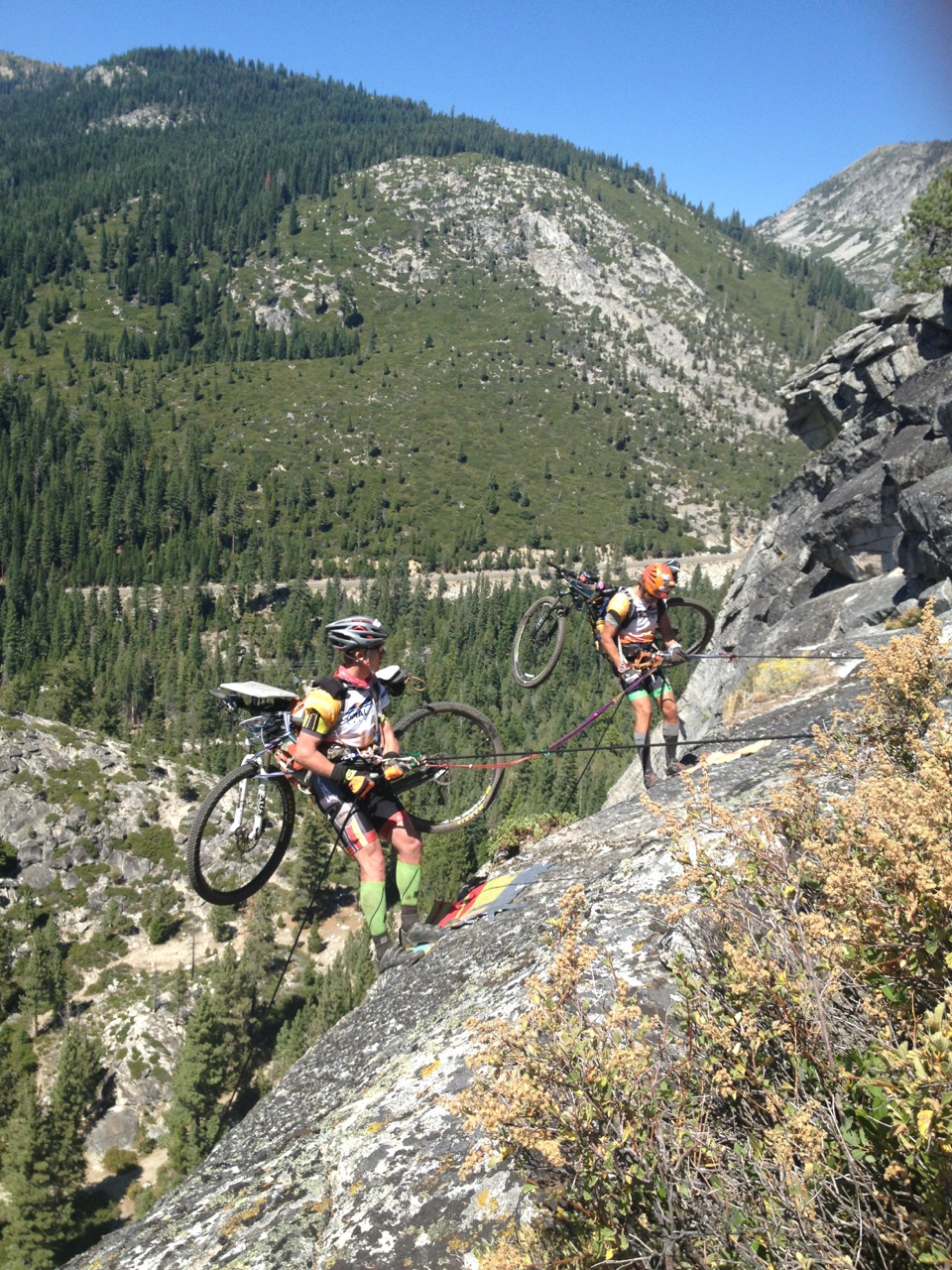
Team Journey, at the time in third place, rappel with their bikes down the cliff. Photo/Provided

Team Journey, at the time in third place, rappel with their bikes down the cliff. Photo/Provided

By Molly Hucklebridge

It’s been a long day for the Primal Quest Tahoe adventure racers. Wednesday night, after a trek down Heavenly Mountain Resort and a six-mile paddle on Lake Tahoe, racers biked into the night from Cave Rock to the Tahoe Rim Trail.  They checked in at Star Lake and continued on to Lover’s Leap.

Wednesday at 3pm, endurance racers took off from the Heavenly gondola on the 550-mile adventure race. Coed teams of four must navigate to 31 checkpoints on a multi-sport adventure throughout the Sierra.

Team GODZone from New Zealand, one of the two teams in the lead, pushed their bikes to the top of Lover’s Leap at 7:30am only to realize that the checkpoint was below them. They strategically descended the summit and accidentally skipped the designated marker. Making a quick decision, they abandoned their bikes and scurried back up to the checkpoint.

Team Bones, not far behind GODZone, found themselves in the same predicament with their bikes more than 1,000 feet below where they needed to be. So they hiked back up. After stamping their passports, both teams rappelled back down to retrieve their mountain bikes and head cross country toward Kirkwood.

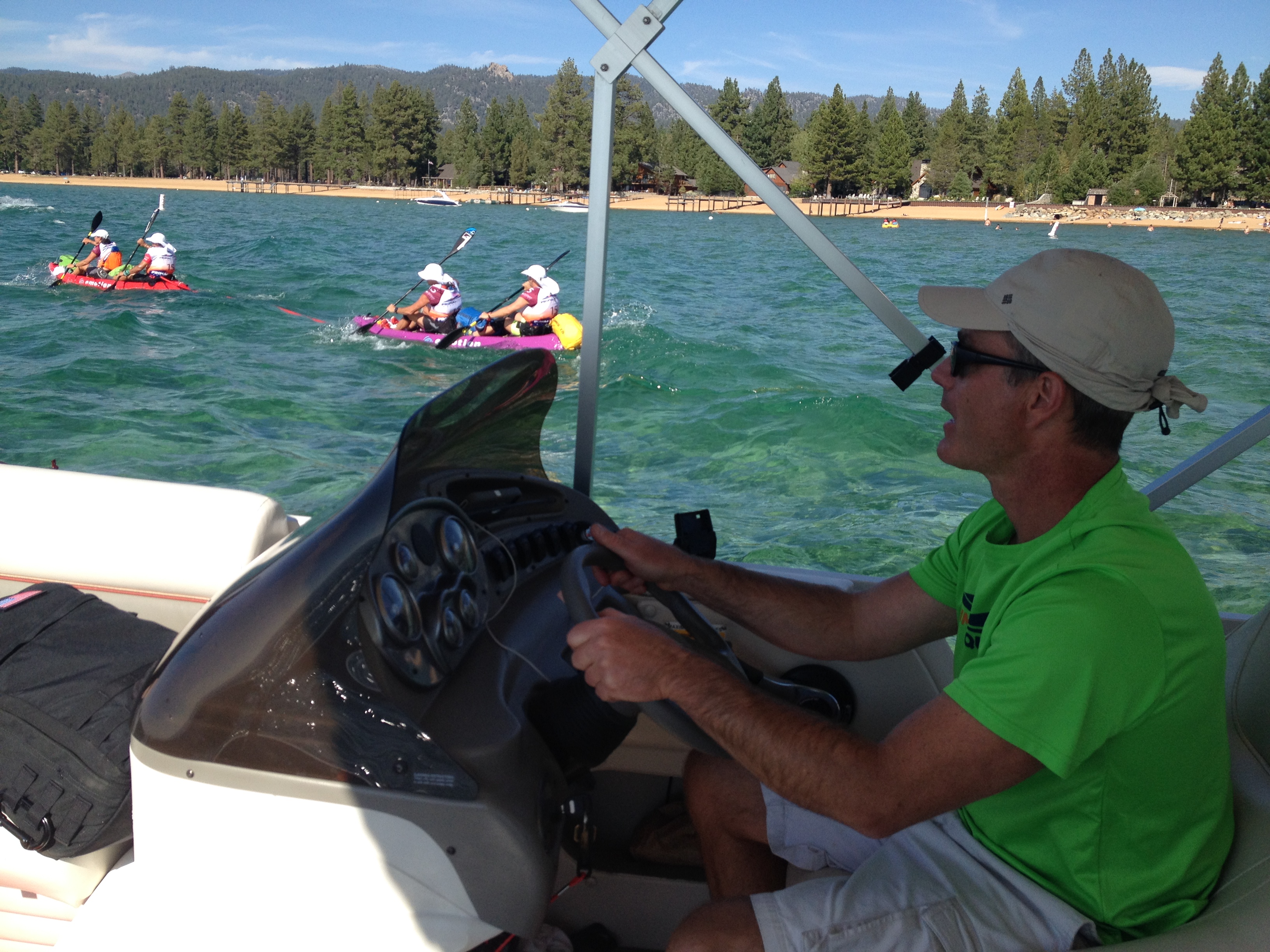
 Steve Bannar, co-medical director for Primal Quest and orthopedic surgeon at Tahoe Center for Orthopedics keeps an eye on racers as they kayak on Lake Tahoe.

Steve Bannar, co-medical director for Primal Quest and orthopedic surgeon at Tahoe Center for Orthopedics, keeps an eye on racers as they kayak on Tahoe. Photo/Provided

Five hours later at about 1:30pm, three teams – Team Journey, Team Tahoe, and Team NorCal – arrived at the Lover’s Leap checkpoint within 10 minutes of each other and their bikes in hand. They all faced a different challenge: rappel down the cliff with the bikes on their backs so they could bike to the next checkpoint. One participant exclaimed he “hated this bike” another shared he had “never carried $4,000 [his bike] and 30 extra pounds down a mountain.”

Team GODZones and Team Bones continue to hold the lead.

On Primal Quest, teams must supply their own food and gear. The only race support available is medical support. More than 40 volunteers are providing medical support, including 21 orthopedic physicians, nurses, athletic trainers, and physical therapists from Barton’s Tahoe Center for Orthopedics.

Rattlesnakes have been spotted, but so far no participants have experienced any injuries.

Here is a tracking map to know where the racers are and who they are.

Molly Hucklebridge works for Barton Health.


July was Earth’s hottest month on record

Source: NOAA

                                                                                                                                                                                                                                    Source: NOAA

By Seth Borenstein, AP

Federal officials say July was Earth’s hottest month on record, smashing old marks.

July’s average temperature was 61.86 degrees Fahrenheit, beating the previous global mark set in 1998 and 2010 by about one-seventh of a degree. That’s a large margin for weather records.

Records go back to 1880, but nine of the 10 hottest months on record have happened since 2005.

The first seven months of 2015 are the hottest January-to-July span on record.

National Oceanic and Atmospheric Administration climate scientist Jake Crouch says it is quite likely that 2015 will end up the hottest year on record, beating last year.

Crouch says this reaffirms that the Earth is warming, with a boost this year from an El Nino warming of the Pacific Ocean.


App allows beach-goers to be citizen scientists

The UC Davis Tahoe Environmental Research Center has launched a smartphone app called Citizen Science Tahoe to encourage beach-goers to let scientists know what they see.

The goal is to better understand conditions around the lake.

The app may be download at CitizenScienceTahoe.org. It was created by Shahzeb Khan, a UC Davis freshman studying computer science.

Citizen scientists may enter what they see at the beach, from algae to wildlife — the good and the bad. Each observation automatically records the user’s location and the date and time. Users may also add photos and comments.


S. Tahoe man accused of sex crimes with child

Allan Delisle

Allan Delisle

A 69-year-old South Lake Tahoe man was arrested Aug. 19 on charges of lewd and lascivious acts with a child, oral copulation of a child under 16 years old, oral copulation of a child by force, and oral copulation of a victim with a mental disability.

Bail was set at $1 million for Allan Delisle.

South Lake Tahoe police officers are not releasing specifics about the case to protect the juvenile victim.

Anyone with information about the case or have concerns about potential other victims is asked to call South Lake Tahoe Police Department at 530.542.6100 or the Lake Tahoe Secret Witness Program at 530.541.6800.

— Lake Tahoe News staff report