Santiago seeks back pay from El Dorado County

By Kathryn Reed

Former El Dorado County Supervisor Norma Santiago believes the county owes her back wages.

She is the second supervisor to demand more money since leaving office. The other was Ron Briggs. 

Norma Santiago

Norma Santiago

“I’m not commenting on that,” Santiago told Lake Tahoe News before she abruptly hung up the phone.

Santiago was on the board for nine years, coming off in January after being termed out. She never made a formal request in all that time to have her $76,875 salary increased.

In the email she wrote to then acting CAO Pamela Knorr and County Counsel Robyn Drivon, Santiago said, “Before leaving office, I requested that my wages be evaluated against certain resolutions adopted by the BOS to make a determination if I was owed back wages. I never formally put this in writing and given all the craziness that was happening, I didn’t do much follow up except an occasional inquiry.”

Santiago is of the belief she is owed cost of living adjustments and money for not taking time off as a manager.

The county has rejected Santiago and Brigg’s claims.

Paula Frantz, senior deputy county counsel, responded to Santiago by writing, “ … none of the claims has merit.”

The state Constitution stipulates that the only way boards of supervisors may increase their pay is through an ordinance. This gives the electorate almost two months to potentially overturn that decision. It is irrelevant how many resolutions the local body passes regarding salaries, the Constitution trumps them all.

Santiago did not put a dollar amount in the request stating what she believes she is owed. Briggs believes he is owed more than $90,000.

The next step, if either chooses to do so, is to file a lawsuit against the county.


Opinion: Protect Lake Tahoe for future generations

By Dean Heller and Dianne Feinstein

It was 142 years ago that John Muir, the famous naturalist and conservationist, first laid eyes on Lake Tahoe.

Muir wrote in a letter to a friend that he “sauntered through the piney woods, pausing countless times to absorb the blue glimpses of the lake, all so heavenly clean, so terrestrial yet so openly spiritual.”

He continued: “Tahoe is surely not one but many. As I curve around its heads and bays and look far out on its level sky fairly tinted and fading in pensive air, I am reminded of all the mountain lakes I ever knew, as if this were a kind of water heaven to which they all had come.”

Each of us who has fallen in love with Lake Tahoe has a similar story, that jaw-dropping first encounter.

Mark Twain wrote, “As it lay there with the shadows of the mountains brilliantly photographed upon its still surface I thought it must surely be the fairest picture the whole earth affords.”

There’s a reason that Lake Tahoe attracts such notables and such fawning reviews. It’s a world treasure with an unmistakable spirit.

That’s why John Muir pushed for it to be a National Park. It’s why California and Nevada leaders came together in the 1960s to establish formal means to protect it. It’s why the federal government for nearly 20 years has devoted funds to Keep Tahoe Blue. And it’s why last month we introduced legislation to continue that fight.

There are many threats facing Lake Tahoe, and unless we take action, the pristine beauty Muir described will soon be only a memory.

We joined our colleagues, Sens. Harry Reid and Barbara Boxer, to introduce the bipartisan Lake Tahoe Restoration Act of 2015, a bill to protect Lake Tahoe and the Tahoe Basin for generations to come.

The push started in earnest in 1997 when President Bill Clinton and Vice President Al Gore hosted a presidential forum on Lake Tahoe. In 2000, we were able to pass legislation to begin a 10-year, $900-million restoration and conservation effort.

It’s been hugely successful. We’ve been able to restore more than 16,000 acres of wildlife habitat, implement innovative transportation solutions, significantly reduce erosion that clouds the lake, improve water clarity and mitigate the risk of wildfires.

Since 1997, the federal government, California, Nevada, local municipalities and the private sector have provided a combined total of $1.8 billion.

Unfortunately, the resources that Washington chipped in have largely dried up. Our bill recommits the federal government to continue the vital projects that are saving Tahoe every day.

The bill includes fuel reduction projects to protect against the threat of wildfires. It prioritizes environmental restoration projects. And in order to strengthen the ecosystem, we allocate funds for an extensive invasive species control program.

These resources really can have an impact. We’ve seen progress from decades ago usher in a new era, and we need to maintain that drumbeat.

Without additional support for Tahoe, we fear the beauty that Muir, Twain and countless others have enjoyed may be short-lived.

The vistas and natural wonders deserve to be timeless.

Let us all recommit ourselves to protecting Lake Tahoe’s special qualities. As we preserve the water and the land, we’ll also be preserving the lake’s singular spirit.

Dean Heller is a Republican senator from Nevada and Dianne Feinstein a Democrat senator from California.

—–

Note: Sens. Heller and Feinstein will join other key stakeholders at the 19th annual Lake Tahoe Summit at Round Hill Pines in South Lake Tahoe at 10am Aug. 24. The event is open to the public. This year’s theme is Connecting Lake Tahoe’s Environment and Economy through Innovation and Transportation.


Online campaign ads will target, track you

By Russ Choma, Mother Jones

In June, a video popped up on YouTube featuring a frenetic, shaggy-bearded pitchman in a chartreuse blazer. “Max Power here to tell you about an amazing new presidential candidate: Bailout Bush! If you love bailouts, you’re going to love Bailout Bush!” He touted Jeb Bush’s work for Lehman Brothers before the investment bank tanked in 2008 and his backing of the Wall Street bailout initiated by his brother’s administration. The 75-second clip concludes with him soaking in a bathtub full of cash, as a voice-over intones: “This offer guarantees a presidential candidate [who] cannot win a single primary state, let alone the general election!”

The bizarre but memorable video was bankrolled by America’s Liberty, a super-PAC supporting Sen. Rand Paul, R-Ky. It was just a taste of what’s coming in the 2016 race, when memes, GIFs, and other social-media catnip will blanket the internet. As the race heats up, every device you own, from your laptop to your Apple Watch, will become a delivery vehicle for all manner of political messaging. And you may never know which billionaire players or dark-money groups are targeting you—or how they’re tracking you.

The amount of spending on digital advertising is expected to nearly double in this election cycle compared with 2012. Online spots cost a fraction of traditional TV or print ads, and political operatives are giddy over the new-and-improved ways to cheaply and creatively bombard voters with their messages.

Read the whole story


Mountain biker and wilderness relationship: It’s complicated

By Grayson Schaffer, Outside

On Aug. 7, President Obama signed into law a bill that converted just over 275,000 acres among the Boulder and White Cloud Mountains into federal wilderness — three separate areas collectively known as the Boulder–White Clouds.

For years, it’s been obscure and sparsely trafficked by hikers, mountain bikers, off-road motorcyclists, skiers, hunters, and cattlemen. The president’s signature brings to a close a long and sometimes ugly debate. But it has also left many local mountain bikers, who’ve long ridden trails in the Boulder–White Clouds, disappointed that they’ll no longer be allowed in.

The entire process has put riders in the increasingly familiar and uncomfortable position of opposing wilderness legislation.


According to the Outdoor Foundation’s most recent participation report, there are roughly 8 million mountain bikers in America and 10 million backpackers. And mountain biking, which didn’t exist to have a seat at the table when the Wilderness Act was passed in 1964, is only getting more popular.

For bikers, the insult is compounded because older and more clearly detrimental practices like cattle grazing and mining are grandfathered into wilderness areas, as are many airstrips.

Read the whole story


Snippets about Lake Tahoe

Butterfly fireworks·       The Sept. 6 fireworks show on the South Shore starts at 8:30pm.

·       Russ Nygaard has been hired by Tahoe Transportation District as transportation capital program manager to oversee the planning, design and execution of the agency’s capital projects.

·       Heavenly Resort Mountain Run is a 5.8-mile trek that begins at California Base Lodge on Sept. 6, climbs to the top of the ski resort, and finishes at the Tamarack Lodge at 9,150-feet. Runners may take the Heavenly gondola back to the base or descend on their own. Sign up online.

·       The​ Village at Squaw Valley hosts the sixth annual Peaks and Paws event, benefiting the Human Society of Truckee-Tahoe on Aug. 22. The day of dog-friendly activities begins at 7:30am with a 10K for owners and canines, followed by more festivities from 11am-7pm.

·      Construction begins on Glenshire Drive near Highland Avenue in Truckee on Aug. 26. The majority of work will occur during the daytime on weekdays with alternating one-way traffic and flaggers. Two-way traffic will be in place on school days during the morning and afternoon peak school bus periods. On Aug. 29 Glenshire Drive will be closed from 7am-10pm from just east of Olympic Boulevard to east of Highland Avenue.


Placerville PD expanding use of body cameras

By Bill Lindelof, Sacramento Bee

After a test period proved successful, Placerville police want to expand the use of body-worn cameras.

“We are pleased with the current testing and evaluation of body-worn cameras on our patrol officers,” said Chief Scott Heller. “It puts everyone, officers and citizens alike, on their best behaviors.”

The cameras, mounted on the officers’ collars, have been worn since March in Placerville.

Read the whole story


Foundation has grant money for SLT nonprofits

The El Dorado Community Foundation has $74,000 to give to nonprofits that offer services and/or programs for residents of South Lake Tahoe.

Seventy percent of the total is open to the entire community, while 30 percent will toward classroom curriculum support. Proposals of up to $5,000 will be considered.

The grant process will open Sept. 15, with a deadline of 5pm Oct. 15. Further details and application forms will be available online beginning Sept. 15.


USFS drains Seneca Pond before restoring area

U.S. Forest Service crews are in the process of restoring Seneca Pond. Photos/Kathryn Reed

U.S. Forest Service crews are in the process of restoring the area where Seneca Pond was. Photos/Kathryn Reed

By Kathryn Reed

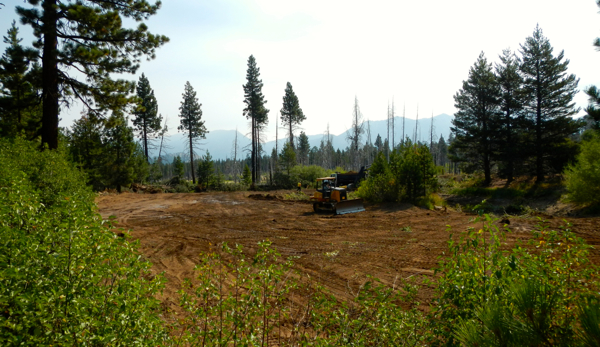
Seneca Pond is no more. The 51-year-old manmade lake has been drained, and excavators are moving dirt and vegetation with the goal of the site being restored this fall.

Today it is a mudflat. In a couple years U.S. Forest Service officials hope it will be hard to tell they had heavy equipment in there.

The pond was about a half acre, but by the time the work is done 2 acres of stream environmental zone will have been restored in the forest off North Upper Truckee Road in El Dorado County.

At the deepest point it was about 4 feet. For the last two weeks the water was siphoned off into the forest. By the end of next week the excavation should be completed, with restoration work continuing through the fall.

Seneca Pond has long been a favorite spot for area residents. User created trails – many of which will be removed in this process – are intertwined, providing a mountain biking and hiking mecca mostly used by locals.

The pond is most famous for being the ignition point of the 2007 Angora Fire. It was an illegal campground that had not been fully extinguished that led to 254 houses being destroyed. No marker will commemorate that tragedy, but the boulder near where it started still exists.

It was after the fire that a set of protocols was developed for the area. The forest supervisor at the time signed off on the decision in 2010. Getting rid of the pond and working on Angora Creek are the last projects to be completed, and they will be finished this fall.

The pond was built in 1964 and enlarged a year later. This was when the land was privately owned. A hippie commune was out there, including teepees. It was in the early 1970s that the Forest Service became the landlord.

We are trying to make it an equally pleasing experience, just different,”
“We are trying to make it an equally pleasing experience, just different.” — Stephanie Heller, USFS Seneca Pond project manager

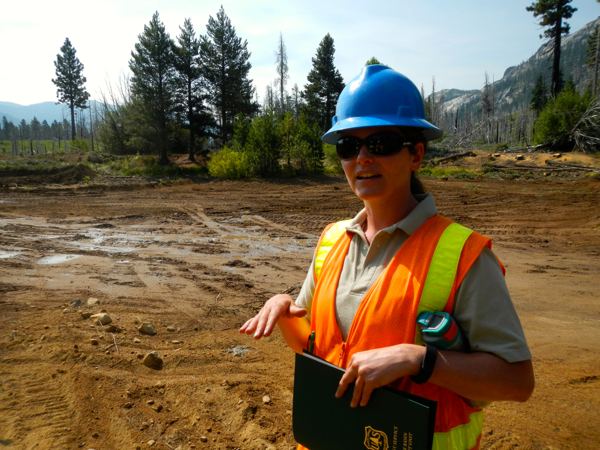
Stephanie Heller, project manager for the USFS, said the main reason to remove the pond is that as a manmade entity it isn’t natural.

“It’s typically not something we have in the forest to manage,” Heller said as she walked along side what would have been the shore of the pond.

In the early 1990s the Forest Service took measures to keep the pond full of water year-round. Clay was added as a liner and a conveyance system from the uphill spring was created.

Post-Angora the water table rose significantly because there were no longer the trees to absorb the moisture. This led to the conveyance system breaching, which caused issues.

The hillside above this area with the charred trees is a stark reminder of the 2007 fire. There is also lush undergrowth that proves the area is wet even during the fourth year of a drought.

This pond was also home to the American bullfrog, an invasive species that will eat nearly anything that comes into its path. This in turn has hurt the native Western toad and Pacific tree frog populations.

Heller said amphibians are in such a state of decline that her agency is doing what it can to protect their habitat. As crews continue to work through the fall to return the Seneca Pond area into a setting more like what it would have been like pre-human interference, the goal is the contours and undulations will create pockets of water in normal and wet years where amphibians could thrive.

The little island that was in the pond is staying, though it will be thinned. It will be a landmark of sorts.

Heller said neighbors have an emotional connection to the pond and have voiced their displeasure with the change.

“We are trying to make it an equally pleasing experience, just different,” Heller told Lake Tahoe News.


Cocktail event to benefit Barton trauma center

Barton Health’s Signature Cocktail Contest is Sept. 23 at Riva Grill in South Lake Tahoe.

This year all event proceeds will expand medical services and community programs for Barton Memorial Hospital’s Level III trauma center.

The event starts at 5:30pm and ends at 8pm. Admission, which includes heavy appetizers, music, and cocktail samples, is $35 in advance and $40 at the door. Attendees must be 21 or older.

Purchase tickets by calling 530.543.5909.


Report: Calif. energy-efficiency programs not enough

By Ivan Penn, Los Angeles Times

California’s efforts to reduce electricity consumption over the last four decades saved $90 billion on utility bills, created hundreds of thousands of jobs and avoided construction of 41 power plants, according to a report released Thursday.

And it’s not enough, the Natural Resources Defense Council said.

Report author Lara Ettenson attributed the state’s progress to building code changes and more efficient appliances. Going forward, she said, California must focus on the “challenging area” of reworking existing buildings to cut energy use.

Read the whole story